THE REPORTED SPEECH
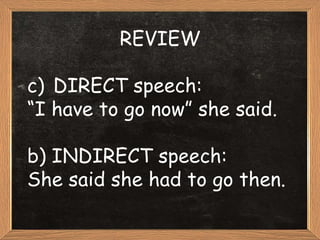
REVIEW DIRECT speech: “ I have to go now” she said. b) INDIRECT speech: She said she had to go then.
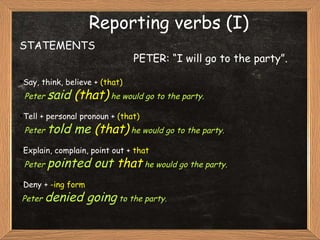
Reporting verbs (I) STATEMENTS PETER: “I will go to the party”. Say, think, believe +  (that) Peter  said  (that)   he would go to the party. Tell + personal pronoun +  (that) Peter  told me  (that)  he would go to the party. Explain, complain, point out +  that Peter  pointed out  that  he would go the party. Deny +  -ing form Peter  denied going  to the party.
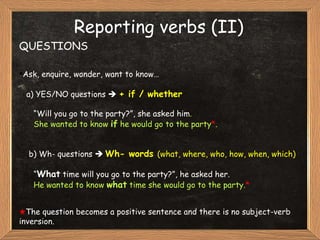
Reporting verbs (II) QUESTIONS Ask, enquire, wonder, want to know… a) YES/NO questions     + if / whether “ Will you go to the party?”, she asked him . She wanted to know  if  he would go to the party * .   b) Wh- questions     Wh- words  (what, where, who, how, when, which) “ What  time will you go to the party?”, he asked her. He wanted to know  what  time she would go to the party. * ★ The question becomes a positive sentence and there is no subject-verb inversion.
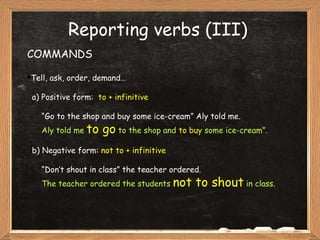
Reporting verbs (III) COMMANDS Tell, ask, order, demand… a) Positive form:  to   + infinitive “ Go to the shop and buy some ice-cream” Aly told me. Aly told me  to go  to the shop and  to buy  some ice-cream”. b)   Negative form:  not to + infinitive “ Don’t shout in class” the teacher ordered. The teacher ordered the students  not to shout  in class.
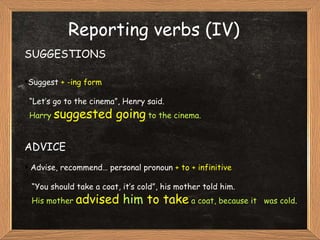
SUGGESTIONS Suggest  + -ing form “ Let’s go to the cinema”, Henry said. Harry  suggested going  to the cinema. ADVICE Advise, recommend… personal pronoun  + to + infinitive “ You should take a coat, it’s cold”, his mother told him. His mother  advised  him  to take  a coat, because it  was cold .  Reporting verbs (IV)
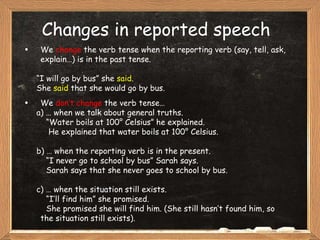
Changes in reported speech We  change  the verb tense when the reporting verb (say, tell, ask, explain…) is in the past tense. “ I will go by bus” she  said . She  said  that she would go by bus. We  don’t change  the verb tense… a) … when we talk about general truths. “ Water boils at 100° Celsius” he explained. He explained that water boils at 100° Celsius. b) … when the reporting verb is in the present. “ I never go to school by bus” Sarah says. Sarah says that she never goes to school by bus. c) … when the situation still exists. “ I’ll find him” she promised. She promised she will find him. (She still hasn’t found him, so  the situation still exists).
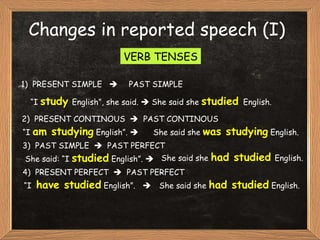
VERB TENSES 1)  PRESENT SIMPLE     PAST SIMPLE “ I  study   English”, she said.    She said she  studied   English. 2)  PRESENT CONTINOUS     PAST CONTINOUS   “ I  am studying   English”.     She said she  was   studying  English. 3)  PAST SIMPLE     PAST PERFECT She said: “I  studied   English”.   She said she  had studied   English. 4)  PRESENT PERFECT     PAST PERFECT “ I  have studied  English”.   She said she  had studied  English. Changes in reported speech (I)
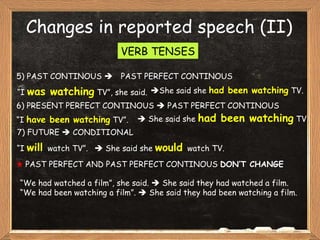
5) PAST CONTINOUS   PAST PERFECT CONTINOUS VERB TENSES Changes in reported speech (II) “ I  was watching  TV”, she said.  She said she  had been watching  TV. 6) PRESENT PERFECT CONTINOUS    PAST PERFECT CONTINOUS   “ I  have been watching  TV”.    She said she  had been watching  TV. 7) FUTURE    CONDITIONAL “ I  will  watch TV”.    She said she  would  watch TV. ★   PAST PERFECT AND PAST PERFECT CONTINOUS  DON’T CHANGE   “ We had watched a film”, she said.    She said they had watched a film. “ We had been watching a film”.    She said they had been watching a film.
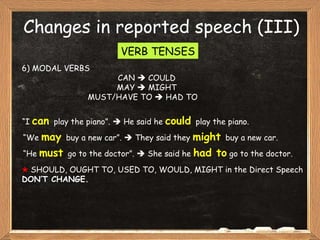
6) MODAL VERBS CAN    COULD MAY    MIGHT MUST/HAVE TO    HAD TO  Changes in reported speech (III) VERB TENSES “ I  can  play the piano”.    He said he  could  play the piano. “ We  may  buy a new car”.    They said they  might  buy a new car. “ He  must  go to the doctor”.    She said he  had to  go to the doctor. ★   SHOULD, OUGHT TO, USED TO, WOULD, MIGHT in the Direct Speech  DON’T CHANGE.
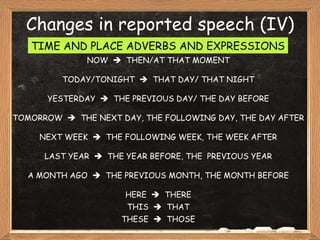
Changes in reported speech (IV) TIME AND PLACE ADVERBS AND EXPRESSIONS NOW     THEN/AT THAT MOMENT TODAY/TONIGHT     THAT DAY/ THAT NIGHT YESTERDAY     THE PREVIOUS DAY/ THE DAY BEFORE TOMORROW     THE NEXT DAY, THE FOLLOWING DAY, THE DAY AFTER NEXT WEEK     THE FOLLOWING WEEK, THE WEEK AFTER LAST YEAR     THE YEAR BEFORE, THE  PREVIOUS YEAR A MONTH AGO     THE PREVIOUS MONTH, THE MONTH BEFORE HERE     THERE THIS     THAT THESE     THOSE
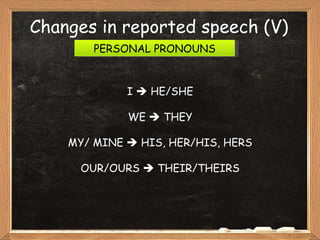
Changes in reported speech (V) PERSONAL PRONOUNS I    HE/SHE WE    THEY MY/ MINE    HIS, HER/HIS, HERS OUR/OURS    THEIR/THEIRS
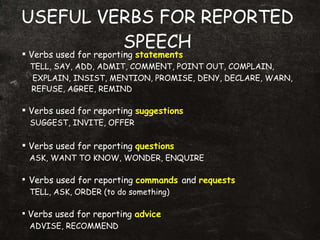
USEFUL VERBS FOR REPORTED SPEECH Verbs used for reporting  statements TELL, SAY, ADD, ADMIT, COMMENT, POINT OUT, COMPLAIN, EXPLAIN, INSIST, MENTION, PROMISE, DENY, DECLARE, WARN, REFUSE, AGREE, REMIND  Verbs used for reporting  suggestions SUGGEST, INVITE, OFFER  Verbs used for reporting  questions ASK, WANT TO KNOW, WONDER, ENQUIRE Verbs used for reporting  commands  and  requests TELL, ASK, ORDER (to do something) Verbs used for reporting  advice ADVISE, RECOMMEND
THE END www.presentationmagazine.com

Reported speech

  • 1.
  • 2.
    REVIEW DIRECT speech:“ I have to go now” she said. b) INDIRECT speech: She said she had to go then.
  • 3.
    Reporting verbs (I)STATEMENTS PETER: “I will go to the party”. Say, think, believe + (that) Peter said (that) he would go to the party. Tell + personal pronoun + (that) Peter told me (that) he would go to the party. Explain, complain, point out + that Peter pointed out that he would go the party. Deny + -ing form Peter denied going to the party.
  • 4.
    Reporting verbs (II)QUESTIONS Ask, enquire, wonder, want to know… a) YES/NO questions  + if / whether “ Will you go to the party?”, she asked him . She wanted to know if he would go to the party * . b) Wh- questions  Wh- words (what, where, who, how, when, which) “ What time will you go to the party?”, he asked her. He wanted to know what time she would go to the party. * ★ The question becomes a positive sentence and there is no subject-verb inversion.
  • 5.
    Reporting verbs (III)COMMANDS Tell, ask, order, demand… a) Positive form: to + infinitive “ Go to the shop and buy some ice-cream” Aly told me. Aly told me to go to the shop and to buy some ice-cream”. b) Negative form: not to + infinitive “ Don’t shout in class” the teacher ordered. The teacher ordered the students not to shout in class.
  • 6.
    SUGGESTIONS Suggest + -ing form “ Let’s go to the cinema”, Henry said. Harry suggested going to the cinema. ADVICE Advise, recommend… personal pronoun + to + infinitive “ You should take a coat, it’s cold”, his mother told him. His mother advised him to take a coat, because it was cold . Reporting verbs (IV)
  • 7.
    Changes in reportedspeech We change the verb tense when the reporting verb (say, tell, ask, explain…) is in the past tense. “ I will go by bus” she said . She said that she would go by bus. We don’t change the verb tense… a) … when we talk about general truths. “ Water boils at 100° Celsius” he explained. He explained that water boils at 100° Celsius. b) … when the reporting verb is in the present. “ I never go to school by bus” Sarah says. Sarah says that she never goes to school by bus. c) … when the situation still exists. “ I’ll find him” she promised. She promised she will find him. (She still hasn’t found him, so the situation still exists).
  • 8.
    VERB TENSES 1) PRESENT SIMPLE  PAST SIMPLE “ I study English”, she said.  She said she studied English. 2) PRESENT CONTINOUS  PAST CONTINOUS “ I am studying English”.  She said she was studying English. 3) PAST SIMPLE  PAST PERFECT She said: “I studied English”.  She said she had studied English. 4) PRESENT PERFECT  PAST PERFECT “ I have studied English”.  She said she had studied English. Changes in reported speech (I)
  • 9.
    5) PAST CONTINOUS  PAST PERFECT CONTINOUS VERB TENSES Changes in reported speech (II) “ I was watching TV”, she said.  She said she had been watching TV. 6) PRESENT PERFECT CONTINOUS  PAST PERFECT CONTINOUS “ I have been watching TV”.  She said she had been watching TV. 7) FUTURE  CONDITIONAL “ I will watch TV”.  She said she would watch TV. ★ PAST PERFECT AND PAST PERFECT CONTINOUS DON’T CHANGE “ We had watched a film”, she said.  She said they had watched a film. “ We had been watching a film”.  She said they had been watching a film.
  • 10.
    6) MODAL VERBSCAN  COULD MAY  MIGHT MUST/HAVE TO  HAD TO  Changes in reported speech (III) VERB TENSES “ I can play the piano”.  He said he could play the piano. “ We may buy a new car”.  They said they might buy a new car. “ He must go to the doctor”.  She said he had to go to the doctor. ★ SHOULD, OUGHT TO, USED TO, WOULD, MIGHT in the Direct Speech DON’T CHANGE.
  • 11.
    Changes in reportedspeech (IV) TIME AND PLACE ADVERBS AND EXPRESSIONS NOW  THEN/AT THAT MOMENT TODAY/TONIGHT  THAT DAY/ THAT NIGHT YESTERDAY  THE PREVIOUS DAY/ THE DAY BEFORE TOMORROW  THE NEXT DAY, THE FOLLOWING DAY, THE DAY AFTER NEXT WEEK  THE FOLLOWING WEEK, THE WEEK AFTER LAST YEAR  THE YEAR BEFORE, THE PREVIOUS YEAR A MONTH AGO  THE PREVIOUS MONTH, THE MONTH BEFORE HERE  THERE THIS  THAT THESE  THOSE
  • 12.
    Changes in reportedspeech (V) PERSONAL PRONOUNS I  HE/SHE WE  THEY MY/ MINE  HIS, HER/HIS, HERS OUR/OURS  THEIR/THEIRS
  • 13.
    USEFUL VERBS FORREPORTED SPEECH Verbs used for reporting statements TELL, SAY, ADD, ADMIT, COMMENT, POINT OUT, COMPLAIN, EXPLAIN, INSIST, MENTION, PROMISE, DENY, DECLARE, WARN, REFUSE, AGREE, REMIND Verbs used for reporting suggestions SUGGEST, INVITE, OFFER Verbs used for reporting questions ASK, WANT TO KNOW, WONDER, ENQUIRE Verbs used for reporting commands and requests TELL, ASK, ORDER (to do something) Verbs used for reporting advice ADVISE, RECOMMEND
  • 14.