


 Report is derived from the Latin word
Reportare which consists of 2 words; Re =
Back + Portare = To Carry. Thus it means to
carry back.
 Report writing is a skillful representation of
an event carried back to someone who was
not present on that occasion.
 Report is a communication from someone
who has information, to someone who wants
that information.
 According to Johan Michell
” A technical report is a written statement
of the facts of the information, project,
process or test; how these facts were
ascertained; their significance; the conclusion
that have been drawn from them; the
recommendations that are being made”.
1. Accuracy
2. Well structured format
3. Specific Purpose
4. Highly objective
5. Use of formal language & style
 Oral Report
◦ An oral report is face to face communication about
something which has been observed or seen.
◦ It may consist of an impression or an observation.
 Written Report
◦ A written report is more formal than oral report.
◦ It is more useful as it becomes a part of the
document
An orderly and objective communication of
factual information that serves a business
purpose.
 Business Report
◦ Reports vary widely – in Length, formality and
format.
◦ Quality of a report process effects the quality of
final result.
◦ Accuracy is most important.
1. Informational Report
2. Interpretative report
3. Analytical Report
4. Research Report
5. Routine Report
6. Special Report
1. Accuracy and Brevity
2. Complete objectivity
3. Critical Evaluation of Performance
4. Need Format and Style
5. Relevance
6. Lack of Self Interest
7. It must include 5 Ws and 1 H – What is the
main problem, What is the important issue,
Who is involved in the situation, When did
the Problem arise, Where will the report be
read; How best to present the report
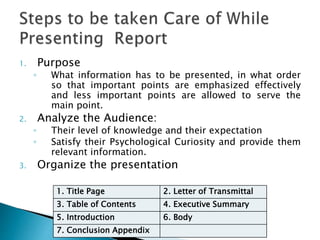
1. Purpose
◦ What information has to be presented, in what order
so that important points are emphasized effectively
and less important points are allowed to serve the
main point.
2. Analyze the Audience:
◦ Their level of knowledge and their expectation
◦ Satisfy their Psychological Curiosity and provide them
relevant information.
3. Organize the presentation
1. Title Page 2. Letter of Transmittal
3. Table of Contents 4. Executive Summary
5. Introduction 6. Body
7. Conclusion Appendix
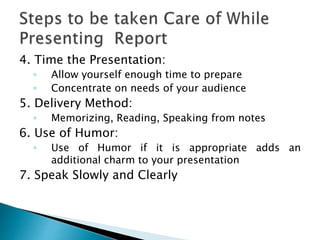
4. Time the Presentation:
◦ Allow yourself enough time to prepare
◦ Concentrate on needs of your audience
5. Delivery Method:
◦ Memorizing, Reading, Speaking from notes
6. Use of Humor:
◦ Use of Humor if it is appropriate adds an
additional charm to your presentation
7. Speak Slowly and Clearly
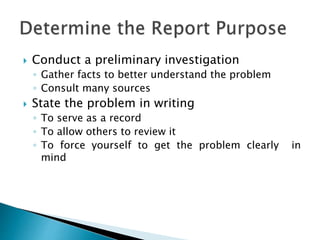
 Conduct a preliminary investigation
◦ Gather facts to better understand the problem
◦ Consult many sources
 State the problem in writing
◦ To serve as a record
◦ To allow others to review it
◦ To force yourself to get the problem clearly in
mind
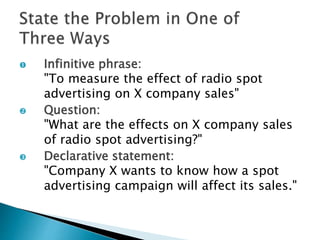
 Infinitive phrase:
"To measure the effect of radio spot
advertising on X company sales"
 Question:
"What are the effects on X company sales
of radio spot advertising?"
 Declarative statement:
"Company X wants to know how a spot
advertising campaign will affect its sales."
Types of Factors
 Subtopics in informational and some
analytical reports
 Hypotheses in problem-solving situations
 Bases of comparison in evaluative reports
A consumer research organization plans to test three
leading low-priced automobiles in an effort to
determine which one is the best buy as a family car
for the typical American consumer.
Problem statement
To determine which of three economy cars is the best
buy for the American Consumer
Factors
Durability
Operating costs Repairs
Comfort Safety
A national chain of dress shops wants to learn what
qualities to seek in hiring sales personnel.
Problem statement
What qualities determine the successful salespeople for
X Dress Shop?
Factors
Education
Cultural background
Experience
Vital statistics (age, height, weight, marital status,
religion, etc.)
Personal qualities (personality, character, etc.)
A daily newspaper wants to know how well the
various types of items in a typical issue are read.
Problem statement
What is the readership of the types of items in a
typical issue of X newspaper?
Factors
Probably such a study would involve an item-by-item
survey. The items would be classified by types, which
would be the factors of the problem.
World news Local news Society
Editorials Sports Comics
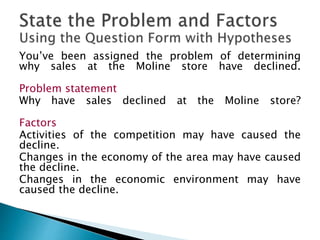
You’ve been assigned the problem of determining
why sales at the Moline store have declined.
Problem statement
Why have sales declined at the Moline store?
Factors
Activities of the competition may have caused the
decline.
Changes in the economy of the area may have caused
the decline.
Changes in the economic environment may have
caused the decline.
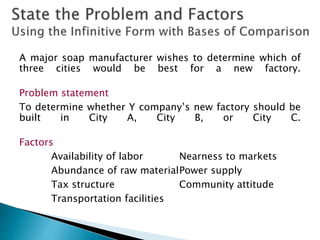
A major soap manufacturer wishes to determine which of
three cities would be best for a new factory.
Problem statement
To determine whether Y company’s new factory should be
built in City A, City B, or City C.
Factors
Availability of labor Nearness to markets
Abundance of raw materialPower supply
Tax structure Community attitude
Transportation facilities
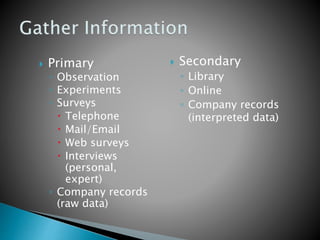
 Primary
◦ Observation
◦ Experiments
◦ Surveys
 Telephone
 Mail/Email
 Web surveys
 Interviews
(personal,
expert)
◦ Company records
(raw data)
 Secondary
◦ Library
◦ Online
◦ Company records
(interpreted data)
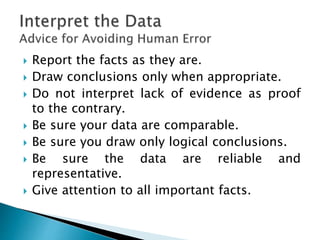
 Report the facts as they are.
 Draw conclusions only when appropriate.
 Do not interpret lack of evidence as proof
to the contrary.
 Be sure your data are comparable.
 Be sure you draw only logical conclusions.
 Be sure the data are reliable and
representative.
 Give attention to all important facts.
 Maintain a judicial attitude.
 Consult with others.
 Test the interpretations.
◦ 1.Test of Experience
“Is this conclusion logical in light of all I know?”
◦ 2.Negative Test
Examine the opposite interpretation--build a case
for it.
Q. A study produced data that showed United
States college students to be far behind their
comparable groups in European countries.
The conclusion was made that the educational
systems in these European countries are
superior to that in the United States.
A. The education systems are not comparable.
The United States is committed to a system of
educating the masses. Many of the other
countries maintain a system of highly selective
education.
Q. A report writer found data showing that
sales of soft drinks were correlated with
vacation travel. She concluded that soft
drink sales were heavily affected by
vacations.
A. Probably both are related to seasonal
factors. They have no cause-effect
relationship.
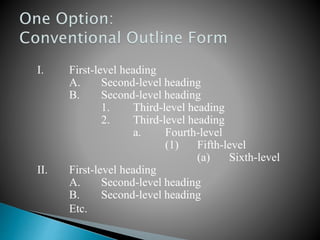
I. First-level heading
A. Second-level heading
B. Second-level heading
1. Third-level heading
2. Third-level heading
a. Fourth-level
(1) Fifth-level
(a) Sixth-level
II. First-level heading
A. Second-level heading
B. Second-level heading
Etc.
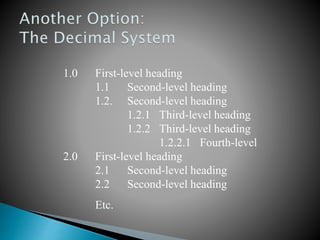
1.0 First-level heading
1.1 Second-level heading
1.2. Second-level heading
1.2.1 Third-level heading
1.2.2 Third-level heading
1.2.2.1 Fourth-level
2.0 First-level heading
2.1 Second-level heading
2.2 Second-level heading
Etc.
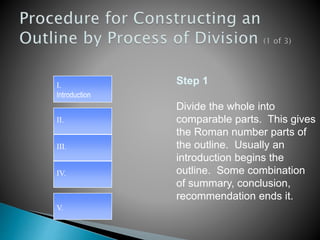
Step 1
Divide the whole into
comparable parts. This gives
the Roman number parts of
the outline. Usually an
introduction begins the
outline. Some combination
of summary, conclusion,
recommendation ends it.
I.
Introduction
II.
III.
IV.
V.
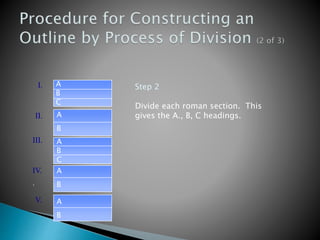
Step 2
Divide each roman section. This
gives the A., B, C headings.
.
I.
II.
III.
IV.
V.
A
B
A
B
C
A
B
C
A
B
A
B
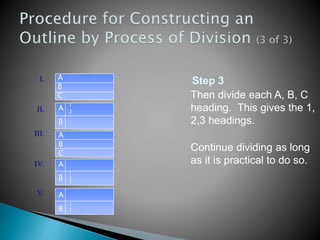
Step 3
Then divide each A, B, C
heading. This gives the 1,
2,3 headings.
Continue dividing as long
as it is practical to do so.
I.
II.
III.
IV.
V.
A
B
A
B
C
A
B
C
A
B
A
B
1
2
1
2
3
1
2
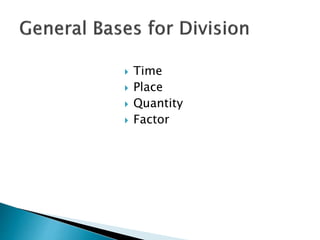
 Time
 Place
 Quantity
 Factor
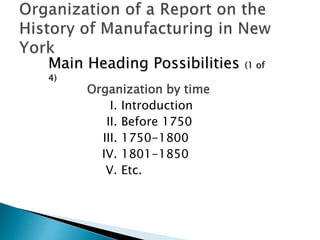
Organization by time
I. Introduction
II. Before 1750
III. 1750-1800
IV. 1801-1850
V. Etc.
Main Heading Possibilities (1 of
4)
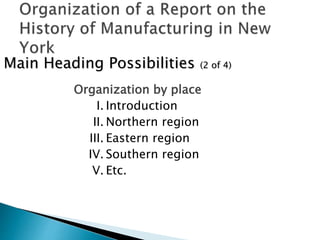
Organization by place
I. Introduction
II. Northern region
III. Eastern region
IV. Southern region
V. Etc.
Main Heading Possibilities (2 of 4)
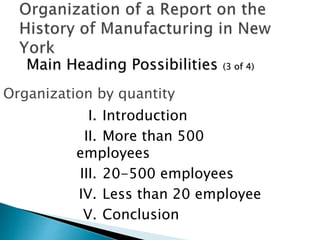
Organization by quantity
I. Introduction
II. More than 500
employees
III. 20-500 employees
IV. Less than 20 employee
V. Conclusion
Main Heading Possibilities (3 of 4)
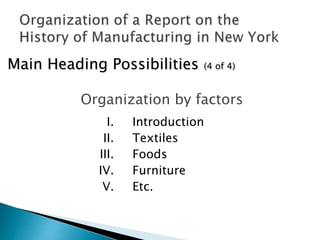
I. Introduction
II. Textiles
III. Foods
IV. Furniture
V. Etc.
Organization by factors
Main Heading Possibilities (4 of 4)
 Parallel Construction
 Conciseness in Wording
 Variety of Expression
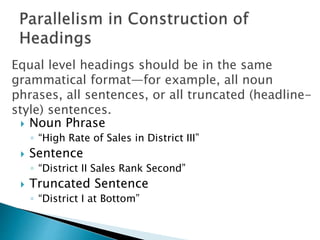
 Noun Phrase
◦ “High Rate of Sales in District III”
 Sentence
◦ “District II Sales Rank Second”
 Truncated Sentence
◦ “District I at Bottom”
Equal level headings should be in the same
grammatical format—for example, all noun
phrases, all sentences, or all truncated (headline-
style) sentences.
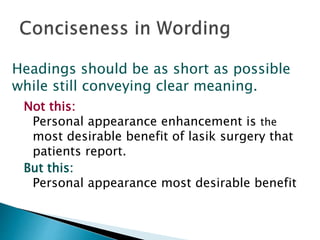
Not this:
Personal appearance enhancement is the
most desirable benefit of lasik surgery that
patients report.
But this:
Personal appearance most desirable benefit
Headings should be as short as possible
while still conveying clear meaning.
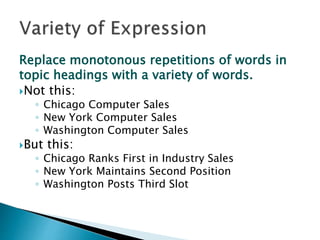
Replace monotonous repetitions of words in
topic headings with a variety of words.
Not this:
◦ Chicago Computer Sales
◦ New York Computer Sales
◦ Washington Computer Sales
But this:
◦ Chicago Ranks First in Industry Sales
◦ New York Maintains Second Position
◦ Washington Posts Third Slot
 Select words carefully.
 Watch the rhythm of expression.
 Stress content over techniques.
 Be complete without using more words than
necessary.
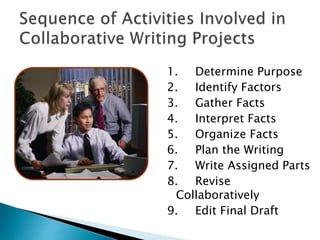
1. Determine Purpose
2. Identify Factors
3. Gather Facts
4. Interpret Facts
5. Organize Facts
6. Plan the Writing
7. Write Assigned Parts
8. Revise
Collaboratively
9. Edit Final Draft
Report writing

Report writing

  • 2.
     Report isderived from the Latin word Reportare which consists of 2 words; Re = Back + Portare = To Carry. Thus it means to carry back.  Report writing is a skillful representation of an event carried back to someone who was not present on that occasion.  Report is a communication from someone who has information, to someone who wants that information.
  • 3.
     According toJohan Michell ” A technical report is a written statement of the facts of the information, project, process or test; how these facts were ascertained; their significance; the conclusion that have been drawn from them; the recommendations that are being made”.
  • 4.
    1. Accuracy 2. Wellstructured format 3. Specific Purpose 4. Highly objective 5. Use of formal language & style
  • 5.
     Oral Report ◦An oral report is face to face communication about something which has been observed or seen. ◦ It may consist of an impression or an observation.  Written Report ◦ A written report is more formal than oral report. ◦ It is more useful as it becomes a part of the document
  • 6.
    An orderly andobjective communication of factual information that serves a business purpose.
  • 7.
     Business Report ◦Reports vary widely – in Length, formality and format. ◦ Quality of a report process effects the quality of final result. ◦ Accuracy is most important.
  • 8.
    1. Informational Report 2.Interpretative report 3. Analytical Report 4. Research Report 5. Routine Report 6. Special Report
  • 9.
    1. Accuracy andBrevity 2. Complete objectivity 3. Critical Evaluation of Performance 4. Need Format and Style 5. Relevance 6. Lack of Self Interest 7. It must include 5 Ws and 1 H – What is the main problem, What is the important issue, Who is involved in the situation, When did the Problem arise, Where will the report be read; How best to present the report
  • 10.
    1. Purpose ◦ Whatinformation has to be presented, in what order so that important points are emphasized effectively and less important points are allowed to serve the main point. 2. Analyze the Audience: ◦ Their level of knowledge and their expectation ◦ Satisfy their Psychological Curiosity and provide them relevant information. 3. Organize the presentation 1. Title Page 2. Letter of Transmittal 3. Table of Contents 4. Executive Summary 5. Introduction 6. Body 7. Conclusion Appendix
  • 11.
    4. Time thePresentation: ◦ Allow yourself enough time to prepare ◦ Concentrate on needs of your audience 5. Delivery Method: ◦ Memorizing, Reading, Speaking from notes 6. Use of Humor: ◦ Use of Humor if it is appropriate adds an additional charm to your presentation 7. Speak Slowly and Clearly
  • 12.
     Conduct apreliminary investigation ◦ Gather facts to better understand the problem ◦ Consult many sources  State the problem in writing ◦ To serve as a record ◦ To allow others to review it ◦ To force yourself to get the problem clearly in mind
  • 13.
     Infinitive phrase: "Tomeasure the effect of radio spot advertising on X company sales"  Question: "What are the effects on X company sales of radio spot advertising?"  Declarative statement: "Company X wants to know how a spot advertising campaign will affect its sales."
  • 14.
    Types of Factors Subtopics in informational and some analytical reports  Hypotheses in problem-solving situations  Bases of comparison in evaluative reports
  • 15.
    A consumer researchorganization plans to test three leading low-priced automobiles in an effort to determine which one is the best buy as a family car for the typical American consumer. Problem statement To determine which of three economy cars is the best buy for the American Consumer Factors Durability Operating costs Repairs Comfort Safety
  • 16.
    A national chainof dress shops wants to learn what qualities to seek in hiring sales personnel. Problem statement What qualities determine the successful salespeople for X Dress Shop? Factors Education Cultural background Experience Vital statistics (age, height, weight, marital status, religion, etc.) Personal qualities (personality, character, etc.)
  • 17.
    A daily newspaperwants to know how well the various types of items in a typical issue are read. Problem statement What is the readership of the types of items in a typical issue of X newspaper? Factors Probably such a study would involve an item-by-item survey. The items would be classified by types, which would be the factors of the problem. World news Local news Society Editorials Sports Comics
  • 18.
    You’ve been assignedthe problem of determining why sales at the Moline store have declined. Problem statement Why have sales declined at the Moline store? Factors Activities of the competition may have caused the decline. Changes in the economy of the area may have caused the decline. Changes in the economic environment may have caused the decline.
  • 19.
    A major soapmanufacturer wishes to determine which of three cities would be best for a new factory. Problem statement To determine whether Y company’s new factory should be built in City A, City B, or City C. Factors Availability of labor Nearness to markets Abundance of raw materialPower supply Tax structure Community attitude Transportation facilities
  • 20.
     Primary ◦ Observation ◦Experiments ◦ Surveys  Telephone  Mail/Email  Web surveys  Interviews (personal, expert) ◦ Company records (raw data)  Secondary ◦ Library ◦ Online ◦ Company records (interpreted data)
  • 21.
     Report thefacts as they are.  Draw conclusions only when appropriate.  Do not interpret lack of evidence as proof to the contrary.  Be sure your data are comparable.  Be sure you draw only logical conclusions.  Be sure the data are reliable and representative.  Give attention to all important facts.
  • 22.
     Maintain ajudicial attitude.  Consult with others.  Test the interpretations. ◦ 1.Test of Experience “Is this conclusion logical in light of all I know?” ◦ 2.Negative Test Examine the opposite interpretation--build a case for it.
  • 23.
    Q. A studyproduced data that showed United States college students to be far behind their comparable groups in European countries. The conclusion was made that the educational systems in these European countries are superior to that in the United States. A. The education systems are not comparable. The United States is committed to a system of educating the masses. Many of the other countries maintain a system of highly selective education.
  • 24.
    Q. A reportwriter found data showing that sales of soft drinks were correlated with vacation travel. She concluded that soft drink sales were heavily affected by vacations. A. Probably both are related to seasonal factors. They have no cause-effect relationship.
  • 25.
    I. First-level heading A.Second-level heading B. Second-level heading 1. Third-level heading 2. Third-level heading a. Fourth-level (1) Fifth-level (a) Sixth-level II. First-level heading A. Second-level heading B. Second-level heading Etc.
  • 26.
    1.0 First-level heading 1.1Second-level heading 1.2. Second-level heading 1.2.1 Third-level heading 1.2.2 Third-level heading 1.2.2.1 Fourth-level 2.0 First-level heading 2.1 Second-level heading 2.2 Second-level heading Etc.
  • 27.
    Step 1 Divide thewhole into comparable parts. This gives the Roman number parts of the outline. Usually an introduction begins the outline. Some combination of summary, conclusion, recommendation ends it. I. Introduction II. III. IV. V.
  • 28.
    Step 2 Divide eachroman section. This gives the A., B, C headings. . I. II. III. IV. V. A B A B C A B C A B A B
  • 29.
    Step 3 Then divideeach A, B, C heading. This gives the 1, 2,3 headings. Continue dividing as long as it is practical to do so. I. II. III. IV. V. A B A B C A B C A B A B 1 2 1 2 3 1 2
  • 30.
     Time  Place Quantity  Factor
  • 31.
    Organization by time I.Introduction II. Before 1750 III. 1750-1800 IV. 1801-1850 V. Etc. Main Heading Possibilities (1 of 4)
  • 32.
    Organization by place I.Introduction II. Northern region III. Eastern region IV. Southern region V. Etc. Main Heading Possibilities (2 of 4)
  • 33.
    Organization by quantity I.Introduction II. More than 500 employees III. 20-500 employees IV. Less than 20 employee V. Conclusion Main Heading Possibilities (3 of 4)
  • 34.
    I. Introduction II. Textiles III.Foods IV. Furniture V. Etc. Organization by factors Main Heading Possibilities (4 of 4)
  • 35.
     Parallel Construction Conciseness in Wording  Variety of Expression
  • 36.
     Noun Phrase ◦“High Rate of Sales in District III”  Sentence ◦ “District II Sales Rank Second”  Truncated Sentence ◦ “District I at Bottom” Equal level headings should be in the same grammatical format—for example, all noun phrases, all sentences, or all truncated (headline- style) sentences.
  • 37.
    Not this: Personal appearanceenhancement is the most desirable benefit of lasik surgery that patients report. But this: Personal appearance most desirable benefit Headings should be as short as possible while still conveying clear meaning.
  • 38.
    Replace monotonous repetitionsof words in topic headings with a variety of words. Not this: ◦ Chicago Computer Sales ◦ New York Computer Sales ◦ Washington Computer Sales But this: ◦ Chicago Ranks First in Industry Sales ◦ New York Maintains Second Position ◦ Washington Posts Third Slot
  • 39.
     Select wordscarefully.  Watch the rhythm of expression.  Stress content over techniques.  Be complete without using more words than necessary.
  • 40.
    1. Determine Purpose 2.Identify Factors 3. Gather Facts 4. Interpret Facts 5. Organize Facts 6. Plan the Writing 7. Write Assigned Parts 8. Revise Collaboratively 9. Edit Final Draft