REPORT WRITING
SUBMITTED TO:
PROF. SANA MANSOOR
GROUP MEMBERS
 TAHA HASSAN
 MUHAMMAD ZEESHAN
GROUP MEMBERS
 HAMZA ZAMAN
 MUBASHAR WAHEED
LEARNING OUTCOME
By the end of the lesson you will be able to –
 say what a report is.
 describe why we write reports.
 say how should it be.
 Success criteria of a good report
 say the types of report.
 describe various part of a newspaper report.
 write a newspaper report maintaining its structure.
TAHA HASSANReport Writing
4
WHAT IS A REPORT
• A means to convey some information to others.
• An organized, factual, objective presentation of
information.
• ‘Organized’ since it follows a systematic pattern.
• ‘Objective' means it should not be influenced by our
personal feelings.
• Report is a comprehensive document and covers all
aspects of the subject matter of study.
WRITING
WHAT IS A REPORT
o It is a study of facts & information
o It is formed in a structured format
o Based on observation and analysis
o It helps the management in an organization for making
plans & solving issues in the organization
o It is an outcome of an any event
WRITING
REPORTS AND ESSAYS.!!!
• Similarities:
- formal style
- careful proof-reading and neat presentation
- introduction, body and conclusion
- analytical thinking
KEY DIFFERENCES:
• presents information, not an argument
• is meant to be scanned quickly by the reader
• uses numbered headings and sub-headings
• uses short, concise paragraphs and dot-points where applicable
• uses graphics wherever possible (tables, graphs, illustrations)
• may need an abstract (sometimes called an executive summary)
• does not always need references and bibliography
• is often followed by recommendations and/or appendices
• A good report is always fact finding and not fault finding. It should
be prepared in an impartial manner. The writers of the report
should be impartial in their outlook and approach.
A report:
WHY DO WE WRITE REPORTS?
TAHA HASSAN
9
Report Writing
HOW SHOULD IT BE?
A report aims to inform, as clearly and
succinctly (briefly) as possible. It should
be easy to read, and professional in its
presentation.
Reports must always be:
 Accurate
 Concise
 Clear
 well structured
TAHA HASSAN
10
Report Writing
• Write in present tense.
• Write in passive sentence.
• Write in the third person.
• Use vocabulary associated with time (First,
then, after, later, finally…..).
• Use factual and precise descriptive language
TAHA HASSANReport Writing
11
PROBLEMS IN REPORT WRITING
 A failure to understand when and why report
will be used.
 Lack of understanding what needs to be
recorded.
 Lack of time
 Iliteracy of some staff.
 Inappropriate/no systems to facilitate good
record keeping and report writing.
TYPES OF REPORT
 Research Report
 Business Report
 Scientific Report
 Routine Report
 Investigation Report
 Project Report
 Director’s Report
TYPES OF REPORTS :
• Provides basic information
• Very very short
• Report writing on monthly budgets, staff
absentees and so on..
1. Information only Reports
2. RESEARCH REPORTS
• Most widely used report
• Important for university level
• Includes R&D subjects.
• Writing a report on some product development.
• Report writing for your competitor’s activities.
3. CASE STUDY ANALYSIS REPORTS
• Hypothetical research reports.
• Includes real life examples
• Submit a report based on a case given to
you
• Widely used in university level competitions.
FORMAL AND INFORMAL
 Formal Reports: A formal report is one which is prepared in a prescribed form and is
presented according to an established procedure to a prescribed authority.
 Informal Reports: An informal report is usually in the form of a person-to-person
communication. It may range from a short, almost fragmentary statement of facts on a
single page, to a more developed presentation taking several pages.
On the basis of formal organization:
 Statutory report: A report prepared and presented according to the form and procedure laid
down by law is called a statutory report. Ex: audit report
 Non-statutory report: Formal reports which are not required under any law but which are
prepared to help the management in framing the policies is called non statutory report. Ex:
for policy formulations
 Periodic or Routine Reports: are prepared and presented at regular, prescribed intervals.
They may be submitted annually, semi-annually, quarterly, monthly, fortnightly, weekly or
even daily.
 Special Reports: They are related to a single occasion or situation. Such as technical
report of a particular product.
INFORMATIVE AND INTERPRETATIVE
 On the basis of function:
 Informative Reports: These reports present facts about certain
given activity in detail without any note or suggestions. Ex: A vice-
chancellor asking about the number of candidates appearing at a particular
examination.
 Interpretative Reports: It analyzes the facts, draws conclusions
and makes recommendations. Ex: A company chairman may ask for a
report on falling trends in sale in a particular area. He will in this case be
naturally interested in knowing all the details including that of opinion of any
of the investigator.
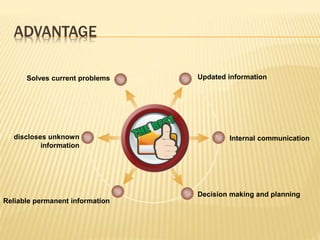
ADVANTAGE
Updated informationSolves current problems
Internal communication
Decision making and planning
discloses unknown
information
Reliable permanent information
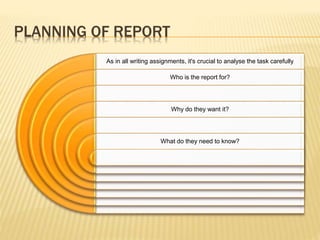
As in all writing assignments, it's crucial to analyse the task carefully
Who is the report for?
Why do they want it?
What do they need to know?
PLANNING OF REPORT
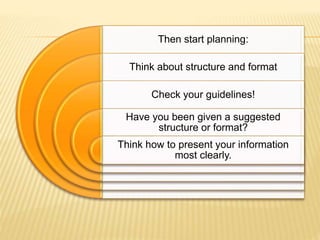
Then start planning:
Think about structure and format
Check your guidelines!
Have you been given a suggested
structure or format?
Think how to present your information
most clearly.
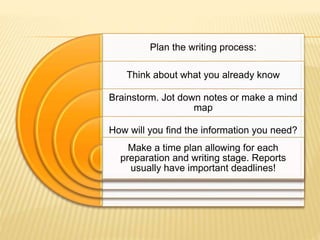
Plan the writing process:
Think about what you already know
Brainstorm. Jot down notes or make a mind
map
How will you find the information you need?
Make a time plan allowing for each
preparation and writing stage. Reports
usually have important deadlines!
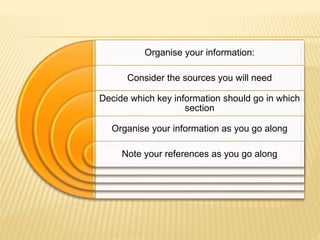
Organise your information:
Consider the sources you will need
Decide which key information should go in which
section
Organise your information as you go along
Note your references as you go along
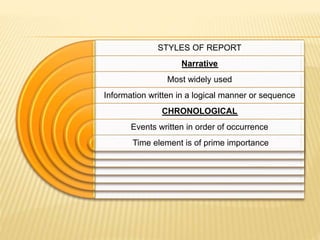
STYLES OF REPORT
Narrative
Most widely used
Information written in a logical manner or sequence
CHRONOLOGICAL
Events written in order of occurrence
Time element is of prime importance
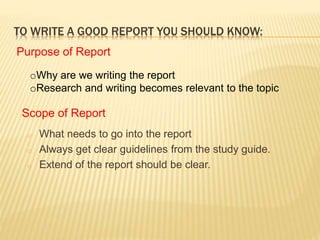
TO WRITE A GOOD REPORT YOU SHOULD KNOW:
o What needs to go into the report
o Always get clear guidelines from the study guide.
o Extend of the report should be clear.
Purpose of Report
oWhy are we writing the report
oResearch and writing becomes relevant to the topic
Scope of Report
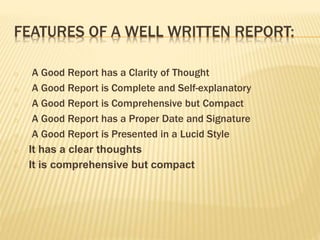
FEATURES OF A WELL WRITTEN REPORT:
o A Good Report has a Clarity of Thought
o A Good Report is Complete and Self-explanatory
o A Good Report is Comprehensive but Compact
o A Good Report has a Proper Date and Signature
o A Good Report is Presented in a Lucid Style
o It has a clear thoughts
o It is comprehensive but compact
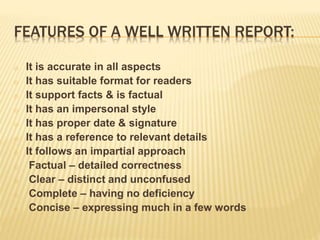
FEATURES OF A WELL WRITTEN REPORT:
o It is accurate in all aspects
o It has suitable format for readers
o It support facts & is factual
o It has an impersonal style
o It has proper date & signature
o It has a reference to relevant details
o It follows an impartial approach
o Factual – detailed correctness
o Clear – distinct and unconfused
o Complete – having no deficiency
o Concise – expressing much in a few words
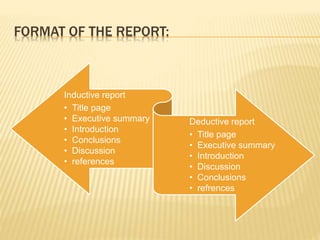
FORMAT OF THE REPORT:
Inductive report
• Title page
• Executive summary
• Introduction
• Conclusions
• Discussion
• references
Deductive report
• Title page
• Executive summary
• Introduction
• Discussion
• Conclusions
• refrences
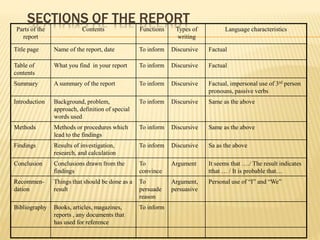
SECTIONS OF THE REPORT
Parts of the
report
Contents Functions Types of
writing
Language characteristics
Title page Name of the report, date To inform Discursive Factual
Table of
contents
What you find in your report To inform Discursive Factual
Summary A summary of the report To inform Discursive Factual, impersonal use of 3rd person
pronouns, passive verbs
Introduction Background, problem,
approach, definition of special
words used
To inform Discursive Same as the above
Methods Methods or procedures which
lead to the findings
To inform Discursive Same as the above
Findings Results of investigation,
research, and calculation
To inform Discursive Sa as the above
Conclusion Conclusions drawn from the
findings
To
convince
Argument It seems that …./ The result indicates
tthat … / It is probable that…
Recommen-
dation
Things that should be done as a
result
To
persuade
reason
Argument,
persuasive
Personal use of “I” and “We”
Bibliography Books, articles, magazines,
reports , any documents that
has used for reference
To inform
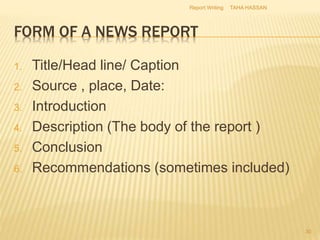
FORM OF A NEWS REPORT
1. Title/Head line/ Caption
2. Source , place, Date:
3. Introduction
4. Description (The body of the report )
5. Conclusion
6. Recommendations (sometimes included)
TAHA HASSANReport Writing
30
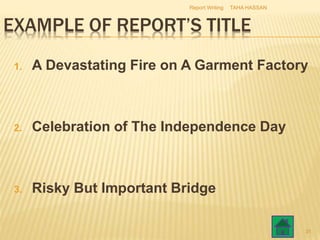
EXAMPLE OF REPORT’S TITLE
1. A Devastating Fire on A Garment Factory
2. Celebration of The Independence Day
3. Risky But Important Bridge
TAHA HASSANReport Writing
31
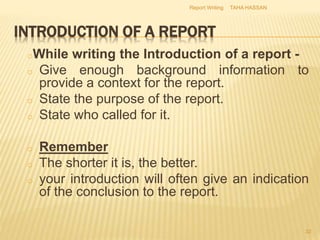
INTRODUCTION OF A REPORT
oWhile writing the Introduction of a report -
o Give enough background information to
provide a context for the report.
o State the purpose of the report.
o State who called for it.
o Remember
o The shorter it is, the better.
o your introduction will often give an indication
of the conclusion to the report.
TAHA HASSANReport Writing
32
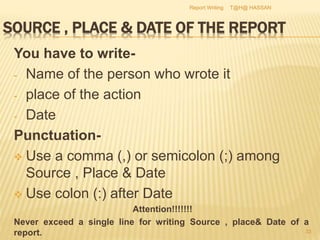
SOURCE , PLACE & DATE OF THE REPORT
You have to write-
- Name of the person who wrote it
- place of the action
- Date
Punctuation-
 Use a comma (,) or semicolon (;) among
Source , Place & Date
 Use colon (:) after Date
Attention!!!!!!!
Never exceed a single line for writing Source , place& Date of a
report.
T@H@ HASSANReport Writing
33
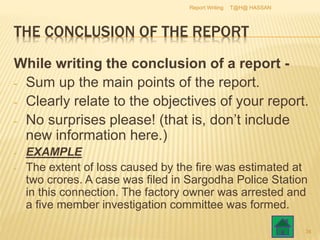
THE CONCLUSION OF THE REPORT
While writing the conclusion of a report -
- Sum up the main points of the report.
- Clearly relate to the objectives of your report.
- No surprises please! (that is, don’t include
new information here.)
- EXAMPLE
- The extent of loss caused by the fire was estimated at
two crores. A case was filed in Sargodha Police Station
in this connection. The factory owner was arrested and
a five member investigation committee was formed.
T@H@ HASSAN
34
Report Writing
THE RECOMMENDATION OF A REPORT
While writing the recommendation of a report -
- propose how the situation/problem could be
improved by suggesting action to be taken.
- Proposing should be logical, specific,
measurable and achievable.
- A “statement of cost” should be included if you
are recommending changes that have financial
implications.
- Recommendations can be numbered if you
wish.
T@H@ HASSAN
35
Report Writing
EXAMPLE OF THE RECOMMENDATION OF A
REPORT
Recommendations:
1. Alternative stairs should be built
immediately.
2. Electrical wire should be checked after
every six months.
3. Every employee should be trained properly
with fire extinguishing materials.
T@H@ HASSANReport Writing
36
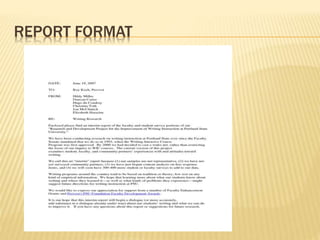
REPORT FORMAT

Report writing Taha english

  • 1.
  • 2.
    GROUP MEMBERS  TAHAHASSAN  MUHAMMAD ZEESHAN
  • 3.
    GROUP MEMBERS  HAMZAZAMAN  MUBASHAR WAHEED
  • 4.
    LEARNING OUTCOME By theend of the lesson you will be able to –  say what a report is.  describe why we write reports.  say how should it be.  Success criteria of a good report  say the types of report.  describe various part of a newspaper report.  write a newspaper report maintaining its structure. TAHA HASSANReport Writing 4
  • 5.
    WHAT IS AREPORT • A means to convey some information to others. • An organized, factual, objective presentation of information. • ‘Organized’ since it follows a systematic pattern. • ‘Objective' means it should not be influenced by our personal feelings. • Report is a comprehensive document and covers all aspects of the subject matter of study. WRITING
  • 6.
    WHAT IS AREPORT o It is a study of facts & information o It is formed in a structured format o Based on observation and analysis o It helps the management in an organization for making plans & solving issues in the organization o It is an outcome of an any event WRITING
  • 7.
    REPORTS AND ESSAYS.!!! •Similarities: - formal style - careful proof-reading and neat presentation - introduction, body and conclusion - analytical thinking
  • 8.
    KEY DIFFERENCES: • presentsinformation, not an argument • is meant to be scanned quickly by the reader • uses numbered headings and sub-headings • uses short, concise paragraphs and dot-points where applicable • uses graphics wherever possible (tables, graphs, illustrations) • may need an abstract (sometimes called an executive summary) • does not always need references and bibliography • is often followed by recommendations and/or appendices • A good report is always fact finding and not fault finding. It should be prepared in an impartial manner. The writers of the report should be impartial in their outlook and approach. A report:
  • 9.
    WHY DO WEWRITE REPORTS? TAHA HASSAN 9 Report Writing
  • 10.
    HOW SHOULD ITBE? A report aims to inform, as clearly and succinctly (briefly) as possible. It should be easy to read, and professional in its presentation. Reports must always be:  Accurate  Concise  Clear  well structured TAHA HASSAN 10 Report Writing
  • 11.
    • Write inpresent tense. • Write in passive sentence. • Write in the third person. • Use vocabulary associated with time (First, then, after, later, finally…..). • Use factual and precise descriptive language TAHA HASSANReport Writing 11
  • 12.
    PROBLEMS IN REPORTWRITING  A failure to understand when and why report will be used.  Lack of understanding what needs to be recorded.  Lack of time  Iliteracy of some staff.  Inappropriate/no systems to facilitate good record keeping and report writing.
  • 13.
    TYPES OF REPORT Research Report  Business Report  Scientific Report  Routine Report  Investigation Report  Project Report  Director’s Report
  • 14.
    TYPES OF REPORTS: • Provides basic information • Very very short • Report writing on monthly budgets, staff absentees and so on.. 1. Information only Reports
  • 15.
    2. RESEARCH REPORTS •Most widely used report • Important for university level • Includes R&D subjects. • Writing a report on some product development. • Report writing for your competitor’s activities.
  • 16.
    3. CASE STUDYANALYSIS REPORTS • Hypothetical research reports. • Includes real life examples • Submit a report based on a case given to you • Widely used in university level competitions.
  • 17.
    FORMAL AND INFORMAL Formal Reports: A formal report is one which is prepared in a prescribed form and is presented according to an established procedure to a prescribed authority.  Informal Reports: An informal report is usually in the form of a person-to-person communication. It may range from a short, almost fragmentary statement of facts on a single page, to a more developed presentation taking several pages. On the basis of formal organization:  Statutory report: A report prepared and presented according to the form and procedure laid down by law is called a statutory report. Ex: audit report  Non-statutory report: Formal reports which are not required under any law but which are prepared to help the management in framing the policies is called non statutory report. Ex: for policy formulations  Periodic or Routine Reports: are prepared and presented at regular, prescribed intervals. They may be submitted annually, semi-annually, quarterly, monthly, fortnightly, weekly or even daily.  Special Reports: They are related to a single occasion or situation. Such as technical report of a particular product.
  • 18.
    INFORMATIVE AND INTERPRETATIVE On the basis of function:  Informative Reports: These reports present facts about certain given activity in detail without any note or suggestions. Ex: A vice- chancellor asking about the number of candidates appearing at a particular examination.  Interpretative Reports: It analyzes the facts, draws conclusions and makes recommendations. Ex: A company chairman may ask for a report on falling trends in sale in a particular area. He will in this case be naturally interested in knowing all the details including that of opinion of any of the investigator.
  • 19.
    ADVANTAGE Updated informationSolves currentproblems Internal communication Decision making and planning discloses unknown information Reliable permanent information
  • 20.
    As in allwriting assignments, it's crucial to analyse the task carefully Who is the report for? Why do they want it? What do they need to know? PLANNING OF REPORT
  • 21.
    Then start planning: Thinkabout structure and format Check your guidelines! Have you been given a suggested structure or format? Think how to present your information most clearly.
  • 22.
    Plan the writingprocess: Think about what you already know Brainstorm. Jot down notes or make a mind map How will you find the information you need? Make a time plan allowing for each preparation and writing stage. Reports usually have important deadlines!
  • 23.
    Organise your information: Considerthe sources you will need Decide which key information should go in which section Organise your information as you go along Note your references as you go along
  • 24.
    STYLES OF REPORT Narrative Mostwidely used Information written in a logical manner or sequence CHRONOLOGICAL Events written in order of occurrence Time element is of prime importance
  • 25.
    TO WRITE AGOOD REPORT YOU SHOULD KNOW: o What needs to go into the report o Always get clear guidelines from the study guide. o Extend of the report should be clear. Purpose of Report oWhy are we writing the report oResearch and writing becomes relevant to the topic Scope of Report
  • 26.
    FEATURES OF AWELL WRITTEN REPORT: o A Good Report has a Clarity of Thought o A Good Report is Complete and Self-explanatory o A Good Report is Comprehensive but Compact o A Good Report has a Proper Date and Signature o A Good Report is Presented in a Lucid Style o It has a clear thoughts o It is comprehensive but compact
  • 27.
    FEATURES OF AWELL WRITTEN REPORT: o It is accurate in all aspects o It has suitable format for readers o It support facts & is factual o It has an impersonal style o It has proper date & signature o It has a reference to relevant details o It follows an impartial approach o Factual – detailed correctness o Clear – distinct and unconfused o Complete – having no deficiency o Concise – expressing much in a few words
  • 28.
    FORMAT OF THEREPORT: Inductive report • Title page • Executive summary • Introduction • Conclusions • Discussion • references Deductive report • Title page • Executive summary • Introduction • Discussion • Conclusions • refrences
  • 29.
    SECTIONS OF THEREPORT Parts of the report Contents Functions Types of writing Language characteristics Title page Name of the report, date To inform Discursive Factual Table of contents What you find in your report To inform Discursive Factual Summary A summary of the report To inform Discursive Factual, impersonal use of 3rd person pronouns, passive verbs Introduction Background, problem, approach, definition of special words used To inform Discursive Same as the above Methods Methods or procedures which lead to the findings To inform Discursive Same as the above Findings Results of investigation, research, and calculation To inform Discursive Sa as the above Conclusion Conclusions drawn from the findings To convince Argument It seems that …./ The result indicates tthat … / It is probable that… Recommen- dation Things that should be done as a result To persuade reason Argument, persuasive Personal use of “I” and “We” Bibliography Books, articles, magazines, reports , any documents that has used for reference To inform
  • 30.
    FORM OF ANEWS REPORT 1. Title/Head line/ Caption 2. Source , place, Date: 3. Introduction 4. Description (The body of the report ) 5. Conclusion 6. Recommendations (sometimes included) TAHA HASSANReport Writing 30
  • 31.
    EXAMPLE OF REPORT’STITLE 1. A Devastating Fire on A Garment Factory 2. Celebration of The Independence Day 3. Risky But Important Bridge TAHA HASSANReport Writing 31
  • 32.
    INTRODUCTION OF AREPORT oWhile writing the Introduction of a report - o Give enough background information to provide a context for the report. o State the purpose of the report. o State who called for it. o Remember o The shorter it is, the better. o your introduction will often give an indication of the conclusion to the report. TAHA HASSANReport Writing 32
  • 33.
    SOURCE , PLACE& DATE OF THE REPORT You have to write- - Name of the person who wrote it - place of the action - Date Punctuation-  Use a comma (,) or semicolon (;) among Source , Place & Date  Use colon (:) after Date Attention!!!!!!! Never exceed a single line for writing Source , place& Date of a report. T@H@ HASSANReport Writing 33
  • 34.
    THE CONCLUSION OFTHE REPORT While writing the conclusion of a report - - Sum up the main points of the report. - Clearly relate to the objectives of your report. - No surprises please! (that is, don’t include new information here.) - EXAMPLE - The extent of loss caused by the fire was estimated at two crores. A case was filed in Sargodha Police Station in this connection. The factory owner was arrested and a five member investigation committee was formed. T@H@ HASSAN 34 Report Writing
  • 35.
    THE RECOMMENDATION OFA REPORT While writing the recommendation of a report - - propose how the situation/problem could be improved by suggesting action to be taken. - Proposing should be logical, specific, measurable and achievable. - A “statement of cost” should be included if you are recommending changes that have financial implications. - Recommendations can be numbered if you wish. T@H@ HASSAN 35 Report Writing
  • 36.
    EXAMPLE OF THERECOMMENDATION OF A REPORT Recommendations: 1. Alternative stairs should be built immediately. 2. Electrical wire should be checked after every six months. 3. Every employee should be trained properly with fire extinguishing materials. T@H@ HASSANReport Writing 36
  • 37.

Editor's Notes