REPORT
WRITING
TYPES OF REPORTS
CONTENTS
• WHAT IS REPORT?
• WHYTOWRITE REPORT?
• WHAT TO INCLUDE?
• WHAT TO AVOID?
• PARTS OF REPORT
• TYPES OF REPORT
• REPORT BY COMMITTEE
• REPORT BY INDIVIUAL
WHAT IS REPORT?
•A report is a Presentation of Facts for the
purpose of
Evaluation by others
Decision Making
Informing Others
WHY TO WRITE
REPORT?
Report helps the owners of business, company,
organizations, or government:
 To provide information
To make recommendations
Give an analysis of facts
WHAT TO INCLUDE?
Business terminology, concepts and definitions
Inclusive language
Full sentence that relate back to scenario
Headings, sub-heading and diagram
Use third person
Always aim to be objective
TWO MAJOR QUESTIONS
1. WHAT ISTHE PURPOSE ?
 To inform readers about a particular situation
 To make recommendations
2. WHO ARETHE AUDIENCE?
 Manager’s
Clients
Shareholder’s
WHAT TO AVOID?
 Using first person ( I,We,You)
 Slang terms and casual language
 Giving your own opinion
 Being Subjective
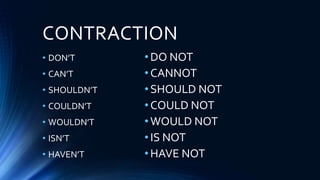
CONTRACTION
• DON’T
• CAN’T
• SHOULDN’T
• COULDN’T
• WOULDN’T
• ISN’T
• HAVEN’T
•DO NOT
•CANNOT
•SHOULD NOT
•COULD NOT
•WOULD NOT
•IS NOT
•HAVE NOT
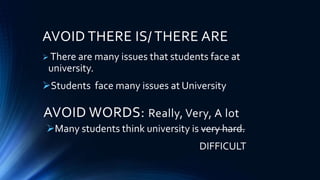
AVOID THERE IS/ THERE ARE
 There are many issues that students face at
university.
Students face many issues at University
AVOID WORDS: Really, Very, A lot
Many students think university is very hard.
DIFFICULT
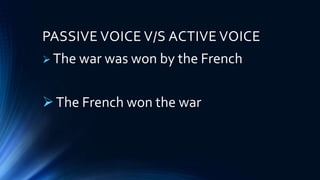
PASSIVE VOICE V/S ACTIVE VOICE
 The war was won by the French
The French won the war
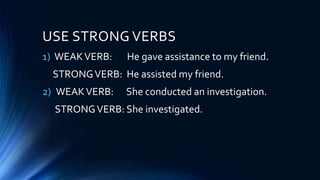
USE STRONG VERBS
1) WEAKVERB: He gave assistance to my friend.
STRONGVERB: He assisted my friend.
2) WEAKVERB: She conducted an investigation.
STRONGVERB: She investigated.
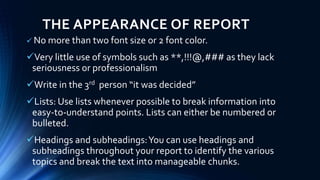
THE APPEARANCE OF REPORT
 No more than two font size or 2 font color.
Very little use of symbols such as **,!!!@,### as they lack
seriousness or professionalism
Write in the 3rd person “it was decided”
Lists: Use lists whenever possible to break information into
easy-to-understand points. Lists can either be numbered or
bulleted.
Headings and subheadings:You can use headings and
subheadings throughout your report to identify the various
topics and break the text into manageable chunks.
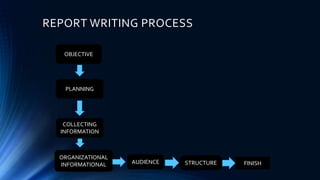
REPORT WRITING PROCESS
OBJECTIVE
PLANNING
COLLECTING
INFORMATION
ORGANIZATIONAL
INFORMATIONAL AUDIENCE STRUCTURE FINISH
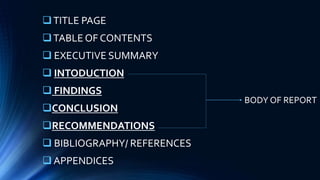
PARTS OF REPORT
TITLE PAGE
TABLE OF CONTENTS
 EXECUTIVE SUMMARY
 INTODUCTION
 FINDINGS
CONCLUSION
RECOMMENDATIONS
 BIBLIOGRAPHY/ REFERENCES
 APPENDICES
BODY OF REPORT
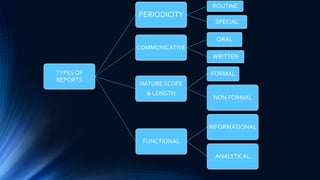
TYPES OF REPORTS
TYPES OF
REPORTS
PERIODICITY
ROUTINE
SPECIAL
COMMUNICATIVE
ORAL
WRITTEN
NATURE SCOPE
& LENGTH
FORMAL
NON FORMAL
FUNCTIONAL
INFORMATIONAL
ANALYTICAL
FUNCTIONAL REPORT
INFORMATIONAL REPORT
• An informational report presents facts , data ,
feedback and other type of information without any
analysis , interpretation or recommendation.
• The function of the writer of an informational report
is to collect , compile and organize facts for the
reader.
• It is a type of business report.
• Examples : conference reports , seminar reports , trip
reports etc.
TIPS OF WRITING A GOOD
INFORMATIONAL REPORT
• Assume the readers are not knowledge on the topic as
we you are.
• Use the correct scientific and technical terminology in
report.
• Find or create some labelled diagram , if possible.
• Use paragraph effectively.
• Always written in present tense and from a third person
perspective.
• Report should be constructed purely of facts and
evidence.
ANALYTICAL REPORT
• Analytical report provides data , facts , feedback
and other type of information with analysis ,
interpretation or recommendation.
• Recommendation is the biggest difference between
informational and analytical report.
• It is also a type of business report.
• Examples : project report , market research report ,
feasibility report etc.
TIPS OF WRITING GOOD
ANALYTICAL REPORT
• This report can be either in a short or a lengthy
discussion of a subject matter.
• Positive and negative aspects of the topic must be
discussed.
• The information you gather should be relevant.
• Present the information in a way that it will be best
used by the people to whom the report is to.
• Come up with the strong recommendation with the
help of the conclusions that you have made.
PERIODICITY REPORT
ROUTINE REPORT
•Routine reports are prepared and presented
as a routine work and at a regular period of
time.
•Routine reports are usually prepared on a
periodic basis like daily , weekly , monthly ,
quarterly or annually.
•Routine reports are called periodic report.
•Examples : daily production report , monthly
sales report , annual reports etc.
TIPS FOR WRITING GOOD ROUTINE
REPORT
• Decide the routine of writing.
• Determine the purpose of writing.
• Proceed the report in a orderly manner.
• The flow of writing the report should be logically
correct.
• The information should be to the point. No
irrelevant matter.
• A conclusion which is helpful in decision making.
SPECIAL REPORT
• Special report is prepared and presented to convey
special information related to a single condition ,
situation , problem or occasion.
• These report do not contain routine or repetitive
information as they are the result of specific
circumstances.
• This type of report is related to a single occasion.
• Example : inquiry report , research report etc.
TIPS OF WRITING A GOOD SPECIAL
REPORT
• Understand the problem or issue.
• Analysis the problem by some facts and data.
• Find the alternative solutions.
• Evaluate the best alternative and explain the
solution.

• The flow of writing the report should be correct.
• The subject matter should be explained well.
ORAL REPORT
• Oral report are Informal and face to face
presentation of information – Reporting of
accidents ,sales, production , joining etc.
• Oral report useful for presenting brief information
related to - Routine activities ,projects ,
development etc .
• In oral communication is influence by pitch
,volume, speed and clarity of speaking .
• Most organizations prefer oral report follow by
written report .
• Oral report provide quick feedback , they may
expedite a work and lead to fast action and
decisions .
• It is a time saving report .
WRITTEN REPORTS
• Written reports are conventional .
• Organizations use these reports to maintain
proper record for future use & reference .
• Written reports have a permanent value ,
indispensable until its destroy .
• A written report is influenced by the vocabulary ,
grammar style , writing style , precious clarity of
the language used .
NATURE SCOPE & LENGTH
FORMAL REPORT
• A formal report is usually the result of a thorough
investigation a problem , condition or situation .
• Formal reports are comparatively longer and need
to elaborate description and discussions .
• The length of report – A few pages to hundreds of
pages .
• They usually follow a fixed format .
• Formal report could be informational , analytical ,
routine .
• Example – Annual reports of companies and
organisations , technical report , projects reports ,
thesis .
COMMUNICATIVE REPORT
NON FORMAL REPORT
• It is generally brief and direct and can be delivered in
email or memo format.
• An non formal report can be used to share important
information with one person or a small group of
people.
• It is written to provide introductory information about
a routine affair .
• Non formal reports are usually short and they do
not need to elaborate description and discussions .
• In non formal report use of slang words, foul
language is restricted .
• Non formal reports may involve the use of printed
forms letter formats or memo formats.
• Example – Laboratory reports , daily production
reports , trip reports etc.
OUTLINE CAN BE USED TO WRITE AN
EFFECTIVE INFORMAL REPORT
• Subject
• Introduction
• Facts
• Feedback
• Conclusion
INFORMAL REPORT
• To: John Davis
• From :Terri Ames
• Date: December 20 , 2012
• Subject: Preliminary Funding Report
• In response to our serious needs to raise money for the organization
programs , I conducted preliminary research on potential foundation
,government ,and corporate funders. I wanted to get an idea of the
number and type of funders who might be interested in supporting
our organizations and programs .
I identified more than 100 foundation and several corporate
giving programs that make grants for jobs readiness
,financial management ,and life skills training programs . I did
not , however, identify and federal governmental agencies
that are currently making grants for these kinds of programs
I recommend conducting more thorough research to create a
list of foundation and corporate funders whose funding
priorities more closely match our mission and programs . I
also recommend conducting research to identify state grant
that our organization might be eligible to receive . Since it
can take six months to a year to receive a grant , we should
begin developing a ist of program of prospective funders and
submitting grant proposals and applications immediately.
REPORT BY COMMITTEE
•Committee Report is a report submitted by a
committee to an assembly on matters relating
to business referred to the committee or on
other matter under its charges
HOW TO WRITE A COMMITTEE
REPORT
• Bring a pen and paper or laptop with you to your
committee report.
• Make record of the date , time , attendees including
the titles and length of the meeting.
• Write down the topics on the agenda and what may
have been discussed without a specific name.
• Note who agreed and who disagreed , the reason
and other important information that occurred
during the meeting.
REPORT BY INDIVIDUAL
•A report by individual is an orderly, objective
communication of factual information that
serves some purpose.
THINGS TO CONSIDER WHEN
WRITING REPORT
• Address your report to the reader.
• Be clear ,informative and concise.
• Give practical information of the results in language
the reader should find understandable
• Practice on preparing neat, effective reports. Use a
word processor for making report.
THIGNS TO BE AVOIDED IN INDIVIUAL
REPORT
•Do not use unnecessary statistical ‘jargon’.
•ChangeTense .
•Define terms that are not use later.
• Over complicated or over simplify.
STRUCTURE OF REPORT BY INDIVIDUAL
TITLE
[BY LINE]
PDM [PLACE, DATE, MONTH]
OPENING PARAGRAPH
[WHO,WHAT,WHEN,WHERE]
HOW ANDWHY
PEOPLE INVOLVED ,EXPERTS,FEEDBACK
CONCLUDETHE REPORT
ABC INTERNATIONAL ORGANIZES
‘GREEN DRIVE’
[By Simran shaikh]
Pune,29 Sep
ABC International school ,had organized GREEN DRIVE
on september,29 from 8 a.m. to 3 p.m. at school
premises.
The program started with planting of medicinal plants
and poster making competition .The students along
with their teachers organized a rally to sensitize people .
They projected their views through slogans and
pamphlets .The aim of the event was to emphasize the
creative aptitude of the students and create awareness
among people.
The chief guest Dr. Ayaan Shaikh a renowned social
worker applauded the performance of the students
and awarded the certificates to the winner of the
competition . He said, ‘Environmental protection is
not the responsibility of the government alone’.
Principal Zain Patel appreciated the efforts made by
the teachers and students. He said, ‘Clean
environment is a shared responsibility’.
The earnest and energetic participation by the
students lived up to the mission of green drive.
There have to be small efforts made and each
individual counts and can help in this initiative of
environment conservation.
Report writing

Report writing

  • 1.
  • 2.
    CONTENTS • WHAT ISREPORT? • WHYTOWRITE REPORT? • WHAT TO INCLUDE? • WHAT TO AVOID? • PARTS OF REPORT • TYPES OF REPORT • REPORT BY COMMITTEE • REPORT BY INDIVIUAL
  • 3.
  • 4.
    •A report isa Presentation of Facts for the purpose of Evaluation by others Decision Making Informing Others
  • 5.
  • 6.
    Report helps theowners of business, company, organizations, or government:  To provide information To make recommendations Give an analysis of facts
  • 7.
  • 8.
    Business terminology, conceptsand definitions Inclusive language Full sentence that relate back to scenario Headings, sub-heading and diagram Use third person Always aim to be objective
  • 9.
    TWO MAJOR QUESTIONS 1.WHAT ISTHE PURPOSE ?  To inform readers about a particular situation  To make recommendations 2. WHO ARETHE AUDIENCE?  Manager’s Clients Shareholder’s
  • 10.
  • 11.
     Using firstperson ( I,We,You)  Slang terms and casual language  Giving your own opinion  Being Subjective
  • 12.
    CONTRACTION • DON’T • CAN’T •SHOULDN’T • COULDN’T • WOULDN’T • ISN’T • HAVEN’T •DO NOT •CANNOT •SHOULD NOT •COULD NOT •WOULD NOT •IS NOT •HAVE NOT
  • 13.
    AVOID THERE IS/THERE ARE  There are many issues that students face at university. Students face many issues at University AVOID WORDS: Really, Very, A lot Many students think university is very hard. DIFFICULT
  • 14.
    PASSIVE VOICE V/SACTIVE VOICE  The war was won by the French The French won the war
  • 15.
    USE STRONG VERBS 1)WEAKVERB: He gave assistance to my friend. STRONGVERB: He assisted my friend. 2) WEAKVERB: She conducted an investigation. STRONGVERB: She investigated.
  • 16.
    THE APPEARANCE OFREPORT  No more than two font size or 2 font color. Very little use of symbols such as **,!!!@,### as they lack seriousness or professionalism Write in the 3rd person “it was decided” Lists: Use lists whenever possible to break information into easy-to-understand points. Lists can either be numbered or bulleted. Headings and subheadings:You can use headings and subheadings throughout your report to identify the various topics and break the text into manageable chunks.
  • 17.
  • 18.
  • 19.
    TITLE PAGE TABLE OFCONTENTS  EXECUTIVE SUMMARY  INTODUCTION  FINDINGS CONCLUSION RECOMMENDATIONS  BIBLIOGRAPHY/ REFERENCES  APPENDICES BODY OF REPORT
  • 20.
  • 21.
    TYPES OF REPORTS PERIODICITY ROUTINE SPECIAL COMMUNICATIVE ORAL WRITTEN NATURE SCOPE &LENGTH FORMAL NON FORMAL FUNCTIONAL INFORMATIONAL ANALYTICAL
  • 22.
  • 23.
    INFORMATIONAL REPORT • Aninformational report presents facts , data , feedback and other type of information without any analysis , interpretation or recommendation. • The function of the writer of an informational report is to collect , compile and organize facts for the reader. • It is a type of business report. • Examples : conference reports , seminar reports , trip reports etc.
  • 24.
    TIPS OF WRITINGA GOOD INFORMATIONAL REPORT • Assume the readers are not knowledge on the topic as we you are. • Use the correct scientific and technical terminology in report. • Find or create some labelled diagram , if possible. • Use paragraph effectively. • Always written in present tense and from a third person perspective. • Report should be constructed purely of facts and evidence.
  • 25.
    ANALYTICAL REPORT • Analyticalreport provides data , facts , feedback and other type of information with analysis , interpretation or recommendation. • Recommendation is the biggest difference between informational and analytical report. • It is also a type of business report. • Examples : project report , market research report , feasibility report etc.
  • 26.
    TIPS OF WRITINGGOOD ANALYTICAL REPORT • This report can be either in a short or a lengthy discussion of a subject matter. • Positive and negative aspects of the topic must be discussed. • The information you gather should be relevant. • Present the information in a way that it will be best used by the people to whom the report is to. • Come up with the strong recommendation with the help of the conclusions that you have made.
  • 27.
  • 28.
    ROUTINE REPORT •Routine reportsare prepared and presented as a routine work and at a regular period of time. •Routine reports are usually prepared on a periodic basis like daily , weekly , monthly , quarterly or annually. •Routine reports are called periodic report. •Examples : daily production report , monthly sales report , annual reports etc.
  • 29.
    TIPS FOR WRITINGGOOD ROUTINE REPORT • Decide the routine of writing. • Determine the purpose of writing. • Proceed the report in a orderly manner. • The flow of writing the report should be logically correct. • The information should be to the point. No irrelevant matter. • A conclusion which is helpful in decision making.
  • 30.
    SPECIAL REPORT • Specialreport is prepared and presented to convey special information related to a single condition , situation , problem or occasion. • These report do not contain routine or repetitive information as they are the result of specific circumstances. • This type of report is related to a single occasion. • Example : inquiry report , research report etc.
  • 31.
    TIPS OF WRITINGA GOOD SPECIAL REPORT • Understand the problem or issue. • Analysis the problem by some facts and data. • Find the alternative solutions. • Evaluate the best alternative and explain the solution. • The flow of writing the report should be correct. • The subject matter should be explained well.
  • 32.
    ORAL REPORT • Oralreport are Informal and face to face presentation of information – Reporting of accidents ,sales, production , joining etc. • Oral report useful for presenting brief information related to - Routine activities ,projects , development etc .
  • 33.
    • In oralcommunication is influence by pitch ,volume, speed and clarity of speaking . • Most organizations prefer oral report follow by written report . • Oral report provide quick feedback , they may expedite a work and lead to fast action and decisions . • It is a time saving report .
  • 34.
    WRITTEN REPORTS • Writtenreports are conventional . • Organizations use these reports to maintain proper record for future use & reference . • Written reports have a permanent value , indispensable until its destroy . • A written report is influenced by the vocabulary , grammar style , writing style , precious clarity of the language used .
  • 35.
  • 36.
    FORMAL REPORT • Aformal report is usually the result of a thorough investigation a problem , condition or situation . • Formal reports are comparatively longer and need to elaborate description and discussions . • The length of report – A few pages to hundreds of pages .
  • 37.
    • They usuallyfollow a fixed format . • Formal report could be informational , analytical , routine . • Example – Annual reports of companies and organisations , technical report , projects reports , thesis .
  • 38.
  • 39.
    NON FORMAL REPORT •It is generally brief and direct and can be delivered in email or memo format. • An non formal report can be used to share important information with one person or a small group of people. • It is written to provide introductory information about a routine affair .
  • 40.
    • Non formalreports are usually short and they do not need to elaborate description and discussions . • In non formal report use of slang words, foul language is restricted . • Non formal reports may involve the use of printed forms letter formats or memo formats. • Example – Laboratory reports , daily production reports , trip reports etc.
  • 41.
    OUTLINE CAN BEUSED TO WRITE AN EFFECTIVE INFORMAL REPORT • Subject • Introduction • Facts • Feedback • Conclusion
  • 42.
    INFORMAL REPORT • To:John Davis • From :Terri Ames • Date: December 20 , 2012 • Subject: Preliminary Funding Report • In response to our serious needs to raise money for the organization programs , I conducted preliminary research on potential foundation ,government ,and corporate funders. I wanted to get an idea of the number and type of funders who might be interested in supporting our organizations and programs .
  • 43.
    I identified morethan 100 foundation and several corporate giving programs that make grants for jobs readiness ,financial management ,and life skills training programs . I did not , however, identify and federal governmental agencies that are currently making grants for these kinds of programs I recommend conducting more thorough research to create a list of foundation and corporate funders whose funding priorities more closely match our mission and programs . I also recommend conducting research to identify state grant that our organization might be eligible to receive . Since it can take six months to a year to receive a grant , we should begin developing a ist of program of prospective funders and submitting grant proposals and applications immediately.
  • 44.
  • 45.
    •Committee Report isa report submitted by a committee to an assembly on matters relating to business referred to the committee or on other matter under its charges
  • 46.
    HOW TO WRITEA COMMITTEE REPORT • Bring a pen and paper or laptop with you to your committee report. • Make record of the date , time , attendees including the titles and length of the meeting. • Write down the topics on the agenda and what may have been discussed without a specific name. • Note who agreed and who disagreed , the reason and other important information that occurred during the meeting.
  • 47.
  • 48.
    •A report byindividual is an orderly, objective communication of factual information that serves some purpose.
  • 49.
    THINGS TO CONSIDERWHEN WRITING REPORT • Address your report to the reader. • Be clear ,informative and concise. • Give practical information of the results in language the reader should find understandable • Practice on preparing neat, effective reports. Use a word processor for making report.
  • 50.
    THIGNS TO BEAVOIDED IN INDIVIUAL REPORT •Do not use unnecessary statistical ‘jargon’. •ChangeTense . •Define terms that are not use later. • Over complicated or over simplify.
  • 51.
    STRUCTURE OF REPORTBY INDIVIDUAL TITLE [BY LINE] PDM [PLACE, DATE, MONTH] OPENING PARAGRAPH [WHO,WHAT,WHEN,WHERE] HOW ANDWHY PEOPLE INVOLVED ,EXPERTS,FEEDBACK CONCLUDETHE REPORT
  • 52.
    ABC INTERNATIONAL ORGANIZES ‘GREENDRIVE’ [By Simran shaikh] Pune,29 Sep ABC International school ,had organized GREEN DRIVE on september,29 from 8 a.m. to 3 p.m. at school premises. The program started with planting of medicinal plants and poster making competition .The students along with their teachers organized a rally to sensitize people . They projected their views through slogans and pamphlets .The aim of the event was to emphasize the creative aptitude of the students and create awareness among people.
  • 53.
    The chief guestDr. Ayaan Shaikh a renowned social worker applauded the performance of the students and awarded the certificates to the winner of the competition . He said, ‘Environmental protection is not the responsibility of the government alone’. Principal Zain Patel appreciated the efforts made by the teachers and students. He said, ‘Clean environment is a shared responsibility’.
  • 54.
    The earnest andenergetic participation by the students lived up to the mission of green drive. There have to be small efforts made and each individual counts and can help in this initiative of environment conservation.