Definition of
a report
A document containing an orderly
and objective examination of a
situation or problem. It sets out
relevant information, findings,
conclusions and/or
recommendations. It is also directed
to a particular reader or audience for
a specific purpose
2 categories of reports
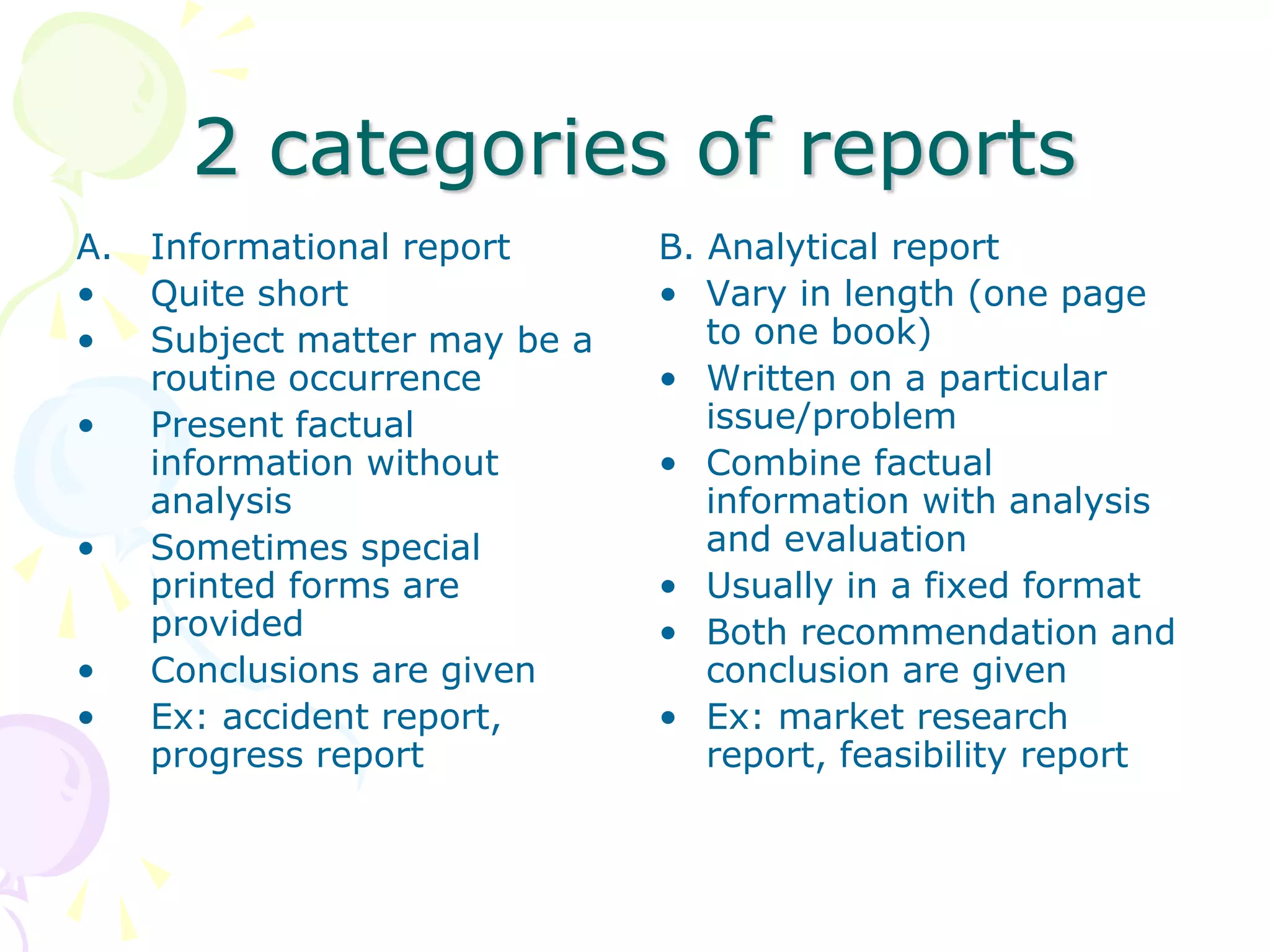
A. Informational report
• Quite short
• Subject matter may be a
routine occurrence
• Present factual
information without
analysis
• Sometimes special
printed forms are
provided
• Conclusions are given
• Ex: accident report,
progress report
B. Analytical report
• Vary in length (one page
to one book)
• Written on a particular
issue/problem
• Combine factual
information with analysis
and evaluation
• Usually in a fixed format
• Both recommendation and
conclusion are given
• Ex: market research
report, feasibility report
Functions of a report
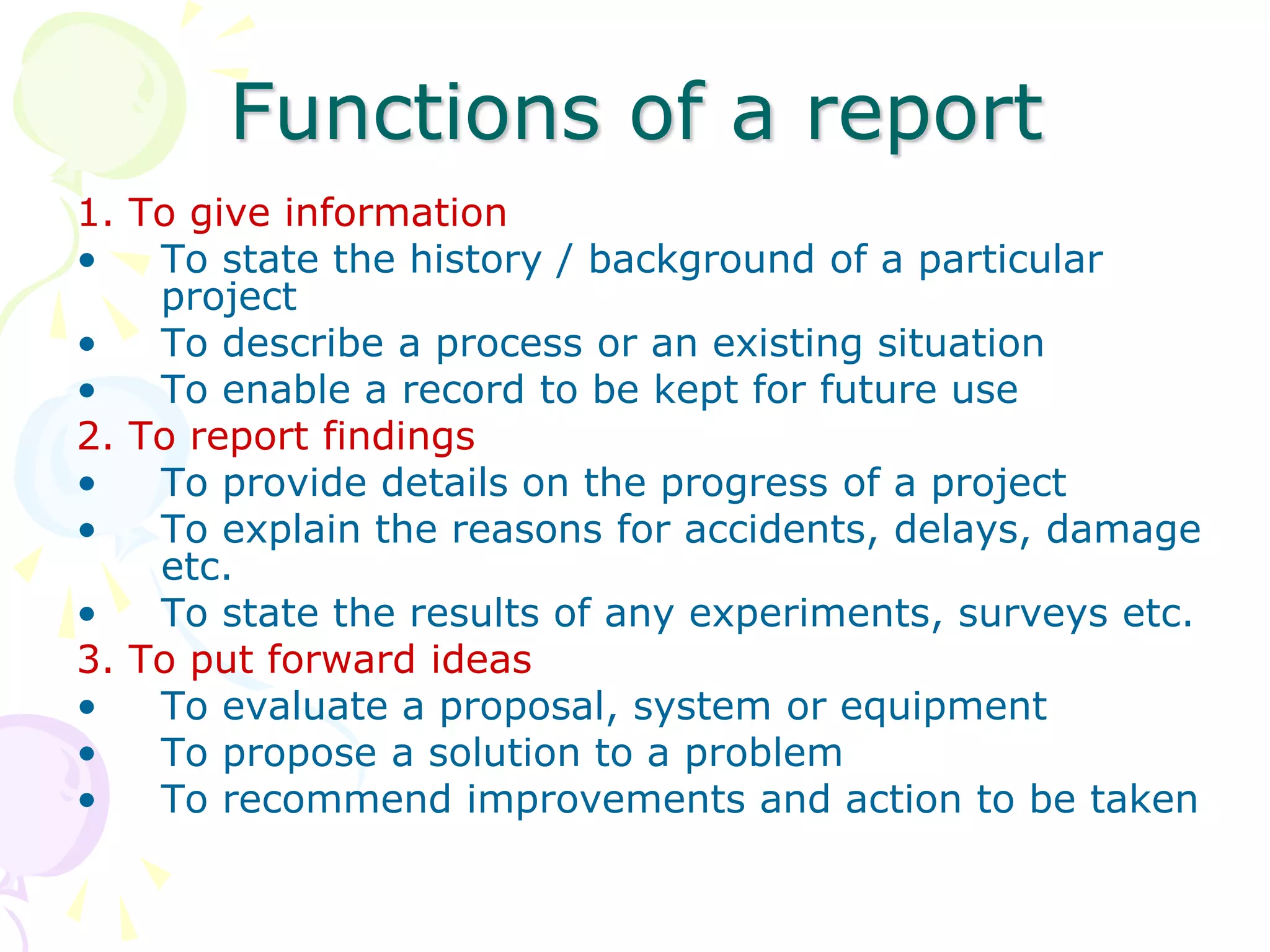
1. To give information
• To state the history / background of a particular
project
• To describe a process or an existing situation
• To enable a record to be kept for future use
2. To report findings
• To provide details on the progress of a project
• To explain the reasons for accidents, delays, damage
etc.
• To state the results of any experiments, surveys etc.
3. To put forward ideas
• To evaluate a proposal, system or equipment
• To propose a solution to a problem
• To recommend improvements and action to be taken
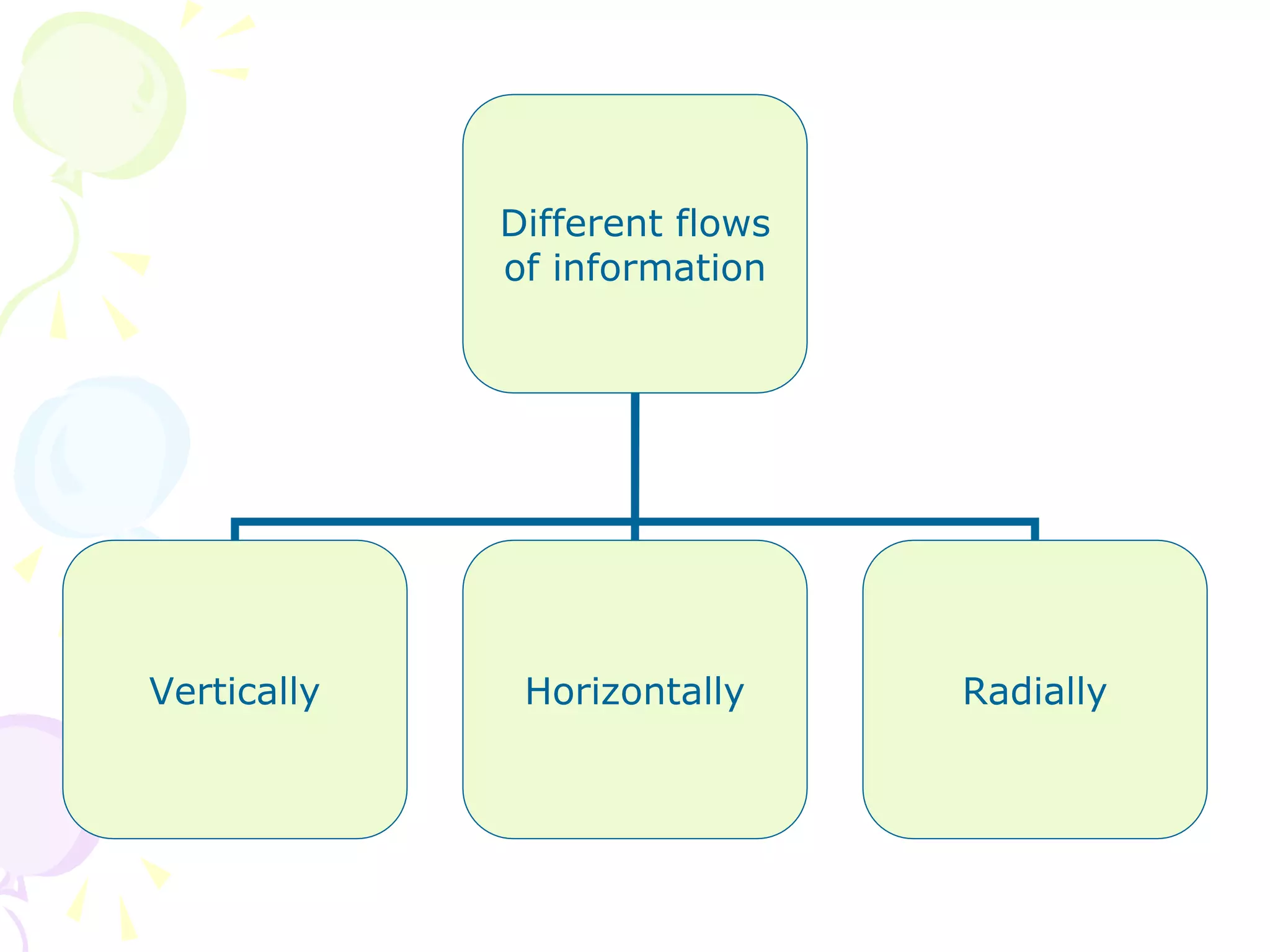
Different flows
of information
Vertically Horizontally Radially
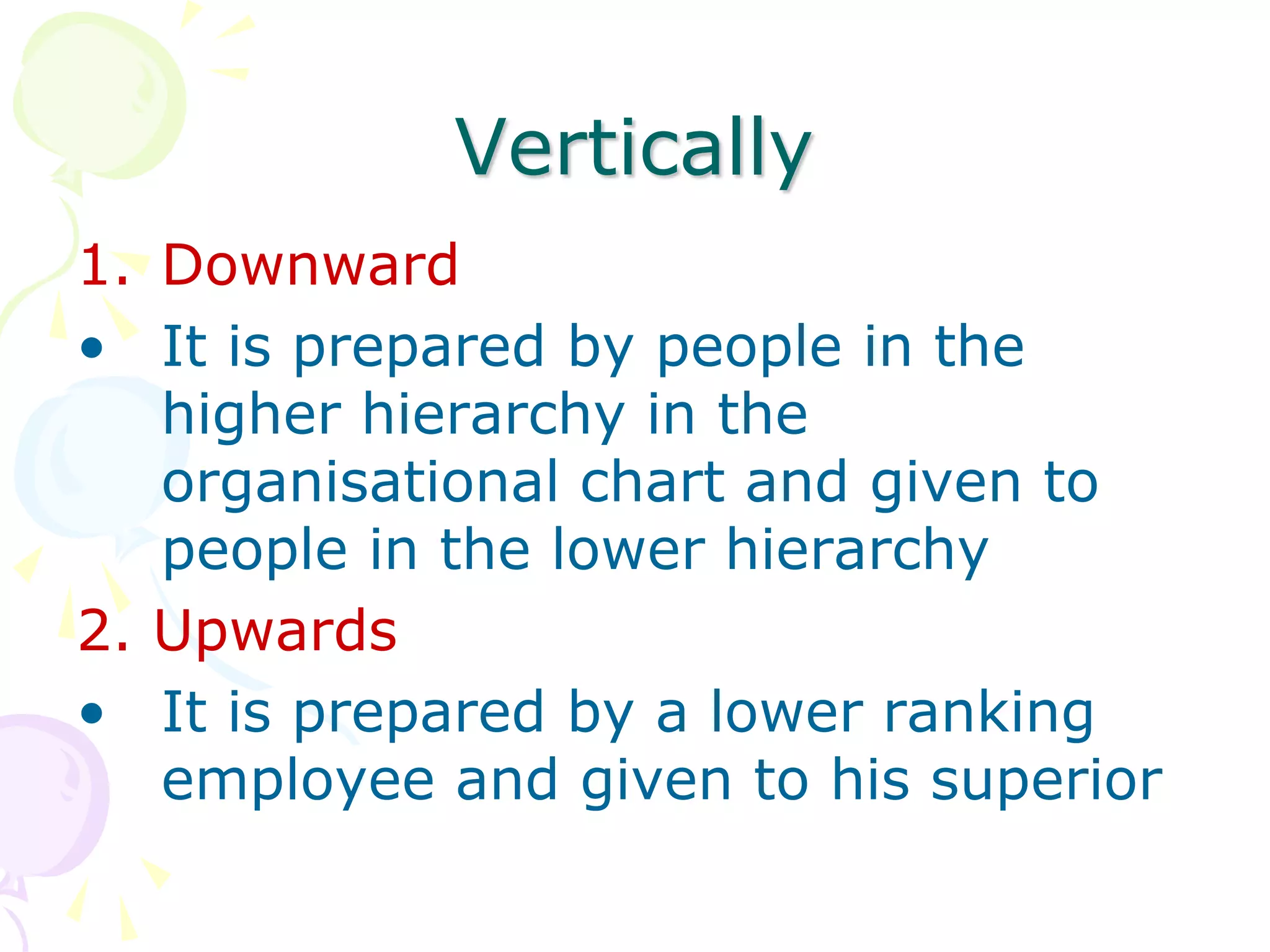
Vertically
1. Downward
• It is prepared by people in the
higher hierarchy in the
organisational chart and given to
people in the lower hierarchy
2. Upwards
• It is prepared by a lower ranking
employee and given to his superior
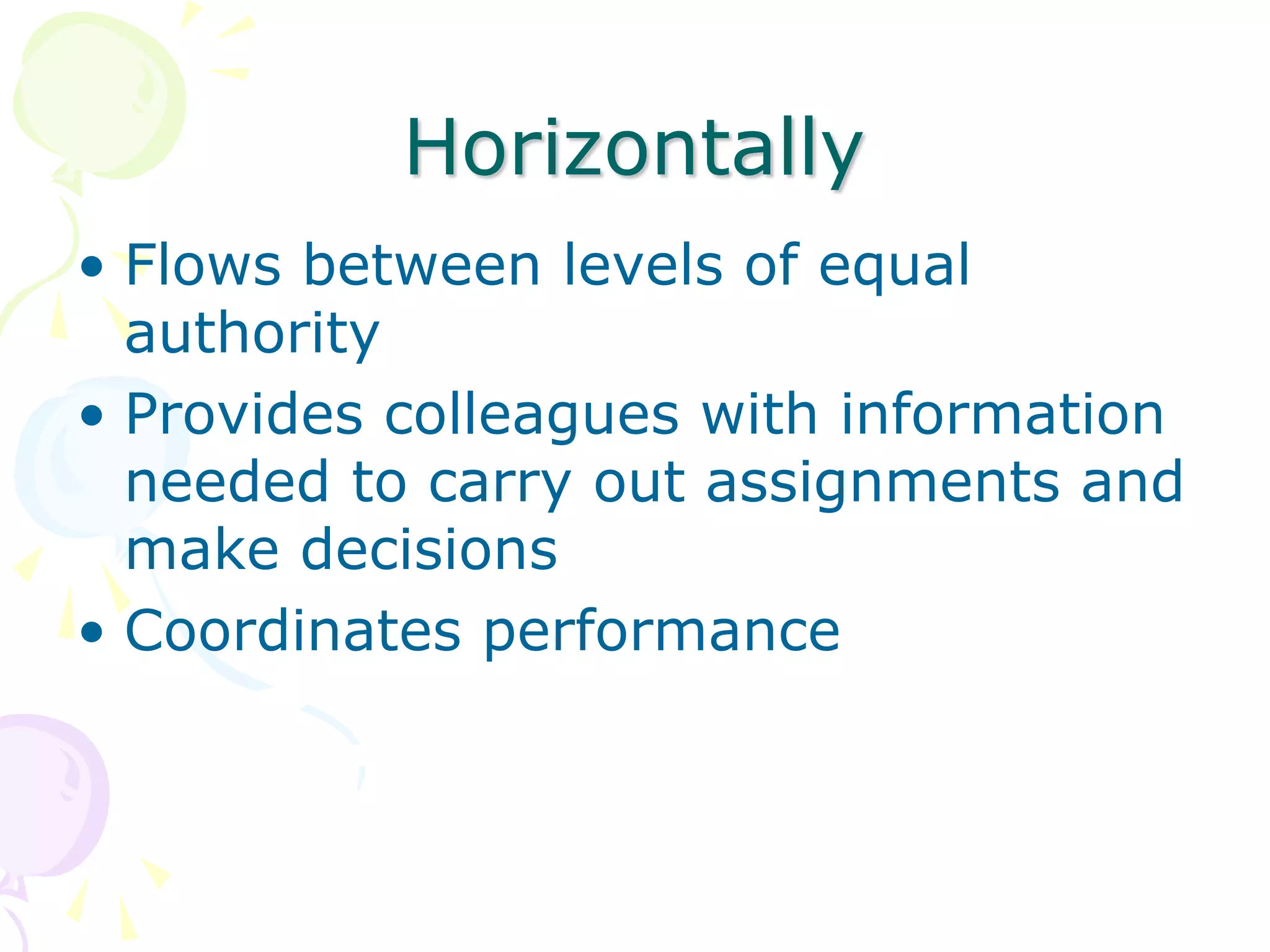
Horizontally
• Flows between levels of equal
authority
• Provides colleagues with information
needed to carry out assignments and
make decisions
• Coordinates performance
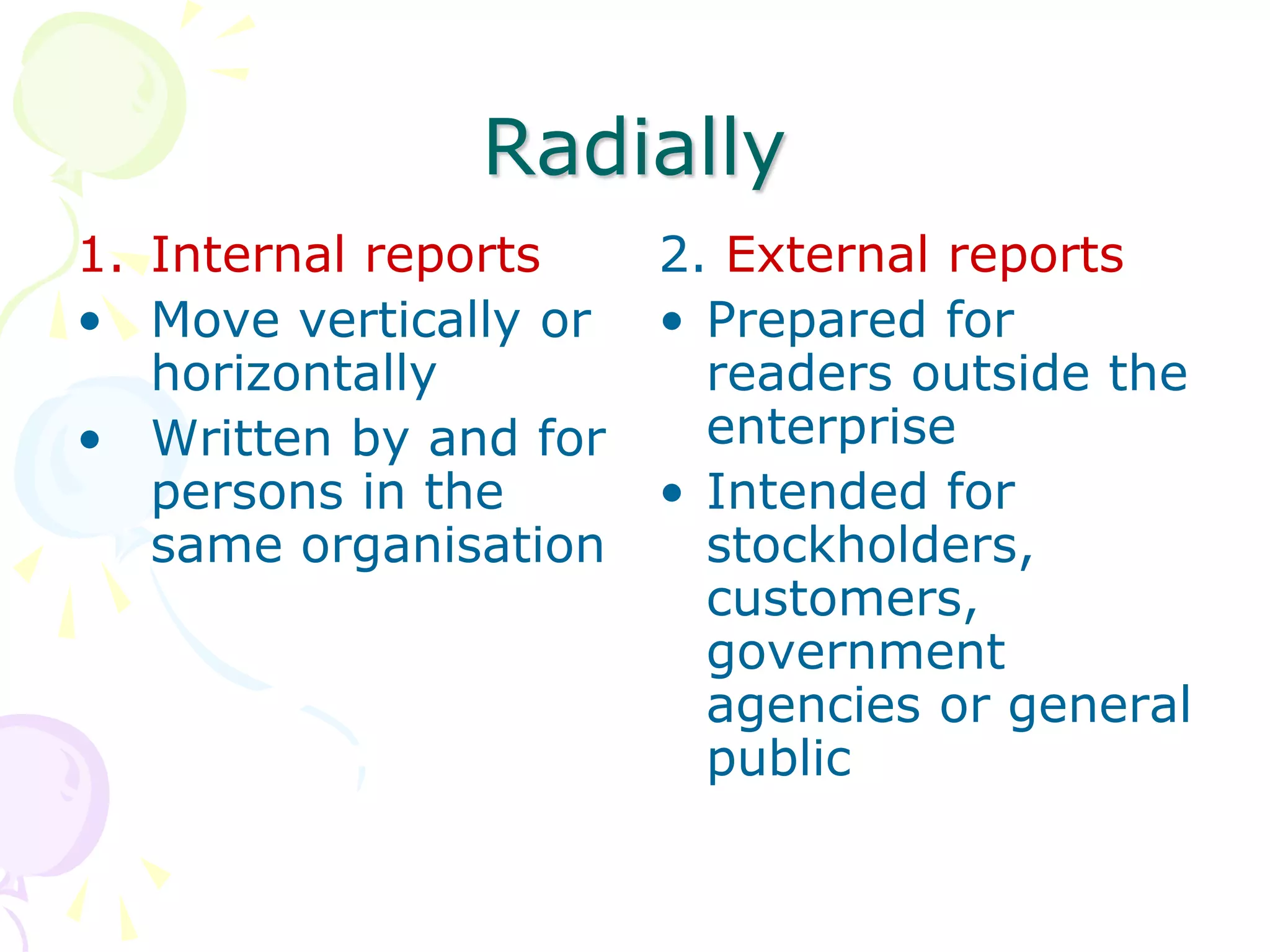
Radially
1. Internal reports
• Move vertically or
horizontally
• Written by and for
persons in the
same organisation
2. External reports
• Prepared for
readers outside the
enterprise
• Intended for
stockholders,
customers,
government
agencies or general
public
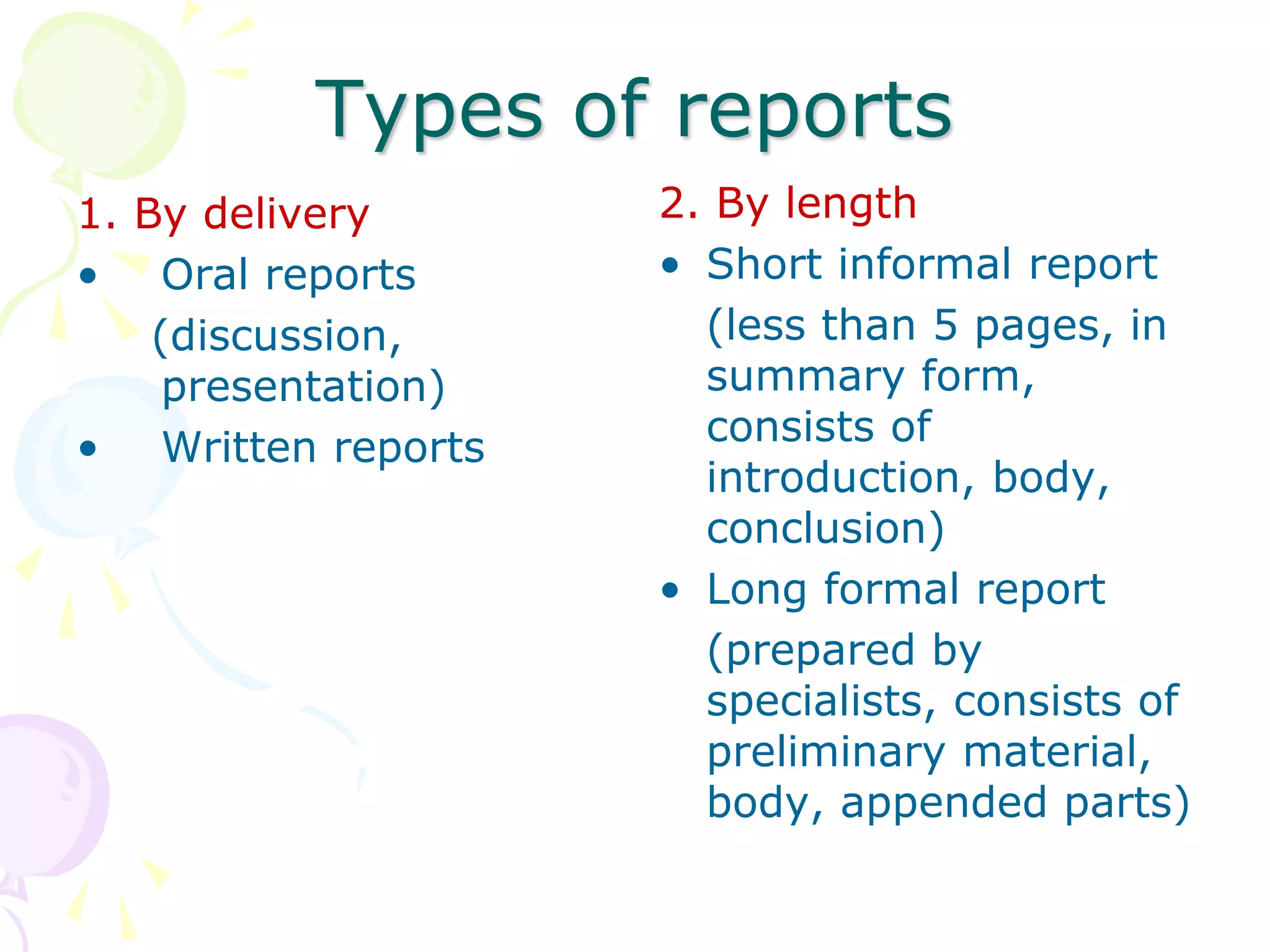
Types of reports
1. By delivery
• Oral reports
(discussion,
presentation)
• Written reports
2. By length
• Short informal report
(less than 5 pages, in
summary form,
consists of
introduction, body,
conclusion)
• Long formal report
(prepared by
specialists, consists of
preliminary material,
body, appended parts)
Types of reports
3. By form or format
• Letter report
(for someone outside
the company using
letterheads)
• Schematic report
(the material is
classified, analysed
and labelled according
to terms of reference,
procedure, findings,
conclusion and
recommendation)
• Memo report
(informal and used
to circulate
information within an
organisation)
• Printed form report
(standardised format
to ask for relevant
information)
Types of reports
4. By time
• Preliminary report
(before projects
commence,
investigate feasibility
of projects)
• Interim report
(mid-term progress,
analyses and deals
with problems)
• Periodic report
(fixed time sequence,
routine in nature)
• Final report
(project is completed)
5. By function
• Information report
(organised set of facts
and findings based on
situation)
• Analytical report
(present solutions to
problems)
• Memo report
• Routine report
• Letter report
• Eye-witness report
(narrative writing in
chronological order)
Qualities of a good report
1. Unity
• Must have one
central purpose and
everything in the
report is meant to
achieve that purpose
• Clear distinction
between major and
minor points
• Consistency in tone
(do not mix active
and passive voice,
formal with colloquial
expression)
2. Clarity
• Information must be
clear and
understandable
• Use exact, specific
words in easily
readable sentence
• A logical sequence in
the presentation of
information (reader
can follow the
progression of ideas)
• Layout of the report
is neat and logical
(reader can easily
locate specific
information)
Qualities of a good report
3. Accuracy
• Facts must be
accurately stated
• Factual information
should be verified by
research, investigation
or valid sources
• Opinion or probability
should be distinguished
and accompanied by
supporting evidence
4. Conciseness
• Should be economical,
transmit complete
information in as few
words as possible
• Omit non-essential
words, use simple
words, direct word
pattern, combine
sentence elements
Qualities of a good report
5. Readibility
• The report should allow
the reader to read with
ease
• Eliminate unnecessary
long sentences,
business cliches and
outdated terms
6. Objectivity
• Its content and
presentation should be
determined by logic
rather than emotion
• Denotative words
should be used (direct
and impersonal)
7. Completeness
• Include all relevant
facts
• Omit irrelevant
information
Qualities of a good report
8. Good organisation
• It makes it easier for
the reader to read and
understand the
content quickly
9. Good presentation
• Pay attention to
physical appearance
of the report
• Must be neat, well-
typed without any
mistakes and
accurately bound
Conducting a research
1. Identify problems, purpose, hypothesis
and objectives of research
2. Review literature/previous studies
3. Collect data, conduct experiment
4. Analyse data
5. Draw conclusions
Writing a report
1. Write the introduction part (background
info, problem statement, objectives etc.)
2. Write a review on literature
3. Write methodology section (data
collection, data analysis)
4. Write findings and result of analysis
5. Write conclusion and recommendation

1a. types and qualities of report.ppt

  • 1.
    Definition of a report Adocument containing an orderly and objective examination of a situation or problem. It sets out relevant information, findings, conclusions and/or recommendations. It is also directed to a particular reader or audience for a specific purpose
  • 2.
    2 categories ofreports A. Informational report • Quite short • Subject matter may be a routine occurrence • Present factual information without analysis • Sometimes special printed forms are provided • Conclusions are given • Ex: accident report, progress report B. Analytical report • Vary in length (one page to one book) • Written on a particular issue/problem • Combine factual information with analysis and evaluation • Usually in a fixed format • Both recommendation and conclusion are given • Ex: market research report, feasibility report
  • 3.
    Functions of areport 1. To give information • To state the history / background of a particular project • To describe a process or an existing situation • To enable a record to be kept for future use 2. To report findings • To provide details on the progress of a project • To explain the reasons for accidents, delays, damage etc. • To state the results of any experiments, surveys etc. 3. To put forward ideas • To evaluate a proposal, system or equipment • To propose a solution to a problem • To recommend improvements and action to be taken
  • 4.
  • 5.
    Vertically 1. Downward • Itis prepared by people in the higher hierarchy in the organisational chart and given to people in the lower hierarchy 2. Upwards • It is prepared by a lower ranking employee and given to his superior
  • 6.
    Horizontally • Flows betweenlevels of equal authority • Provides colleagues with information needed to carry out assignments and make decisions • Coordinates performance
  • 7.
    Radially 1. Internal reports •Move vertically or horizontally • Written by and for persons in the same organisation 2. External reports • Prepared for readers outside the enterprise • Intended for stockholders, customers, government agencies or general public
  • 8.
    Types of reports 1.By delivery • Oral reports (discussion, presentation) • Written reports 2. By length • Short informal report (less than 5 pages, in summary form, consists of introduction, body, conclusion) • Long formal report (prepared by specialists, consists of preliminary material, body, appended parts)
  • 9.
    Types of reports 3.By form or format • Letter report (for someone outside the company using letterheads) • Schematic report (the material is classified, analysed and labelled according to terms of reference, procedure, findings, conclusion and recommendation) • Memo report (informal and used to circulate information within an organisation) • Printed form report (standardised format to ask for relevant information)
  • 10.
    Types of reports 4.By time • Preliminary report (before projects commence, investigate feasibility of projects) • Interim report (mid-term progress, analyses and deals with problems) • Periodic report (fixed time sequence, routine in nature) • Final report (project is completed) 5. By function • Information report (organised set of facts and findings based on situation) • Analytical report (present solutions to problems) • Memo report • Routine report • Letter report • Eye-witness report (narrative writing in chronological order)
  • 11.
    Qualities of agood report 1. Unity • Must have one central purpose and everything in the report is meant to achieve that purpose • Clear distinction between major and minor points • Consistency in tone (do not mix active and passive voice, formal with colloquial expression) 2. Clarity • Information must be clear and understandable • Use exact, specific words in easily readable sentence • A logical sequence in the presentation of information (reader can follow the progression of ideas) • Layout of the report is neat and logical (reader can easily locate specific information)
  • 12.
    Qualities of agood report 3. Accuracy • Facts must be accurately stated • Factual information should be verified by research, investigation or valid sources • Opinion or probability should be distinguished and accompanied by supporting evidence 4. Conciseness • Should be economical, transmit complete information in as few words as possible • Omit non-essential words, use simple words, direct word pattern, combine sentence elements
  • 13.
    Qualities of agood report 5. Readibility • The report should allow the reader to read with ease • Eliminate unnecessary long sentences, business cliches and outdated terms 6. Objectivity • Its content and presentation should be determined by logic rather than emotion • Denotative words should be used (direct and impersonal) 7. Completeness • Include all relevant facts • Omit irrelevant information
  • 14.
    Qualities of agood report 8. Good organisation • It makes it easier for the reader to read and understand the content quickly 9. Good presentation • Pay attention to physical appearance of the report • Must be neat, well- typed without any mistakes and accurately bound
  • 15.
    Conducting a research 1.Identify problems, purpose, hypothesis and objectives of research 2. Review literature/previous studies 3. Collect data, conduct experiment 4. Analyse data 5. Draw conclusions
  • 16.
    Writing a report 1.Write the introduction part (background info, problem statement, objectives etc.) 2. Write a review on literature 3. Write methodology section (data collection, data analysis) 4. Write findings and result of analysis 5. Write conclusion and recommendation