

REPORT WRITING
WHAT IS A REPORT?WHAT IS A REPORT?
 “A report is a statement of the results of an
investigation or of any matter on which definite
information is required”.
(Oxford English Dictionary)
 Reports are a highly structured form of writing.
REPORT WRITING
Report writing is an essential skill for
Professionals in almost every field; accountants
teachers, graphic designers, information
scientists
A report aims to inform, as clearly and
succinctly as possible. It should be easy to
read and professional in its presentation.
To present the findings and results.
To keep records.
To tell about failures and successes.
To tell the progress of the project/research.
WHY DO WE WRITE REPORTS?
TYPES OF REPORTS
According to use:
external
internal
According to period:
routine
special
According to levels of management:
Reports to Top Management
Reports to Functional Management
Reports to Junior Level Management
Functional Reports
Corporate Reports:
Statutory report
Directors’ report
Auditors’ report
Non-statutory report
Other Reports:
Review
Cost-Audit
Interim
Oral
A Report differs from an Essay in that A report:
Present information, not an argument.
Is meant to be scanned quickly by the reader.
Uses numbered headings and sub- headings
Uses graphics where possible (tables, graphs, illustrations)
May nee and abstract (some times called an executive summary).
Does not always need references and bibliography.
Is often followed by recommendations and/ or appendices.
A report is similar to An Essay in that both need:
Formal style, introduction, body and conclusion
Analytical thinking, careful proof-reading and neat presentation.
Meet the needs of the readers.
Answers the questions.
Is it at the right level for readers?.
Clear logical structure.
GOOD REPORT…
REPORT STRUCTURE:
Letter of transmittal
A Salutation
The purpose of the letter
The main finding of the report
Any Important Considerations
An Acknowledgement of any Significant help
An Expression of pleasure or gratitude
Title page
title
writer
organization
date
person/group who commissioned the report
Table of content
accurate, clear layout
section numbering system and indentation
complete
page numbers
list of illustrations if applicable
List of abbreviations and/or glossary
arranged alphabetically
Executive summary/abstract
appropriate length
complete summary of key information
informative, not descriptive, in form
impersonal tone
connected prose
Introduction
relating topic to wider field
necessary background information
purpose of report
scope of report
explanation of arrangement of report
sections
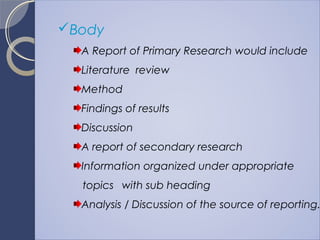
Body
A Report of Primary Research would include
Literature review
Method
Findings of results
Discussion
A report of secondary research
Information organized under appropriate
topics with sub heading
Analysis / Discussion of the source of reporting.
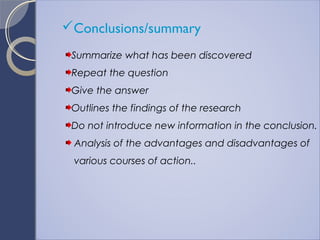
Conclusions/summary
Summarize what has been discovered
Repeat the question
Give the answer
Outlines the findings of the research
Do not introduce new information in the conclusion.
Analysis of the advantages and disadvantages of
various courses of action..
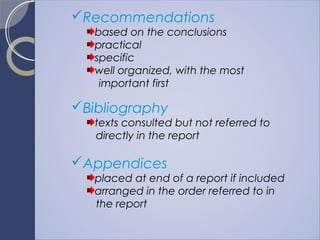
Recommendations
based on the conclusions
practical
specific
well organized, with the most
important first
Bibliography
texts consulted but not referred to
directly in the report
Appendices
placed at end of a report if included
arranged in the order referred to in
the report
REPORT WRITING PROCESSREPORT WRITING PROCESS
Objective
Planning
Collecting
Information
Organization
Information
Audience
Structure Finishing
THE OBJECTIVE..THE OBJECTIVE..
It defines the scope of your investigation.
Identify the purpose…
To inform?
To convince?
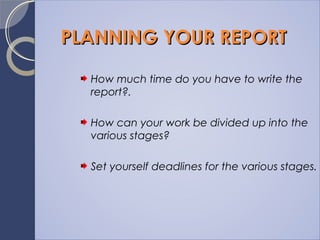
PLANNING YOUR REPORTPLANNING YOUR REPORT
How much time do you have to write the
report?.
How can your work be divided up into the
various stages?
Set yourself deadlines for the various stages.
COLLECTING INFORMATIONCOLLECTING INFORMATION
What is the information you need ?
Where do you find it ?
Survey
Organizations
Online: Google
Publications
How much do you need ?
ORGANIZING INFORMATIONORGANIZING INFORMATION
Discriminate between relevant and irrelevant
information.
Sort/organize information under main
ideas/details.
The computer program, Inspiration, can help
in organizing .
THE AUDIENCETHE AUDIENCE
Often 3 different audiences
The casual reader/big boss who wants the
main message as painlessly as possible.
The interested reader who wants more detail
but doesn’t want to grapple with all the gory
technical details.
The guru who wants the whole story.
WHAT TO DO?WHAT TO DO?
To address all 3 audiences effectively,
Include an abstract for the big boss
A main body for the interested non-specialist
A technical appendix for the guru
Thus, a structure emerges!
FINISHING THE REPORTFINISHING THE REPORT
Writing style
Structure alone is not enough for clarity – you
must also write clear sentences.
Rules:
Write complete short sentences
Avoid jargon and cliché, strive for simplicity
One theme per paragraph
All reports should be written in the third person i.e., as
an objective observer!.
Avoid using terms such as ``I did this experiment and ..".
Instead substitute terms, such as ``The experiment was
performed ...''.
Some friendly help…
The view of an objective and completely fresh reader
can be of great benefit.
This person may also be able to pick up spelling or
grammatical errors which you yourself are unaware of.
WHO IS THE REPORTER?
FINISHING TOUCHESFINISHING TOUCHES
Type
◦ Don’t use too many styles
◦ Avoid All Caps
 Difficult to Read
◦ Double Space
◦ Number Placement
 Bottom Center
Paper
◦ High Quality
◦ 20# Weight
◦ White/Off-White
◦ 8 ½ x 11
Margins
◦ Top & Sides - 1”
◦ Bottom - 1 ½”
◦ Left & Right 1.25”
THANK YOU
DESIGNED BY:
D. SAMUEL MANIRAJ, MBA.,M.Com.,M.Phil.,MA.,PGDCA.,ADCHN.,
CHENNAI, TAMIL NADU,
INDIA

Report writing

  • 1.
  • 2.
    WHAT IS AREPORT?WHAT IS A REPORT?  “A report is a statement of the results of an investigation or of any matter on which definite information is required”. (Oxford English Dictionary)  Reports are a highly structured form of writing.
  • 3.
    REPORT WRITING Report writingis an essential skill for Professionals in almost every field; accountants teachers, graphic designers, information scientists A report aims to inform, as clearly and succinctly as possible. It should be easy to read and professional in its presentation.
  • 4.
    To present thefindings and results. To keep records. To tell about failures and successes. To tell the progress of the project/research. WHY DO WE WRITE REPORTS?
  • 5.
    TYPES OF REPORTS Accordingto use: external internal According to period: routine special According to levels of management: Reports to Top Management Reports to Functional Management Reports to Junior Level Management Functional Reports
  • 6.
    Corporate Reports: Statutory report Directors’report Auditors’ report Non-statutory report Other Reports: Review Cost-Audit Interim Oral
  • 7.
    A Report differsfrom an Essay in that A report: Present information, not an argument. Is meant to be scanned quickly by the reader. Uses numbered headings and sub- headings Uses graphics where possible (tables, graphs, illustrations) May nee and abstract (some times called an executive summary). Does not always need references and bibliography. Is often followed by recommendations and/ or appendices. A report is similar to An Essay in that both need: Formal style, introduction, body and conclusion Analytical thinking, careful proof-reading and neat presentation.
  • 8.
    Meet the needsof the readers. Answers the questions. Is it at the right level for readers?. Clear logical structure. GOOD REPORT…
  • 9.
    REPORT STRUCTURE: Letter oftransmittal A Salutation The purpose of the letter The main finding of the report Any Important Considerations An Acknowledgement of any Significant help An Expression of pleasure or gratitude Title page title writer organization date person/group who commissioned the report
  • 10.
    Table of content accurate,clear layout section numbering system and indentation complete page numbers list of illustrations if applicable List of abbreviations and/or glossary arranged alphabetically
  • 11.
    Executive summary/abstract appropriate length completesummary of key information informative, not descriptive, in form impersonal tone connected prose Introduction relating topic to wider field necessary background information purpose of report scope of report explanation of arrangement of report sections
  • 12.
    Body A Report ofPrimary Research would include Literature review Method Findings of results Discussion A report of secondary research Information organized under appropriate topics with sub heading Analysis / Discussion of the source of reporting.
  • 13.
    Conclusions/summary Summarize what hasbeen discovered Repeat the question Give the answer Outlines the findings of the research Do not introduce new information in the conclusion. Analysis of the advantages and disadvantages of various courses of action..
  • 14.
    Recommendations based on theconclusions practical specific well organized, with the most important first Bibliography texts consulted but not referred to directly in the report Appendices placed at end of a report if included arranged in the order referred to in the report
  • 15.
    REPORT WRITING PROCESSREPORTWRITING PROCESS Objective Planning Collecting Information Organization Information Audience Structure Finishing
  • 16.
    THE OBJECTIVE..THE OBJECTIVE.. Itdefines the scope of your investigation. Identify the purpose… To inform? To convince?
  • 17.
    PLANNING YOUR REPORTPLANNINGYOUR REPORT How much time do you have to write the report?. How can your work be divided up into the various stages? Set yourself deadlines for the various stages.
  • 18.
    COLLECTING INFORMATIONCOLLECTING INFORMATION Whatis the information you need ? Where do you find it ? Survey Organizations Online: Google Publications How much do you need ?
  • 19.
    ORGANIZING INFORMATIONORGANIZING INFORMATION Discriminatebetween relevant and irrelevant information. Sort/organize information under main ideas/details. The computer program, Inspiration, can help in organizing .
  • 20.
    THE AUDIENCETHE AUDIENCE Often3 different audiences The casual reader/big boss who wants the main message as painlessly as possible. The interested reader who wants more detail but doesn’t want to grapple with all the gory technical details. The guru who wants the whole story.
  • 21.
    WHAT TO DO?WHATTO DO? To address all 3 audiences effectively, Include an abstract for the big boss A main body for the interested non-specialist A technical appendix for the guru Thus, a structure emerges!
  • 22.
    FINISHING THE REPORTFINISHINGTHE REPORT Writing style Structure alone is not enough for clarity – you must also write clear sentences. Rules: Write complete short sentences Avoid jargon and cliché, strive for simplicity One theme per paragraph
  • 23.
    All reports shouldbe written in the third person i.e., as an objective observer!. Avoid using terms such as ``I did this experiment and ..". Instead substitute terms, such as ``The experiment was performed ...''. Some friendly help… The view of an objective and completely fresh reader can be of great benefit. This person may also be able to pick up spelling or grammatical errors which you yourself are unaware of. WHO IS THE REPORTER?
  • 24.
    FINISHING TOUCHESFINISHING TOUCHES Type ◦Don’t use too many styles ◦ Avoid All Caps  Difficult to Read ◦ Double Space ◦ Number Placement  Bottom Center
  • 25.
    Paper ◦ High Quality ◦20# Weight ◦ White/Off-White ◦ 8 ½ x 11 Margins ◦ Top & Sides - 1” ◦ Bottom - 1 ½” ◦ Left & Right 1.25”
  • 26.
    THANK YOU DESIGNED BY: D.SAMUEL MANIRAJ, MBA.,M.Com.,M.Phil.,MA.,PGDCA.,ADCHN., CHENNAI, TAMIL NADU, INDIA