Single National Curriculum
2020
Qulb e Abbas
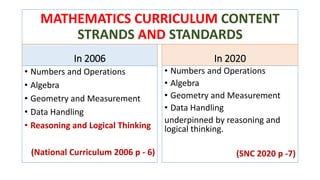
MATHEMATICS CURRICULUM CONTENT
STRANDS AND STANDARDS
In 2006
• Numbers and Operations
• Algebra
• Geometry and Measurement
• Data Handling
• Reasoning and Logical Thinking
(National Curriculum 2006 p - 6)
In 2020
• Numbers and Operations
• Algebra
• Geometry and Measurement
• Data Handling
underpinned by reasoning and
logical thinking.
(SNC 2020 p -7)
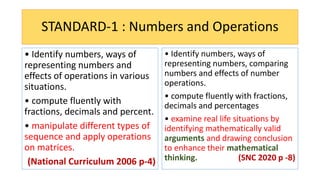
STANDARD-1 : Numbers and Operations
• Identify numbers, ways of
representing numbers and
effects of operations in various
situations.
• compute fluently with
fractions, decimals and percent.
• manipulate different types of
sequence and apply operations
on matrices.
(National Curriculum 2006 p-4)
• Identify numbers, ways of
representing numbers, comparing
numbers and effects of number
operations.
• compute fluently with fractions,
decimals and percentages
• examine real life situations by
identifying mathematically valid
arguments and drawing conclusion
to enhance their mathematical
thinking. (SNC 2020 p -8)
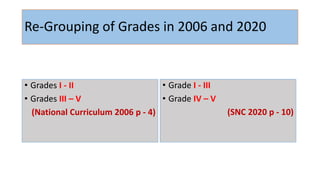
Re-Grouping of Grades in 2006 and 2020
• Grades I - II
• Grades III – V
(National Curriculum 2006 p - 4)
• Grade I - III
• Grade IV – V
(SNC 2020 p - 10)
BENCHMARKS WISE COMPARISON
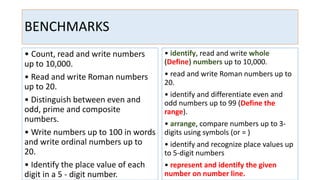
BENCHMARKS
• Count, read and write numbers
up to 10,000.
• Read and write Roman numbers
up to 20.
• Distinguish between even and
odd, prime and composite
numbers.
• Write numbers up to 100 in words
and write ordinal numbers up to
20.
• Identify the place value of each
digit in a 5 - digit number.
• identify, read and write whole
(Define) numbers up to 10,000.
• read and write Roman numbers up to
20.
• identify and differentiate even and
odd numbers up to 99 (Define the
range).
• arrange, compare numbers up to 3-
digits using symbols (or = )
• identify and recognize place values up
to 5-digit numbers
• represent and identify the given
number on number line.
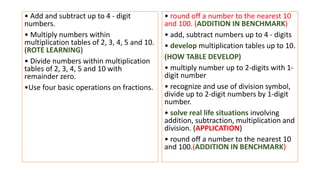
• Add and subtract up to 4 - digit
numbers.
• Multiply numbers within
multiplication tables of 2, 3, 4, 5 and 10.
(ROTE LEARNING)
• Divide numbers within multiplication
tables of 2, 3, 4, 5 and 10 with
remainder zero.
•Use four basic operations on fractions.
• round off a number to the nearest 10
and 100. (ADDITION IN BENCHMARK)
• add, subtract numbers up to 4 - digits
• develop multiplication tables up to 10.
(HOW TABLE DEVELOP)
• multiply number up to 2-digits with 1-
digit number
• recognize and use of division symbol,
divide up to 2-digit numbers by 1-digit
number.
• solve real life situations involving
addition, subtraction, multiplication and
division. (APPLICATION)
• round off a number to the nearest 10
and 100.(ADDITION IN BENCHMARK)
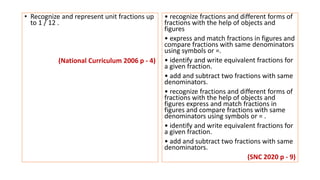
• Recognize and represent unit fractions up
to 1 / 12 .
(National Curriculum 2006 p - 4)
• recognize fractions and different forms of
fractions with the help of objects and
figures
• express and match fractions in figures and
compare fractions with same denominators
using symbols or =.
• identify and write equivalent fractions for
a given fraction.
• add and subtract two fractions with same
denominators.
• recognize fractions and different forms of
fractions with the help of objects and
figures express and match fractions in
figures and compare fractions with same
denominators using symbols or = .
• identify and write equivalent fractions for
a given fraction.
• add and subtract two fractions with same
denominators.
(SNC 2020 p - 9)
SLO (Students Learning Outcomes ) WISE
COMPARISON
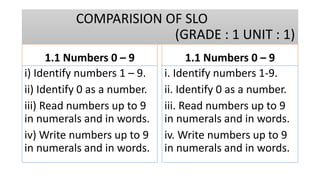
COMPARISION OF SLO
(GRADE : 1 UNIT : 1)
1.1 Numbers 0 – 9
i) Identify numbers 1 – 9.
ii) Identify 0 as a number.
iii) Read numbers up to 9
in numerals and in words.
iv) Write numbers up to 9
in numerals and in words.
1.1 Numbers 0 – 9
i. Identify numbers 1-9.
ii. Identify 0 as a number.
iii. Read numbers up to 9
in numerals and in words.
iv. Write numbers up to 9
in numerals and in words.
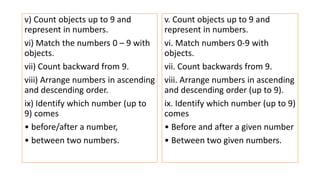
v) Count objects up to 9 and
represent in numbers.
vi) Match the numbers 0 – 9 with
objects.
vii) Count backward from 9.
viii) Arrange numbers in ascending
and descending order.
ix) Identify which number (up to
9) comes
• before/after a number,
• between two numbers.
v. Count objects up to 9 and
represent in numbers.
vi. Match numbers 0-9 with
objects.
vii. Count backwards from 9.
viii. Arrange numbers in ascending
and descending order (up to 9).
ix. Identify which number (up to 9)
comes
• Before and after a given number
• Between two given numbers.
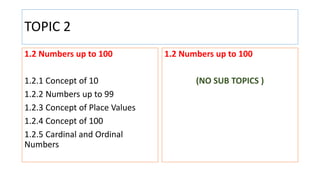
TOPIC 2
1.2 Numbers up to 100
1.2.1 Concept of 10
1.2.2 Numbers up to 99
1.2.3 Concept of Place Values
1.2.4 Concept of 100
1.2.5 Cardinal and Ordinal
Numbers
1.2 Numbers up to 100
(NO SUB TOPICS )
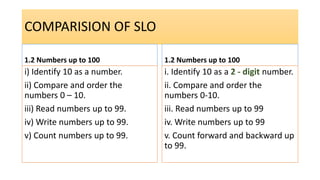
COMPARISION OF SLO
1.2 Numbers up to 100
i) Identify 10 as a number.
ii) Compare and order the
numbers 0 – 10.
iii) Read numbers up to 99.
iv) Write numbers up to 99.
v) Count numbers up to 99.
1.2 Numbers up to 100
i. Identify 10 as a 2 - digit number.
ii. Compare and order the
numbers 0-10.
iii. Read numbers up to 99
iv. Write numbers up to 99
v. Count forward and backward up
to 99.
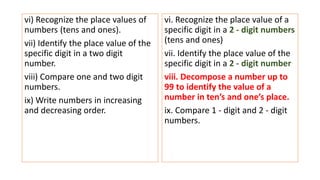
vi) Recognize the place values of
numbers (tens and ones).
vii) Identify the place value of the
specific digit in a two digit
number.
viii) Compare one and two digit
numbers.
ix) Write numbers in increasing
and decreasing order.
vi. Recognize the place value of a
specific digit in a 2 - digit numbers
(tens and ones)
vii. Identify the place value of the
specific digit in a 2 - digit number
viii. Decompose a number up to
99 to identify the value of a
number in ten’s and one’s place.
ix. Compare 1 - digit and 2 - digit
numbers.
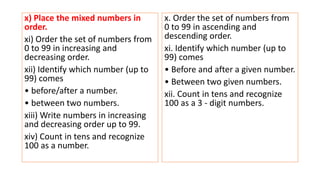
x) Place the mixed numbers in
order.
xi) Order the set of numbers from
0 to 99 in increasing and
decreasing order.
xii) Identify which number (up to
99) comes
• before/after a number.
• between two numbers.
xiii) Write numbers in increasing
and decreasing order up to 99.
xiv) Count in tens and recognize
100 as a number.
x. Order the set of numbers from
0 to 99 in ascending and
descending order.
xi. Identify which number (up to
99) comes
• Before and after a given number.
• Between two given numbers.
xii. Count in tens and recognize
100 as a 3 - digit numbers.
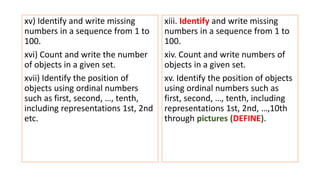
xv) Identify and write missing
numbers in a sequence from 1 to
100.
xvi) Count and write the number
of objects in a given set.
xvii) Identify the position of
objects using ordinal numbers
such as first, second, …, tenth,
including representations 1st, 2nd
etc.
xiii. Identify and write missing
numbers in a sequence from 1 to
100.
xiv. Count and write numbers of
objects in a given set.
xv. Identify the position of objects
using ordinal numbers such as
first, second, …, tenth, including
representations 1st, 2nd, …,10th
through pictures (DEFINE).
UNIT WISE COMPARISION
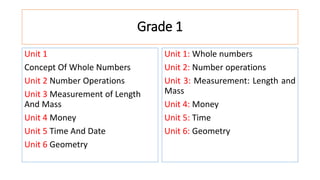
Grade 1
Unit 1
Concept Of Whole Numbers
Unit 2 Number Operations
Unit 3 Measurement of Length
And Mass
Unit 4 Money
Unit 5 Time And Date
Unit 6 Geometry
Unit 1: Whole numbers
Unit 2: Number operations
Unit 3: Measurement: Length and
Mass
Unit 4: Money
Unit 5: Time
Unit 6: Geometry
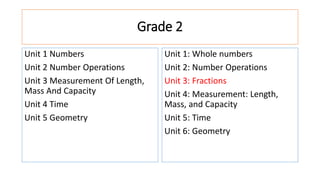
Grade 2
Unit 1 Numbers
Unit 2 Number Operations
Unit 3 Measurement Of Length,
Mass And Capacity
Unit 4 Time
Unit 5 Geometry
Unit 1: Whole numbers
Unit 2: Number Operations
Unit 3: Fractions
Unit 4: Measurement: Length,
Mass, and Capacity
Unit 5: Time
Unit 6: Geometry
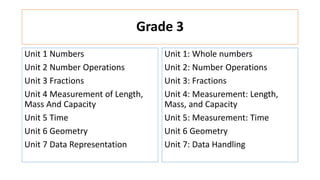
Grade 3
Unit 1 Numbers
Unit 2 Number Operations
Unit 3 Fractions
Unit 4 Measurement of Length,
Mass And Capacity
Unit 5 Time
Unit 6 Geometry
Unit 7 Data Representation
Unit 1: Whole numbers
Unit 2: Number Operations
Unit 3: Fractions
Unit 4: Measurement: Length,
Mass, and Capacity
Unit 5: Measurement: Time
Unit 6 Geometry
Unit 7: Data Handling
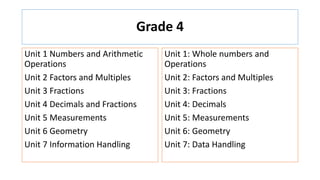
Grade 4
Unit 1 Numbers and Arithmetic
Operations
Unit 2 Factors and Multiples
Unit 3 Fractions
Unit 4 Decimals and Fractions
Unit 5 Measurements
Unit 6 Geometry
Unit 7 Information Handling
Unit 1: Whole numbers and
Operations
Unit 2: Factors and Multiples
Unit 3: Fractions
Unit 4: Decimals
Unit 5: Measurements
Unit 6: Geometry
Unit 7: Data Handling
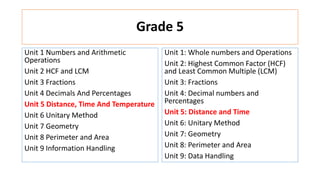
Grade 5
Unit 1 Numbers and Arithmetic
Operations
Unit 2 HCF and LCM
Unit 3 Fractions
Unit 4 Decimals And Percentages
Unit 5 Distance, Time And Temperature
Unit 6 Unitary Method
Unit 7 Geometry
Unit 8 Perimeter and Area
Unit 9 Information Handling
Unit 1: Whole numbers and Operations
Unit 2: Highest Common Factor (HCF)
and Least Common Multiple (LCM)
Unit 3: Fractions
Unit 4: Decimal numbers and
Percentages
Unit 5: Distance and Time
Unit 6: Unitary Method
Unit 7: Geometry
Unit 8: Perimeter and Area
Unit 9: Data Handling
UNIT WISE WEIGHTAGE
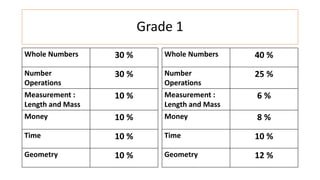
Grade 1
Whole Numbers 30 %
Number
Operations
30 %
Measurement :
Length and Mass
10 %
Money 10 %
Time 10 %
Geometry 10 %
Whole Numbers 40 %
Number
Operations
25 %
Measurement :
Length and Mass
6 %
Money 8 %
Time 10 %
Geometry 12 %
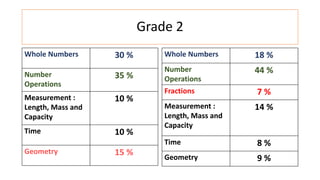
Grade 2
Whole Numbers 30 %
Number
Operations
35 %
Measurement :
Length, Mass and
Capacity
10 %
Time 10 %
Geometry 15 %
Whole Numbers 18 %
Number
Operations
44 %
Fractions 7 %
Measurement :
Length, Mass and
Capacity
14 %
Time 8 %
Geometry 9 %
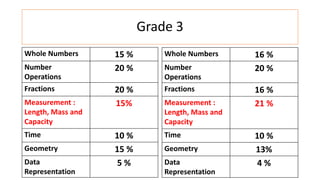
Grade 3
Whole Numbers 15 %
Number
Operations
20 %
Fractions 20 %
Measurement :
Length, Mass and
Capacity
15%
Time 10 %
Geometry 15 %
Data
Representation
5 %
Whole Numbers 16 %
Number
Operations
20 %
Fractions 16 %
Measurement :
Length, Mass and
Capacity
21 %
Time 10 %
Geometry 13%
Data
Representation
4 %
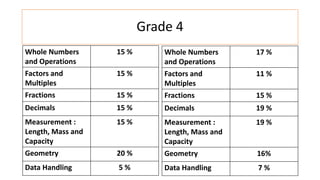
Grade 4
Whole Numbers
and Operations
17 %
Factors and
Multiples
11 %
Fractions 15 %
Decimals 19 %
Measurement :
Length, Mass and
Capacity
19 %
Geometry 16%
Data Handling 7 %
Whole Numbers
and Operations
15 %
Factors and
Multiples
15 %
Fractions 15 %
Decimals 15 %
Measurement :
Length, Mass and
Capacity
15 %
Geometry 20 %
Data Handling 5 %
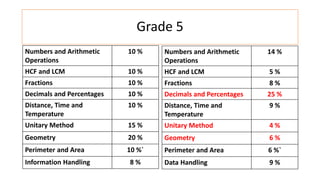
Grade 5
Numbers and Arithmetic
Operations
10 %
HCF and LCM 10 %
Fractions 10 %
Decimals and Percentages 10 %
Distance, Time and
Temperature
10 %
Unitary Method 15 %
Geometry 20 %
Perimeter and Area 10 %`
Information Handling 8 %
Numbers and Arithmetic
Operations
14 %
HCF and LCM 5 %
Fractions 8 %
Decimals and Percentages 25 %
Distance, Time and
Temperature
9 %
Unitary Method 4 %
Geometry 6 %
Perimeter and Area 6 %`
Data Handling 9 %
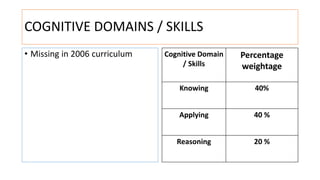
COGNITIVE DOMAINS / SKILLS
• Missing in 2006 curriculum Cognitive Domain
/ Skills
Percentage
weightage
Knowing 40%
Applying 40 %
Reasoning 20 %
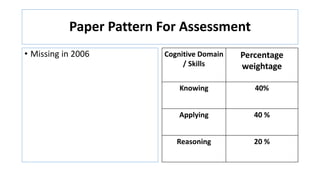
Paper Pattern For Assessment
• Missing in 2006 Cognitive Domain
/ Skills
Percentage
weightage
Knowing 40%
Applying 40 %
Reasoning 20 %
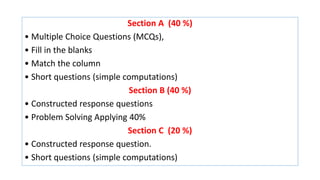
Section A (40 %)
• Multiple Choice Questions (MCQs),
• Fill in the blanks
• Match the column
• Short questions (simple computations)
Section B (40 %)
• Constructed response questions
• Problem Solving Applying 40%
Section C (20 %)
• Constructed response question.
• Short questions (simple computations)
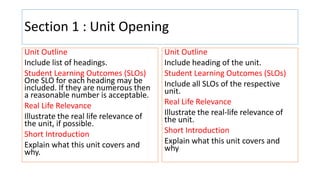
Section 1 : Unit Opening
Unit Outline
Include list of headings.
Student Learning Outcomes (SLOs)
One SLO for each heading may be
included. If they are numerous then
a reasonable number is acceptable.
Real Life Relevance
Illustrate the real life relevance of
the unit, if possible.
Short Introduction
Explain what this unit covers and
why.
Unit Outline
Include heading of the unit.
Student Learning Outcomes (SLOs)
Include all SLOs of the respective
unit.
Real Life Relevance
Illustrate the real-life relevance of
the unit.
Short Introduction
Explain what this unit covers and
why
Section 2 : Unit Body
• Key Terms
• Running Glossary
• Feature Boxes
• Illustrative Examples
• Problem Sets
• Learning Review Points
• Tips or Hints
• Visuals
• Key Terms
• Running Glossary
• Feature Boxes
• Illustrative Examples
• Problem Sets
• Learning Review Points
• Tips or Hints
• Visuals
Section 3 : Unit Ending
• Problem Set (Review)
• Summary
• Problem Set (Review)
• Summary
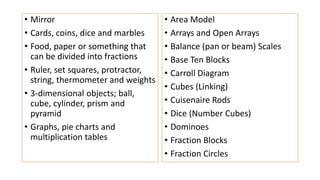
• Mirror
• Cards, coins, dice and marbles
• Food, paper or something that
can be divided into fractions
• Ruler, set squares, protractor,
string, thermometer and weights
• 3-dimensional objects; ball,
cube, cylinder, prism and
pyramid
• Graphs, pie charts and
multiplication tables
• Area Model
• Arrays and Open Arrays
• Balance (pan or beam) Scales
• Base Ten Blocks
• Carroll Diagram
• Cubes (Linking)
• Cuisenaire Rods
• Dice (Number Cubes)
• Dominoes
• Fraction Blocks
• Fraction Circles
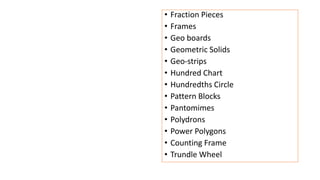
• Fraction Pieces
• Frames
• Geo boards
• Geometric Solids
• Geo-strips
• Hundred Chart
• Hundredths Circle
• Pattern Blocks
• Pantomimes
• Polydrons
• Power Polygons
• Counting Frame
• Trundle Wheel
Web-links / Math Games
ICT Corner
• No Work • https://www.geogebra.org/m/Ex
u3mtz5
• Web games
SNC 2020 MATHEMATICS requirment.pptx

SNC 2020 MATHEMATICS requirment.pptx

  • 1.
  • 2.
    MATHEMATICS CURRICULUM CONTENT STRANDSAND STANDARDS In 2006 • Numbers and Operations • Algebra • Geometry and Measurement • Data Handling • Reasoning and Logical Thinking (National Curriculum 2006 p - 6) In 2020 • Numbers and Operations • Algebra • Geometry and Measurement • Data Handling underpinned by reasoning and logical thinking. (SNC 2020 p -7)
  • 3.
    STANDARD-1 : Numbersand Operations • Identify numbers, ways of representing numbers and effects of operations in various situations. • compute fluently with fractions, decimals and percent. • manipulate different types of sequence and apply operations on matrices. (National Curriculum 2006 p-4) • Identify numbers, ways of representing numbers, comparing numbers and effects of number operations. • compute fluently with fractions, decimals and percentages • examine real life situations by identifying mathematically valid arguments and drawing conclusion to enhance their mathematical thinking. (SNC 2020 p -8)
  • 4.
    Re-Grouping of Gradesin 2006 and 2020 • Grades I - II • Grades III – V (National Curriculum 2006 p - 4) • Grade I - III • Grade IV – V (SNC 2020 p - 10)
  • 5.
  • 6.
    BENCHMARKS • Count, readand write numbers up to 10,000. • Read and write Roman numbers up to 20. • Distinguish between even and odd, prime and composite numbers. • Write numbers up to 100 in words and write ordinal numbers up to 20. • Identify the place value of each digit in a 5 - digit number. • identify, read and write whole (Define) numbers up to 10,000. • read and write Roman numbers up to 20. • identify and differentiate even and odd numbers up to 99 (Define the range). • arrange, compare numbers up to 3- digits using symbols (or = ) • identify and recognize place values up to 5-digit numbers • represent and identify the given number on number line.
  • 7.
    • Add andsubtract up to 4 - digit numbers. • Multiply numbers within multiplication tables of 2, 3, 4, 5 and 10. (ROTE LEARNING) • Divide numbers within multiplication tables of 2, 3, 4, 5 and 10 with remainder zero. •Use four basic operations on fractions. • round off a number to the nearest 10 and 100. (ADDITION IN BENCHMARK) • add, subtract numbers up to 4 - digits • develop multiplication tables up to 10. (HOW TABLE DEVELOP) • multiply number up to 2-digits with 1- digit number • recognize and use of division symbol, divide up to 2-digit numbers by 1-digit number. • solve real life situations involving addition, subtraction, multiplication and division. (APPLICATION) • round off a number to the nearest 10 and 100.(ADDITION IN BENCHMARK)
  • 8.
    • Recognize andrepresent unit fractions up to 1 / 12 . (National Curriculum 2006 p - 4) • recognize fractions and different forms of fractions with the help of objects and figures • express and match fractions in figures and compare fractions with same denominators using symbols or =. • identify and write equivalent fractions for a given fraction. • add and subtract two fractions with same denominators. • recognize fractions and different forms of fractions with the help of objects and figures express and match fractions in figures and compare fractions with same denominators using symbols or = . • identify and write equivalent fractions for a given fraction. • add and subtract two fractions with same denominators. (SNC 2020 p - 9)
  • 9.
    SLO (Students LearningOutcomes ) WISE COMPARISON
  • 10.
    COMPARISION OF SLO (GRADE: 1 UNIT : 1) 1.1 Numbers 0 – 9 i) Identify numbers 1 – 9. ii) Identify 0 as a number. iii) Read numbers up to 9 in numerals and in words. iv) Write numbers up to 9 in numerals and in words. 1.1 Numbers 0 – 9 i. Identify numbers 1-9. ii. Identify 0 as a number. iii. Read numbers up to 9 in numerals and in words. iv. Write numbers up to 9 in numerals and in words.
  • 11.
    v) Count objectsup to 9 and represent in numbers. vi) Match the numbers 0 – 9 with objects. vii) Count backward from 9. viii) Arrange numbers in ascending and descending order. ix) Identify which number (up to 9) comes • before/after a number, • between two numbers. v. Count objects up to 9 and represent in numbers. vi. Match numbers 0-9 with objects. vii. Count backwards from 9. viii. Arrange numbers in ascending and descending order (up to 9). ix. Identify which number (up to 9) comes • Before and after a given number • Between two given numbers.
  • 12.
    TOPIC 2 1.2 Numbersup to 100 1.2.1 Concept of 10 1.2.2 Numbers up to 99 1.2.3 Concept of Place Values 1.2.4 Concept of 100 1.2.5 Cardinal and Ordinal Numbers 1.2 Numbers up to 100 (NO SUB TOPICS )
  • 13.
    COMPARISION OF SLO 1.2Numbers up to 100 i) Identify 10 as a number. ii) Compare and order the numbers 0 – 10. iii) Read numbers up to 99. iv) Write numbers up to 99. v) Count numbers up to 99. 1.2 Numbers up to 100 i. Identify 10 as a 2 - digit number. ii. Compare and order the numbers 0-10. iii. Read numbers up to 99 iv. Write numbers up to 99 v. Count forward and backward up to 99.
  • 14.
    vi) Recognize theplace values of numbers (tens and ones). vii) Identify the place value of the specific digit in a two digit number. viii) Compare one and two digit numbers. ix) Write numbers in increasing and decreasing order. vi. Recognize the place value of a specific digit in a 2 - digit numbers (tens and ones) vii. Identify the place value of the specific digit in a 2 - digit number viii. Decompose a number up to 99 to identify the value of a number in ten’s and one’s place. ix. Compare 1 - digit and 2 - digit numbers.
  • 15.
    x) Place themixed numbers in order. xi) Order the set of numbers from 0 to 99 in increasing and decreasing order. xii) Identify which number (up to 99) comes • before/after a number. • between two numbers. xiii) Write numbers in increasing and decreasing order up to 99. xiv) Count in tens and recognize 100 as a number. x. Order the set of numbers from 0 to 99 in ascending and descending order. xi. Identify which number (up to 99) comes • Before and after a given number. • Between two given numbers. xii. Count in tens and recognize 100 as a 3 - digit numbers.
  • 16.
    xv) Identify andwrite missing numbers in a sequence from 1 to 100. xvi) Count and write the number of objects in a given set. xvii) Identify the position of objects using ordinal numbers such as first, second, …, tenth, including representations 1st, 2nd etc. xiii. Identify and write missing numbers in a sequence from 1 to 100. xiv. Count and write numbers of objects in a given set. xv. Identify the position of objects using ordinal numbers such as first, second, …, tenth, including representations 1st, 2nd, …,10th through pictures (DEFINE).
  • 17.
  • 18.
    Grade 1 Unit 1 ConceptOf Whole Numbers Unit 2 Number Operations Unit 3 Measurement of Length And Mass Unit 4 Money Unit 5 Time And Date Unit 6 Geometry Unit 1: Whole numbers Unit 2: Number operations Unit 3: Measurement: Length and Mass Unit 4: Money Unit 5: Time Unit 6: Geometry
  • 19.
    Grade 2 Unit 1Numbers Unit 2 Number Operations Unit 3 Measurement Of Length, Mass And Capacity Unit 4 Time Unit 5 Geometry Unit 1: Whole numbers Unit 2: Number Operations Unit 3: Fractions Unit 4: Measurement: Length, Mass, and Capacity Unit 5: Time Unit 6: Geometry
  • 20.
    Grade 3 Unit 1Numbers Unit 2 Number Operations Unit 3 Fractions Unit 4 Measurement of Length, Mass And Capacity Unit 5 Time Unit 6 Geometry Unit 7 Data Representation Unit 1: Whole numbers Unit 2: Number Operations Unit 3: Fractions Unit 4: Measurement: Length, Mass, and Capacity Unit 5: Measurement: Time Unit 6 Geometry Unit 7: Data Handling
  • 21.
    Grade 4 Unit 1Numbers and Arithmetic Operations Unit 2 Factors and Multiples Unit 3 Fractions Unit 4 Decimals and Fractions Unit 5 Measurements Unit 6 Geometry Unit 7 Information Handling Unit 1: Whole numbers and Operations Unit 2: Factors and Multiples Unit 3: Fractions Unit 4: Decimals Unit 5: Measurements Unit 6: Geometry Unit 7: Data Handling
  • 22.
    Grade 5 Unit 1Numbers and Arithmetic Operations Unit 2 HCF and LCM Unit 3 Fractions Unit 4 Decimals And Percentages Unit 5 Distance, Time And Temperature Unit 6 Unitary Method Unit 7 Geometry Unit 8 Perimeter and Area Unit 9 Information Handling Unit 1: Whole numbers and Operations Unit 2: Highest Common Factor (HCF) and Least Common Multiple (LCM) Unit 3: Fractions Unit 4: Decimal numbers and Percentages Unit 5: Distance and Time Unit 6: Unitary Method Unit 7: Geometry Unit 8: Perimeter and Area Unit 9: Data Handling
  • 23.
  • 24.
    Grade 1 Whole Numbers30 % Number Operations 30 % Measurement : Length and Mass 10 % Money 10 % Time 10 % Geometry 10 % Whole Numbers 40 % Number Operations 25 % Measurement : Length and Mass 6 % Money 8 % Time 10 % Geometry 12 %
  • 25.
    Grade 2 Whole Numbers30 % Number Operations 35 % Measurement : Length, Mass and Capacity 10 % Time 10 % Geometry 15 % Whole Numbers 18 % Number Operations 44 % Fractions 7 % Measurement : Length, Mass and Capacity 14 % Time 8 % Geometry 9 %
  • 26.
    Grade 3 Whole Numbers15 % Number Operations 20 % Fractions 20 % Measurement : Length, Mass and Capacity 15% Time 10 % Geometry 15 % Data Representation 5 % Whole Numbers 16 % Number Operations 20 % Fractions 16 % Measurement : Length, Mass and Capacity 21 % Time 10 % Geometry 13% Data Representation 4 %
  • 27.
    Grade 4 Whole Numbers andOperations 17 % Factors and Multiples 11 % Fractions 15 % Decimals 19 % Measurement : Length, Mass and Capacity 19 % Geometry 16% Data Handling 7 % Whole Numbers and Operations 15 % Factors and Multiples 15 % Fractions 15 % Decimals 15 % Measurement : Length, Mass and Capacity 15 % Geometry 20 % Data Handling 5 %
  • 28.
    Grade 5 Numbers andArithmetic Operations 10 % HCF and LCM 10 % Fractions 10 % Decimals and Percentages 10 % Distance, Time and Temperature 10 % Unitary Method 15 % Geometry 20 % Perimeter and Area 10 %` Information Handling 8 % Numbers and Arithmetic Operations 14 % HCF and LCM 5 % Fractions 8 % Decimals and Percentages 25 % Distance, Time and Temperature 9 % Unitary Method 4 % Geometry 6 % Perimeter and Area 6 %` Data Handling 9 %
  • 29.
    COGNITIVE DOMAINS /SKILLS • Missing in 2006 curriculum Cognitive Domain / Skills Percentage weightage Knowing 40% Applying 40 % Reasoning 20 %
  • 30.
    Paper Pattern ForAssessment • Missing in 2006 Cognitive Domain / Skills Percentage weightage Knowing 40% Applying 40 % Reasoning 20 %
  • 31.
    Section A (40%) • Multiple Choice Questions (MCQs), • Fill in the blanks • Match the column • Short questions (simple computations) Section B (40 %) • Constructed response questions • Problem Solving Applying 40% Section C (20 %) • Constructed response question. • Short questions (simple computations)
  • 33.
    Section 1 :Unit Opening Unit Outline Include list of headings. Student Learning Outcomes (SLOs) One SLO for each heading may be included. If they are numerous then a reasonable number is acceptable. Real Life Relevance Illustrate the real life relevance of the unit, if possible. Short Introduction Explain what this unit covers and why. Unit Outline Include heading of the unit. Student Learning Outcomes (SLOs) Include all SLOs of the respective unit. Real Life Relevance Illustrate the real-life relevance of the unit. Short Introduction Explain what this unit covers and why
  • 34.
    Section 2 :Unit Body • Key Terms • Running Glossary • Feature Boxes • Illustrative Examples • Problem Sets • Learning Review Points • Tips or Hints • Visuals • Key Terms • Running Glossary • Feature Boxes • Illustrative Examples • Problem Sets • Learning Review Points • Tips or Hints • Visuals
  • 35.
    Section 3 :Unit Ending • Problem Set (Review) • Summary • Problem Set (Review) • Summary
  • 37.
    • Mirror • Cards,coins, dice and marbles • Food, paper or something that can be divided into fractions • Ruler, set squares, protractor, string, thermometer and weights • 3-dimensional objects; ball, cube, cylinder, prism and pyramid • Graphs, pie charts and multiplication tables • Area Model • Arrays and Open Arrays • Balance (pan or beam) Scales • Base Ten Blocks • Carroll Diagram • Cubes (Linking) • Cuisenaire Rods • Dice (Number Cubes) • Dominoes • Fraction Blocks • Fraction Circles
  • 38.
    • Fraction Pieces •Frames • Geo boards • Geometric Solids • Geo-strips • Hundred Chart • Hundredths Circle • Pattern Blocks • Pantomimes • Polydrons • Power Polygons • Counting Frame • Trundle Wheel
  • 39.
  • 40.
    ICT Corner • NoWork • https://www.geogebra.org/m/Ex u3mtz5 • Web games