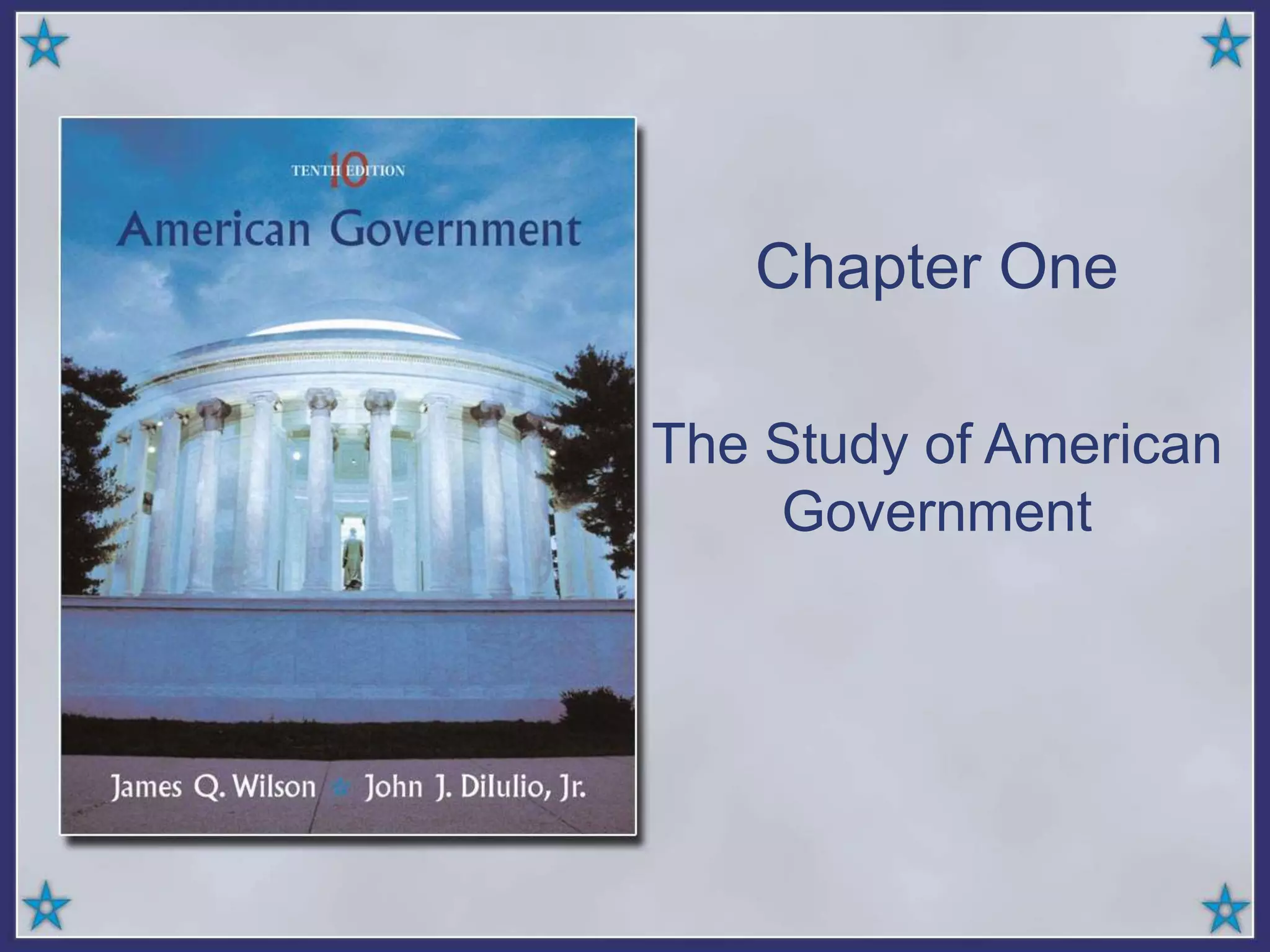
Chapter One
The Study of American
Government
Copyright Ā© Houghton Mifflin Company. All rights reserved. 1 | 2
Two Key Questions
• Who governs? Those who govern will
affect us.
• To what ends? How will government
affect our lives?
Copyright Ā© Houghton Mifflin Company. All rights reserved. 1 | 3
What is Political Power?
• Power: the ability of one person to cause
another person to act in accordance with
the first person’s intentions
• Authority: the right to use power
• Legitimacy: what makes a law or
constitution a source of right
Copyright Ā© Houghton Mifflin Company. All rights reserved. 1 | 4
Kinds of Democracy
• Direct democracy: A form of democracy in
which most, or all, of the citizenry
participate directly.
• Representative democracy: A
government in which leaders make
decisions by winning a competitive struggle
for the popular vote.
Copyright Ā© Houghton Mifflin Company. All rights reserved. 1 | 5
The Framers’ View
• Government would mediate, nor mirror,
popular views
• People were viewed as lacking knowledge
and susceptible to manipulation
• Framers’ goal: to minimize the abuse of
power by a tyrannical majority or by
officeholders
Copyright Ā© Houghton Mifflin Company. All rights reserved. 1 | 6
Theories of Government
• Marxism: Those who own the means of
production, controlling the economic
system, will control the government
• Elitism: A few top leaders, drawn from the
major sectors of the United States polity,
will make all important decisions
Copyright Ā© Houghton Mifflin Company. All rights reserved. 1 | 7
Theories of Government
• Bureaucratic: Appointed civil servants
control the government, without consulting
the public.
• Pluralist: Competition among affected
interests shapes public policy decision-
making

ap gov ppt ch01.ppt

  • 1.
    Chapter One The Studyof American Government
  • 2.
    Copyright Ā© HoughtonMifflin Company. All rights reserved. 1 | 2 Two Key Questions • Who governs? Those who govern will affect us. • To what ends? How will government affect our lives?
  • 3.
    Copyright Ā© HoughtonMifflin Company. All rights reserved. 1 | 3 What is Political Power? • Power: the ability of one person to cause another person to act in accordance with the first person’s intentions • Authority: the right to use power • Legitimacy: what makes a law or constitution a source of right
  • 4.
    Copyright Ā© HoughtonMifflin Company. All rights reserved. 1 | 4 Kinds of Democracy • Direct democracy: A form of democracy in which most, or all, of the citizenry participate directly. • Representative democracy: A government in which leaders make decisions by winning a competitive struggle for the popular vote.
  • 5.
    Copyright Ā© HoughtonMifflin Company. All rights reserved. 1 | 5 The Framers’ View • Government would mediate, nor mirror, popular views • People were viewed as lacking knowledge and susceptible to manipulation • Framers’ goal: to minimize the abuse of power by a tyrannical majority or by officeholders
  • 6.
    Copyright Ā© HoughtonMifflin Company. All rights reserved. 1 | 6 Theories of Government • Marxism: Those who own the means of production, controlling the economic system, will control the government • Elitism: A few top leaders, drawn from the major sectors of the United States polity, will make all important decisions
  • 7.
    Copyright Ā© HoughtonMifflin Company. All rights reserved. 1 | 7 Theories of Government • Bureaucratic: Appointed civil servants control the government, without consulting the public. • Pluralist: Competition among affected interests shapes public policy decision- making