REPLICATION OF VIRUSES
BY 
DR JAWAD NAZIR
ASSISTANT PROFESSOR
DEPARTMENT OF MICROBIOLOGY
UNIVERSITY OF VETERINARY AND ANIMAL SCIENCES, LAHOREUNIVERSITY OF VETERINARY AND ANIMAL SCIENCES, LAHORE
Virus replication? p
Process by which viruses y
multiply inside the host cells by 
using the cellular machinery to 
produce the progeny virionsproduce the progeny virions
Replication of viruses 
Events in the replicationp
Eclipse phaseEclipse phase 
Interval between the viral penetration and 
appearance of the first progeny virionsappearance of the first progeny virions
Duration of replication cycle ranges from 6‐40 
hourshours 
Replication of viruses 
Steps in the replicationp p
AttachmentAttachment
Entry/penetration
UncoatingUncoating
Transcription
T l tiTranslation
Replication of viral genome
Assembly 
Release 
Replication of viruses 
Steps in the replicationp p
Replication of viruses 
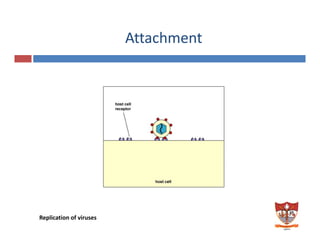
Attachment
First step to initiate infectionFirst step to initiate infection
Receptor ligand interaction 
Ligand on virus surfaceLigand on virus surface
Host cell receptors 
This virus‐cell interaction determines the host 
range and tissue tropism of the viruses 
Viruses might have more than one ligand and may g g y
bind to various cell receptors in sequential order  
Replication of viruses 
Attachment
Initial viral attachment to cells is through a fewInitial viral attachment to cells is through a few 
receptors 
Weak 
Reversible  
When attachment to sufficient receptors
Strong  
Irreversible  
Replication of viruses 
Attachment
Replication of viruses 
Attachment 
Replication of viruses 
Attachment of adenovirus 
Replication of viruses 
Attachment of influenza viruses 
Hemagglutinin molecules 
Sialic acid receptors 
Replication of viruses 
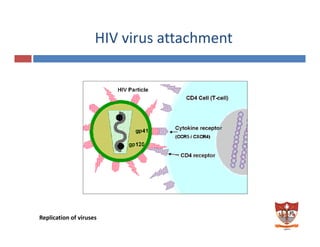
HIV virus attachment 
Replication of viruses 
Cell receptor and virus attachment 
proteinsproteins 
Replication of viruses 
Entry/Penetrationy/
All animal viruses must cross the plasmaAll animal viruses must cross the plasma 
membrane of the cells 
Some viruses must cross the nuclear envelop,Some viruses must cross the nuclear envelop, 
usually via nuclear pore 
Replication of viruses 
Mechanisms of virus entryy
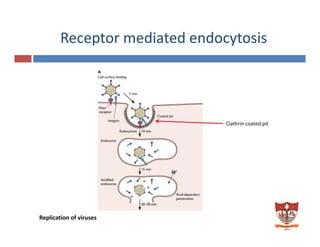
Receptor mediated endocytosisReceptor mediated endocytosis 
Clathrin coated pits 
Acidification within vesicles results into degradation of viral 
structures 
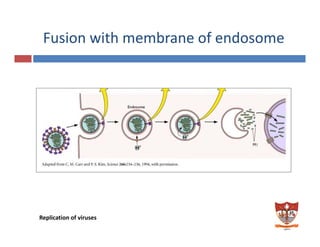
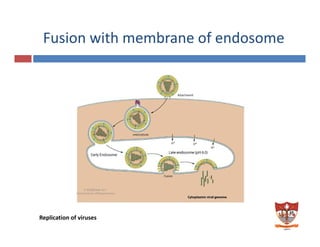
Fusion with membrane of endosome
Fusion with plasma membrane proteins 
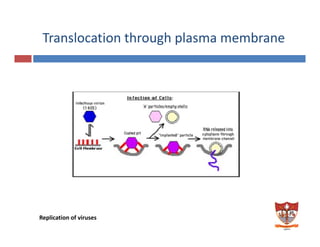
Translocation of genome into cytoplasm through 
h l h l bchannels in the plasma membranes
Replication of viruses 
Receptor mediated endocytosis p y
Clathrin coated pit 
Replication of viruses 
Receptor mediated endocytosis p y
Replication of viruses 
Formation of clathrin coated pit p
Replication of viruses 
Fusion with membrane of endosome 
Replication of viruses 
Fusion with membrane of endosome 
Replication of viruses 
Fusion with plasma membraneFusion with plasma membrane 
Replication of viruses 
Fusion with plasma membrane p
Replication of viruses 
Translocation through plasma membrane 
Replication of viruses 
Uncoating g
Purpose of uncoating is to release the viral genomep g g
In non‐enveloped viruses uncoating proceeds to 
completion 
In enveloped viruses transcription starts before 
complete uncoating is achieved  
Uncoating may occurUncoating may occur 
At plasma membrane while penetrating
Within endosomeWithin endosome
In cytoplasm
At nuclear membrane
Replication of viruses 
At nuclear membrane   
Uncoating g
Replication of viruses 
Transcription and translationp
TranscriptionTranscription
The process of synthesis of complementary RNA 
(usually mRNA) strand from a DNA or RNA(usually mRNA) strand from a DNA or RNA 
template 
TranslationTranslation
Process by which genetic information present on 
mRNA directs the synthesis of proteins from aminomRNA directs the synthesis of proteins from amino 
acids
Replication of viruses 
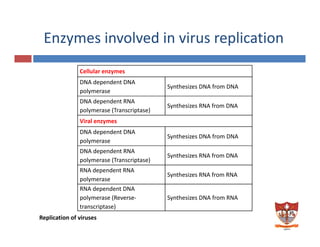
Enzymes involved in virus replicationy p
Cellular enzymes
DNA dependent DNA 
polymerase 
Synthesizes DNA from DNA
DNA dependent RNA 
l ( )
Synthesizes RNA from DNA
polymerase (Transcriptase)
y
Viral enzymes 
DNA dependent DNA 
l
Synthesizes DNA from DNA
polymerase 
y
DNA dependent RNA 
polymerase (Transcriptase)
Synthesizes RNA from DNA
RNA dependent RNARNA dependent RNA 
polymerase 
Synthesizes RNA from RNA
RNA dependent DNA 
polymerase (Reverse‐ Synthesizes DNA from RNA
Replication of viruses 
transcriptase)
Transcription p
Replication of viruses 
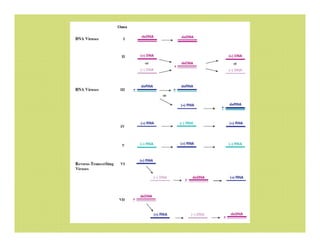
Central dogma of molecular biology g gy
The flow of genetic information is always from DNA to RNA and thenThe flow of genetic information is always from DNA to RNA and then 
to protein, with genetic information transmitted from one generation 
to the next through copying from DNA to DNA
Replication of viruses 
Modified central dogmag
Replication of viruses 
Transcription of viral genome p g
Replication of viruses 
Transcriptionp
The viruses that replicate in nucleus uses cellularThe viruses that replicate in nucleus uses cellular 
enzymes while the ones that replicate in cytoplasm 
encode their own
All viruses that carry out transcription in the 
cytoplasm (except the plus strand RNA viruses) havecytoplasm (except the plus‐strand RNA viruses) have 
the transcriptases packed in the virion
Replication of viruses 
Need to make mRNA
DOUBLE‐STRANDED DNA GENOMES
Mostly cellular transcriptases 
AAAmRNA
Double‐stranded genomic DNA
Replication of viruses  34
Need to make mRNA
SINGLE‐STRANDED DNA GENOMES
Mostly cellular transcriptases 
AAAmRNA
Replication of viruses  35
Single‐stranded genomic DNA
Need to make mRNA
PLUS (POSITIVE) SENSE RNA GENOMES
AAA
(+ve) sense mRNA
Replication of viruses  36
Need to make mRNA
MINUS (NEGATIVE) SENSE RNA GENOMES
RNA polymerase must beRNA polymerase must be
packaged in virion.
AAA
(+ve) sense mRNA
(‐ve) sense genomic RNA
Replication of viruses  37
Need to make mRNA
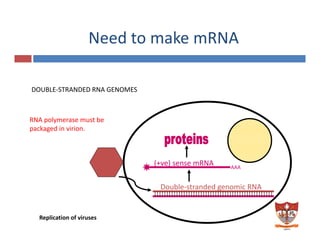
DOUBLE‐STRANDED RNA GENOMES
RNA polymerase must be
packaged in virion.
AAA
(+ve) sense mRNA
Double‐stranded genomic RNA
Replication of viruses  38
Need to make mRNA
RETROVIRUSES
R i
DS
DNA
DS
DNA
Reverse transcriptase must
be packaged in virion.
DNA
+VE 
DNA
RNA
Replication of viruses  39
RNA viruses that do NOT have a DNA phase
Genome RNA-dependent Infectivity of Initial event in
RNA viruses that do NOT have a DNA phase
Genome RNA dependent
RNA polymerase
(=transcriptase)
IN VIRION
Infectivity of
RNA
Initial event in
cell
Plus-stranded
RNA
No Infectious Translation
Negative-
stranded RNA
Yes Non-infectious Transcription
Double-
stranded RNA
Yes Non-infectious Transcription
Replication of viruses  40
RETROVIRUSESRETROVIRUSES
Genome RNA-dependent
DNA polymerase
(=reverse
Infectivity of
RNA
Initial event in
cell
(=reverse
transcriptase) in
virion
Plus-stranded
RNA
Yes
Non-
infectious
Reverse
transcription
Replication of viruses  41
Translation 
Replication of viruses 
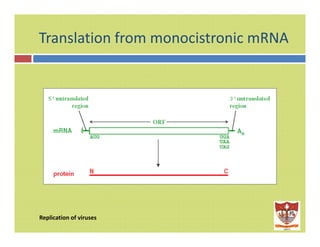
Translation from monocistronic mRNA 
Replication of viruses 
Translation from bicistronic mRNA 
Replication of viruses 
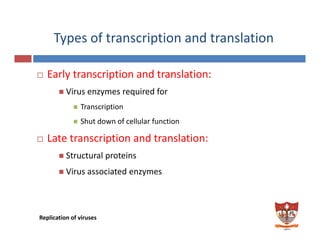
Types of transcription and translation
Early transcription and translation:Early transcription and translation:
Virus enzymes required for
TranscriptionTranscription 
Shut down of cellular function  
Late transcription and translation:Late transcription and translation:
Structural proteins 
Virus associated enzymesVirus associated enzymes 
Replication of viruses 
Categories of proteins encoded by the viruses
Structural proteins of viruses S uc u a p o e s o uses
Virus associated enzymes (transcriptases) 
Non structural proteins mainly enzymes required for 
transcription, replication of NA and cleavage 
Regulatory proteins that control the temporal expression 
of viral genome
Proteins down regulating the expression of cellular 
genome
Replication of viruses 
Categories of proteins encoded by the viruses
Oncogene products (Oncoproteins) and inactivators of O coge e p oduc s (O cop o e s) a d ac a o s o
cellular tumor suppressors
Proteins influencing viral virulence host range tissueProteins influencing viral virulence, host range, tissue 
tropism etc
Virokines, act on noninfected cells to modulate the 
progress of infection in the host
Replication of viruses 
Replication of viral genomep g
Location of viral genome replication 
Replication of viruses 
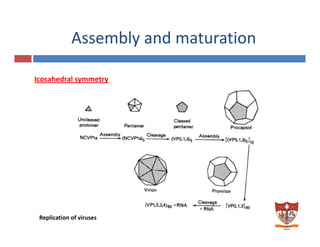
Assembly and maturation y
I h d lIcosahedral symmetry 
Replication of viruses 
Assembly and packing y p g
I h d l N l idIcosahedral Nucleocapsid 
Replication of viruses 
Assembly and packing y p g
I h d lIcosahedral 
Nucleocapsid 
Replication of viruses 
Assembly and packing y p g
H li l N l idHelical Nucleocapsid  
Replication of viruses 
Virus release mechanism
BuddingBudding
Enveloped viruses are released by budding from 
plasma memberane
Cell Lysis
Naked viruses are released by lysis y y
Exocytosis
Viruses may acquire envelope by budding through y q p y g g
membranes of Golgi apparatus or rough endoplasmic 
reticulum  
Replication of viruses 
Virus release (Budding) ( g)
Replication of viruses 
Virus release (Budding) ( g)
Replication of viruses 
Virus release (cell lysis)  ( y )
Replication of viruses 
Virus release (exocytosis)  ( y )
Replication of viruses 
Virus assembly, maturation, and release
Important events in virus replicationp p
Replication of viruses 
THANK YOUTHANK YOU

Replication of viruses