VIROLOGY-4
The maximum yield per cell is characteristic for each virus-cell system, and reflects
the balance between the rate at which virus components continue to be synthesized
and assembled into virions, and the rate at which the cell loses the synthetic
capacity and structural integrity needed to produce new virus particles. This may be
from 8 to 72 hours or longer, with yields of 100 to 10,000 virions per cell.
• Steps in the Replication Cycles of Viruses
• The individual steps in the virus replication cycle are presented below
in sequence,
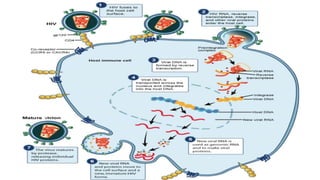
• virus attachment to the host cell
• leading to penetration
• uncoating of the viral genome.
• Gene expression and replication are followed by assembly and release
of viral progeny.
Dr. Farzin Asghari Sana
Viral Replication
• Viruses are intracellular obligate parasites which means that they cannot
replicate or express their genes without the help of a living cell. A single
virus particle (Virion) is in and of itself essentially inert. It lacks needed
components that cells have to reproduce. When a virus infects a cell, it
marshals the cell's ribosomes, enzymes and much of the cellular machinery
to replicate.
Dr. Farzin Asghari Sana
Progress of Viral Multiplication
• Once a virus infects its host and the viral progeny components are
produced by the host's cellular machinery, the assembly of the viral
capsid is a non-enzymatic process. It is usually spontaneous. Viruses
typically can only infect a limited number of hosts (also known as host
range). The "lock and key" mechanism is the most common
explanation for this range. Certain proteins on the virus particle must
fit certain receptor sites on the particular host's cell surface.
Dr. Farzin Asghari Sana
• When a virus infects a cell, nucleic acid must be uncoated and gain access to metabolic machinery of cell.
• Virus life cycle is characterized by:
• attachment
• penetration, with entry of nucleic acid into cell
• early expression of virus genes (either directly by translation, if virus contains "+" RNA, or indirectly after
transcription and then translation)
• replication of virus nucleic acid
• synthesis of new Virion components
• packaging and assembly of new virions
• exit from cell
Viral Replication
Dr. Farzin Asghari Sana
Pricipliple of Replication
 Replication of the genome is governed by the principle of
complementarity  requires a strand with complementary base
sequence be synthesized  serve as template  synthesis of actual
viral genome
 Late synthesis  viral structural proteins for the capsid are also
synthesized almost simultaneously
Dr. Farzin Asghari Sana
IMPORTANT FACTS ABOUT VIRUS REPLICATION
Viruses multiply only in living cells
Host cell provides the energy & machinery for the synthesis
of viral proteins & nucleic acids
Viral genome must be able to produce mRNA  host cell
protein-synthesizing machinery may be able to synthesize
viral proteins
Dr. Farzin Asghari Sana
Stages in Multiplication
Soon after interaction with the host cell  Virion is disrupted 
infectivity is lost  ECLIPSE PERIOD
The yield of infectious virus per cell ranges from moderate
numbers to > 100,000 particles
The duration of replication cycle varies from 6-8 hrs to > 40 hrs
Dr. Farzin Asghari Sana
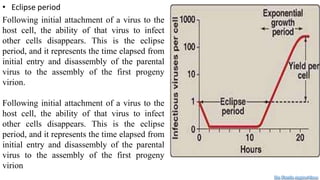
• Eclipse period
Following initial attachment of a virus to the
host cell, the ability of that virus to infect
other cells disappears. This is the eclipse
period, and it represents the time elapsed from
initial entry and disassembly of the parental
virus to the assembly of the first progeny
virion.
Following initial attachment of a virus to the
host cell, the ability of that virus to infect
other cells disappears. This is the eclipse
period, and it represents the time elapsed from
initial entry and disassembly of the parental
virus to the assembly of the first progeny
virion
Dr. Farzin Asghari Sana
All infections are not Productive
 PRODUCTIVE INFECTIONS
> occur in permissive cells  infectious virus
 ABORTIVE INFECTIONS
> no infectious virus produce because :
a. cell is non-permissive
b. virus may be defective
DEFECTIVE VIRUS – lack certain genes for replication & requires the help of
another virus (dependo or helper virus)
Dr. Farzin Asghari Sana
LATENT INFECTIONS
LATENT INFECTIONS
a. viral genome persists within the host cell
b. expression of no or few viral genes
c. survival of the infected cell
Dr. Farzin Asghari Sana
Pricipliple of Replication
Replication of the genome is governed by the principle of
complementarity  requires a strand with complementary base
sequence be synthesized  serve as template  synthesis of
actual viral genome
Late synthesis  viral structural proteins for the capsid are also
synthesized almost simultaneously
Dr. Farzin Asghari Sana
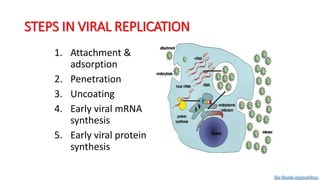
STEPS IN VIRAL REPLICATION
1. Attachment &
adsorption
2. Penetration
3. Uncoating
4. Early viral mRNA
synthesis
5. Early viral protein
synthesis
Dr. Farzin Asghari Sana
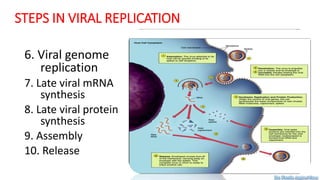
STEPS IN VIRAL REPLICATION
6. Viral genome
replication
7. Late viral mRNA
synthesis
8. Late viral protein
synthesis
9. Assembly
10. Release
Dr. Farzin Asghari Sana
Early steps in Multiplication
• Attachment
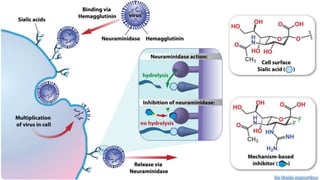
• specific binding of a Virion protein (the anti-receptor) to a constituent of the cell surface
(the receptor)
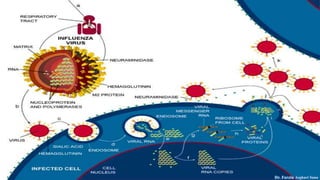
• e.g. hemagglutinin of influenza virus
• some complex viruses (HSV) may have more than one species of anti-receptor
molecule
• Penetration
• energy-dependent step
• occurs almost instantaneously after attachment
Dr. Farzin Asghari Sana
ASSEMBLY & RELEASE
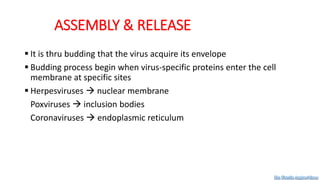
 It is thru budding that the virus acquire its envelope
 Budding process begin when virus-specific proteins enter the cell
membrane at specific sites
 Herpesviruses  nuclear membrane
Poxviruses  inclusion bodies
Coronaviruses  endoplasmic reticulum
Dr. Farzin Asghari Sana
ASSEMBLY & RELEASE
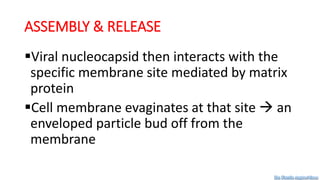
Viral nucleocapsid then interacts with the
specific membrane site mediated by matrix
protein
Cell membrane evaginates at that site  an
enveloped particle bud off from the
membrane
Dr. Farzin Asghari Sana
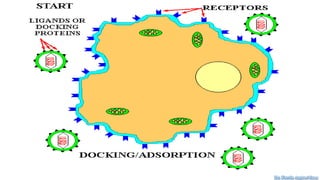
ATTACHMENT & ADSORPTION
Reversible step
Does not require energy
2 requirements:
1. recognition & attachment to specific host
receptor  determines the host range of the
virus
Dr.T.V.Rao MD 21
Dr. Farzin Asghari Sana
Mechanism differ the various types
> Rhinovirus – ICAM-1
> HIV – CD4 + T cells
> Rabies virus – acetylcholine receptors
> HSV-1 – fibroblast growth factor receptor
2. appropriate ph & ionic concentration 
both the host cell & viral particle are negatively charged at ph 7 
require counter-ion  Magnesium ion
Dr. Farzin Asghari Sana
PENETRATION
Refers to the entry of the viral particle into the cytoplasm
of the host cell
Temperature-dependent step (37 C)
Carried out through:
a. receptor-mediated endocytosis
b. direct penetration (viropexis)
c. cell fusion
Dr. Farzin Asghari Sana
UNCOATING
•Refers to the physical separation of the viral capsid
from the viral genome
•Considered an obligatory step in viral replication
 makes the viral genome accessible for
transcription
•Favored by low pH
Dr. Farzin Asghari Sana
Assembly and Release
• Components of capsid synthesis directed by late genes
• Assembly of enveloped viruses needs interaction with plasma membrane
which has been modified
• Final stage of infection
• Enveloped viruses released gradually by budding or exocytosis
• Naked viruses accumulate in cytoplasm and released during lysis
Dr. Farzin Asghari Sana
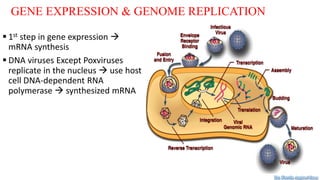
GENE EXPRESSION & GENOME REPLICATION
 1st step in gene expression 
mRNA synthesis
 DNA viruses Except Poxviruses
replicate in the nucleus  use host
cell DNA-dependent RNA
polymerase  synthesized mRNA
Dr. Farzin Asghari Sana
Multiply in
Poxviruses replicate in the cytoplasm no access to
host cell RNA polymerase  carry their own RNA
polymerase
RNA viruses replicate in the cytoplasm EXCEPT
Influenza virus & Retrovirus
Dr. Farzin Asghari Sana
ASSEMBLY & RELEASE
Progeny particles assembled by packaging the viral
nucleic acid within the capsid proteins
2 processes of Release:
1. Rupture or lysis of cell membrane
2. Budding through the outer membrane
Dr. Farzin Asghari Sana
Differences in Single Stranded and Double Stranded
Virus
Double-stranded RNA  cell has no enzyme to
transcribe RNA into mRNA  virus carries its own
polymerase
Single-stranded RNA (+ polarity) e.g. Retrovirus 
carries RNA-dependent DNA polymerase  ds
DNA  transcribed to mRNA by host cell polymerase
Dr. Farzin Asghari Sana
Synthesis of RNA
Once m RNA is synthesized  translated into viral
proteins (enzymes & early proteins for the genome) by
host ribosomes
The most important of the early proteins is the
Polymerase  synthesize many copies of viral genetic
material for the progeny virus particle
VIROLOGY

Viral replication

  • 1.
  • 2.
    The maximum yieldper cell is characteristic for each virus-cell system, and reflects the balance between the rate at which virus components continue to be synthesized and assembled into virions, and the rate at which the cell loses the synthetic capacity and structural integrity needed to produce new virus particles. This may be from 8 to 72 hours or longer, with yields of 100 to 10,000 virions per cell. • Steps in the Replication Cycles of Viruses • The individual steps in the virus replication cycle are presented below in sequence, • virus attachment to the host cell • leading to penetration • uncoating of the viral genome. • Gene expression and replication are followed by assembly and release of viral progeny. Dr. Farzin Asghari Sana
  • 4.
    Viral Replication • Virusesare intracellular obligate parasites which means that they cannot replicate or express their genes without the help of a living cell. A single virus particle (Virion) is in and of itself essentially inert. It lacks needed components that cells have to reproduce. When a virus infects a cell, it marshals the cell's ribosomes, enzymes and much of the cellular machinery to replicate. Dr. Farzin Asghari Sana
  • 5.
    Progress of ViralMultiplication • Once a virus infects its host and the viral progeny components are produced by the host's cellular machinery, the assembly of the viral capsid is a non-enzymatic process. It is usually spontaneous. Viruses typically can only infect a limited number of hosts (also known as host range). The "lock and key" mechanism is the most common explanation for this range. Certain proteins on the virus particle must fit certain receptor sites on the particular host's cell surface. Dr. Farzin Asghari Sana
  • 6.
    • When avirus infects a cell, nucleic acid must be uncoated and gain access to metabolic machinery of cell. • Virus life cycle is characterized by: • attachment • penetration, with entry of nucleic acid into cell • early expression of virus genes (either directly by translation, if virus contains "+" RNA, or indirectly after transcription and then translation) • replication of virus nucleic acid • synthesis of new Virion components • packaging and assembly of new virions • exit from cell Viral Replication Dr. Farzin Asghari Sana
  • 7.
    Pricipliple of Replication Replication of the genome is governed by the principle of complementarity  requires a strand with complementary base sequence be synthesized  serve as template  synthesis of actual viral genome  Late synthesis  viral structural proteins for the capsid are also synthesized almost simultaneously Dr. Farzin Asghari Sana
  • 8.
    IMPORTANT FACTS ABOUTVIRUS REPLICATION Viruses multiply only in living cells Host cell provides the energy & machinery for the synthesis of viral proteins & nucleic acids Viral genome must be able to produce mRNA  host cell protein-synthesizing machinery may be able to synthesize viral proteins Dr. Farzin Asghari Sana
  • 9.
    Stages in Multiplication Soonafter interaction with the host cell  Virion is disrupted  infectivity is lost  ECLIPSE PERIOD The yield of infectious virus per cell ranges from moderate numbers to > 100,000 particles The duration of replication cycle varies from 6-8 hrs to > 40 hrs Dr. Farzin Asghari Sana
  • 10.
    • Eclipse period Followinginitial attachment of a virus to the host cell, the ability of that virus to infect other cells disappears. This is the eclipse period, and it represents the time elapsed from initial entry and disassembly of the parental virus to the assembly of the first progeny virion. Following initial attachment of a virus to the host cell, the ability of that virus to infect other cells disappears. This is the eclipse period, and it represents the time elapsed from initial entry and disassembly of the parental virus to the assembly of the first progeny virion Dr. Farzin Asghari Sana
  • 11.
    All infections arenot Productive  PRODUCTIVE INFECTIONS > occur in permissive cells  infectious virus  ABORTIVE INFECTIONS > no infectious virus produce because : a. cell is non-permissive b. virus may be defective DEFECTIVE VIRUS – lack certain genes for replication & requires the help of another virus (dependo or helper virus) Dr. Farzin Asghari Sana
  • 12.
    LATENT INFECTIONS LATENT INFECTIONS a.viral genome persists within the host cell b. expression of no or few viral genes c. survival of the infected cell Dr. Farzin Asghari Sana
  • 13.
    Pricipliple of Replication Replicationof the genome is governed by the principle of complementarity  requires a strand with complementary base sequence be synthesized  serve as template  synthesis of actual viral genome Late synthesis  viral structural proteins for the capsid are also synthesized almost simultaneously Dr. Farzin Asghari Sana
  • 14.
    STEPS IN VIRALREPLICATION 1. Attachment & adsorption 2. Penetration 3. Uncoating 4. Early viral mRNA synthesis 5. Early viral protein synthesis Dr. Farzin Asghari Sana
  • 15.
    STEPS IN VIRALREPLICATION 6. Viral genome replication 7. Late viral mRNA synthesis 8. Late viral protein synthesis 9. Assembly 10. Release Dr. Farzin Asghari Sana
  • 16.
    Early steps inMultiplication • Attachment • specific binding of a Virion protein (the anti-receptor) to a constituent of the cell surface (the receptor) • e.g. hemagglutinin of influenza virus • some complex viruses (HSV) may have more than one species of anti-receptor molecule • Penetration • energy-dependent step • occurs almost instantaneously after attachment Dr. Farzin Asghari Sana
  • 17.
  • 18.
  • 19.
    ASSEMBLY & RELEASE It is thru budding that the virus acquire its envelope  Budding process begin when virus-specific proteins enter the cell membrane at specific sites  Herpesviruses  nuclear membrane Poxviruses  inclusion bodies Coronaviruses  endoplasmic reticulum Dr. Farzin Asghari Sana
  • 20.
    ASSEMBLY & RELEASE Viralnucleocapsid then interacts with the specific membrane site mediated by matrix protein Cell membrane evaginates at that site  an enveloped particle bud off from the membrane Dr. Farzin Asghari Sana
  • 21.
    ATTACHMENT & ADSORPTION Reversiblestep Does not require energy 2 requirements: 1. recognition & attachment to specific host receptor  determines the host range of the virus Dr.T.V.Rao MD 21
  • 22.
  • 23.
    Mechanism differ thevarious types > Rhinovirus – ICAM-1 > HIV – CD4 + T cells > Rabies virus – acetylcholine receptors > HSV-1 – fibroblast growth factor receptor 2. appropriate ph & ionic concentration  both the host cell & viral particle are negatively charged at ph 7  require counter-ion  Magnesium ion Dr. Farzin Asghari Sana
  • 24.
    PENETRATION Refers to theentry of the viral particle into the cytoplasm of the host cell Temperature-dependent step (37 C) Carried out through: a. receptor-mediated endocytosis b. direct penetration (viropexis) c. cell fusion Dr. Farzin Asghari Sana
  • 25.
    UNCOATING •Refers to thephysical separation of the viral capsid from the viral genome •Considered an obligatory step in viral replication  makes the viral genome accessible for transcription •Favored by low pH Dr. Farzin Asghari Sana
  • 26.
    Assembly and Release •Components of capsid synthesis directed by late genes • Assembly of enveloped viruses needs interaction with plasma membrane which has been modified • Final stage of infection • Enveloped viruses released gradually by budding or exocytosis • Naked viruses accumulate in cytoplasm and released during lysis Dr. Farzin Asghari Sana
  • 27.
    GENE EXPRESSION &GENOME REPLICATION  1st step in gene expression  mRNA synthesis  DNA viruses Except Poxviruses replicate in the nucleus  use host cell DNA-dependent RNA polymerase  synthesized mRNA Dr. Farzin Asghari Sana
  • 28.
    Multiply in Poxviruses replicatein the cytoplasm no access to host cell RNA polymerase  carry their own RNA polymerase RNA viruses replicate in the cytoplasm EXCEPT Influenza virus & Retrovirus Dr. Farzin Asghari Sana
  • 29.
    ASSEMBLY & RELEASE Progenyparticles assembled by packaging the viral nucleic acid within the capsid proteins 2 processes of Release: 1. Rupture or lysis of cell membrane 2. Budding through the outer membrane Dr. Farzin Asghari Sana
  • 30.
    Differences in SingleStranded and Double Stranded Virus Double-stranded RNA  cell has no enzyme to transcribe RNA into mRNA  virus carries its own polymerase Single-stranded RNA (+ polarity) e.g. Retrovirus  carries RNA-dependent DNA polymerase  ds DNA  transcribed to mRNA by host cell polymerase Dr. Farzin Asghari Sana
  • 31.
    Synthesis of RNA Oncem RNA is synthesized  translated into viral proteins (enzymes & early proteins for the genome) by host ribosomes The most important of the early proteins is the Polymerase  synthesize many copies of viral genetic material for the progeny virus particle
  • 32.

Editor's Notes

  • #24 Rhinoviruses are the most common viral infectious agents in humans and are the predominant cause of the common cold. Rhinovirus infection proliferates in temperatures between 33–35 °C , the temperatures found in the nose. Rhinoviruses is a genus within the Picornaviridae family of viruses. There are 99 recognized types of human rhinoviruses that differ according to their surface proteins (serotypes). They are lytic in nature and are among the smallest viruses, with diameters of about 30 nanometers. By comparison, other viruses, such as smallpox and vaccinia, are around 10 times larger at about 300 nanometers.  Rhinovirus A and B bind to ICAM-1 (Inter-Cellular Adhesion Molecule 1) also known as CD54 (Cluster of Differentiation 54) receptors on respiratory epithelial cells while Rhinovirus C uses Cadherin-related family member 3 (CDHR3) to mediate cellular entry.