Quartiles, Deciles and Percentiles
 Let us now extend the concept of
partitioning of the frequency
distribution by taking up the concept
of quantiles (i.e. quartiles, deciles and
percentiles)
 We have already seen that the
median divides the area under the
frequency polygon into two equal
halves:
50% 50%
X
f
Median
A further split to produce quarters, tenths or
hundredths of the total area under the frequency polygon
is equally possible, and may be extremely useful for
analysis. (We are often interested in the highest 10% of
some group of values or the middle 50% another.)
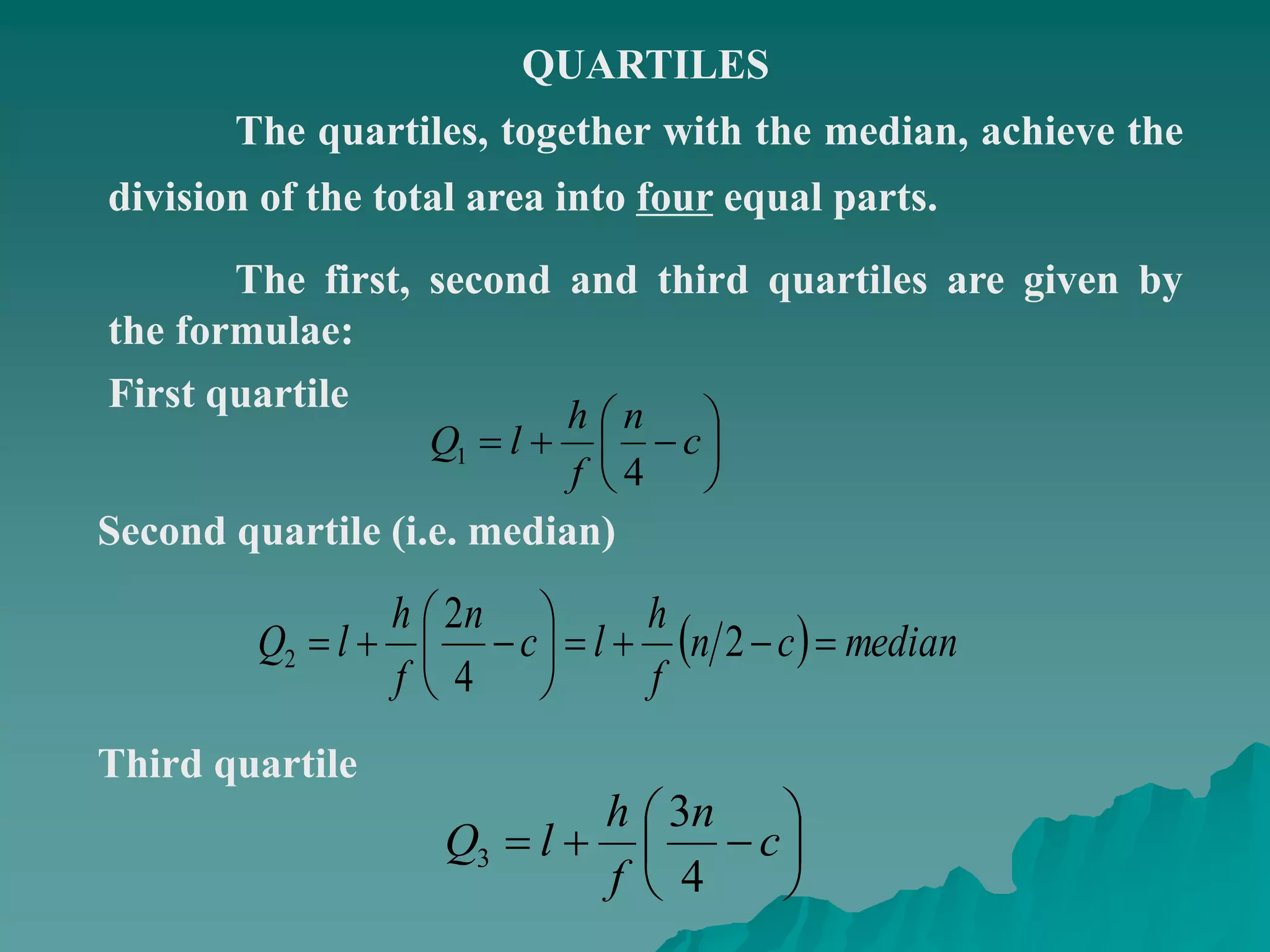
QUARTILES
The quartiles, together with the median, achieve the
division of the total area into four equal parts.
The first, second and third quartiles are given by
the formulae:






 c
n
f
h
lQ
4
1






 c
n
f
h
lQ
4
3
3
First quartile
Second quartile (i.e. median)
Third quartile
  mediancn
f
h
lc
n
f
h
lQ 





 2
4
2
2
25%
X
f
Q1 Q2 =X
~
Q3
25%25%25%
It is clear from the formula of the second
quartile that the second quartile is the same as the
median.
DECILES & PERCENTILES:
The deciles and the percentiles give the division of the
total area into 10 and 100 equal parts respectively.






 c
n
f
h
lD
10
1
The formula for the first decile is
The formulae for the subsequent deciles are






 c
n
f
h
lD
10
3
3
and so on. It is easily seen that the 5th decile is the same quantity as
the median.






 c
n
f
h
lD
10
2
2






 c
n
f
h
lP
100
1
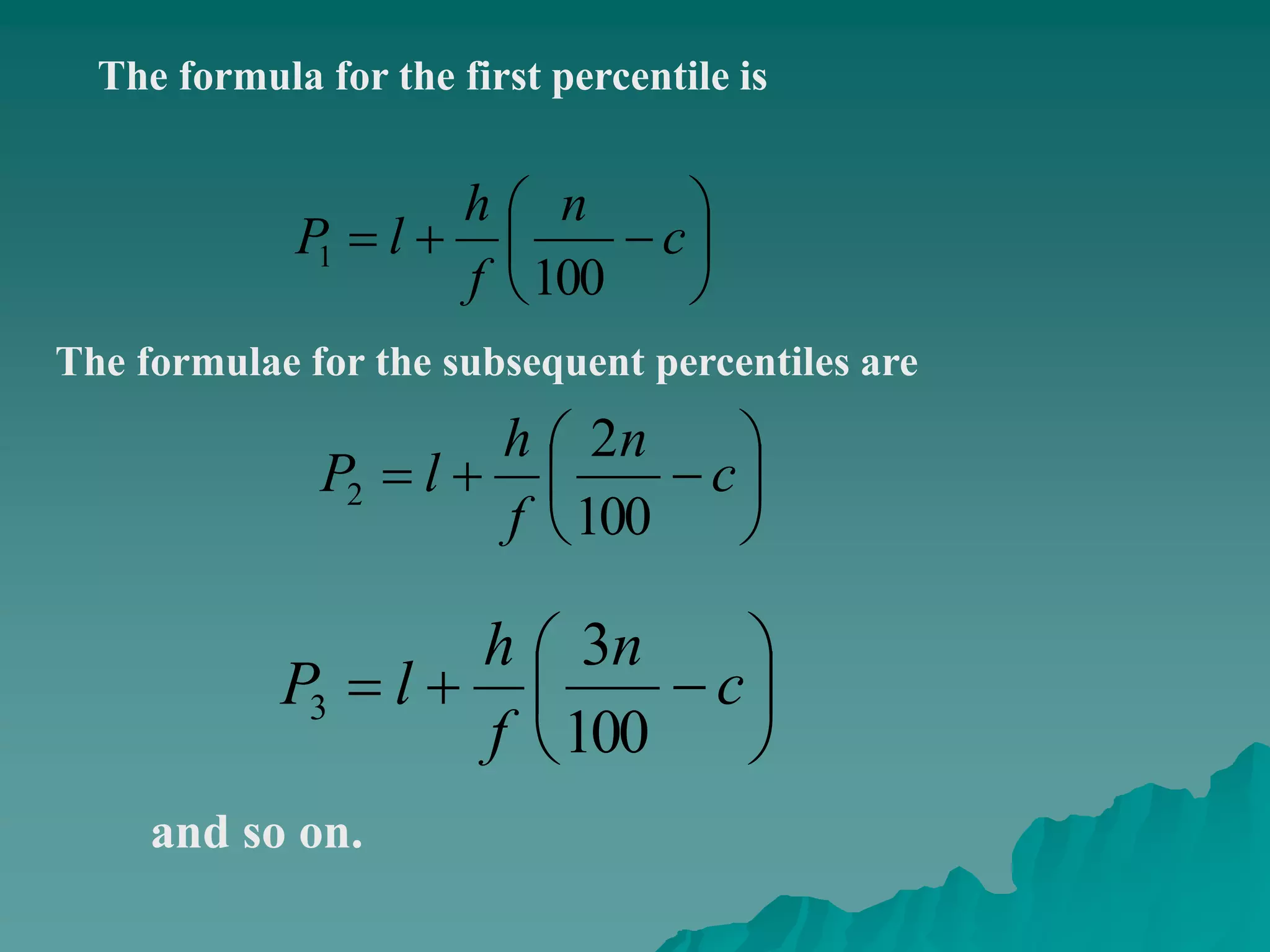
The formula for the first percentile is
The formulae for the subsequent percentiles are






 c
n
f
h
lP
100
2
2






 c
n
f
h
lP
100
3
3
and so on.
Again, it is easily seen that the 50th percentile is the same as
the median, the 25th percentile is the same as the 1st quartile, the 75th
percentile is the same as the 3rd quartile, the 40th percentile is the
same as the 4th decile, and so on.
All these measures i.e. the median, quartiles, deciles and percentiles
are collectively called quantiles or fractiles.
The question is, “What is the significance of this concept of
partitioning? Why is it that we wish to divide our frequency
distribution into two, four, ten or hundred parts?”
The answer to the above questions is:
In certain situations, we may be interested in describing the relative
quantitative location of a particular measurement within a data set.
Quantiles provide us with an easy way of achieving this. Out
of these various quantiles, one of the most frequently used is
percentile ranking.
FREQUENCY DISTRIBUTION OF
CHILD-CARE MANAGERS AGE
Class Interval Frequency
20 – 29 6
30 – 39 18
40 – 49 11
50 – 59 11
60 – 69 3
70 – 79 1
Total 50
Suppose we wish to determine:
The 1st quartile
The 6th decile
The 17th percentile
Solution
We begin with the 1st quartile (also known as lower
quartile).
The 1st quartile is given by:
Where, l, h and f pertain to the class that contains
the first quartile.






 c
n
f
h
lQ
4
1
In this example,
n = 50, and hence
n/4 = 50/4 = 12.5
Class Boundaries Frequency
f
Cumulative
Frequency
cf
19.5 – 29.5 6 6
29.5 – 39.5 18 24
39.5 – 49.5 11 35
49.5 – 59.5 11 46
59.5 – 69.5 3 49
69.5 – 79.5 1 50
Total 50
Class
containing
Q1
Hence,
l = 29.5
h = 10
f = 18
and
C = 6
Hence, the 1st quartile is given by:
 
1 =
4
10
= 29.5 12.5 6
18
= 29.5 3.6
= 33.1
h n
Q l c
f
 
  
 
 

Interpretation
One-fourth of the managers are younger than age
33.1 years, and three-fourth are older than this
age.
The 6th Decile is given by
6
6
10
h n
D l c
f
 
   
 
In this example,
n = 50, and hence
6n/10 = 6(50)/10 = 30
Class Boundaries Frequency
f
Cumulative
Frequency
cf
19.5 – 29.5 6 6
29.5 – 39.5 18 24
39.5 – 49.5 11 35
49.5 – 59.5 11 46
59.5 – 69.5 3 49
69.5 – 79.5 1 50
Total 50
Class
containing
D6
Hence,
l = 39.5
h = 10
f = 11
and
C = 24
Hence, 6th decile is given by
 
6
6
=
10
10
= 39.5 30 24
11
= 29.5 5.45
= 44.95
h n
D l c
f
 
  
 
 

Interpretation
Six-tenth i.e. 60% of the managers are younger than
age 44.95 years, and four-tenth are older than this age.
The 17th Percentile is given by
17
17
100
h n
P l c
f
 
   
 
In this example,
n = 50, and hence
17n/100 = 17(50)/100 = 8.5
Class Boundaries Frequency
f
Cumulative
Frequency
cf
19.5 – 29.5 6 6
29.5 – 39.5 18 24
39.5 – 49.5 11 35
49.5 – 59.5 11 46
59.5 – 69.5 3 49
69.5 – 79.5 1 50
Total 50
Class
containing
P17
Hence,
l = 29.5
h = 10
f = 18
and
C = 6
Hence, 6th decile is given by
 
17
17
=
100
10
= 29.5 8.5 6
18
= 29.5 1.4
= 30.9
h n
P l c
f
 
  
 
 

Interpretation
17% of the managers are younger than age 30.9 years,
and 83% are older than this age.
EXAMPLE:
If oil company ‘A’ reports that its yearly sales are at the
90th percentile of all companies in the industry, the
implication is that 90% of all oil companies have yearly
sales less than company A’s, and only 10% have yearly
sales exceeding company A’s:
0.1
0
RelativeFrequency
Company A’s sales
(90th percentile)
Yearly Sales
0.9
0
EXAMPLE
Suppose that the Environmental Protection Agency of
a developed country performs extensive tests on all new car
models in order to determine their mileage rating.
Suppose that the following 30 measurements are
obtained by conducting such tests on a particular new car
model.
EPA MILEAGE RATINGS ON 30 CARS
(MILES PER GALLON)
36.3 42.1 44.9
30.1 37.5 32.9
40.5 40.0 40.2
36.2 35.6 35.9
38.5 38.8 38.6
36.3 38.4 40.5
41.0 39.0 37.0
37.0 36.7 37.1
37.1 34.8 33.9
39.9 38.1 39.8
EPA: Environmental Protection Agency
When the above data was converted to a frequency
distribution, we obtained:
Class Limit Frequency
30.0 – 32.9 2
33.0 – 35.9 4
36.0 – 38.9 14
39.0 – 41.9 8
42.0 – 44.9 2
30
0
5
10
15
20
25
30
35
29.95
32.95
35.95
38.95
41.95
44.95
Cumulative Frequency Polygon
or OGIVE
This Ogive enables us to find the median and any other
quantile that we may be interested in very conveniently.
And this process is known as the graphic location of
quantiles. Let us begin with the graphical location of
the median:
Because of the fact that the median is that value
before which half of the data lies, the first step is to divide
the total number of observations n by 2.
In this example:
15
2
30
2
n

The next step is to locate this number 15 on the y-axis
of the cumulative frequency polygon.
0
5
10
15
20
25
30
35
29.95
32.95
35.95
38.95
41.95
44.95
Cumulative Frequency Polygon
or OGIVE
2
n
0
5
10
15
20
25
30
35
29.95
32.95
35.95
38.95
41.95
44.95
Cumulative Frequency Polygon or OGIVE
2
n
Next, we draw a horizontal line perpendicular to the y-
axis starting from the point 15, and extend this line upto the
cumulative frequency polygon.
0
5
10
15
20
25
30
35
29.95
32.95
35.95
38.95
41.95
44.95
Cumulative Frequency Polygon
or OGIVE
2
n
0
5
10
15
20
25
30
35
29.95
32.95
35.95
38.95
41.95
44.95
Cumulative Frequency Polygon
or OGIVE
2
n
9.37X
~

In a similar way, we can
locate the quartiles, deciles and
percentiles.
To obtain the first quartile,
the horizontal line will be
drawn against the value n/4,
and for the third quartile, the
horizontal line will be drawn
against the value 3n/4.
0
5
10
15
20
25
30
35
29.95
32.95
35.95
38.95
41.95
44.95
Cumulative Frequency Polygon
or OGIVE
4
n
Q1 Q3
4
n3

Quartiles, Deciles and Percentiles

  • 1.
    Quartiles, Deciles andPercentiles  Let us now extend the concept of partitioning of the frequency distribution by taking up the concept of quantiles (i.e. quartiles, deciles and percentiles)  We have already seen that the median divides the area under the frequency polygon into two equal halves:
  • 2.
    50% 50% X f Median A furthersplit to produce quarters, tenths or hundredths of the total area under the frequency polygon is equally possible, and may be extremely useful for analysis. (We are often interested in the highest 10% of some group of values or the middle 50% another.)
  • 3.
    QUARTILES The quartiles, togetherwith the median, achieve the division of the total area into four equal parts. The first, second and third quartiles are given by the formulae:        c n f h lQ 4 1        c n f h lQ 4 3 3 First quartile Second quartile (i.e. median) Third quartile   mediancn f h lc n f h lQ        2 4 2 2
  • 4.
    25% X f Q1 Q2 =X ~ Q3 25%25%25% Itis clear from the formula of the second quartile that the second quartile is the same as the median.
  • 5.
    DECILES & PERCENTILES: Thedeciles and the percentiles give the division of the total area into 10 and 100 equal parts respectively.        c n f h lD 10 1 The formula for the first decile is The formulae for the subsequent deciles are        c n f h lD 10 3 3 and so on. It is easily seen that the 5th decile is the same quantity as the median.        c n f h lD 10 2 2
  • 6.
           c n f h lP 100 1 The formulafor the first percentile is The formulae for the subsequent percentiles are        c n f h lP 100 2 2        c n f h lP 100 3 3 and so on.
  • 7.
    Again, it iseasily seen that the 50th percentile is the same as the median, the 25th percentile is the same as the 1st quartile, the 75th percentile is the same as the 3rd quartile, the 40th percentile is the same as the 4th decile, and so on. All these measures i.e. the median, quartiles, deciles and percentiles are collectively called quantiles or fractiles. The question is, “What is the significance of this concept of partitioning? Why is it that we wish to divide our frequency distribution into two, four, ten or hundred parts?” The answer to the above questions is: In certain situations, we may be interested in describing the relative quantitative location of a particular measurement within a data set. Quantiles provide us with an easy way of achieving this. Out of these various quantiles, one of the most frequently used is percentile ranking.
  • 8.
    FREQUENCY DISTRIBUTION OF CHILD-CAREMANAGERS AGE Class Interval Frequency 20 – 29 6 30 – 39 18 40 – 49 11 50 – 59 11 60 – 69 3 70 – 79 1 Total 50
  • 9.
    Suppose we wishto determine: The 1st quartile The 6th decile The 17th percentile
  • 10.
    Solution We begin withthe 1st quartile (also known as lower quartile). The 1st quartile is given by: Where, l, h and f pertain to the class that contains the first quartile.        c n f h lQ 4 1 In this example, n = 50, and hence n/4 = 50/4 = 12.5
  • 11.
    Class Boundaries Frequency f Cumulative Frequency cf 19.5– 29.5 6 6 29.5 – 39.5 18 24 39.5 – 49.5 11 35 49.5 – 59.5 11 46 59.5 – 69.5 3 49 69.5 – 79.5 1 50 Total 50 Class containing Q1
  • 12.
    Hence, l = 29.5 h= 10 f = 18 and C = 6
  • 13.
    Hence, the 1stquartile is given by:   1 = 4 10 = 29.5 12.5 6 18 = 29.5 3.6 = 33.1 h n Q l c f          
  • 14.
    Interpretation One-fourth of themanagers are younger than age 33.1 years, and three-fourth are older than this age.
  • 15.
    The 6th Decileis given by 6 6 10 h n D l c f         In this example, n = 50, and hence 6n/10 = 6(50)/10 = 30
  • 16.
    Class Boundaries Frequency f Cumulative Frequency cf 19.5– 29.5 6 6 29.5 – 39.5 18 24 39.5 – 49.5 11 35 49.5 – 59.5 11 46 59.5 – 69.5 3 49 69.5 – 79.5 1 50 Total 50 Class containing D6
  • 17.
    Hence, l = 39.5 h= 10 f = 11 and C = 24 Hence, 6th decile is given by   6 6 = 10 10 = 39.5 30 24 11 = 29.5 5.45 = 44.95 h n D l c f          
  • 18.
    Interpretation Six-tenth i.e. 60%of the managers are younger than age 44.95 years, and four-tenth are older than this age.
  • 19.
    The 17th Percentileis given by 17 17 100 h n P l c f         In this example, n = 50, and hence 17n/100 = 17(50)/100 = 8.5
  • 20.
    Class Boundaries Frequency f Cumulative Frequency cf 19.5– 29.5 6 6 29.5 – 39.5 18 24 39.5 – 49.5 11 35 49.5 – 59.5 11 46 59.5 – 69.5 3 49 69.5 – 79.5 1 50 Total 50 Class containing P17
  • 21.
    Hence, l = 29.5 h= 10 f = 18 and C = 6 Hence, 6th decile is given by   17 17 = 100 10 = 29.5 8.5 6 18 = 29.5 1.4 = 30.9 h n P l c f          
  • 22.
    Interpretation 17% of themanagers are younger than age 30.9 years, and 83% are older than this age.
  • 23.
    EXAMPLE: If oil company‘A’ reports that its yearly sales are at the 90th percentile of all companies in the industry, the implication is that 90% of all oil companies have yearly sales less than company A’s, and only 10% have yearly sales exceeding company A’s: 0.1 0 RelativeFrequency Company A’s sales (90th percentile) Yearly Sales 0.9 0
  • 24.
    EXAMPLE Suppose that theEnvironmental Protection Agency of a developed country performs extensive tests on all new car models in order to determine their mileage rating. Suppose that the following 30 measurements are obtained by conducting such tests on a particular new car model. EPA MILEAGE RATINGS ON 30 CARS (MILES PER GALLON) 36.3 42.1 44.9 30.1 37.5 32.9 40.5 40.0 40.2 36.2 35.6 35.9 38.5 38.8 38.6 36.3 38.4 40.5 41.0 39.0 37.0 37.0 36.7 37.1 37.1 34.8 33.9 39.9 38.1 39.8 EPA: Environmental Protection Agency
  • 25.
    When the abovedata was converted to a frequency distribution, we obtained: Class Limit Frequency 30.0 – 32.9 2 33.0 – 35.9 4 36.0 – 38.9 14 39.0 – 41.9 8 42.0 – 44.9 2 30
  • 26.
  • 27.
    This Ogive enablesus to find the median and any other quantile that we may be interested in very conveniently. And this process is known as the graphic location of quantiles. Let us begin with the graphical location of the median: Because of the fact that the median is that value before which half of the data lies, the first step is to divide the total number of observations n by 2. In this example: 15 2 30 2 n  The next step is to locate this number 15 on the y-axis of the cumulative frequency polygon.
  • 28.
  • 29.
    0 5 10 15 20 25 30 35 29.95 32.95 35.95 38.95 41.95 44.95 Cumulative Frequency Polygonor OGIVE 2 n Next, we draw a horizontal line perpendicular to the y- axis starting from the point 15, and extend this line upto the cumulative frequency polygon.
  • 30.
  • 31.
  • 32.
    In a similarway, we can locate the quartiles, deciles and percentiles. To obtain the first quartile, the horizontal line will be drawn against the value n/4, and for the third quartile, the horizontal line will be drawn against the value 3n/4.
  • 33.