Nuclear Renography
Objectives 
 we will learn 
 How a nuclear renogram is performed 
 Three classes of radionuclides used in renography 
 How to read nuclear renogram images 
 Plus 
 We will learn about three congenital anomalies for which 
nuclear renography is useful.
Introduction 
 Ultrasound and cystography give us a lot of 
information about the urinary tract 
 Nuclear renography gives a very detailed 
representation of the function and drainage of the 
kidneys.
 Nuclear renography is highly accurate at measuring 
kidney function, but the images are low resolution.
Technique 
 Nuclear renography is performed by injecting a 
radionuclide into the venous circulation. The uptake 
and passage of the radionuclide is detected by a 
nuclear medicine camera.
Synonyms 
 The terms radionuclide, radioisotope, radio tracer or 
nuclear imaging agent all refer to the radioactive 
material that is used to make the nuclear medicine 
images. These substances are molecules that contain 
radioactive atoms. When those atoms decay, they 
emit energy in the form of gamma rays or alpha or 
beta particles that are detected by the nuclear 
medicine camera.
Radionuclides 
 Three basic classes of radionuclide are employed in 
nuclear renography. 
 Filtered agents 
 Excreted agents 
 Cortical imaging agents
Filtered Radionuclides 
 DTPA and MAG3 are filtered through the 
glomerulus. This is useful in evaluating: 
 Perfusion 
Vascular supply 
 Filtration 
Measuring renal function (glomerular 
filtration rate) 
 Drainage 
Detects obstruction
Excreted Radionuclides 
 MAG3 and Hipuran are excreted by the renal 
tubules. These radionuclides are helpful in 
evaluating patients with: 
 Diminished renal function 
 Kidney transplants
Cortical Imaging Radionuclides 
 DMSA and Glucoheptonate are accumulated in the 
cortex so they are helpful in evaluating: 
 Renal scarring from chronic infection 
 Infarction 
 Renal mass 
 Differential renal mass (proportion of total renal 
mass contributed by each kidney)
Nuclear Renography – Conventions 
 After intravenous injection of the radionuclide 
the nuclear camera (radiation detection 
instrument) is usually placed behind the patient, 
so the image of the left kidney is on the left,. 
Why does the right kidney image look sharper than the left?
Nuclear Renography – Orientation 
 Notice the label? RPO means right posterior 
oblique. The patient is lying on her right side 
rotated about 45 degrees. The camera is closer to 
the right kidney so that image is somewhat 
sharper.
Case History 
• A six year old girl with known vesicoureteric reflux 
has had febrile urine infections despite prophylactic 
antibiotics. Pyelonephritis can cause renal scarring. 
Previously, this patient had no renal scars. In order 
to determine if this girl has new renal scars, what 
radionuclide would you use? 
• Filtered imaging agent 
• Excreted imaging agent 
• •CCoorrttiiccaall iimmaaggiinngg aaggeenntt
Cortical Imaging Scan 
 The radioisotope is injected intravenously. 
 Images are obtained in various orientations 
 Posterior (because the kidneys are closer to the back) 
 LPO (left posterior oblique) 
 RPO (right posterior oblique) 
• We examine the images to detect defects. A scarred area 
will have no uptake of the radionuclide and, therefore, no 
radioactivity detected by the camera. Such areas are described 
as photopenic.
look DMSA (cortical agent) scan.
DMSA Cortical Scan 
 Her right kidney is smooth and 
reniform (bean-shaped). 
 The left kidney is irregular. It 
looks as if someone took a bite 
out of the upper pole. The 
lower pole is irregular too. 
• Besides renal scarring from chronic infection, what could give this 
appearance (photopenic areas)?
Case Summary 
• Renal scars show up as photopenic areas where one 
would expect to see cortical uptake. 
• Scar formation represents a loss of renal 
parenchyma. 
• This girl has suffered renal scarring from recurrent 
pyelonephritis. 
• Infarction of a portion of a kidney would also show 
up on a cortical imaging scan as a photopenic area.
Case History 
 A 4-year-old male is referred for evaluation of colicky 
right flank pain. Ultrasound showed grade IV right 
hydronephrosis. Past history is otherwise negative. 
 Exam: healthy male. BP = 116/72 (high for a 4-year-old). 
Non-tender fullness in the right upper quadrant. 
 We suspect that he has an obstruction, but we need 
to confirm. What radionuclide class should we use to 
evaluate his kidney drainage?
Evaluation of Hydronephrosis 
 A filtered agent is best for evaluating filtration and 
drainage. The nuclear imaging study used to 
evaluate obstruction is called a lasix renogram. 
 A lasix renogram is dynamic study performed over 
time.
 A filtered radionuclide is injected 
intravenously. 
 The radionuclide is followed continuously. 
 After the radionuclide has circulated 
thoroughly (usually after peak concentration 
and active drainage from the kidneys) lasix is 
given intravenously in order to maximize urine 
production. This helps to demonstrate 
obstruction.
look at a normal lasix renogram. 
 The scans you will read will vary in appearance, but 
you should see three image panels: 
 Perfusion 
 Excretion/drainage 
 Analysis/curves
Perfusion Panel 
• Images are accumulated over 
intervals of 10 seconds. You 
can tell when you’re looking 
at a perfusion image. The 
images appear a bit more 
fuzzy than those from the 
drainage phase, and the time 
intervals will be in seconds, 
rather than minutes. 
• The kidneys should show 
uptake simultaneously 
within one frame of the 
appearance of the great 
vessels (arrows).
Perfusion Panel 
 Look at image #1 (1 – 10 
SEC). This frame 
represents the activity that 
occurred during the first 10 
seconds following injection 
of the radionuclide. 
Subsequent frames 
represent seconds 10 to 20, 
20 to 30 and so on. Follow 
the frames.
Perfusion Panel 
 You can see uptake in 
both kidneys equally. Both 
kidneys get brighter in the 
first 5 or 6 frames. 
 Uptake (perfusion) 
appears to be uniform 
throughout both kidneys. 
What would a perfusion 
image look like if a patient 
had thrown an embolus 
into the renal artery?
Excretion / Drainage Panel 
 As on the perfusion panel, 
these images are 
accumulated over time. 
However, they represent 
activity over minutes, rather 
than seconds (3 minute 
intervals on this scan).
Excretion / Drainage Panel 
 You may find it useful to 
ask yourself two 
questions: 
 Which frame on the 
excretion/ drainage 
panel is the brightest for 
each kidney? 
 Do the kidneys look less 
bright in subsequent 
frames (do both kidneys 
show drainage)?
Excretion / Drainage Panel 
 On this scan, both kidneys 
are brightest in the first 
frame. The left kidney 
drains a bit more slowly 
than the right (image #5).
Excretion / Drainage 
 About 15 minutes after 
injection of the radionuclide, 
lasix is given intravenously. 
 Unless obstruction is 
complete, there will be some 
drainage. If the obstruction is 
partial, it may be detected 
only with high urine flow. 
Lasix helps to demonstrate 
partial obstruction by 
maximizing urine output. 
Notice how rapidly both kidneys 
drain in response to the intravenous 
lasix. The image of the kidneys 
fades rapidly.
Curves / Analysis Panel 
The computer generated 
curves give a graphical 
representation of the 
scan images over time. 
They vary in appearance 
depending on the 
equipment used, but 
there are some common 
elements you will find 
on any study: 
– Curves representing early 
uptake (perfusion phase) 
– Curves representing 
drainage 
– Tables for differential 
function and clearance 
On the line graphs, radioactivity 
counts are plotted on the Y axis while 
time is plotted on the X axis.
Curves / Analysis Panel 
• Area of interest 
– This is a graphical representation of 
the area from which radioactivity is 
measured in the analysis. There are 
two such areas for each kidney. 
• Kidney area 
• Background area 
– The radioactivity detected in the 
background area is subtracted from 
that detected from the kidney to 
eliminate background noise.
Look at some normal curves. 
 Normally, the curves show rapid uptake (flow curve 
on left) and rapid drainage (function curve on right). 
Each kidney is plotted separately
Compare those results to these.
Table 
 This table gives a numeric 
representation of the scan 
including: 
 Differential function, the 
relative contribution of each 
kidney to total renal 
perfusion/uptake. 
 T ½ - the time at which half 
of the radionuclide has 
drained (ignore T ½ pre-lasix 
for now).
Lasix Renogram 
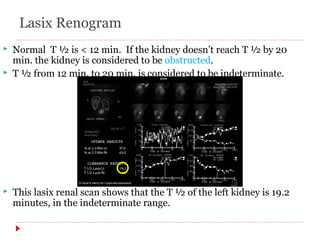
 Normal T ½ is < 12 min. If the kidney doesn’t reach T ½ by 20 
min. the kidney is considered to be obstructed. 
 T ½ from 12 min. to 20 min. is considered to be indeterminate. 
 This lasix renal scan shows that the T ½ of the left kidney is 19.2 
minutes, in the indeterminate range.
The laisx renogram on that boy with right 
hydronephrosis is finished.
 This is the perfusion panel. Notice that the time 
intervals are in seconds. Both kidneys show prompt 
uptake, but the right kidney doesn’t get quite as 
bright.
Drainage Panel 
 The left kidney shows prompt drainage, but the right 
kidney retains the radionuclide even in the last 
image.
Curves / Analysis 
 The right kidney contributes 42.6% of total renal 
function. 
 The right kidney has a prolonged T ½ (42.8 
min).
Case Summary 
 The right kidney shows slightly less perfusion and 
significantly slower drainage than the left. 
 This boy has a significant obstruction of his right 
kidney. 
Pyeloplasty is performed to relieve the 
obstruction.
Case History 
 You are called to see a newborn male. Prenatal 
ultrasounds have shown an abnormality of the right 
kidney. Unfortunately, neither the ultrasound 
images nor the report is available. 
 The baby was born at 40 weeks gestational age with 
APGARs of 9/9/9. Exam is completely normal. His 
pediatrician orders an ultrasound
Ultrasound Interpretation 
 Size 
 Right: 6.6 cm. Why is this 
kidney so large? (Nl = 4 cm) 
 Left: 5.2 cm. Why is this kidney 
so large? 
 Shape 
 Right: Reniform 
 Left: Reniform
Ultrasound Interpretation 
 Parenchyma? 
 Right: What parenchyma? 
 Left: Normal 
 Hydronephrosis? 
 Right: What do you think? 
Multiple round cystic 
areas in the right kidney 
don’t appear to 
communicate 
 Left: None
Renal Function? 
 What type of nuclear scan would be appropriate 
to determine function and possible obstruction of 
the kidneys? 
 Filtered agent 
 Demonstrates perfusion and obstruction 
 Excreted agent 
 Function and perfusion (indirectly) 
 Cortical agent 
 Renal mass
We ordered a DTPA Renal Scan (Filtered 
radionuclide)
Your interpretation? 
 Perfusion 
 Normal on left 
 None on right 
 We know from the 
ultrasound that 
there is a kidney on 
the right. Why 
doesn’t it show up 
on the nuclear 
scan?
Your interpretation? 
 Drainage 
 None on right 
 Delayed on left
Analysis/curves Panel 
 The curves show no perfusion 
on the right, and there is 
delayed drainage on the left. 
This delay on the left is due to 
immaturity of the newborn 
kidney. Remember, we saw no 
left hydronephrosis on 
ultrasound. 
Look at the curve on the 
lower right. Why is it so 
irregular?
Analysis/ Curves Panel 
Take a look at the figures in the table. The differential 
function is 98.1% from the left and only 1.9% from the 
right. That right kidney isn’t doing much. When the 
function of a kidney is that poor you can probably 
ignore any other data in the table such as T ½. 
The T ½ of the left kidney is in the indeterminate 
range (15.8 min.). The ultrasound of the left kidney 
showed no hydronephrosis, so we can chalk that long 
T ½ to immaturity of this newborn’s kidney. When we 
need accurate renal function data, we usually wait 
until a baby is at least two months old to perform a 
renogram.
Case Summary 
This baby’s right kidney is enlarged with 
multiple non-communicating cystic 
areas. It has no perfusion and no 
function. This is a typical 
multicystic–dysplastic kidney. The 
cause for this condition is thought to be 
a failure in the canalization and/or 
development of the proximal collecting 
system from the calyces to the renal 
pelvis. There is no communication 
between the collecting ducts and the 
ureter.
Nuclear Renography Summary 
 A nuclear renal scan is performed by intravenous 
injection of a radioisotope. A radiation detection 
device (nuclear medicine camera) is used to detect 
passage of the radioisotope through the urinary tract 
over time. Because the camera is placed posterior to 
the patient, the scan will show the right kidney on 
your right as you face the scan.
Nuclear Renography Summary 
 Remember the 3 radionuclide classes 
 Filtered – Shows perfusion, drainage and function 
 Excreted – Shows tubular function 
 Cortical imaging – Shows scaring and renal mass 
 3 panels of a nuclear renogram 
 Perfusion 
 Drainage/function 
 Curves/analysis
Nuclear Renography Summary 
 Ureteropelvic junction obstruction 
 An obstruction of urine flow from the kidney pelvis to the 
ureter. UPJ obstruction can cause pain, urine infection, 
gross hematuria and it can increase the risk of kidney 
stones. 
 Multicystic-dysplastic kidney 
 A congenital condition caused by failure of development 
of the most proximal collecting system that results in a 
non-functioning kidney composed of cysts of varying size.
THANK YOU

Nuclear renography

  • 1.
  • 2.
    Objectives  wewill learn  How a nuclear renogram is performed  Three classes of radionuclides used in renography  How to read nuclear renogram images  Plus  We will learn about three congenital anomalies for which nuclear renography is useful.
  • 3.
    Introduction  Ultrasoundand cystography give us a lot of information about the urinary tract  Nuclear renography gives a very detailed representation of the function and drainage of the kidneys.
  • 4.
     Nuclear renographyis highly accurate at measuring kidney function, but the images are low resolution.
  • 5.
    Technique  Nuclearrenography is performed by injecting a radionuclide into the venous circulation. The uptake and passage of the radionuclide is detected by a nuclear medicine camera.
  • 6.
    Synonyms  Theterms radionuclide, radioisotope, radio tracer or nuclear imaging agent all refer to the radioactive material that is used to make the nuclear medicine images. These substances are molecules that contain radioactive atoms. When those atoms decay, they emit energy in the form of gamma rays or alpha or beta particles that are detected by the nuclear medicine camera.
  • 7.
    Radionuclides  Threebasic classes of radionuclide are employed in nuclear renography.  Filtered agents  Excreted agents  Cortical imaging agents
  • 8.
    Filtered Radionuclides DTPA and MAG3 are filtered through the glomerulus. This is useful in evaluating:  Perfusion Vascular supply  Filtration Measuring renal function (glomerular filtration rate)  Drainage Detects obstruction
  • 9.
    Excreted Radionuclides MAG3 and Hipuran are excreted by the renal tubules. These radionuclides are helpful in evaluating patients with:  Diminished renal function  Kidney transplants
  • 10.
    Cortical Imaging Radionuclides  DMSA and Glucoheptonate are accumulated in the cortex so they are helpful in evaluating:  Renal scarring from chronic infection  Infarction  Renal mass  Differential renal mass (proportion of total renal mass contributed by each kidney)
  • 11.
    Nuclear Renography –Conventions  After intravenous injection of the radionuclide the nuclear camera (radiation detection instrument) is usually placed behind the patient, so the image of the left kidney is on the left,. Why does the right kidney image look sharper than the left?
  • 12.
    Nuclear Renography –Orientation  Notice the label? RPO means right posterior oblique. The patient is lying on her right side rotated about 45 degrees. The camera is closer to the right kidney so that image is somewhat sharper.
  • 13.
    Case History •A six year old girl with known vesicoureteric reflux has had febrile urine infections despite prophylactic antibiotics. Pyelonephritis can cause renal scarring. Previously, this patient had no renal scars. In order to determine if this girl has new renal scars, what radionuclide would you use? • Filtered imaging agent • Excreted imaging agent • •CCoorrttiiccaall iimmaaggiinngg aaggeenntt
  • 14.
    Cortical Imaging Scan  The radioisotope is injected intravenously.  Images are obtained in various orientations  Posterior (because the kidneys are closer to the back)  LPO (left posterior oblique)  RPO (right posterior oblique) • We examine the images to detect defects. A scarred area will have no uptake of the radionuclide and, therefore, no radioactivity detected by the camera. Such areas are described as photopenic.
  • 15.
    look DMSA (corticalagent) scan.
  • 16.
    DMSA Cortical Scan  Her right kidney is smooth and reniform (bean-shaped).  The left kidney is irregular. It looks as if someone took a bite out of the upper pole. The lower pole is irregular too. • Besides renal scarring from chronic infection, what could give this appearance (photopenic areas)?
  • 17.
    Case Summary •Renal scars show up as photopenic areas where one would expect to see cortical uptake. • Scar formation represents a loss of renal parenchyma. • This girl has suffered renal scarring from recurrent pyelonephritis. • Infarction of a portion of a kidney would also show up on a cortical imaging scan as a photopenic area.
  • 18.
    Case History A 4-year-old male is referred for evaluation of colicky right flank pain. Ultrasound showed grade IV right hydronephrosis. Past history is otherwise negative.  Exam: healthy male. BP = 116/72 (high for a 4-year-old). Non-tender fullness in the right upper quadrant.  We suspect that he has an obstruction, but we need to confirm. What radionuclide class should we use to evaluate his kidney drainage?
  • 19.
    Evaluation of Hydronephrosis  A filtered agent is best for evaluating filtration and drainage. The nuclear imaging study used to evaluate obstruction is called a lasix renogram.  A lasix renogram is dynamic study performed over time.
  • 20.
     A filteredradionuclide is injected intravenously.  The radionuclide is followed continuously.  After the radionuclide has circulated thoroughly (usually after peak concentration and active drainage from the kidneys) lasix is given intravenously in order to maximize urine production. This helps to demonstrate obstruction.
  • 21.
    look at anormal lasix renogram.  The scans you will read will vary in appearance, but you should see three image panels:  Perfusion  Excretion/drainage  Analysis/curves
  • 22.
    Perfusion Panel •Images are accumulated over intervals of 10 seconds. You can tell when you’re looking at a perfusion image. The images appear a bit more fuzzy than those from the drainage phase, and the time intervals will be in seconds, rather than minutes. • The kidneys should show uptake simultaneously within one frame of the appearance of the great vessels (arrows).
  • 23.
    Perfusion Panel Look at image #1 (1 – 10 SEC). This frame represents the activity that occurred during the first 10 seconds following injection of the radionuclide. Subsequent frames represent seconds 10 to 20, 20 to 30 and so on. Follow the frames.
  • 24.
    Perfusion Panel You can see uptake in both kidneys equally. Both kidneys get brighter in the first 5 or 6 frames.  Uptake (perfusion) appears to be uniform throughout both kidneys. What would a perfusion image look like if a patient had thrown an embolus into the renal artery?
  • 25.
    Excretion / DrainagePanel  As on the perfusion panel, these images are accumulated over time. However, they represent activity over minutes, rather than seconds (3 minute intervals on this scan).
  • 26.
    Excretion / DrainagePanel  You may find it useful to ask yourself two questions:  Which frame on the excretion/ drainage panel is the brightest for each kidney?  Do the kidneys look less bright in subsequent frames (do both kidneys show drainage)?
  • 27.
    Excretion / DrainagePanel  On this scan, both kidneys are brightest in the first frame. The left kidney drains a bit more slowly than the right (image #5).
  • 28.
    Excretion / Drainage  About 15 minutes after injection of the radionuclide, lasix is given intravenously.  Unless obstruction is complete, there will be some drainage. If the obstruction is partial, it may be detected only with high urine flow. Lasix helps to demonstrate partial obstruction by maximizing urine output. Notice how rapidly both kidneys drain in response to the intravenous lasix. The image of the kidneys fades rapidly.
  • 29.
    Curves / AnalysisPanel The computer generated curves give a graphical representation of the scan images over time. They vary in appearance depending on the equipment used, but there are some common elements you will find on any study: – Curves representing early uptake (perfusion phase) – Curves representing drainage – Tables for differential function and clearance On the line graphs, radioactivity counts are plotted on the Y axis while time is plotted on the X axis.
  • 30.
    Curves / AnalysisPanel • Area of interest – This is a graphical representation of the area from which radioactivity is measured in the analysis. There are two such areas for each kidney. • Kidney area • Background area – The radioactivity detected in the background area is subtracted from that detected from the kidney to eliminate background noise.
  • 31.
    Look at somenormal curves.  Normally, the curves show rapid uptake (flow curve on left) and rapid drainage (function curve on right). Each kidney is plotted separately
  • 32.
  • 33.
    Table  Thistable gives a numeric representation of the scan including:  Differential function, the relative contribution of each kidney to total renal perfusion/uptake.  T ½ - the time at which half of the radionuclide has drained (ignore T ½ pre-lasix for now).
  • 34.
    Lasix Renogram Normal T ½ is < 12 min. If the kidney doesn’t reach T ½ by 20 min. the kidney is considered to be obstructed.  T ½ from 12 min. to 20 min. is considered to be indeterminate.  This lasix renal scan shows that the T ½ of the left kidney is 19.2 minutes, in the indeterminate range.
  • 35.
    The laisx renogramon that boy with right hydronephrosis is finished.
  • 36.
     This isthe perfusion panel. Notice that the time intervals are in seconds. Both kidneys show prompt uptake, but the right kidney doesn’t get quite as bright.
  • 37.
    Drainage Panel The left kidney shows prompt drainage, but the right kidney retains the radionuclide even in the last image.
  • 38.
    Curves / Analysis  The right kidney contributes 42.6% of total renal function.  The right kidney has a prolonged T ½ (42.8 min).
  • 39.
    Case Summary The right kidney shows slightly less perfusion and significantly slower drainage than the left.  This boy has a significant obstruction of his right kidney. Pyeloplasty is performed to relieve the obstruction.
  • 40.
    Case History You are called to see a newborn male. Prenatal ultrasounds have shown an abnormality of the right kidney. Unfortunately, neither the ultrasound images nor the report is available.  The baby was born at 40 weeks gestational age with APGARs of 9/9/9. Exam is completely normal. His pediatrician orders an ultrasound
  • 41.
    Ultrasound Interpretation Size  Right: 6.6 cm. Why is this kidney so large? (Nl = 4 cm)  Left: 5.2 cm. Why is this kidney so large?  Shape  Right: Reniform  Left: Reniform
  • 42.
    Ultrasound Interpretation Parenchyma?  Right: What parenchyma?  Left: Normal  Hydronephrosis?  Right: What do you think? Multiple round cystic areas in the right kidney don’t appear to communicate  Left: None
  • 43.
    Renal Function? What type of nuclear scan would be appropriate to determine function and possible obstruction of the kidneys?  Filtered agent  Demonstrates perfusion and obstruction  Excreted agent  Function and perfusion (indirectly)  Cortical agent  Renal mass
  • 44.
    We ordered aDTPA Renal Scan (Filtered radionuclide)
  • 45.
    Your interpretation? Perfusion  Normal on left  None on right  We know from the ultrasound that there is a kidney on the right. Why doesn’t it show up on the nuclear scan?
  • 46.
    Your interpretation? Drainage  None on right  Delayed on left
  • 47.
    Analysis/curves Panel The curves show no perfusion on the right, and there is delayed drainage on the left. This delay on the left is due to immaturity of the newborn kidney. Remember, we saw no left hydronephrosis on ultrasound. Look at the curve on the lower right. Why is it so irregular?
  • 48.
    Analysis/ Curves Panel Take a look at the figures in the table. The differential function is 98.1% from the left and only 1.9% from the right. That right kidney isn’t doing much. When the function of a kidney is that poor you can probably ignore any other data in the table such as T ½. The T ½ of the left kidney is in the indeterminate range (15.8 min.). The ultrasound of the left kidney showed no hydronephrosis, so we can chalk that long T ½ to immaturity of this newborn’s kidney. When we need accurate renal function data, we usually wait until a baby is at least two months old to perform a renogram.
  • 49.
    Case Summary Thisbaby’s right kidney is enlarged with multiple non-communicating cystic areas. It has no perfusion and no function. This is a typical multicystic–dysplastic kidney. The cause for this condition is thought to be a failure in the canalization and/or development of the proximal collecting system from the calyces to the renal pelvis. There is no communication between the collecting ducts and the ureter.
  • 50.
    Nuclear Renography Summary  A nuclear renal scan is performed by intravenous injection of a radioisotope. A radiation detection device (nuclear medicine camera) is used to detect passage of the radioisotope through the urinary tract over time. Because the camera is placed posterior to the patient, the scan will show the right kidney on your right as you face the scan.
  • 51.
    Nuclear Renography Summary  Remember the 3 radionuclide classes  Filtered – Shows perfusion, drainage and function  Excreted – Shows tubular function  Cortical imaging – Shows scaring and renal mass  3 panels of a nuclear renogram  Perfusion  Drainage/function  Curves/analysis
  • 52.
    Nuclear Renography Summary  Ureteropelvic junction obstruction  An obstruction of urine flow from the kidney pelvis to the ureter. UPJ obstruction can cause pain, urine infection, gross hematuria and it can increase the risk of kidney stones.  Multicystic-dysplastic kidney  A congenital condition caused by failure of development of the most proximal collecting system that results in a non-functioning kidney composed of cysts of varying size.
  • 53.

Editor's Notes

  • #4 1.but neither imaging technology tells us about the function of the kidneys.
  • #5 Compare a kidney image from a nuclear renogram (left) with 3D-CT scan.
  • #6 Various radionuclides are handled by the kidney in different ways. We can use those differences to answer questions about the urinary tract.
  • #10 MAG3 is both filtered and excreted so some radiologists prefer it to other radionuclides.
  • #12 unlike conventional radiography or axial CT scans. As with other imaging studies, image labels will help to orient you
  • #17 Infarction, for example from an arterial embolus, or severe atherosclerosis in the renal artery can also give this appearance.
  • #32 (see labels) on each graph.
  • #33 Look at the labels to see which curve represents each kidney. In this scan the left kidney is represented by the line with circles, the right by the line with diamonds. There is almost no perfusion to the left kidney. Similarly, there is no significant function in the left kidney. The table shows that the left kidney uptake is only 6.7% of the total. Let’s look at the table more closely.
  • #40 The most common cause of hydronephrosis in a child is a ureteropelvic junction obstruction.