RENAL SCINTIGRAPHY
Presenter – Dr.Ahammed Sahal B K (JR I)
Moderator – Dr. Ishank (JR II Senior)
Date – 22/01/2024
CONTENTS:
• INTRODUCTION
• GAMMA CAMERA
• POSITIONING
• RADIONUCLIDES
• DYNAMIC RENOGRAPHY
• STATIC RENOGRAPHY
INTRODUCTION
• Medical imaging of the kidney using radionuclide material and viewed with a
Gamma camera.
• Also called Nuclear Renography or Radioisotope Renography.
• Done by injecting a radionuclide material into the intravenous system and it’s
progress can be traced using a gamma camera.
• Radionuclides contain radioactive atoms & when they decay , they emit
gamma rays that are detected by the gamma camera.
GAMMA CAMERA
Consists of :-
• Collimators – Made of lead, helps maintain image quality.
• Scintillator(Image crystal) – Converts gamma ray photons to visible light.
• Photomultiplier tube(PMT) – Converts the visible light to electrical signals.
• Pre-amplifier – Attached to the back of the PMT to amplify the electrical
signal, and send to the computer for encoding and image formation.
POSITIONING
• Posterior - Patient will lie supine or can be seated on a stool where the
detector is brought as close as possible to the patient’s back.
• Right Posterior Oblique(RPO) – To view the right kidney better, with the
patient lying sideward on his/her right side.
• Left Posterior Oblique(LPO) – To view the left kidney better, with the patient
lying sideward on his/her left side.
RADIONUCLIDES
• Isotope - Two or more forms of the same element that contain equal numbers
of protons but different numbers of neutrons in their nuclei.
• Isotopes attempting to reach stability by emitting radiation are called
radionuclides/radioisotopes.
• Divided into 2 groups:
» Rapidly eliminated by the kidneys
» Concentrated in the renal parenchyma for a sufficiently long time
• Rapidly eliminated by the kidneys:-
» 99mTc-MAG(mercapto-acetyl-triglycine)
» 99mTc-DTPA(diethylene triamine penta-acetic acid)
» 99mTc-GHA(glucoheptonate)
» 99mTc-LLEC(L,L ethylene cystine)
» 123I-OIH(orthoiodohippurate)
• Concentrated in renal parenchyma for a long time:-
» 99mTc-DMSA(dimercaptosuccinic acid)
» 99mTc-GHA
99Tc DTPA
• ECF distribution
• Tracer of choice for dynamic renal scintigraphy.
• 2-6% plasma protien binding
• Extraction fraction 20 %
• 90% excreted in urine in first 4hrs
• Useful in measuring GFR
99Tc - DMSA
• 75% Plasma protein binding.
• Slow renal excretion – retained in renal cortex.
• 40-65% of injected dose concentrated in renal cortex at 6 hours.
• Gives best morphological images.
• Assessment of scarring.
• Differential renal function.
99Tc – MAG3
• It is the most commonly used renal radiopharmaceutical.
• Excreted by active tubular secretion and remaining by glomerular
filtration.
• Preferred in paediatric patients and patients with poor renal
function.
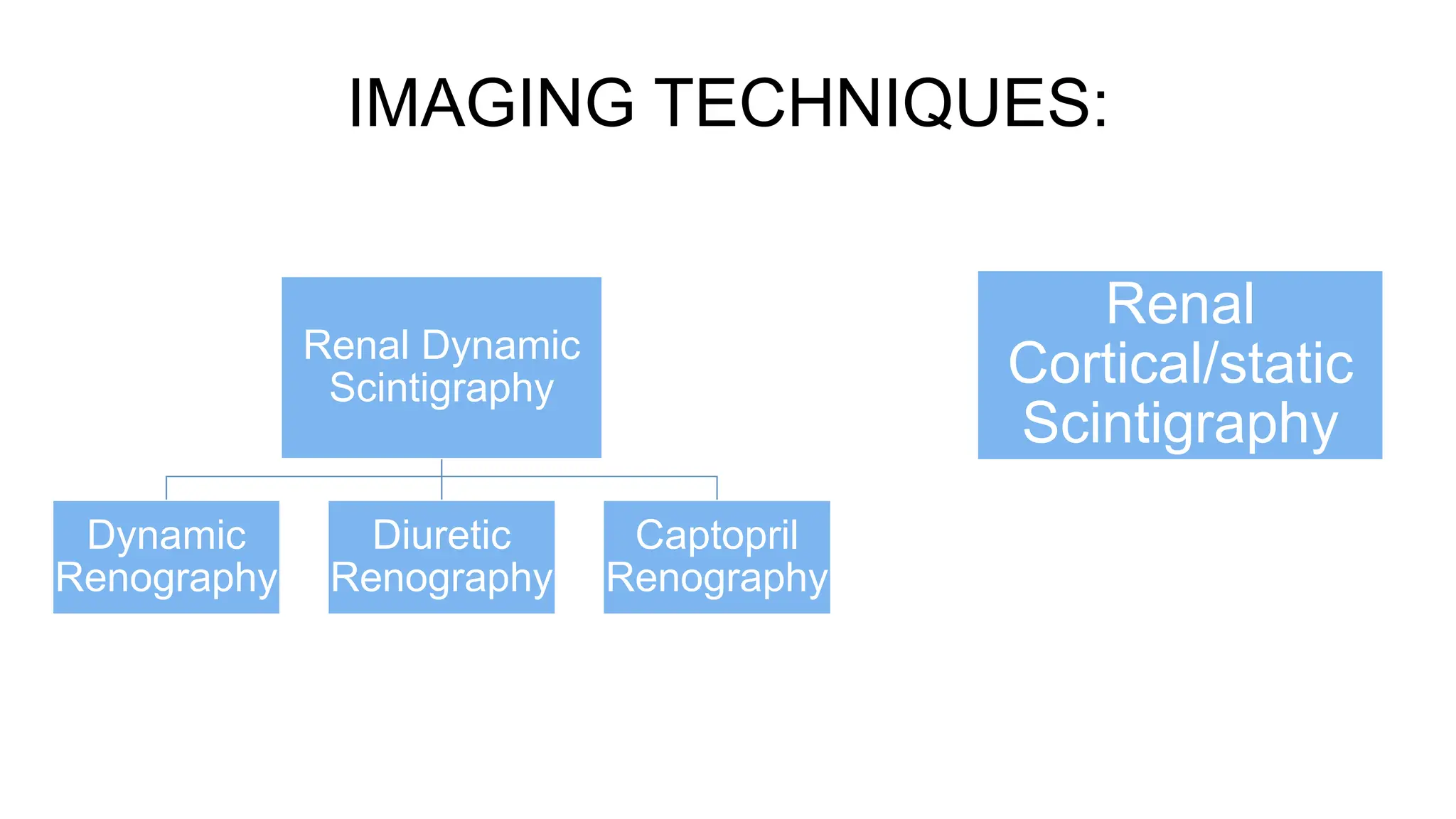
IMAGING TECHNIQUES:
Renal
Cortical/static
Scintigraphy
Renal Dynamic
Scintigraphy
Dynamic
Renography
Diuretic
Renography
Captopril
Renography
DYNAMIC RENOGRAPHY
Indications :-
• Evaluation of obstruction.
• Assessment of renal function following drainage procedures
of the urinary tract.
• Demonstration of vesicoureteric reflux.
• Assessment of renal transplantation.
• Renal trauma.
• Diagnosis of Renal artery stenosis.
Contraindications :-
• Pregnancy
• Patient preparation :-
» Should be well hydrated before study
» Patient is asked to empty their bladder before examination
» In suspected cases of obstruction, Foley’s should be
inserted.
» IV line is established to avoid extravasations of the tracer.
• Radiopharmaceuticals used :-
» 99mTc-MAG(Most common).
» 99mTc-DTPA
» 99mTc-LLEC
» 99mTc-GHA
Dose - 0.100 mCi/kg
» 123I-OIH
Dose -0.010
Imaging:-
• Examined in supine position with gamma camera placed underneath
the examination table.
• In children, appropriate immobilisation should be attained during
imaging.
• Once appropriately positioned, a rapid IV bolus of the tracer is injected
and simultaneously the acquisition is started.
• 1 frame/2s is recorded for 1 minute, followed by 1 frame/15s for a
duration of 20-30 mins.
Parenchymal phase:
Visualized 60-120 seconds after the initial vascular distribution of the tracer and
shows:-
• Relative and absolute size of the functional renal parenchyma units
• Total renal function(kidney/background ratio)
• Relative or split renal function
• Overall renal morphology and redistribution of functioning parenchyma
• Position of the renal units.
Cortical transit time :-
• Interval between IV injection of the radiotracer and its first appearance
within the renal collecting system
• Normally, it’s about 3-6 mins.
• Normal cortical transit time indicates that the renal parenchymal
function is not compromised.
• Poorer the renal function, longer is the cortical transit time.
• Conditions which prolong the cortical transit time are:-
» Ureteral obstruction
» Acute and chronic pyelonephritis
» Nephrotoxicity
» Trauma
» Renal artery stenosis
» Renal vein thrombosis
» Acute Tubular necrosis
» Allograft rejection
Drainage phase:-
• Passage of radiotracer from the pelvicalyceal system through the ureter into
the bladder
• Most of the radiotracer leaves the renal parenchyma after 20 mins
DIURETIC RENOGRAPHY
• Uses 99mTc-MAG combined with IV Furosemide administered 20-30 mins
after injection of the radiotracer.
• Used to distinguish between simple dilation of the collecting system and true
obstruction.
• Rapid washout of the radiotracer from the kidney indicates simple dilation.
• Persistence of the radiotracer indicates a degree of obstruction.
CAPTOPRIL RENOGRAPHY
• To evaluate for renal artery stenosis and renovascular hypertension.
• Patient needs to be well hydrated and not eat anything for atleast 4 hours before the exam.
• ACE inhibitors or Angiotension receptor blockers(ARBs) should be stopped prior to exam.
• Baseline study is obtained either one hour after oral captopril(1 mg/kg upto 50 mg) or 15 mins after
IV enalapril(0.03 mg/kg).
• Typical findings of a positive study include:-
» Split renal uptake
» Increase in cortical transit time
» Prolongation of time to peak and retention of tracer in the renal
parenchyma.
CORTICAL/STATIC RENAL
SCINTIGRAPHY
• Indications include evaluation of renal scarring or
calculation of differential renal function.
• 99mTc-DMSA is used.
• Imaging occurs 2-4 hours after radiotracer administration.
• Imaging techniques:-
– Planar Renal Scinitigraphy
– Magnified Renal Scintigraphy
– SPECT(Single Photon Emission Computed Tomography)
REFERENCES
• AIIMS-MAMC-PGI’s Comprehensive Textbook of Diagnostic Radiology.
• Chapman and Nakielny’s Guide to Radiological Procedures.
THANK YOU

RENAL SCINTIGRAPHY.pptx

  • 1.
    RENAL SCINTIGRAPHY Presenter –Dr.Ahammed Sahal B K (JR I) Moderator – Dr. Ishank (JR II Senior) Date – 22/01/2024
  • 2.
    CONTENTS: • INTRODUCTION • GAMMACAMERA • POSITIONING • RADIONUCLIDES • DYNAMIC RENOGRAPHY • STATIC RENOGRAPHY
  • 3.
    INTRODUCTION • Medical imagingof the kidney using radionuclide material and viewed with a Gamma camera. • Also called Nuclear Renography or Radioisotope Renography. • Done by injecting a radionuclide material into the intravenous system and it’s progress can be traced using a gamma camera. • Radionuclides contain radioactive atoms & when they decay , they emit gamma rays that are detected by the gamma camera.
  • 4.
    GAMMA CAMERA Consists of:- • Collimators – Made of lead, helps maintain image quality. • Scintillator(Image crystal) – Converts gamma ray photons to visible light. • Photomultiplier tube(PMT) – Converts the visible light to electrical signals. • Pre-amplifier – Attached to the back of the PMT to amplify the electrical signal, and send to the computer for encoding and image formation.
  • 6.
    POSITIONING • Posterior -Patient will lie supine or can be seated on a stool where the detector is brought as close as possible to the patient’s back. • Right Posterior Oblique(RPO) – To view the right kidney better, with the patient lying sideward on his/her right side. • Left Posterior Oblique(LPO) – To view the left kidney better, with the patient lying sideward on his/her left side.
  • 7.
    RADIONUCLIDES • Isotope -Two or more forms of the same element that contain equal numbers of protons but different numbers of neutrons in their nuclei. • Isotopes attempting to reach stability by emitting radiation are called radionuclides/radioisotopes. • Divided into 2 groups: » Rapidly eliminated by the kidneys » Concentrated in the renal parenchyma for a sufficiently long time
  • 8.
    • Rapidly eliminatedby the kidneys:- » 99mTc-MAG(mercapto-acetyl-triglycine) » 99mTc-DTPA(diethylene triamine penta-acetic acid) » 99mTc-GHA(glucoheptonate) » 99mTc-LLEC(L,L ethylene cystine) » 123I-OIH(orthoiodohippurate) • Concentrated in renal parenchyma for a long time:- » 99mTc-DMSA(dimercaptosuccinic acid) » 99mTc-GHA
  • 9.
    99Tc DTPA • ECFdistribution • Tracer of choice for dynamic renal scintigraphy. • 2-6% plasma protien binding • Extraction fraction 20 % • 90% excreted in urine in first 4hrs • Useful in measuring GFR
  • 10.
    99Tc - DMSA •75% Plasma protein binding. • Slow renal excretion – retained in renal cortex. • 40-65% of injected dose concentrated in renal cortex at 6 hours. • Gives best morphological images. • Assessment of scarring. • Differential renal function.
  • 11.
    99Tc – MAG3 •It is the most commonly used renal radiopharmaceutical. • Excreted by active tubular secretion and remaining by glomerular filtration. • Preferred in paediatric patients and patients with poor renal function.
  • 12.
  • 13.
    DYNAMIC RENOGRAPHY Indications :- •Evaluation of obstruction. • Assessment of renal function following drainage procedures of the urinary tract. • Demonstration of vesicoureteric reflux. • Assessment of renal transplantation. • Renal trauma. • Diagnosis of Renal artery stenosis. Contraindications :- • Pregnancy
  • 14.
    • Patient preparation:- » Should be well hydrated before study » Patient is asked to empty their bladder before examination » In suspected cases of obstruction, Foley’s should be inserted. » IV line is established to avoid extravasations of the tracer. • Radiopharmaceuticals used :- » 99mTc-MAG(Most common). » 99mTc-DTPA » 99mTc-LLEC » 99mTc-GHA Dose - 0.100 mCi/kg » 123I-OIH Dose -0.010
  • 15.
    Imaging:- • Examined insupine position with gamma camera placed underneath the examination table. • In children, appropriate immobilisation should be attained during imaging. • Once appropriately positioned, a rapid IV bolus of the tracer is injected and simultaneously the acquisition is started. • 1 frame/2s is recorded for 1 minute, followed by 1 frame/15s for a duration of 20-30 mins.
  • 16.
    Parenchymal phase: Visualized 60-120seconds after the initial vascular distribution of the tracer and shows:- • Relative and absolute size of the functional renal parenchyma units • Total renal function(kidney/background ratio) • Relative or split renal function • Overall renal morphology and redistribution of functioning parenchyma • Position of the renal units.
  • 17.
    Cortical transit time:- • Interval between IV injection of the radiotracer and its first appearance within the renal collecting system • Normally, it’s about 3-6 mins. • Normal cortical transit time indicates that the renal parenchymal function is not compromised. • Poorer the renal function, longer is the cortical transit time. • Conditions which prolong the cortical transit time are:- » Ureteral obstruction » Acute and chronic pyelonephritis » Nephrotoxicity » Trauma » Renal artery stenosis » Renal vein thrombosis » Acute Tubular necrosis » Allograft rejection
  • 18.
    Drainage phase:- • Passageof radiotracer from the pelvicalyceal system through the ureter into the bladder • Most of the radiotracer leaves the renal parenchyma after 20 mins
  • 20.
    DIURETIC RENOGRAPHY • Uses99mTc-MAG combined with IV Furosemide administered 20-30 mins after injection of the radiotracer. • Used to distinguish between simple dilation of the collecting system and true obstruction. • Rapid washout of the radiotracer from the kidney indicates simple dilation. • Persistence of the radiotracer indicates a degree of obstruction.
  • 21.
    CAPTOPRIL RENOGRAPHY • Toevaluate for renal artery stenosis and renovascular hypertension. • Patient needs to be well hydrated and not eat anything for atleast 4 hours before the exam. • ACE inhibitors or Angiotension receptor blockers(ARBs) should be stopped prior to exam. • Baseline study is obtained either one hour after oral captopril(1 mg/kg upto 50 mg) or 15 mins after IV enalapril(0.03 mg/kg). • Typical findings of a positive study include:- » Split renal uptake » Increase in cortical transit time » Prolongation of time to peak and retention of tracer in the renal parenchyma.
  • 22.
    CORTICAL/STATIC RENAL SCINTIGRAPHY • Indicationsinclude evaluation of renal scarring or calculation of differential renal function. • 99mTc-DMSA is used. • Imaging occurs 2-4 hours after radiotracer administration. • Imaging techniques:- – Planar Renal Scinitigraphy – Magnified Renal Scintigraphy – SPECT(Single Photon Emission Computed Tomography)
  • 26.
    REFERENCES • AIIMS-MAMC-PGI’s ComprehensiveTextbook of Diagnostic Radiology. • Chapman and Nakielny’s Guide to Radiological Procedures.
  • 27.