 Functional Relationships
 Urinary System Anatomy
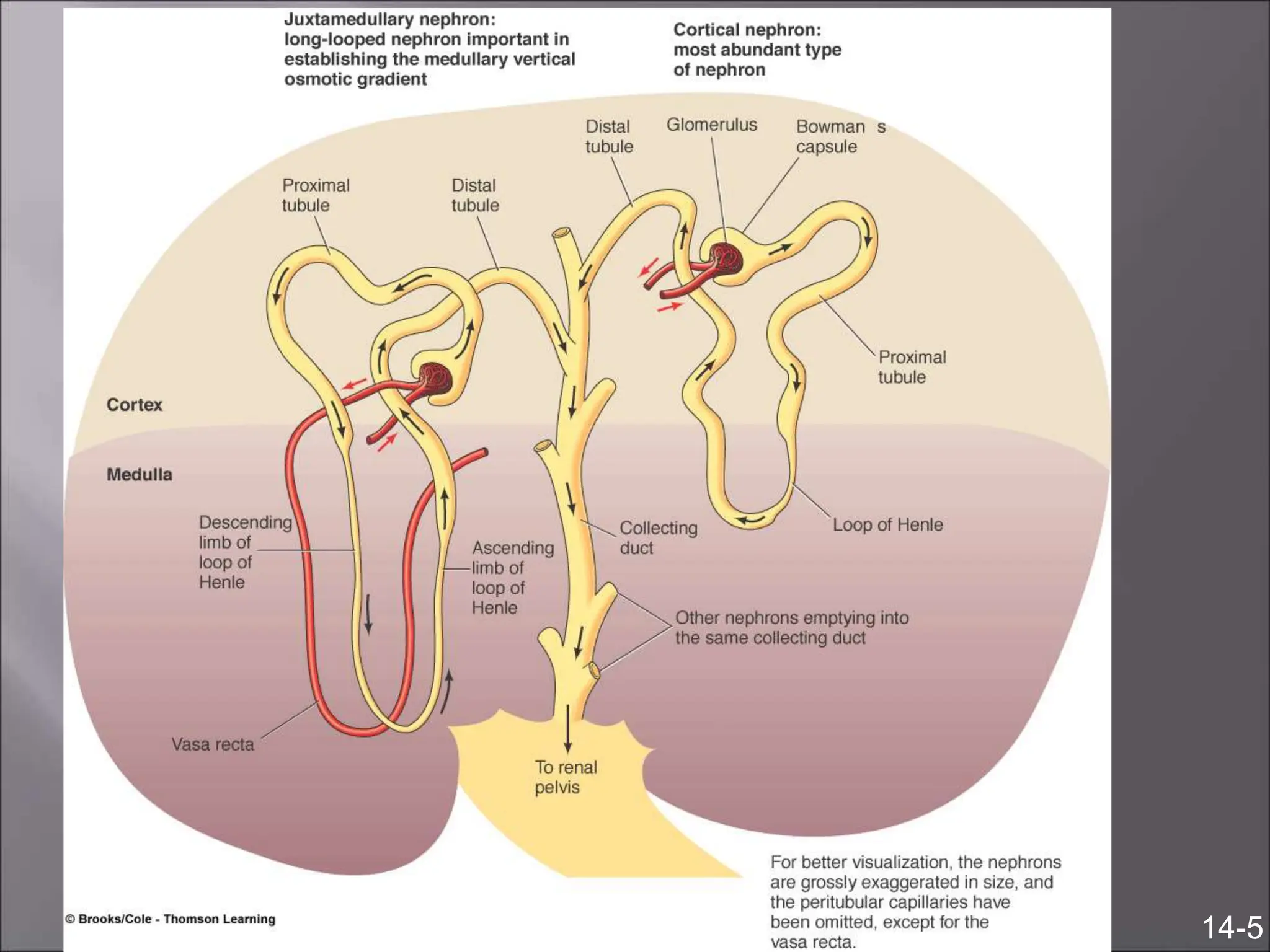
 Nephron
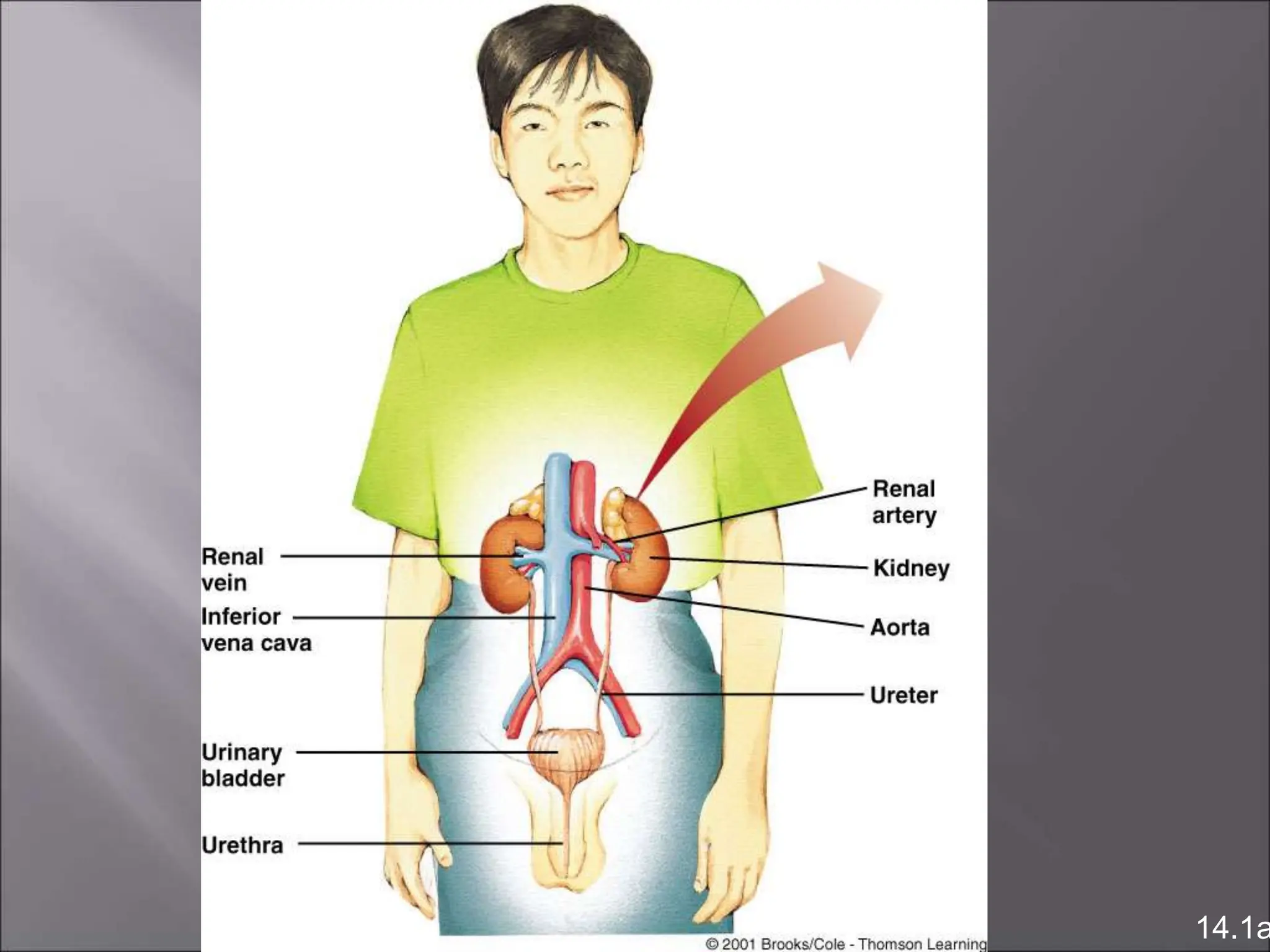
 Kidneys
 Nephrons
14.1a
14-1b
14-5
Juxtamedullary Nephron Cortical Nephron
 Filtration
 Tubular Secretion
 Selective Reabsorption
 Excretion
14-6
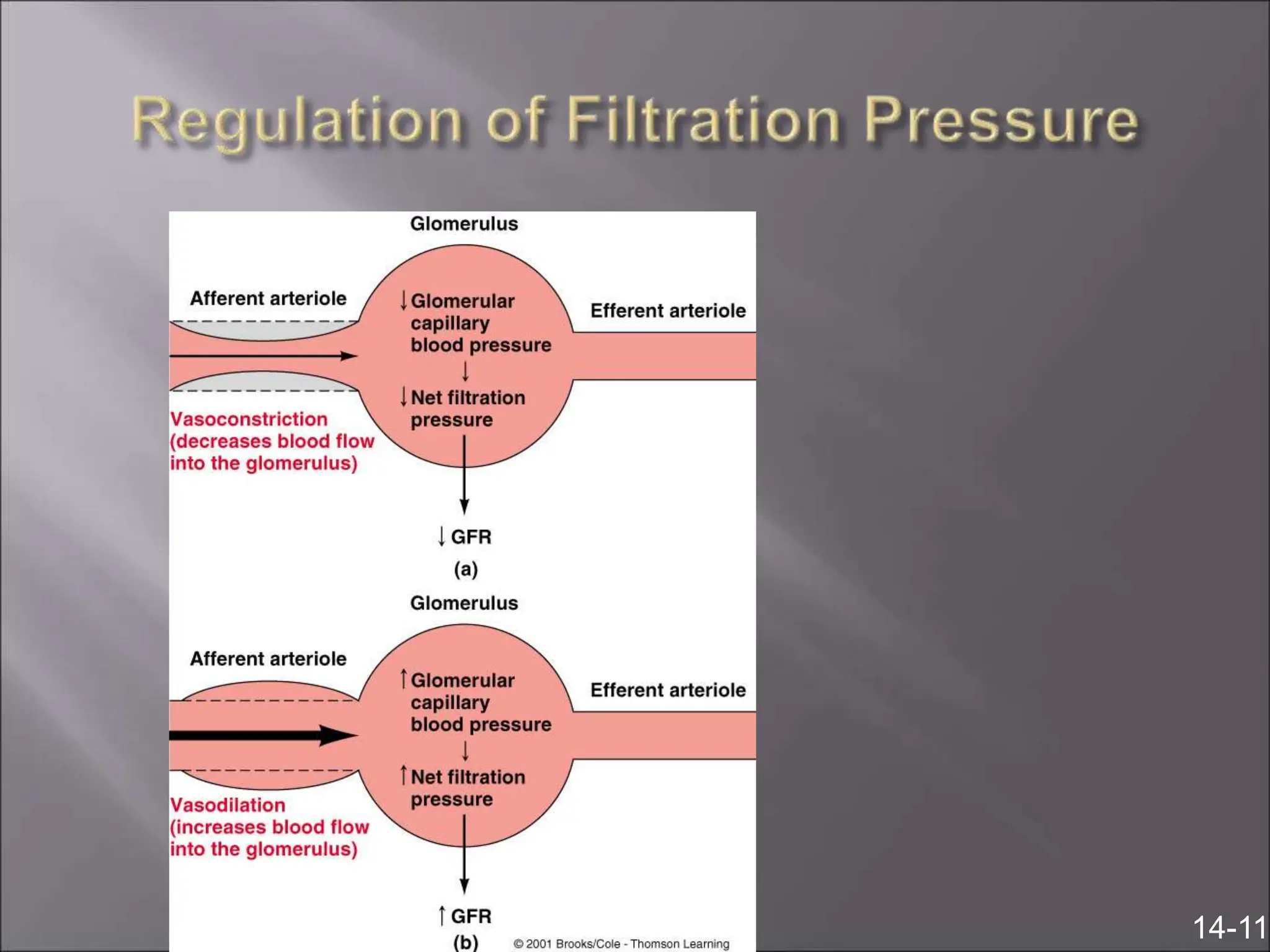
14-11
 Regulation of Filtration Pressure - via
juxtaglomerular apparatus
14-13
 Produce & expel urine
 Regulate the volume and composition of the
extracellular fluid
 Control pH
 Control blood volume & blood pressure
 Controls osmolarity
 Controls ion balance
 Secretion of hormones
 Renin
 EPO
 The nephron consists of:
 Vascular components
 Afferent & efferent
arterioles
 Glomerulus
 Peritubular capillaries
 Vasa recta
 Tubular components
 Proximal convoluted
tubule
 Distal convoluted tubule
 Nephron loop (loop of
Henle)
 Collecting duct
 Tubovascular component
 Juxtaglomerular appartus
 Simplified view of its functions
• Glomerular
Filtration
• Tubular
Reabsorption
• Tubular
Secretion
• Excretion
 Locations for filtration, reabsorption, secretion
& excretion
 First step in urine formation
 No other urinary function would occur without this
aspect!
 Occurs in the glomerulus due to
 Filtration membrane &
 Capillary hydrostatic pressure
 Colloid osmotic pressure
 Capsular hydrostatic pressure
 Capillaries are fenestrated
 Overlying podocytes with pedicels form
filtration slits
 Basement membrane between the two
 Barriers
 Mesanglial cells can alter blood flow through
capillaries
 Basal lamina alters filtration as well by
 Containing negatively charged glycoproteins
 Act to repel negatively charged plasma proteins
 Podocytes form the final barrier to filtration by
forming “filtration slits”
 Forces
 Blood hydrostatic pressure
(PH)
 Outward filtration pressure
of 55 mm Hg
 Constant across capillaries due
to restricted outflow (efferent
arteriole is smaller in diameter
than the afferent arteriole)
 Colloid osmotic pressure (π)
 Opposes hydrostatic pressure
at 30 mm Hg
 Due to presence of proteins in
plasma, but not in glomerular
capsule (Bowman’s capsule)
 Capsular hydrostatic pressure
(Pfluid)
 Opposes hydrostatic pressure
at 15 mm Hg
 10 mm Hg of filtration pressure
 Not high, but has a large surface area and nature of filtration
membrane
 creates a glomerular filtration rate (GFR) of 125 ml/min which
equates to a fluid volume of 180L/day entering the glomerular
capsule.
 Plasma volume is filtered 60 times/day or 2 ½ times per hour
 Requires that most of the filtrate must be reabsorbed, or we would
be out of plasma in 24 minutes!
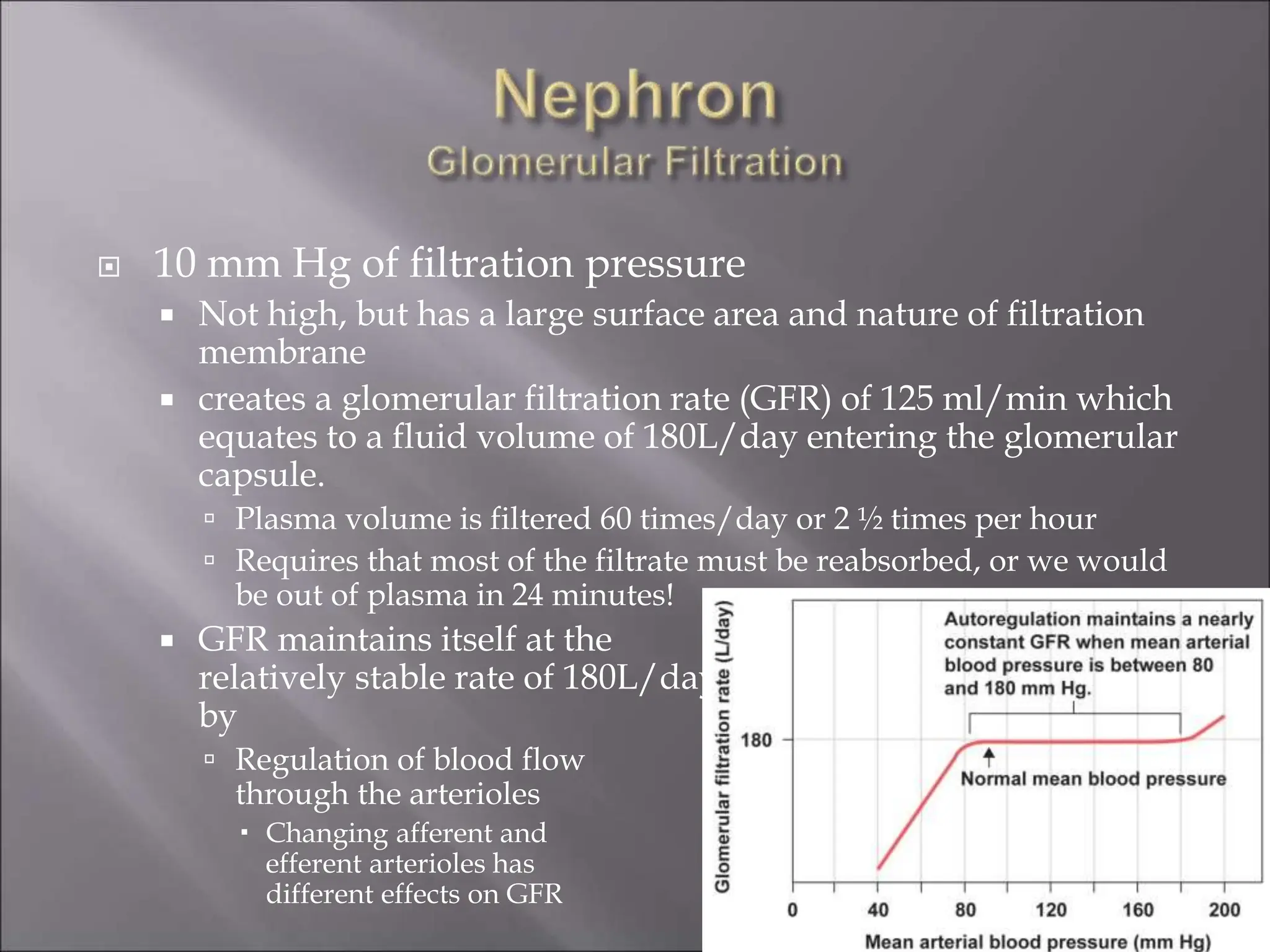
 GFR maintains itself at the
relatively stable rate of 180L/day
by
 Regulation of blood flow
through the arterioles
 Changing afferent and
efferent arterioles has
different effects on GFR
 How does GFR remain relatively constant
despite changing mean arterial pressure?
1. Myogenic response
 Typical response to stretch of arteriolar smooth muscle due
to increased blood pressure:
 increase stretch results in smooth muscle contraction and
decreased arteriole diameter
 Causes a reduction in GFR
 If arteriole blood pressure decreases slightly, GFR only
increases slightly as arterioles dilate
 Due to the fact that the arterioles are normally close to maximal
dilation
 Further drop in bp (below 80mmHg) reduced GFR and conserves
plasma volume
2. Tubulooglomerular feedback at the JGA
3. Hormones & ANS
2. Tubulooglomerular feedback at the JGA
 Fluid flow is monitored in the tubule where it comes
back between the afferent and efferent arterioles
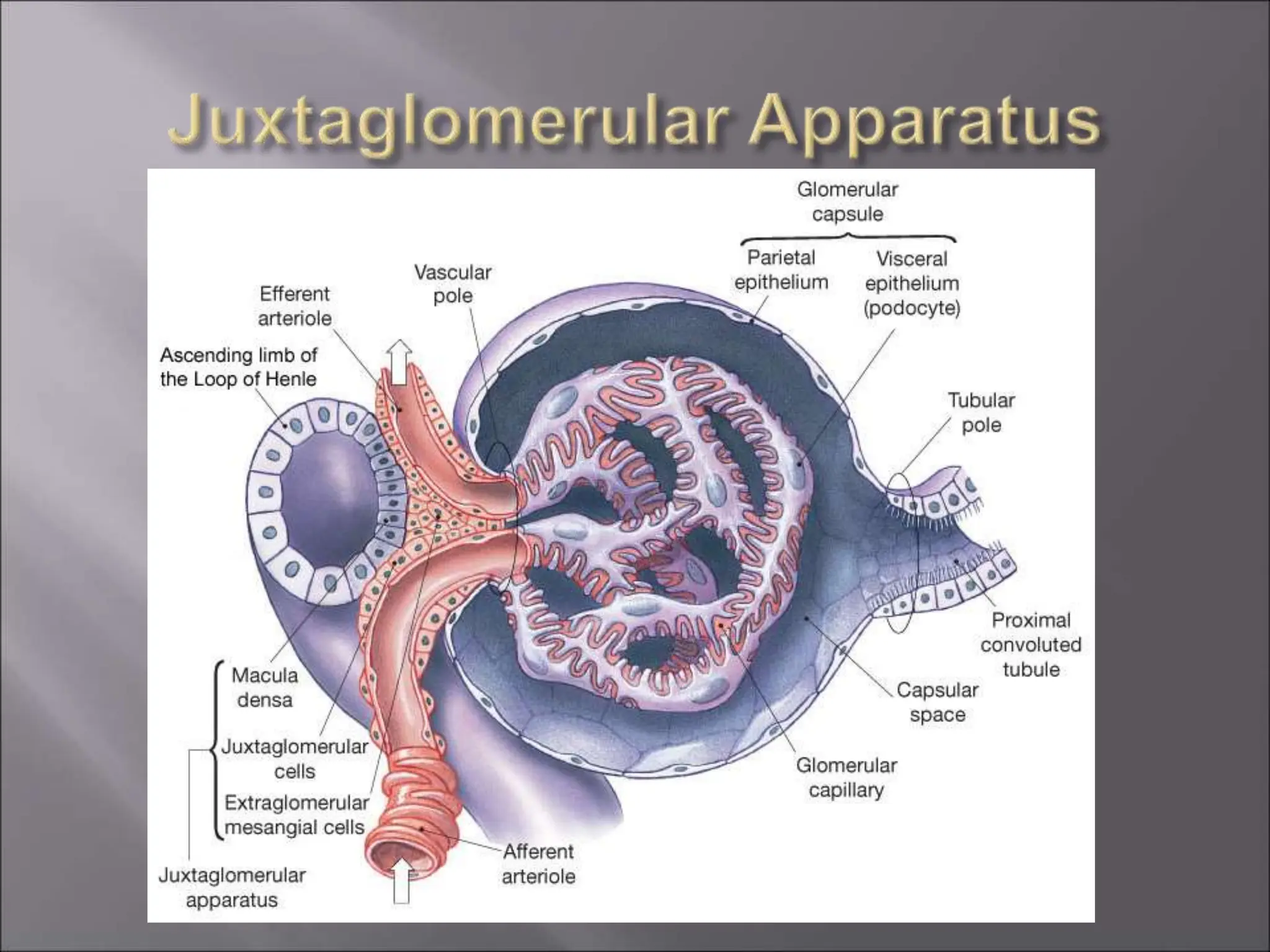
 Forms the juxtaglomerular apparatus
 Specialized tubular cells in the JGA form the macula densa
 Specialized contractile cells in the afferent arteriole in the
JGA are called granular cells or juxtaglomerular cells
 The cells of the
macula densa
monitor NaCl
concentration in
the fluid moving
into the dital
convoluted tubule.
 If GFR increases,
then NaCl
movement also
increases as a
result
 Macula densa
cells send a
paracrine
message
(unknown for
certain) causing
the afferent
arteriole to
contract,
decreasing GFR
and NaCl
movment
3. Hormones & ANS
 Autoregulation does a pretty good job, however
extrinsic control systems can affect a change by
overriding local autoregulation factors by
 Changing arteriole resistance
 Sympathetic innervation to both afferent and efferent
arterioles
 Acts on alpha receptors causing vasoconstriction
 Used when bp drops drastically to reduce GFR and
conserve fluid volume
 Changing the filtration coefficient
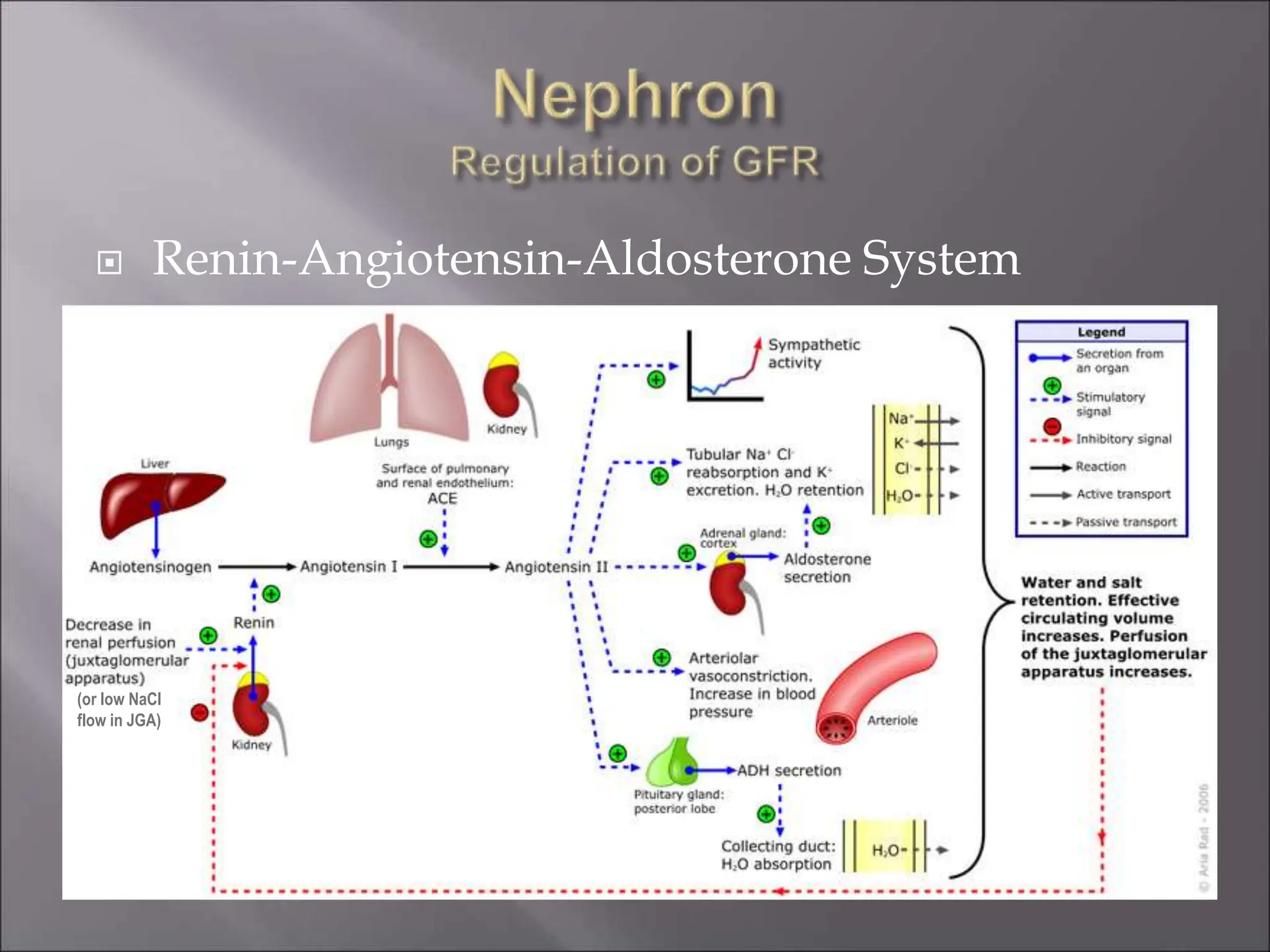
 Release of renin from the granular cells (JG cells) of the JGA
initiates the renin-angiotensin-aldosterone system (RAAS)
 Angiotensin II is a strong vasoconstrictor
 Prostaglandins
 Vasodilators
 These hormones may also change the configuration of the
mesanglial cells and the podocytes, altering the filtration
coefficient
 Renin-Angiotensin-Aldosterone System
(or low NaCl
flow in JGA)
 GFR = 180 L/day, >99% is reabsorbed
 Why so high on both ends?
 Allows material to be cleared from plasma quickly
and effectively if needed
 Allows for easy tuning of ion and water balance
 Reabsorption
 Passive and Active Transport Processes
 Most of the reabsorption takes place in the PCT
Movement may be
via epithelial
transport (through
the cells) or by
paracellular
pathways (between
the epithelial cells)
 Na+ reabsorption
 An active process
 Occurs on the basolateral membrane (Na+/K+ ATPase)
 Na+ is pumped into the interstitial fluid
 K+ is pumped into the tubular cell
 Creates a Na+ gradient that can be utilized for 2º active
transport
 Secondary Active Transport utilizing Na+
gradient (Sodium Symport)
 Used for transporting
 Glucose, amino acids, ions, metabolites
 The transport membrane proteins
 Will reach a saturation point
 They have a maximum transport rate = transport maximum
(Tm)
 The maximum number
of molecules that can be
transported per unit of
time
 Related to the plasma
concentration called the
renal threshold…
 The point at which
saturation occurs and
Tm is exceeded
 Glucose Reabsorption
 Glucose is filtered and reabsorbed hopefully 100%
 Glucose excreted = glucose filtered – glucose reabsorbed
Implication of
no glucose
transports past
the PCT?
 Where does filtered material go?
 Into peritubular capillaries because in the capillaries
there exists
 Low hydrostatic pressure
 Higher colloid osmotic pressure
 Tubular secretion is the movement of material
from the peritubular capillaries and interstitial
space into the nephron tubules
 Depends mainly on transport systems
 Enables further removal of unwanted substances
 Occurs mostly by secondary active transport
 If something is filtered, not reabsorbed, and
secreted… the clearance rate from plasma is greater
than GFR!
 Ex. penicillin – filtered and secreted, not reabsorbed
 80% of penicillin is gone within 4 hours after administration
Filtration – reabsorption + secretion = Excretion
 The excretion rate then of a substance (x) depends on
 the filtration rate of x
 if x is reabsorbed, secreted or both
 This just tells us excretion, but not much about how the
nephron is working in someone
 This is done by testing a known substance that should be
filtered, but neither reabsorbed or secreted
 100% of the filtered substance is excreted and by monitoring plasma
levels of the substance, a clearance rate can be determined
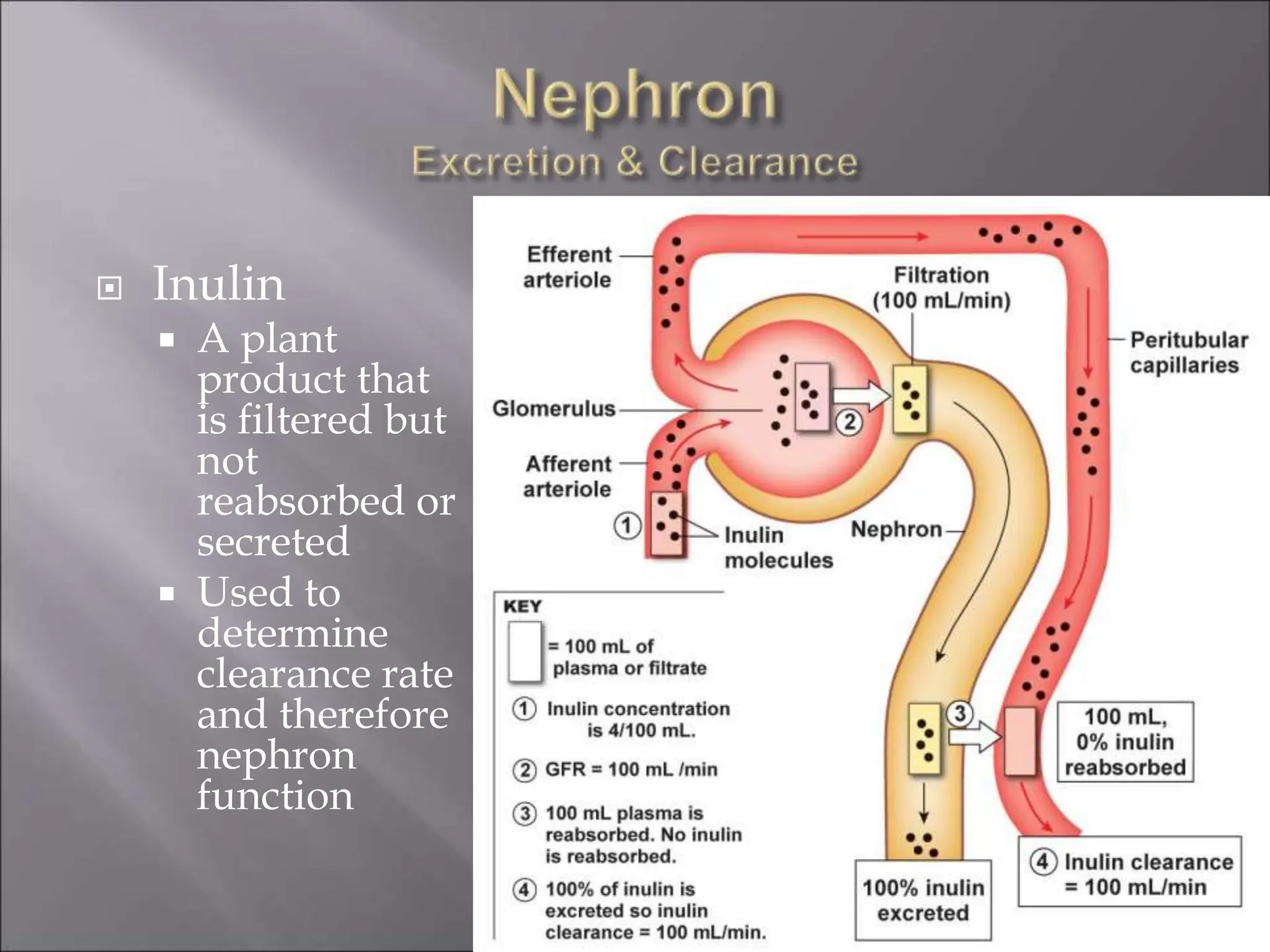
 Inulin
 A plant
product that
is filtered but
not
reabsorbed or
secreted
 Used to
determine
clearance rate
and therefore
nephron
function
 The relationship between clearance and
excretion using a few examples
 Urine normally exits the nephron in a dilute
state, however under hormonal controls, water
reabsorption occurs and can create an
extremely concentrated urine.
 Aldosterone & ADH are the two main hormones that
drive this water reabsorption
 Aldosterone creates an obligatory response
 Aldosterone increases Na+/K+ ATPase activity and therefore
reabsorption of Na+… where Na+ goes, water is obliged to follow
 ADH creates a facultative response
 Opens up water channels in the collecting duct, allowing for the
reabsorption of water via osmosis
 Once excreted, urine travels via the paired
ureters to the urinary bladder where it is held
(about ½ L)
 Sphincters control movement out of the
bladder
 Internal sphincter – smooth muscle (invol.)
 External sphincter – skeletal muscle (vol.)
 Reflex Pathway

109 Renal pathology.ppt

  • 1.
     Functional Relationships Urinary System Anatomy  Nephron
  • 3.
  • 4.
  • 5.
  • 6.
  • 7.
     Filtration  TubularSecretion  Selective Reabsorption  Excretion
  • 8.
  • 9.
  • 10.
     Regulation ofFiltration Pressure - via juxtaglomerular apparatus
  • 11.
  • 12.
     Produce &expel urine  Regulate the volume and composition of the extracellular fluid  Control pH  Control blood volume & blood pressure  Controls osmolarity  Controls ion balance  Secretion of hormones  Renin  EPO
  • 13.
     The nephronconsists of:  Vascular components  Afferent & efferent arterioles  Glomerulus  Peritubular capillaries  Vasa recta  Tubular components  Proximal convoluted tubule  Distal convoluted tubule  Nephron loop (loop of Henle)  Collecting duct  Tubovascular component  Juxtaglomerular appartus
  • 14.
     Simplified viewof its functions • Glomerular Filtration • Tubular Reabsorption • Tubular Secretion • Excretion
  • 15.
     Locations forfiltration, reabsorption, secretion & excretion
  • 16.
     First stepin urine formation  No other urinary function would occur without this aspect!  Occurs in the glomerulus due to  Filtration membrane &  Capillary hydrostatic pressure  Colloid osmotic pressure  Capsular hydrostatic pressure
  • 17.
     Capillaries arefenestrated  Overlying podocytes with pedicels form filtration slits  Basement membrane between the two
  • 18.
     Barriers  Mesanglialcells can alter blood flow through capillaries  Basal lamina alters filtration as well by  Containing negatively charged glycoproteins  Act to repel negatively charged plasma proteins  Podocytes form the final barrier to filtration by forming “filtration slits”
  • 19.
     Forces  Bloodhydrostatic pressure (PH)  Outward filtration pressure of 55 mm Hg  Constant across capillaries due to restricted outflow (efferent arteriole is smaller in diameter than the afferent arteriole)  Colloid osmotic pressure (π)  Opposes hydrostatic pressure at 30 mm Hg  Due to presence of proteins in plasma, but not in glomerular capsule (Bowman’s capsule)  Capsular hydrostatic pressure (Pfluid)  Opposes hydrostatic pressure at 15 mm Hg
  • 20.
     10 mmHg of filtration pressure  Not high, but has a large surface area and nature of filtration membrane  creates a glomerular filtration rate (GFR) of 125 ml/min which equates to a fluid volume of 180L/day entering the glomerular capsule.  Plasma volume is filtered 60 times/day or 2 ½ times per hour  Requires that most of the filtrate must be reabsorbed, or we would be out of plasma in 24 minutes!  GFR maintains itself at the relatively stable rate of 180L/day by  Regulation of blood flow through the arterioles  Changing afferent and efferent arterioles has different effects on GFR
  • 21.
     How doesGFR remain relatively constant despite changing mean arterial pressure? 1. Myogenic response  Typical response to stretch of arteriolar smooth muscle due to increased blood pressure:  increase stretch results in smooth muscle contraction and decreased arteriole diameter  Causes a reduction in GFR  If arteriole blood pressure decreases slightly, GFR only increases slightly as arterioles dilate  Due to the fact that the arterioles are normally close to maximal dilation  Further drop in bp (below 80mmHg) reduced GFR and conserves plasma volume 2. Tubulooglomerular feedback at the JGA 3. Hormones & ANS
  • 22.
    2. Tubulooglomerular feedbackat the JGA  Fluid flow is monitored in the tubule where it comes back between the afferent and efferent arterioles  Forms the juxtaglomerular apparatus  Specialized tubular cells in the JGA form the macula densa  Specialized contractile cells in the afferent arteriole in the JGA are called granular cells or juxtaglomerular cells
  • 24.
     The cellsof the macula densa monitor NaCl concentration in the fluid moving into the dital convoluted tubule.  If GFR increases, then NaCl movement also increases as a result  Macula densa cells send a paracrine message (unknown for certain) causing the afferent arteriole to contract, decreasing GFR and NaCl movment
  • 25.
    3. Hormones &ANS  Autoregulation does a pretty good job, however extrinsic control systems can affect a change by overriding local autoregulation factors by  Changing arteriole resistance  Sympathetic innervation to both afferent and efferent arterioles  Acts on alpha receptors causing vasoconstriction  Used when bp drops drastically to reduce GFR and conserve fluid volume  Changing the filtration coefficient  Release of renin from the granular cells (JG cells) of the JGA initiates the renin-angiotensin-aldosterone system (RAAS)  Angiotensin II is a strong vasoconstrictor  Prostaglandins  Vasodilators  These hormones may also change the configuration of the mesanglial cells and the podocytes, altering the filtration coefficient
  • 26.
  • 27.
     GFR =180 L/day, >99% is reabsorbed  Why so high on both ends?  Allows material to be cleared from plasma quickly and effectively if needed  Allows for easy tuning of ion and water balance  Reabsorption  Passive and Active Transport Processes  Most of the reabsorption takes place in the PCT Movement may be via epithelial transport (through the cells) or by paracellular pathways (between the epithelial cells)
  • 28.
     Na+ reabsorption An active process  Occurs on the basolateral membrane (Na+/K+ ATPase)  Na+ is pumped into the interstitial fluid  K+ is pumped into the tubular cell  Creates a Na+ gradient that can be utilized for 2º active transport
  • 29.
     Secondary ActiveTransport utilizing Na+ gradient (Sodium Symport)  Used for transporting  Glucose, amino acids, ions, metabolites
  • 30.
     The transportmembrane proteins  Will reach a saturation point  They have a maximum transport rate = transport maximum (Tm)  The maximum number of molecules that can be transported per unit of time  Related to the plasma concentration called the renal threshold…  The point at which saturation occurs and Tm is exceeded
  • 31.
     Glucose Reabsorption Glucose is filtered and reabsorbed hopefully 100%  Glucose excreted = glucose filtered – glucose reabsorbed Implication of no glucose transports past the PCT?
  • 32.
     Where doesfiltered material go?  Into peritubular capillaries because in the capillaries there exists  Low hydrostatic pressure  Higher colloid osmotic pressure
  • 33.
     Tubular secretionis the movement of material from the peritubular capillaries and interstitial space into the nephron tubules  Depends mainly on transport systems  Enables further removal of unwanted substances  Occurs mostly by secondary active transport  If something is filtered, not reabsorbed, and secreted… the clearance rate from plasma is greater than GFR!  Ex. penicillin – filtered and secreted, not reabsorbed  80% of penicillin is gone within 4 hours after administration
  • 34.
    Filtration – reabsorption+ secretion = Excretion  The excretion rate then of a substance (x) depends on  the filtration rate of x  if x is reabsorbed, secreted or both  This just tells us excretion, but not much about how the nephron is working in someone  This is done by testing a known substance that should be filtered, but neither reabsorbed or secreted  100% of the filtered substance is excreted and by monitoring plasma levels of the substance, a clearance rate can be determined
  • 35.
     Inulin  Aplant product that is filtered but not reabsorbed or secreted  Used to determine clearance rate and therefore nephron function
  • 36.
     The relationshipbetween clearance and excretion using a few examples
  • 37.
     Urine normallyexits the nephron in a dilute state, however under hormonal controls, water reabsorption occurs and can create an extremely concentrated urine.  Aldosterone & ADH are the two main hormones that drive this water reabsorption  Aldosterone creates an obligatory response  Aldosterone increases Na+/K+ ATPase activity and therefore reabsorption of Na+… where Na+ goes, water is obliged to follow  ADH creates a facultative response  Opens up water channels in the collecting duct, allowing for the reabsorption of water via osmosis
  • 38.
     Once excreted,urine travels via the paired ureters to the urinary bladder where it is held (about ½ L)  Sphincters control movement out of the bladder  Internal sphincter – smooth muscle (invol.)  External sphincter – skeletal muscle (vol.)
  • 39.