PRESENTOR: DR.NANDHINI NACHIMUTHU
DR.RMLIMS,LUCKNOW
DEPT.OF.ANAESTHESIOLOGY
RENAL
PHYSIOLOGY
ANATOMY
 Kidneys are a paired organs situated on the
posterior abdominal wall, one on each side
of the vertebral column, in the retroperitoneal
space.
LOCATION
 Extends from : T12 –L3 vertebra
 Size : 11 cm long, 6 cm broad, 3 cm thick
 Weight : 150g in males
130g in females
 Colour : Reddish –brown
 Shape : Bean-shaped
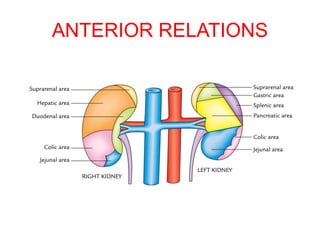
ANTERIOR RELATIONS
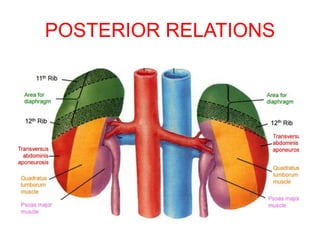
POSTERIOR RELATIONS
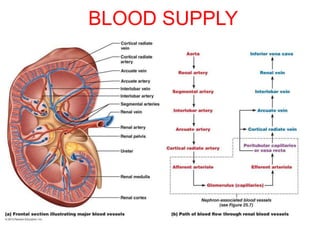
BLOOD SUPPLY
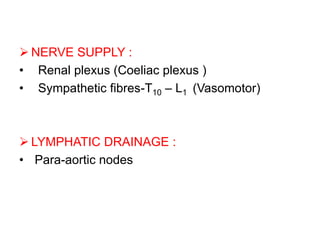
 NERVE SUPPLY :
• Renal plexus (Coeliac plexus )
• Sympathetic fibres-T10 – L1 (Vasomotor)
 LYMPHATIC DRAINAGE :
• Para-aortic nodes
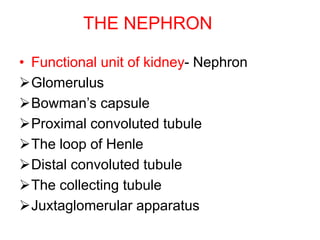
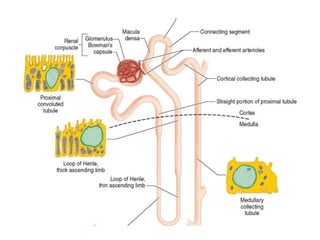
THE NEPHRON
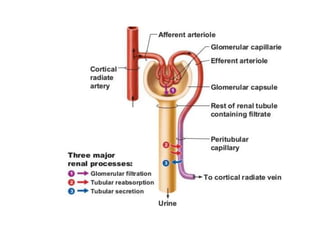
• Functional unit of kidney- Nephron
Glomerulus
Bowman’s capsule
Proximal convoluted tubule
The loop of Henle
Distal convoluted tubule
The collecting tubule
Juxtaglomerular apparatus
• Nephrons- 2 types :
 Cortical nephrons
(closer to the surface-Cortex)
 Juxtamedullary nephrons
(have tubules that descend into medulla)
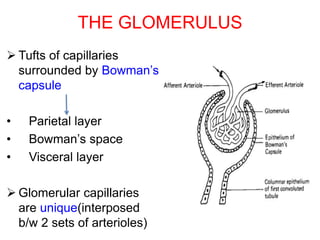
THE GLOMERULUS
 Tufts of capillaries
surrounded by Bowman’s
capsule
• Parietal layer
• Bowman’s space
• Visceral layer
 Glomerular capillaries
are unique(interposed
b/w 2 sets of arterioles)
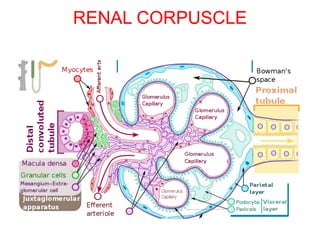
RENAL CORPUSCLE
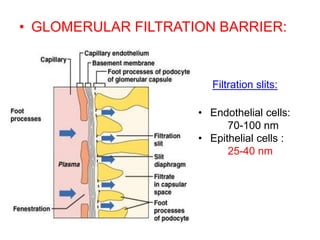
• GLOMERULAR FILTRATION BARRIER:
Filtration slits:
• Endothelial cells:
70-100 nm
• Epithelial cells :
25-40 nm
GLOMERULAR CAPILLARY PRESSURE:
 Function of vascular activity of both arterioles
 Favors glomerular filtration
 Causes water & LMW-substances to be filtered into
Bowman’s capsule & tubule system.
GLOMERULAR FILTRATE
 Composition-similar to plasma but without plasma
proteins & cellular elements
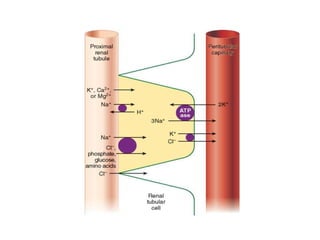
PROXIMAL CONVOLUTED TUBULE
 65-75% of ultrafiltrate –Reabsorbed
 Major function : Sodium reabsorption
• Actively transported out of PCT at their capillary
side by membrane-bound Na+-K+-ATPase
• Low intracellular concentration of Na+
• Passive movement of Na+ down its gradient
from tubular fluid into epithelial cells.
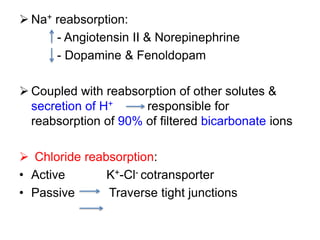
 Na+ reabsorption:
- Angiotensin II & Norepinephrine
- Dopamine & Fenoldopam
 Coupled with reabsorption of other solutes &
secretion of H+ responsible for
reabsorption of 90% of filtered bicarbonate ions
 Chloride reabsorption:
• Active K+-Cl- cotransporter
• Passive Traverse tight junctions
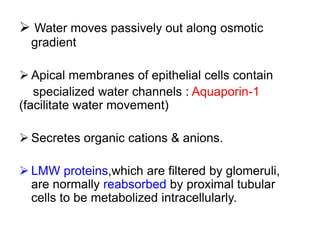
 Water moves passively out along osmotic
gradient
 Apical membranes of epithelial cells contain
specialized water channels : Aquaporin-1
(facilitate water movement)
 Secretes organic cations & anions.
 LMW proteins,which are filtered by glomeruli,
are normally reabsorbed by proximal tubular
cells to be metabolized intracellularly.
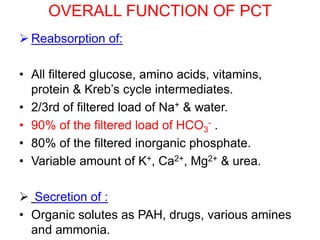
OVERALL FUNCTION OF PCT
 Reabsorption of:
• All filtered glucose, amino acids, vitamins,
protein & Kreb’s cycle intermediates.
• 2/3rd of filtered load of Na+ & water.
• 90% of the filtered load of HCO3
- .
• 80% of the filtered inorganic phosphate.
• Variable amount of K+, Ca2+, Mg2+ & urea.
 Secretion of :
• Organic solutes as PAH, drugs, various amines
and ammonia.
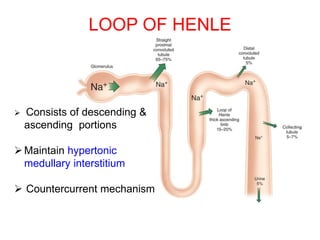
LOOP OF HENLE
 Consists of descending &
ascending portions
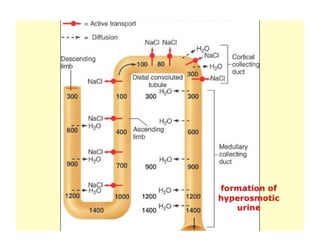
Maintain hypertonic
medullary interstitium
 Countercurrent mechanism
COUNTERCURRENT MECHANISM
 The ability of kidneys to produce either
dilute or concentrated urine depends on the
gradient in osmolarity b/w renal cortex &
medulla that is created by Loop of Henle
 Countercurrent Multiplier : LOH
 Countercurrent Exchanger : Vasa Recta
 THIN DESCENDING LIMB:
-Permeable to water
-Impermeable to ions & urea
 THIN ASCENDING LIMB :
-Permeable to ions & urea
-Impermeable to water
 THICK ASCENDING LIMB :
-Impermeable to water
-Moves ions via secondary active transport
involving luminal Na+-K+-2Cl- cotransporters
 OSMOLARITY of filtrate entering:
• Descending limb of LOH: Iso-osmolar
• Distal convoluted tubule: Hypo-osmolar
• Renal medullary intersitium: Hyper-osmolar
 LOH-Highly metabolically active
(requires good blood supply)
Osmolarity in renal medulla :
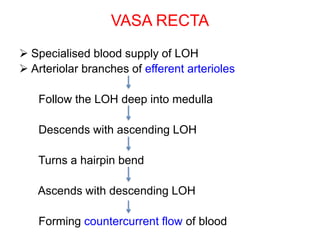
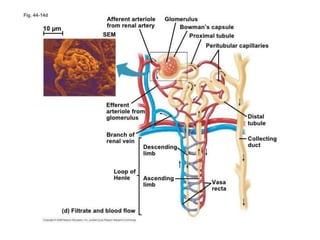
VASA RECTA
 Specialised blood supply of LOH
 Arteriolar branches of efferent arterioles
Follow the LOH deep into medulla
Descends with ascending LOH
Turns a hairpin bend
Ascends with descending LOH
Forming countercurrent flow of blood
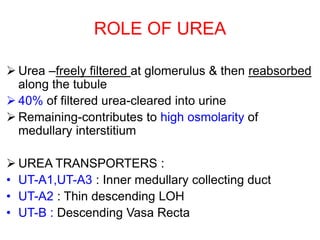
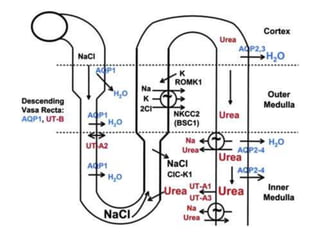
ROLE OF UREA
 Urea –freely filtered at glomerulus & then reabsorbed
along the tubule
 40% of filtered urea-cleared into urine
 Remaining-contributes to high osmolarity of
medullary interstitium
 UREA TRANSPORTERS :
• UT-A1,UT-A3 : Inner medullary collecting duct
• UT-A2 : Thin descending LOH
• UT-B : Descending Vasa Recta
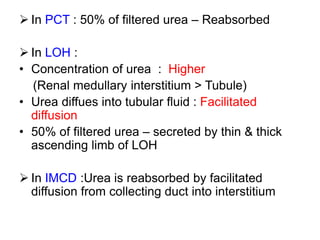
 In PCT : 50% of filtered urea – Reabsorbed
 In LOH :
• Concentration of urea : Higher
(Renal medullary interstitium > Tubule)
• Urea diffues into tubular fluid : Facilitated
diffusion
• 50% of filtered urea – secreted by thin & thick
ascending limb of LOH
 In IMCD :Urea is reabsorbed by facilitated
diffusion from collecting duct into interstitium
DISTAL CONVOLUTED TUBULE
 Receives hypotonic fluid from the LOH
 Responsible for only minor modifications of tubular
fluid
 In contrast to more proximal portions,
distal nephron has numerous tight junctions b/w
tubular cells relatively impermeable to water & sodium.
 Maintain the gradients generated by the LOH
OVERALL FUNCTION OF DCT
Reabsorption :
• 7-10% of filtered load of Na+
• 10-15% of filtered lead of H2O
Secretion : variable amount of H+ & K+
Major control site for Na+, K+, Ca2+ & acid-
base balance of body.
- Controlled by hormones
• Na reabsorption - Aldosterone
• H2O reabsorption - ADH
• Calcium reabsorption - PTH & vitamin-D
COLLECTING TUBULE
 Divided into :
Cortical & Medullary portions
 CORTICAL COLLECTING TUBULE :
2 cell types :
• Principal (P) cells- secrete K+ & aldosterone-
stimulated Na+ reabsorption
• Intercalated (I)cells-Acid-base regulation
MEDULLARY COLLECTING TUBULE:
 The high osmolarity in medulla allows for quick
reabsorption of water by osmosis mediated by
AQUAPORINS:
• Tetramer protein Channels that facilitate rapid
passage of water across lipid cell membranes
• Found in : kidneys, brain, salivary & lacrimal
glands & respiratory tract.
• Aquaporin-1- proximal renal tubules
• Aquaporin-2- renal collecting ducts.
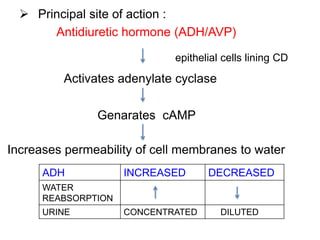
 Principal site of action :
Antidiuretic hormone (ADH/AVP)
Activates adenylate cyclase
Genarates cAMP
Increases permeability of cell membranes to water
epithelial cells lining CD
ADH INCREASED DECREASED
WATER
REABSORPTION
URINE CONCENTRATED DILUTED
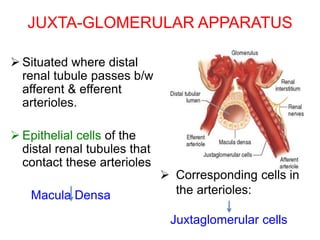
JUXTA-GLOMERULAR APPARATUS
 Situated where distal
renal tubule passes b/w
afferent & efferent
arterioles.
 Epithelial cells of the
distal renal tubules that
contact these arterioles
Macula Densa
 Corresponding cells in
the arterioles:
Juxtaglomerular cells
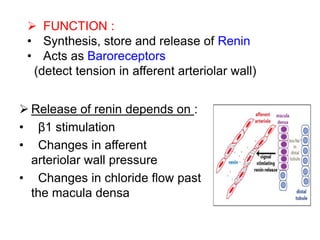
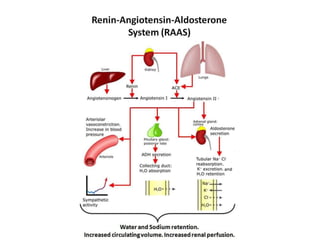
 Release of renin depends on :
• β1 stimulation
• Changes in afferent
arteriolar wall pressure
• Changes in chloride flow past
the macula densa
 FUNCTION :
• Synthesis, store and release of Renin
• Acts as Baroreceptors
(detect tension in afferent arteriolar wall)
TUBULAR TRANSPORT MAXIMUM
 Maximum amount of a substance that can
be actively reabsorbed from the lumens of
renal tubules each minute.
 Depends on :
• Amounts of carrier substance
• Enzyme available to the specific active
transport system in lining epithelial cells of
renal tubules.
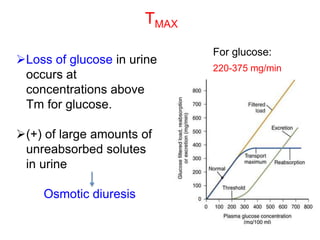
For glucose:
220-375 mg/min
Loss of glucose in urine
occurs at
concentrations above
Tm for glucose.
(+) of large amounts of
unreabsorbed solutes
in urine
Osmotic diuresis
TMAX
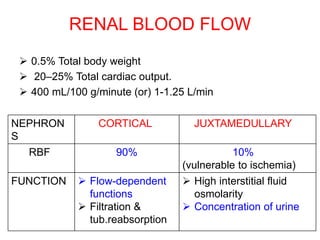
RENAL BLOOD FLOW
 0.5% Total body weight
 20–25% Total cardiac output.
 400 mL/100 g/minute (or) 1-1.25 L/min
NEPHRON
S
CORTICAL JUXTAMEDULLARY
RBF 90% 10%
(vulnerable to ischemia)
FUNCTION  Flow-dependent
functions
 Filtration &
tub.reabsorption
 High interstitial fluid
osmolarity
 Concentration of urine
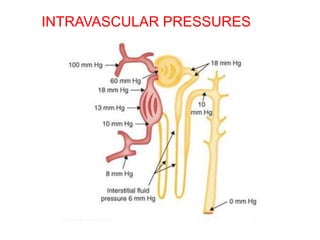
INTRAVASCULAR PRESSURES
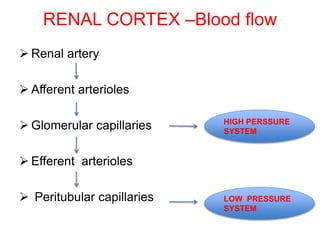
RENAL CORTEX –Blood flow
 Renal artery
 Afferent arterioles
 Glomerular capillaries
 Efferent arterioles
 Peritubular capillaries
HIGH PERSSURE
SYSTEM
LOW PRESSURE
SYSTEM
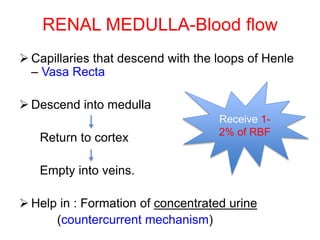
RENAL MEDULLA-Blood flow
 Capillaries that descend with the loops of Henle
– Vasa Recta
 Descend into medulla
Return to cortex
Empty into veins.
 Help in : Formation of concentrated urine
(countercurrent mechanism)
Receive 1-
2% of RBF
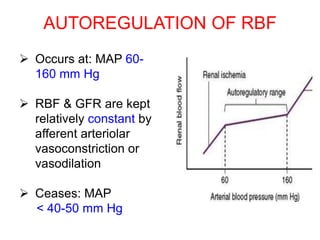
AUTOREGULATION OF RBF
 Occurs at: MAP 60-
160 mm Hg
 RBF & GFR are kept
relatively constant by
afferent arteriolar
vasoconstriction or
vasodilation
 Ceases: MAP
< 40-50 mm Hg
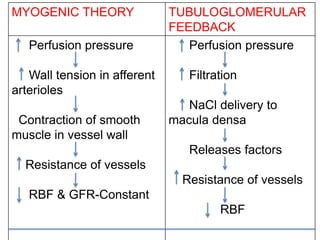
MYOGENIC THEORY TUBULOGLOMERULAR
FEEDBACK
Perfusion pressure
Wall tension in afferent
arterioles
Contraction of smooth
muscle in vessel wall
Resistance of vessels
RBF & GFR-Constant
Perfusion pressure
Filtration
NaCl delivery to
macula densa
Releases factors
Resistance of vessels
RBF
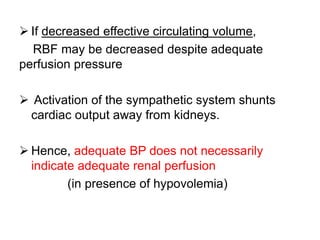
 If decreased effective circulating volume,
RBF may be decreased despite adequate
perfusion pressure
 Activation of the sympathetic system shunts
cardiac output away from kidneys.
 Hence, adequate BP does not necessarily
indicate adequate renal perfusion
(in presence of hypovolemia)
Measurement of RBF
 Renal plasma flow (RPF) : most commonly
measured by p-aminohippurate clearance
 PAH : Completely cleared from plasma
 RPF =Clearance of PAH= * Urine flow
RBF=
[PAH]U
[PAH]P
RPF
1-Hematocrit
 Normally, RPF 660 ml/min
RBF 1200 ml/min
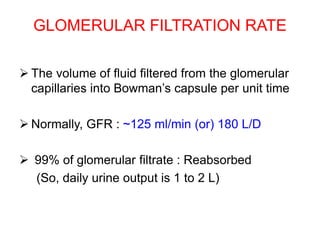
GLOMERULAR FILTRATION RATE
 The volume of fluid filtered from the glomerular
capillaries into Bowman’s capsule per unit time
 Normally, GFR : ~125 ml/min (or) 180 L/D
 99% of glomerular filtrate : Reabsorbed
(So, daily urine output is 1 to 2 L)
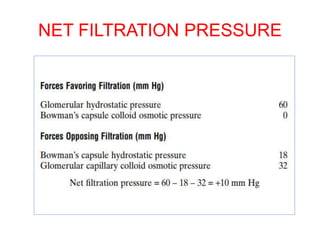
NET FILTRATION PRESSURE
FACTORS AFFECTING GFR
 Renal blood flow
 Glomerular capillary hydrostatic pressure
 Hydrostatic pressure in Bowman’s capsule
 Glomerular capillary permeability
 Effective filtration surface area
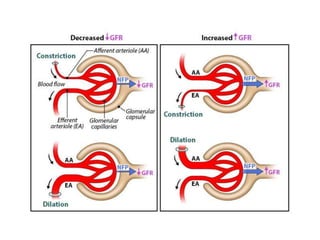
 Afferent or efferent arteriolar constriction
 Systemic blood pressure
 Ureteral obstruction
 Edema of kidney inside tight renal capsule
 Concentration of plasma proteins
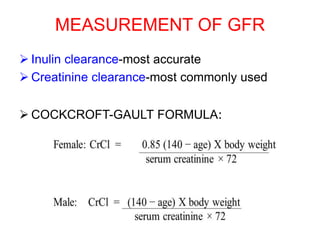
MEASUREMENT OF GFR
 Inulin clearance-most accurate
 Creatinine clearance-most commonly used
 COCKCROFT-GAULT FORMULA:
 Creatinine clearance =
[Urine]Cr * Volume
[Plasma]Cr
 Filtration fraction =
GFR
RPF
• Normally, FF = 20%
• Fraction of plasma that is
filtered by glomerulus
REGULATION OF RBF & GFR
 Intrinsic autoregulation
 Tubuloglomerular balance & feedback
 Hormonal regulation
 Neurocrine & Paracrine regulation
HORMONAL REGULATION :
 Angiotensin II
 Epinephrine & Norepinephrine
 Prostaglandins
 Atrial natriuretic peptide (ANP)
NEURONAL REGULATION :
 Sym.outflow (T4–L1) –celiac & renal plexus.
 Innervation:
β1-JG apparatus
α1-Renal vasculature
 α1 Na+ reabsorption in PCT
 α2 Na+ reabsorption & promote water
excretion.
 Dopamine & fenoldopam dilate afferent &
efferent arterioles (D1)
SODIUM HANDLING
 CHANGES IN GFR :
• Plasma volume - GFR - Na+ filtered
& excreted in urine
• Plasma volume - Na+ is conserved through
reduced GFR
 CHANGES IN Na+ REABSORPTION :
1)Bulk reabsorption in PCT & LOH
2) Reabsorption in DCT & Collecting duct
(Controlled by Aldosterone)
Bulk reabsorption in PCT & LOH :
 60% of filtered Na+ - Reabsorbed in PCT
-Driven by : Basolateral Na+-K+-ATPase pump
-Reabsorbed from tubular lumen by:
Passive diffusion, Co-transport with
glucose,Counter-transport with H+
 30% of filtered Na+- Reabsorbed in LOH
- Through Na+-K+-2Cl- co-transporter
Reabsorption in early DCT:
 90% of filtered Na+ - already reabsorbed before
filtrate reaches DCT
 Intracellular [Na+] –kept low as a result of
basolateral Na+-K+-ATPase
• Na+ transfer across tubular cell luminal
membrane-controlled by ALDOSTERONE
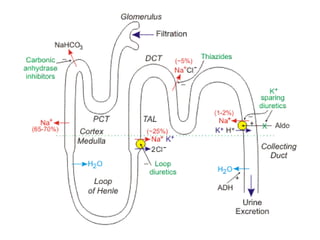
1) In DCT :
5% of filtered Na+ -Reabsorbed through Na+-Cl-
co-transporter in luminal membrane
2) In late DCT & Collecting duct :
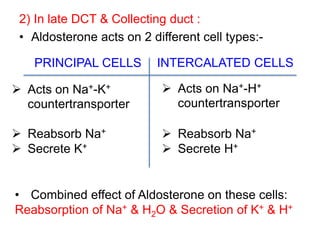
• Aldosterone acts on 2 different cell types:-
PRINCIPAL CELLS INTERCALATED CELLS
 Reabsorb Na+
 Secrete K+
 Reabsorb Na+
 Secrete H+
 Acts on Na+-K+
countertransporter
 Acts on Na+-H+
countertransporter
• Combined effect of Aldosterone on these cells:
Reabsorption of Na+ & H2O & Secretion of K+ & H+
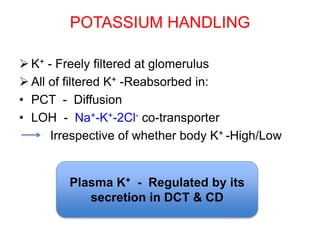
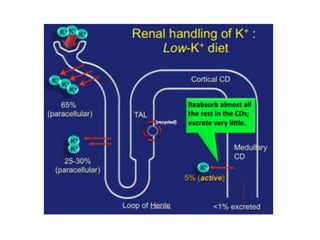
POTASSIUM HANDLING
 K+ - Freely filtered at glomerulus
 All of filtered K+ -Reabsorbed in:
• PCT - Diffusion
• LOH - Na+-K+-2Cl- co-transporter
Irrespective of whether body K+ -High/Low
Plasma K+ - Regulated by its
secretion in DCT & CD
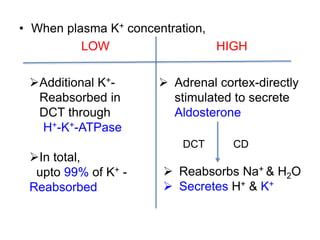
• When plasma K+ concentration,
LOW HIGH
Additional K+-
Reabsorbed in
DCT through
H+-K+-ATPase
In total,
upto 99% of K+ -
Reabsorbed
 Adrenal cortex-directly
stimulated to secrete
Aldosterone
 Reabsorbs Na+ & H2O
 Secretes H+ & K+
DCT CD
Renal  physiology
Renal  physiology

Renal physiology

  • 1.
  • 2.
    ANATOMY  Kidneys area paired organs situated on the posterior abdominal wall, one on each side of the vertebral column, in the retroperitoneal space.
  • 3.
    LOCATION  Extends from: T12 –L3 vertebra  Size : 11 cm long, 6 cm broad, 3 cm thick  Weight : 150g in males 130g in females  Colour : Reddish –brown  Shape : Bean-shaped
  • 4.
  • 5.
  • 6.
  • 7.
     NERVE SUPPLY: • Renal plexus (Coeliac plexus ) • Sympathetic fibres-T10 – L1 (Vasomotor)  LYMPHATIC DRAINAGE : • Para-aortic nodes
  • 8.
    THE NEPHRON • Functionalunit of kidney- Nephron Glomerulus Bowman’s capsule Proximal convoluted tubule The loop of Henle Distal convoluted tubule The collecting tubule Juxtaglomerular apparatus
  • 10.
    • Nephrons- 2types :  Cortical nephrons (closer to the surface-Cortex)  Juxtamedullary nephrons (have tubules that descend into medulla)
  • 11.
    THE GLOMERULUS  Tuftsof capillaries surrounded by Bowman’s capsule • Parietal layer • Bowman’s space • Visceral layer  Glomerular capillaries are unique(interposed b/w 2 sets of arterioles)
  • 12.
  • 13.
    • GLOMERULAR FILTRATIONBARRIER: Filtration slits: • Endothelial cells: 70-100 nm • Epithelial cells : 25-40 nm
  • 14.
    GLOMERULAR CAPILLARY PRESSURE: Function of vascular activity of both arterioles  Favors glomerular filtration  Causes water & LMW-substances to be filtered into Bowman’s capsule & tubule system. GLOMERULAR FILTRATE  Composition-similar to plasma but without plasma proteins & cellular elements
  • 16.
    PROXIMAL CONVOLUTED TUBULE 65-75% of ultrafiltrate –Reabsorbed  Major function : Sodium reabsorption • Actively transported out of PCT at their capillary side by membrane-bound Na+-K+-ATPase • Low intracellular concentration of Na+ • Passive movement of Na+ down its gradient from tubular fluid into epithelial cells.
  • 17.
     Na+ reabsorption: -Angiotensin II & Norepinephrine - Dopamine & Fenoldopam  Coupled with reabsorption of other solutes & secretion of H+ responsible for reabsorption of 90% of filtered bicarbonate ions  Chloride reabsorption: • Active K+-Cl- cotransporter • Passive Traverse tight junctions
  • 19.
     Water movespassively out along osmotic gradient  Apical membranes of epithelial cells contain specialized water channels : Aquaporin-1 (facilitate water movement)  Secretes organic cations & anions.  LMW proteins,which are filtered by glomeruli, are normally reabsorbed by proximal tubular cells to be metabolized intracellularly.
  • 20.
    OVERALL FUNCTION OFPCT  Reabsorption of: • All filtered glucose, amino acids, vitamins, protein & Kreb’s cycle intermediates. • 2/3rd of filtered load of Na+ & water. • 90% of the filtered load of HCO3 - . • 80% of the filtered inorganic phosphate. • Variable amount of K+, Ca2+, Mg2+ & urea.  Secretion of : • Organic solutes as PAH, drugs, various amines and ammonia.
  • 21.
    LOOP OF HENLE Consists of descending & ascending portions Maintain hypertonic medullary interstitium  Countercurrent mechanism
  • 22.
    COUNTERCURRENT MECHANISM  Theability of kidneys to produce either dilute or concentrated urine depends on the gradient in osmolarity b/w renal cortex & medulla that is created by Loop of Henle  Countercurrent Multiplier : LOH  Countercurrent Exchanger : Vasa Recta
  • 23.
     THIN DESCENDINGLIMB: -Permeable to water -Impermeable to ions & urea  THIN ASCENDING LIMB : -Permeable to ions & urea -Impermeable to water  THICK ASCENDING LIMB : -Impermeable to water -Moves ions via secondary active transport involving luminal Na+-K+-2Cl- cotransporters
  • 24.
     OSMOLARITY offiltrate entering: • Descending limb of LOH: Iso-osmolar • Distal convoluted tubule: Hypo-osmolar • Renal medullary intersitium: Hyper-osmolar  LOH-Highly metabolically active (requires good blood supply) Osmolarity in renal medulla :
  • 25.
    VASA RECTA  Specialisedblood supply of LOH  Arteriolar branches of efferent arterioles Follow the LOH deep into medulla Descends with ascending LOH Turns a hairpin bend Ascends with descending LOH Forming countercurrent flow of blood
  • 28.
    ROLE OF UREA Urea –freely filtered at glomerulus & then reabsorbed along the tubule  40% of filtered urea-cleared into urine  Remaining-contributes to high osmolarity of medullary interstitium  UREA TRANSPORTERS : • UT-A1,UT-A3 : Inner medullary collecting duct • UT-A2 : Thin descending LOH • UT-B : Descending Vasa Recta
  • 29.
     In PCT: 50% of filtered urea – Reabsorbed  In LOH : • Concentration of urea : Higher (Renal medullary interstitium > Tubule) • Urea diffues into tubular fluid : Facilitated diffusion • 50% of filtered urea – secreted by thin & thick ascending limb of LOH  In IMCD :Urea is reabsorbed by facilitated diffusion from collecting duct into interstitium
  • 31.
    DISTAL CONVOLUTED TUBULE Receives hypotonic fluid from the LOH  Responsible for only minor modifications of tubular fluid  In contrast to more proximal portions, distal nephron has numerous tight junctions b/w tubular cells relatively impermeable to water & sodium.  Maintain the gradients generated by the LOH
  • 32.
    OVERALL FUNCTION OFDCT Reabsorption : • 7-10% of filtered load of Na+ • 10-15% of filtered lead of H2O Secretion : variable amount of H+ & K+ Major control site for Na+, K+, Ca2+ & acid- base balance of body. - Controlled by hormones • Na reabsorption - Aldosterone • H2O reabsorption - ADH • Calcium reabsorption - PTH & vitamin-D
  • 33.
    COLLECTING TUBULE  Dividedinto : Cortical & Medullary portions  CORTICAL COLLECTING TUBULE : 2 cell types : • Principal (P) cells- secrete K+ & aldosterone- stimulated Na+ reabsorption • Intercalated (I)cells-Acid-base regulation
  • 34.
    MEDULLARY COLLECTING TUBULE: The high osmolarity in medulla allows for quick reabsorption of water by osmosis mediated by AQUAPORINS: • Tetramer protein Channels that facilitate rapid passage of water across lipid cell membranes • Found in : kidneys, brain, salivary & lacrimal glands & respiratory tract. • Aquaporin-1- proximal renal tubules • Aquaporin-2- renal collecting ducts.
  • 35.
     Principal siteof action : Antidiuretic hormone (ADH/AVP) Activates adenylate cyclase Genarates cAMP Increases permeability of cell membranes to water epithelial cells lining CD ADH INCREASED DECREASED WATER REABSORPTION URINE CONCENTRATED DILUTED
  • 36.
    JUXTA-GLOMERULAR APPARATUS  Situatedwhere distal renal tubule passes b/w afferent & efferent arterioles.  Epithelial cells of the distal renal tubules that contact these arterioles Macula Densa  Corresponding cells in the arterioles: Juxtaglomerular cells
  • 37.
     Release ofrenin depends on : • β1 stimulation • Changes in afferent arteriolar wall pressure • Changes in chloride flow past the macula densa  FUNCTION : • Synthesis, store and release of Renin • Acts as Baroreceptors (detect tension in afferent arteriolar wall)
  • 39.
    TUBULAR TRANSPORT MAXIMUM Maximum amount of a substance that can be actively reabsorbed from the lumens of renal tubules each minute.  Depends on : • Amounts of carrier substance • Enzyme available to the specific active transport system in lining epithelial cells of renal tubules.
  • 40.
    For glucose: 220-375 mg/min Lossof glucose in urine occurs at concentrations above Tm for glucose. (+) of large amounts of unreabsorbed solutes in urine Osmotic diuresis TMAX
  • 41.
    RENAL BLOOD FLOW 0.5% Total body weight  20–25% Total cardiac output.  400 mL/100 g/minute (or) 1-1.25 L/min NEPHRON S CORTICAL JUXTAMEDULLARY RBF 90% 10% (vulnerable to ischemia) FUNCTION  Flow-dependent functions  Filtration & tub.reabsorption  High interstitial fluid osmolarity  Concentration of urine
  • 42.
  • 43.
    RENAL CORTEX –Bloodflow  Renal artery  Afferent arterioles  Glomerular capillaries  Efferent arterioles  Peritubular capillaries HIGH PERSSURE SYSTEM LOW PRESSURE SYSTEM
  • 44.
    RENAL MEDULLA-Blood flow Capillaries that descend with the loops of Henle – Vasa Recta  Descend into medulla Return to cortex Empty into veins.  Help in : Formation of concentrated urine (countercurrent mechanism) Receive 1- 2% of RBF
  • 45.
    AUTOREGULATION OF RBF Occurs at: MAP 60- 160 mm Hg  RBF & GFR are kept relatively constant by afferent arteriolar vasoconstriction or vasodilation  Ceases: MAP < 40-50 mm Hg
  • 46.
    MYOGENIC THEORY TUBULOGLOMERULAR FEEDBACK Perfusionpressure Wall tension in afferent arterioles Contraction of smooth muscle in vessel wall Resistance of vessels RBF & GFR-Constant Perfusion pressure Filtration NaCl delivery to macula densa Releases factors Resistance of vessels RBF
  • 47.
     If decreasedeffective circulating volume, RBF may be decreased despite adequate perfusion pressure  Activation of the sympathetic system shunts cardiac output away from kidneys.  Hence, adequate BP does not necessarily indicate adequate renal perfusion (in presence of hypovolemia)
  • 48.
    Measurement of RBF Renal plasma flow (RPF) : most commonly measured by p-aminohippurate clearance  PAH : Completely cleared from plasma  RPF =Clearance of PAH= * Urine flow RBF= [PAH]U [PAH]P RPF 1-Hematocrit  Normally, RPF 660 ml/min RBF 1200 ml/min
  • 49.
    GLOMERULAR FILTRATION RATE The volume of fluid filtered from the glomerular capillaries into Bowman’s capsule per unit time  Normally, GFR : ~125 ml/min (or) 180 L/D  99% of glomerular filtrate : Reabsorbed (So, daily urine output is 1 to 2 L)
  • 50.
  • 51.
    FACTORS AFFECTING GFR Renal blood flow  Glomerular capillary hydrostatic pressure  Hydrostatic pressure in Bowman’s capsule  Glomerular capillary permeability  Effective filtration surface area  Afferent or efferent arteriolar constriction  Systemic blood pressure  Ureteral obstruction  Edema of kidney inside tight renal capsule  Concentration of plasma proteins
  • 53.
    MEASUREMENT OF GFR Inulin clearance-most accurate  Creatinine clearance-most commonly used  COCKCROFT-GAULT FORMULA:
  • 54.
     Creatinine clearance= [Urine]Cr * Volume [Plasma]Cr  Filtration fraction = GFR RPF • Normally, FF = 20% • Fraction of plasma that is filtered by glomerulus
  • 55.
    REGULATION OF RBF& GFR  Intrinsic autoregulation  Tubuloglomerular balance & feedback  Hormonal regulation  Neurocrine & Paracrine regulation
  • 56.
    HORMONAL REGULATION : Angiotensin II  Epinephrine & Norepinephrine  Prostaglandins  Atrial natriuretic peptide (ANP)
  • 57.
    NEURONAL REGULATION : Sym.outflow (T4–L1) –celiac & renal plexus.  Innervation: β1-JG apparatus α1-Renal vasculature  α1 Na+ reabsorption in PCT  α2 Na+ reabsorption & promote water excretion.  Dopamine & fenoldopam dilate afferent & efferent arterioles (D1)
  • 58.
    SODIUM HANDLING  CHANGESIN GFR : • Plasma volume - GFR - Na+ filtered & excreted in urine • Plasma volume - Na+ is conserved through reduced GFR  CHANGES IN Na+ REABSORPTION : 1)Bulk reabsorption in PCT & LOH 2) Reabsorption in DCT & Collecting duct (Controlled by Aldosterone)
  • 59.
    Bulk reabsorption inPCT & LOH :  60% of filtered Na+ - Reabsorbed in PCT -Driven by : Basolateral Na+-K+-ATPase pump -Reabsorbed from tubular lumen by: Passive diffusion, Co-transport with glucose,Counter-transport with H+  30% of filtered Na+- Reabsorbed in LOH - Through Na+-K+-2Cl- co-transporter
  • 60.
    Reabsorption in earlyDCT:  90% of filtered Na+ - already reabsorbed before filtrate reaches DCT  Intracellular [Na+] –kept low as a result of basolateral Na+-K+-ATPase • Na+ transfer across tubular cell luminal membrane-controlled by ALDOSTERONE 1) In DCT : 5% of filtered Na+ -Reabsorbed through Na+-Cl- co-transporter in luminal membrane
  • 61.
    2) In lateDCT & Collecting duct : • Aldosterone acts on 2 different cell types:- PRINCIPAL CELLS INTERCALATED CELLS  Reabsorb Na+  Secrete K+  Reabsorb Na+  Secrete H+  Acts on Na+-K+ countertransporter  Acts on Na+-H+ countertransporter • Combined effect of Aldosterone on these cells: Reabsorption of Na+ & H2O & Secretion of K+ & H+
  • 63.
    POTASSIUM HANDLING  K+- Freely filtered at glomerulus  All of filtered K+ -Reabsorbed in: • PCT - Diffusion • LOH - Na+-K+-2Cl- co-transporter Irrespective of whether body K+ -High/Low Plasma K+ - Regulated by its secretion in DCT & CD
  • 64.
    • When plasmaK+ concentration, LOW HIGH Additional K+- Reabsorbed in DCT through H+-K+-ATPase In total, upto 99% of K+ - Reabsorbed  Adrenal cortex-directly stimulated to secrete Aldosterone  Reabsorbs Na+ & H2O  Secretes H+ & K+ DCT CD

Editor's Notes

  • #14 Selectivity results from: 1) Effective pore siz of GC 2) particle charge
  • #48 As in case of SEPTIC SHOCK
  • #49 Req a substance tat s both freely filtered & actively secreted into tubule So tat all the substances entering renal arteries pass into urine
  • #54 Ideally produced endogenously at constant rate,freely filtered & not absorbed or secreted in tubules CREATININE-endogenous mol produced during ske.mus metabolism-measured using blood / 24 hr urine samples Ly an estimate of gfr . . . .as the rate of creatinine production is dep on skeletal muscle mass. . . .influenced by : age , sex, race Actively secreted into pct,accounting for 10-20% of excreted creatinine-overestimatn of GFR
  • #57 LOW SODIUM LOAD DELIVERY IN DCT….MAC.DENSA SESNSES IT & RELES RENIN AS EFF.ARTERIOLES R SMALLER...RESISTANCE BECOMES RELATIVELY GREATER THAN TAT OF AFFERENT ARTERIOLE.....GFR IS PRESERVED NE & E.....pref.increse aff.art tone......bt dont caus markd decrese in gfr.......as they increse renin rel also VD PG....D2 , E2 , I2.....protective mech during periods of sys.hypotension......protect frm R.ischemia ANP.......direct SM dilatr tat antagonises VC actn of NE & AT2.pref. ...dilates aff.art, constricts eff.art,relaxes mesangial cells.....increasing gfr Inhibits rel.of.renin & antagonises aldosterone actn
  • #58 Dopamine….....formd extraneuronally in prox.tubules from circulating l-dopa & rel.into tubules...........wre it binds wit dop.receptrs to reduce proximal reabsorptn of sodium