
DR. AMIR BAHADUR
Re-absorption and Secretion by
Nephron
Important to remember
Different types of cells and different
structures at different parts of
nephron causes different changes to
the filtrate
Difference of osmolality in various
parts of nephron causes changes to
filtrate
Different hormones/chemicals exert
their actions
Few basic facts
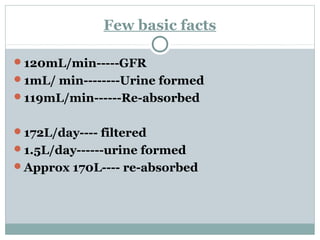
120mL/min-----GFR
1mL/ min--------Urine formed
119mL/min------Re-absorbed
172L/day---- filtered
1.5L/day------urine formed
Approx 170L---- re-absorbed
Filtrate
Water
Glucose
Amino acids
Bicarbonates
Sodium
Chloride
Phosphates
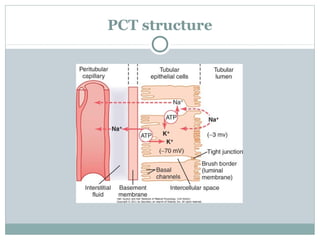
PCT structure
PCT--- series of events
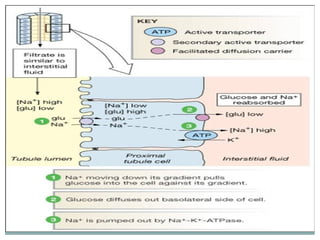
On baso-lateral membrane are 3Na/
2K ATPase. 3 Na out to interstitium,
2K inside to PCT cell
K- leaky channels---- K outside to
insterstitium
Above two events, set the start by
Negative electro-chemical state inside
the PCT cell
Sodium in PCT
Concentration gradient for sodium
Electric gradient for sodium
Sodium transporters (co-transporters)
Facilitated transport
Other arm of co-transporter can attach
glucose, chloride or amino acid.
Sodium is transported from lumen to PCT
cells via facilitated diffusion
65% sodium is re-absorbed in PCT
Glucose & Amino Acids in PCT
Co-transporters in the luminal brush border
with one arm for sodium and other for
glucose and amino acid.
Glucose and amino acids are transported via
secondary active transport from lumen to the
PCT cells.
100% of glucose and amino acids are re-
absorbed in PCT.
Chloride in PCT
Chloride is re-absorbed by same way as
glucose and amino acids.
Only difference is that preference is given to
glucose and amino acid and later chlorine is
take up.
Chloride re-absorption from lumen to PCT is
secondary active transport.
65% of chloride is re-absorbed in PCT
Bicarbonate
Not really re-absorbed
Rather replaced
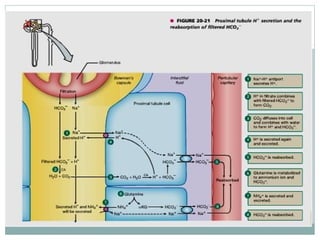
 hydrogen ions are transported from inside of
PCT to lumen of PCT via Na/H counter-transport
H combines with HCO3 in lumen to form
carbonic acid which dis-associates to CO2 and
H2O.
CO2 diffuse into PCT and combines with H2O to
form H and HCO3 ions.
HCO3 are transported to interstitium.
Water
Trans-cellular by the solutes
Para-cellular through tight junctions
Also solutes go along with water through
tight junctions
65% water is re-absorbed in PCT
Plasma proteins
Usually no plasma proteins are
filtered.
If filtered, PCT brush border has
affinity to get them attached
PINO-CYTOSIS and re-absorbed to
PCT cell
Secretion in to PCT lumen
Oxalates
Urates
Bile salts
Catecholamines
Toxins
Drugs
Secreted through special channels in the baso-
lateral surface. Transported across
concentration gradient from capp to
interstitium to PCT cell to Lumen.
Bit more in PCT
Minimal urea re-absorption across
concentration gradient.
PTH---- phosphate trashing hormone---
inhibits phosphate re-absorption.
Angiotensin II acts on PCT and increases
sodium re-absorption.
PCT cells also activates 25-hydroxy
cholecalciferol to 1,25 di-hydroxy
cholecalciferol
Leaving PCT
Same proportion of solutes and water are re-
absorbed in PCT hence; the osmolality of
filtrate entering and leaving PCT is SAME.
Though osmolality of the filtrate remains the
same, quantity of water and solutes
decreases.
Descending Loop of Henle
Cells are freely permeable to water
Cells are minimally active metabolically
No brush border and not much of ATPases
Descending limb is freely permeable to water
and interstitium is hyper-osmolar so water
re-absorbed.
20% of water here.
Descending Loop of Henle
Water going out, solutes retained and further
solutes coming in---- all across conentration
gradient.
Filtrate is concentrated so much that filtrate
osmolality equals that of interstitium.
Ascending Loop of Henle
Ascending Loop of Henle is totally
impermeable to water up to half of distal
convoluted tubule.
Hyper-osmotic filtrate reach thick part of
ascending Loop of Henle
Thick part of ALOH
On the baso-lateral membrane of this part,
3Na/2K ATPases and they create negative
gradient inside the cell.
The luminal membrane has Na-K-2Cl co-
transporter which pumps 1 sodium, 1
pottasium and 2 chlorides in to the cells from
lumen.
This sodium is pumped out in to the
interstitium by the ATPases.
Chloride moves to interstitium via chloride
channels.
Thick part of ALOH
K is getting in to the cell via Na/K ATPases
and also by Na-K-2Cl co-transport.
Cell is TOO RICH in potassium.
Potassium leaks to lumen via leaky channels
and make the lumen electro-positive.
This electro-positivity of lumen created by
potassium excess repels the calcium and
magnesium ions of the filtrate.
This repulsive force cause re-absorption of
Ca and Mg through tight junctions.
Thick part of ALOH
Processes of re-absorbing solutes with out
water causes…….
a)Increase of osmolality in interstitium
b)Decrease of osmolality in the tubules.
So this part is also called DILUTING SEGMENT
Thick part of ALOH
25% sodium is re-absorbed
25% chloride is re-absorbed
How much water?
Loop diuretics
Frusemide
Blocks Na-K-2Cl co-transport.
More sodium going next part
More Ca and Mg going next part
Less K going next part
Early Distal Convoluted Tubules
First half of EDCT have same roles as that of
ALOH
Diluting segment
At start of EDCT is present-------?
Mechanism of solutes re-absorption is bit
different.
EDCT
3Na/2K ATPases at baso-lateral membrane
Na/Cl co-transport channels at luminal
membrane instead of Na-K-2Cl co-
transporters
EDCT cell is negative inside, Na poor cell
5% Na is re-absorbed in DCT
Thiazide diuretic
Thiazide diuretics can block this Na/Cl co-
transporter and causes diuresis
Weak diuretic
Calcium conserving diuretic
EDCT---- calcium re-absorption
Para-thyroid hormonal acts on EDCT for re-
absorption of calcium.
PTH increases the activity of calcium pump
and Ca/Na exchanger at baso-lateral
membrane and make cell calcium poor
hence; increase calcium re-absorption via
calcium channels.
Late DCT & Cortical Collecting tubules
Discussed together due to same properties
Principal cells and inter-calated cells
Inter-calated Cells
Inter-calated cells are special cells meant for
hydrogen secretion.
H ions are produced in the inter-calated cells
by decomposition of carbonic acid and H ion
is transported to lumen by H-ATPases on
luminal membrane.
HCO3 produced is supplied to circulation
hence; called bicarbonate factory
Principal Cells
Baso-lateral membrane has 3Na/2K ATPases,
making cells Na poor.
Luminal membrane has Na and K channels.
Na moves to the principal cells across
electrical gradient.
Potassium moves out from cell to lumen
through K channels across electrical
gradient.
Principal Cells
Aldosterone acts on principal cells
Increases the ATPases activity on baso-lateral
membrane, making cells more poor in Na
and more rich in K
Also K channels are increased on luminal
membrane
Na channels are also increased and Na re-
absorption is increased.
Increased Na re-absorption, drag extra water
as well.
K- sparing Diuretics
Spironolactone
Blocks the action of aldosterone
Less K is secreted to the lumen.
Amiloride/ triamterine
Block Na channels
Less K is secreted to the lumen
Principal Cells
Anti-diuretic Hormone (ADH)
In absence of ADH, no water pores on
luminal membrane, water not absorbed.
In presence of ADH, water pores on luminal
side apparent and water re-absorption
increases.
Medullary Collecting Tubles
Some of the cells act as principal cells and
some act as inter-calated cells.
Final tunning of urine osmolality.
Special receptors for urea.
Urea is transported to inerstitium via
concentration gradient which is taken in to
the loop of Henle again and put in to the cycle
again.
Re absorption and secretion by nephron

Re absorption and secretion by nephron

  • 1.
    DR. AMIR BAHADUR Re-absorptionand Secretion by Nephron
  • 2.
    Important to remember Differenttypes of cells and different structures at different parts of nephron causes different changes to the filtrate Difference of osmolality in various parts of nephron causes changes to filtrate Different hormones/chemicals exert their actions
  • 3.
    Few basic facts 120mL/min-----GFR 1mL/min--------Urine formed 119mL/min------Re-absorbed 172L/day---- filtered 1.5L/day------urine formed Approx 170L---- re-absorbed
  • 4.
  • 5.
  • 6.
    PCT--- series ofevents On baso-lateral membrane are 3Na/ 2K ATPase. 3 Na out to interstitium, 2K inside to PCT cell K- leaky channels---- K outside to insterstitium Above two events, set the start by Negative electro-chemical state inside the PCT cell
  • 7.
    Sodium in PCT Concentrationgradient for sodium Electric gradient for sodium Sodium transporters (co-transporters) Facilitated transport Other arm of co-transporter can attach glucose, chloride or amino acid. Sodium is transported from lumen to PCT cells via facilitated diffusion 65% sodium is re-absorbed in PCT
  • 8.
    Glucose & AminoAcids in PCT Co-transporters in the luminal brush border with one arm for sodium and other for glucose and amino acid. Glucose and amino acids are transported via secondary active transport from lumen to the PCT cells. 100% of glucose and amino acids are re- absorbed in PCT.
  • 9.
    Chloride in PCT Chlorideis re-absorbed by same way as glucose and amino acids. Only difference is that preference is given to glucose and amino acid and later chlorine is take up. Chloride re-absorption from lumen to PCT is secondary active transport. 65% of chloride is re-absorbed in PCT
  • 11.
    Bicarbonate Not really re-absorbed Ratherreplaced  hydrogen ions are transported from inside of PCT to lumen of PCT via Na/H counter-transport H combines with HCO3 in lumen to form carbonic acid which dis-associates to CO2 and H2O. CO2 diffuse into PCT and combines with H2O to form H and HCO3 ions. HCO3 are transported to interstitium.
  • 13.
    Water Trans-cellular by thesolutes Para-cellular through tight junctions Also solutes go along with water through tight junctions 65% water is re-absorbed in PCT
  • 14.
    Plasma proteins Usually noplasma proteins are filtered. If filtered, PCT brush border has affinity to get them attached PINO-CYTOSIS and re-absorbed to PCT cell
  • 15.
    Secretion in toPCT lumen Oxalates Urates Bile salts Catecholamines Toxins Drugs Secreted through special channels in the baso- lateral surface. Transported across concentration gradient from capp to interstitium to PCT cell to Lumen.
  • 16.
    Bit more inPCT Minimal urea re-absorption across concentration gradient. PTH---- phosphate trashing hormone--- inhibits phosphate re-absorption. Angiotensin II acts on PCT and increases sodium re-absorption. PCT cells also activates 25-hydroxy cholecalciferol to 1,25 di-hydroxy cholecalciferol
  • 17.
    Leaving PCT Same proportionof solutes and water are re- absorbed in PCT hence; the osmolality of filtrate entering and leaving PCT is SAME. Though osmolality of the filtrate remains the same, quantity of water and solutes decreases.
  • 18.
    Descending Loop ofHenle Cells are freely permeable to water Cells are minimally active metabolically No brush border and not much of ATPases Descending limb is freely permeable to water and interstitium is hyper-osmolar so water re-absorbed. 20% of water here.
  • 19.
    Descending Loop ofHenle Water going out, solutes retained and further solutes coming in---- all across conentration gradient. Filtrate is concentrated so much that filtrate osmolality equals that of interstitium.
  • 20.
    Ascending Loop ofHenle Ascending Loop of Henle is totally impermeable to water up to half of distal convoluted tubule. Hyper-osmotic filtrate reach thick part of ascending Loop of Henle
  • 21.
    Thick part ofALOH On the baso-lateral membrane of this part, 3Na/2K ATPases and they create negative gradient inside the cell. The luminal membrane has Na-K-2Cl co- transporter which pumps 1 sodium, 1 pottasium and 2 chlorides in to the cells from lumen. This sodium is pumped out in to the interstitium by the ATPases. Chloride moves to interstitium via chloride channels.
  • 22.
    Thick part ofALOH K is getting in to the cell via Na/K ATPases and also by Na-K-2Cl co-transport. Cell is TOO RICH in potassium. Potassium leaks to lumen via leaky channels and make the lumen electro-positive. This electro-positivity of lumen created by potassium excess repels the calcium and magnesium ions of the filtrate. This repulsive force cause re-absorption of Ca and Mg through tight junctions.
  • 23.
    Thick part ofALOH Processes of re-absorbing solutes with out water causes……. a)Increase of osmolality in interstitium b)Decrease of osmolality in the tubules. So this part is also called DILUTING SEGMENT
  • 24.
    Thick part ofALOH 25% sodium is re-absorbed 25% chloride is re-absorbed How much water?
  • 25.
    Loop diuretics Frusemide Blocks Na-K-2Clco-transport. More sodium going next part More Ca and Mg going next part Less K going next part
  • 26.
    Early Distal ConvolutedTubules First half of EDCT have same roles as that of ALOH Diluting segment At start of EDCT is present-------? Mechanism of solutes re-absorption is bit different.
  • 27.
    EDCT 3Na/2K ATPases atbaso-lateral membrane Na/Cl co-transport channels at luminal membrane instead of Na-K-2Cl co- transporters EDCT cell is negative inside, Na poor cell 5% Na is re-absorbed in DCT
  • 28.
    Thiazide diuretic Thiazide diureticscan block this Na/Cl co- transporter and causes diuresis Weak diuretic Calcium conserving diuretic
  • 29.
    EDCT---- calcium re-absorption Para-thyroidhormonal acts on EDCT for re- absorption of calcium. PTH increases the activity of calcium pump and Ca/Na exchanger at baso-lateral membrane and make cell calcium poor hence; increase calcium re-absorption via calcium channels.
  • 30.
    Late DCT &Cortical Collecting tubules Discussed together due to same properties Principal cells and inter-calated cells
  • 31.
    Inter-calated Cells Inter-calated cellsare special cells meant for hydrogen secretion. H ions are produced in the inter-calated cells by decomposition of carbonic acid and H ion is transported to lumen by H-ATPases on luminal membrane. HCO3 produced is supplied to circulation hence; called bicarbonate factory
  • 32.
    Principal Cells Baso-lateral membranehas 3Na/2K ATPases, making cells Na poor. Luminal membrane has Na and K channels. Na moves to the principal cells across electrical gradient. Potassium moves out from cell to lumen through K channels across electrical gradient.
  • 33.
    Principal Cells Aldosterone actson principal cells Increases the ATPases activity on baso-lateral membrane, making cells more poor in Na and more rich in K Also K channels are increased on luminal membrane Na channels are also increased and Na re- absorption is increased. Increased Na re-absorption, drag extra water as well.
  • 34.
    K- sparing Diuretics Spironolactone Blocksthe action of aldosterone Less K is secreted to the lumen. Amiloride/ triamterine Block Na channels Less K is secreted to the lumen
  • 35.
    Principal Cells Anti-diuretic Hormone(ADH) In absence of ADH, no water pores on luminal membrane, water not absorbed. In presence of ADH, water pores on luminal side apparent and water re-absorption increases.
  • 36.
    Medullary Collecting Tubles Someof the cells act as principal cells and some act as inter-calated cells. Final tunning of urine osmolality. Special receptors for urea. Urea is transported to inerstitium via concentration gradient which is taken in to the loop of Henle again and put in to the cycle again.