Figurative Sculpture History
Sculpture
Manami Ishimura
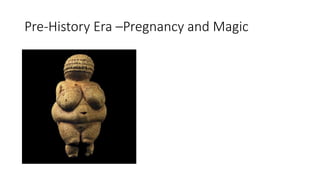
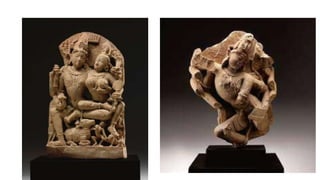
Pre-History Era –Pregnancy and Magic
Greek Era – Philosophy and Principles
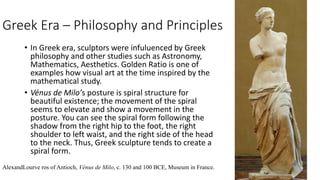
AlexandLourve ros of Antioch, Vénus de Milo, c. 130 and 100 BCE, Museum in France.
• In Greek era, sculptors were infuluenced by Greek
philosophy and other studies such as Astronomy,
Mathematics, Aesthetics. Golden Ratio is one of
examples how visual art at the time inspired by the
mathematical study.
• Vénus de Milo’s posture is spiral structure for
beautiful existence; the movement of the spiral
seems to elevate and show a movement in the
posture. You can see the spiral form following the
shadow from the right hip to the foot, the right
shoulder to left waist, and the right side of the head
to the neck. Thus, Greek sculpture tends to create a
spiral form.
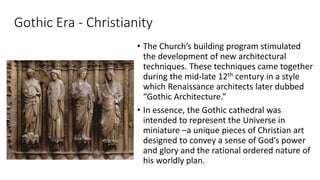
Gothic Era - Christianity
• The Church’s building program stimulated
the development of new architectural
techniques. These techniques came together
during the mid-late 12th century in a style
which Renaissance architects later dubbed
“Gothic Architecture.”
• In essence, the Gothic cathedral was
intended to represent the Universe in
miniature –a unique pieces of Christian art
designed to convey a sense of God’s power
and glory and the rational ordered nature of
his worldly plan.
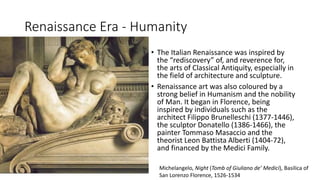
Renaissance Era - Humanity
• The Italian Renaissance was inspired by
the “rediscovery” of, and reverence for,
the arts of Classical Antiquity, especially in
the field of architecture and sculpture.
• Renaissance art was also coloured by a
strong belief in Humanism and the nobility
of Man. It began in Florence, being
inspired by individuals such as the
architect Filippo Brunelleschi (1377-1446),
the sculptor Donatello (1386-1466), the
painter Tommaso Masaccio and the
theorist Leon Battista Alberti (1404-72),
and financed by the Medici Family.
Michelangelo, Night (Tomb of Giuliano de’ Medici), Basilica of
San Lorenzo Florence, 1526-1534
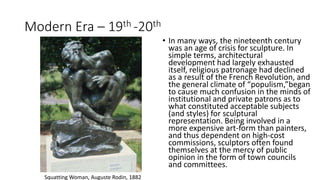
Modern Era – 19th -20th
• In many ways, the nineteenth century
was an age of crisis for sculpture. In
simple terms, architectural
development had largely exhausted
itself, religious patronage had declined
as a result of the French Revolution, and
the general climate of “populism,”began
to cause much confusion in the minds of
institutional and private patrons as to
what constituted acceptable subjects
(and styles) for sculptural
representation. Being involved in a
more expensive art-form than painters,
and thus dependent on high-cost
commissions, sculptors often found
themselves at the mercy of public
opinion in the form of town councils
and committees.
Squatting Woman, Auguste Rodin, 1882
Western / Eastern
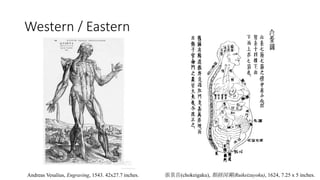
Andreas Vesalius, Engraving, 1543. 42x27.7 inches. 張景岳(chokeigaku), 類経図翼(Ruikeizuyoku), 1624, 7.25 x 5 inches.
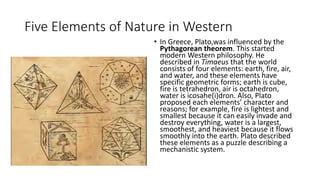
Five Elements of Nature in Western
• In Greece, Plato,was influenced by the
Pythagorean theorem. This started
modern Western philosophy. He
described in Timaeus that the world
consists of four elements: earth, fire, air,
and water, and these elements have
specific geometric forms; earth is cube,
fire is tetrahedron, air is octahedron,
water is icosahe(i)dron. Also, Plato
proposed each elements’ character and
reasons; for example, fire is lightest and
smallest because it can easily invade and
destroy everything, water is a largest,
smoothest, and heaviest because it flows
smoothly into the earth. Plato described
these elements as a puzzle describing a
mechanistic system.
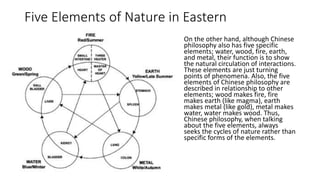
Five Elements of Nature in Eastern
• On the other hand, although Chinese
philosophy also has five specific
elements; water, wood, fire, earth,
and metal, their function is to show
the natural circulation of interactions.
These elements are just turning
points of phenomena. Also, the five
elements of Chinese philosophy are
described in relationship to other
elements; wood makes fire, fire
makes earth (like magma), earth
makes metal (like gold), metal makes
water, water makes wood. Thus,
Chinese philosophy, when talking
about the five elements, always
seeks the cycles of nature rather than
specific forms of the elements.
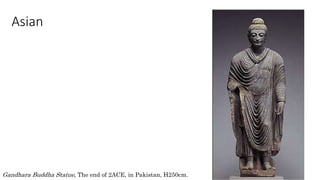
Asian
Gandhara Buddha Statue, The end of 2ACE, in Pakistan, H250cm.
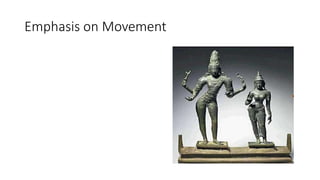
Emphasis on Movement
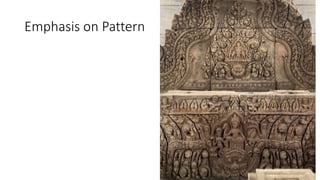
Emphasis on Pattern
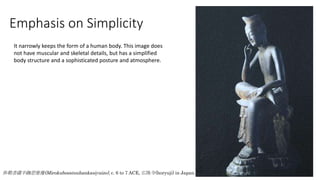
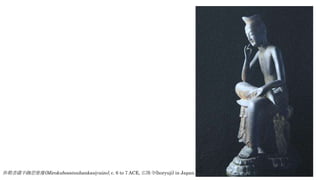
弥勒菩薩半跏思惟像(Mirokubosatsuhankasiyuizo), c. 6 to 7 ACE, 広隆寺(horyuji) in Japan.
Emphasis on Simplicity
It narrowly keeps the form of a human body. This image does
not have muscular and skeletal details, but has a simplified
body structure and a sophisticated posture and atmosphere.
Oceanian / Native American / African Art
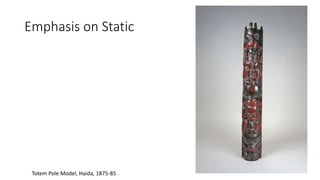
Emphasis on Static
Totem Pole Model, Haida, 1875-85
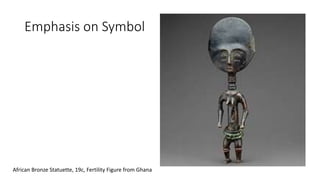
Emphasis on Symbol
African Bronze Statuette, 19c, Fertility Figure from Ghana
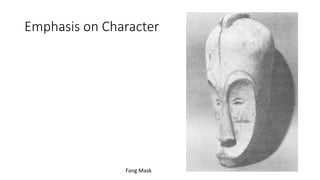
Emphasis on Character
Fang Mask
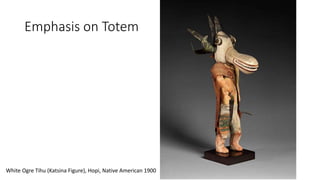
Emphasis on Totem
White Ogre Tihu (Katsina Figure), Hopi, Native American 1900
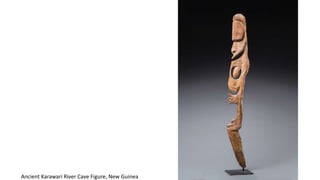
Ancient Karawari River Cave Figure, New Guinea
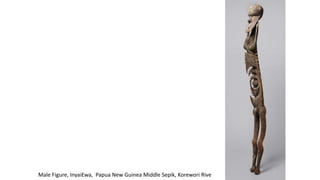
Male Figure, InyaiEwa, Papua New Guinea Middle Sepik, Korewori Rive
Modern Era- 20th
• Western sculpture really began to change at the turn of the 21st
century. For the influence of tribal cultures on the development of
20th century sculpture, “primitive art.”
• In particular, note the impact of African sculptures on modern
sculptor of the Ecole of Paris.
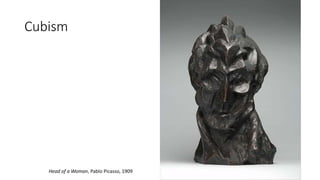
Cubism
Head of a Woman, Pablo Picasso, 1909
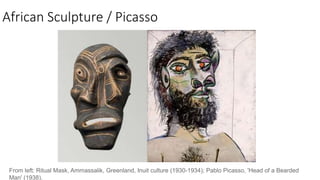
African Sculpture / Picasso
From left: Ritual Mask, Ammassalik, Greenland, Inuit culture (1930-1934); Pablo Picasso, 'Head of a Bearded
Man' (1938).
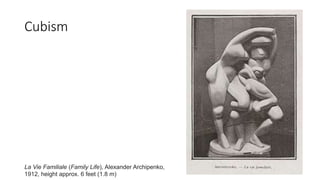
Cubism
La Vie Familiale (Family Life), Alexander Archipenko,
1912, height approx. 6 feet (1.8 m)
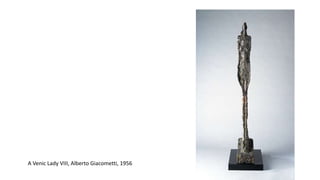
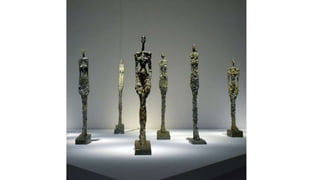
A Venic Lady VIII, Alberto Giacometti, 1956
弥勒菩薩半跏思惟像(Mirokubosatsuhankasiyuizo), c. 6 to 7 ACE, 広隆寺(horyuji) in Japan.
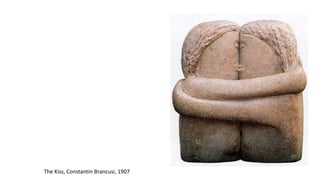
The Kiss, Constantin Brancusi, 1907
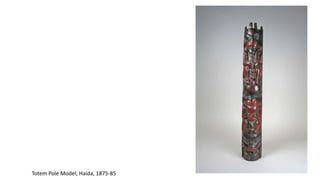
Totem Pole Model, Haida, 1875-85
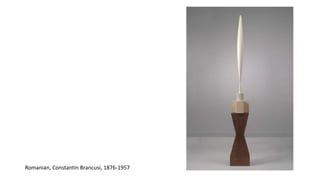
Romanian, Constantin Brancusi, 1876-1957
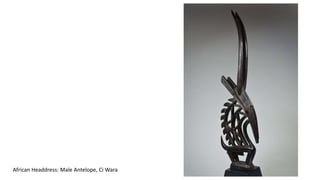
African Headdress: Male Antelope, Ci Wara
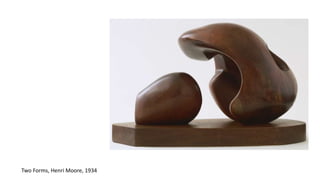
Two Forms, Henri Moore, 1934
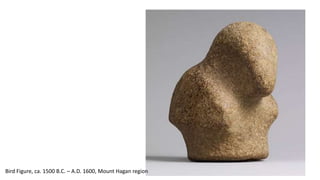
Bird Figure, ca. 1500 B.C. – A.D. 1600, Mount Hagan region
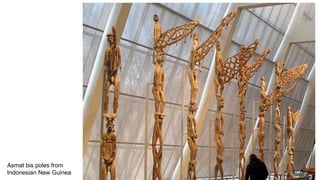
Asmat bis poles from
Indonesian New Guinea
Resource
Ball, Philip. Branches: Nature's Patterns: A Tapestry in Three Parts (Natures Patterns). Oxford: Oxford Univ. Press, 2011.
Benjamin, Rowland Jr. "Notes on the Dated Statues of the Northern Wei Dynasty and the Beginnings of Buddhist Sculpture in China." The Art Bulletin 19, no. 1 (March
1937): 92,107. ttp://www.jstor.org/stable/3045664.
Berg, Maxine, and Kristine Bruland. Technological Revolutions in Europe: Historical Perspectives. Chelten, UK: Edward Elgar, 1998.
Black, John A. The Four Elements in Plato's Timaeus. Lewiston, NY: Edwin Mellen Press, 2000.
Cook, Theodore Andrea. The Curves of Life: Being an Account of Spiral Formations and Their Application to Growth in Nature, to Science, and to Art: With Special
Reference to the Manuscripts of Leonardo Da Vinci. New York: Dover Publications, 1979.
Cooper, Frederick, and Ann Laura. Stoler. Tensions of Empire: Colonial Cultures in a Bourgeois World. Berkeley, CA: University of California Press, 1997. Pp198-237.
Donald Harms (2011) Geometry of the Mandala, Jung Journal, 5:2, 84-101, DOI: 10.1525/jung.2011.5.2.84
Jacobi, Jolande, and Ralph Manheim. The Psychology of C.G. Jung: An Introduction with Illustrations. New Haven: Yale University Press, 1973. P139.
LE DOUBLE, Frédéric Marie Auguste Aimé. n.p.: Oxford University Press, 2006. Grove Art Online, EBSCOhost (accessed December 4, 2016).
Message, Kylie. "Museums in the Twenty-first Century: Still Looking for Signs of Difference." Konsthistorisk Tidskrift 78, no. 4 (December 2009): 204. Publisher Provided Full Text
Searching File, EBSCOhost (accessed November 30, 2016).
宮崎, 興二(Miyazaki, Kōji). An Adventure in Multidimensional Space: The Art and Geometry of Polygons, Polyhedra, and Polytopes. New York: Wiley, 1986.
Ong, Ling. "The Kinesthetic Buddha, Human Form and Function—Part 1: Breathing Torso." Journal of Bodywork and Movement Therapies 11, no. 3 (2007): 214-22.
doi:10.1016/j.jbmt.2007.04.004.
Plato, and Peter Kalkavage. Plato‘s Timaeus: Translation, Glossary, Appendices and Introductory Essay. Newburyport, MA: Focus Pub./R. Pullins, 2001.
渡辺, 迪男(Watanabe, Michio). Kodai Kanpō Igaku Nyūmon: Jintai No Shizen Na Shikumi. Tōkyō: Taniguchishoten, 2013.
Williams, Robert. Art Theory: An Historical Introduction. Chichester, U.K.: Wiley-Blackwell, 2009.
Yuasa, Yukihiko. Kinshiroku. Tokyo, Japan: Tachibana Shuppan, 1996.
http://www.visual-arts-cork.com/sculpture-history.htm#gothic

Figurative sculpture history

  • 1.
  • 2.
  • 3.
    Greek Era –Philosophy and Principles AlexandLourve ros of Antioch, Vénus de Milo, c. 130 and 100 BCE, Museum in France. • In Greek era, sculptors were infuluenced by Greek philosophy and other studies such as Astronomy, Mathematics, Aesthetics. Golden Ratio is one of examples how visual art at the time inspired by the mathematical study. • Vénus de Milo’s posture is spiral structure for beautiful existence; the movement of the spiral seems to elevate and show a movement in the posture. You can see the spiral form following the shadow from the right hip to the foot, the right shoulder to left waist, and the right side of the head to the neck. Thus, Greek sculpture tends to create a spiral form.
  • 4.
    Gothic Era -Christianity • The Church’s building program stimulated the development of new architectural techniques. These techniques came together during the mid-late 12th century in a style which Renaissance architects later dubbed “Gothic Architecture.” • In essence, the Gothic cathedral was intended to represent the Universe in miniature –a unique pieces of Christian art designed to convey a sense of God’s power and glory and the rational ordered nature of his worldly plan.
  • 5.
    Renaissance Era -Humanity • The Italian Renaissance was inspired by the “rediscovery” of, and reverence for, the arts of Classical Antiquity, especially in the field of architecture and sculpture. • Renaissance art was also coloured by a strong belief in Humanism and the nobility of Man. It began in Florence, being inspired by individuals such as the architect Filippo Brunelleschi (1377-1446), the sculptor Donatello (1386-1466), the painter Tommaso Masaccio and the theorist Leon Battista Alberti (1404-72), and financed by the Medici Family. Michelangelo, Night (Tomb of Giuliano de’ Medici), Basilica of San Lorenzo Florence, 1526-1534
  • 6.
    Modern Era –19th -20th • In many ways, the nineteenth century was an age of crisis for sculpture. In simple terms, architectural development had largely exhausted itself, religious patronage had declined as a result of the French Revolution, and the general climate of “populism,”began to cause much confusion in the minds of institutional and private patrons as to what constituted acceptable subjects (and styles) for sculptural representation. Being involved in a more expensive art-form than painters, and thus dependent on high-cost commissions, sculptors often found themselves at the mercy of public opinion in the form of town councils and committees. Squatting Woman, Auguste Rodin, 1882
  • 7.
    Western / Eastern AndreasVesalius, Engraving, 1543. 42x27.7 inches. 張景岳(chokeigaku), 類経図翼(Ruikeizuyoku), 1624, 7.25 x 5 inches.
  • 8.
    Five Elements ofNature in Western • In Greece, Plato,was influenced by the Pythagorean theorem. This started modern Western philosophy. He described in Timaeus that the world consists of four elements: earth, fire, air, and water, and these elements have specific geometric forms; earth is cube, fire is tetrahedron, air is octahedron, water is icosahe(i)dron. Also, Plato proposed each elements’ character and reasons; for example, fire is lightest and smallest because it can easily invade and destroy everything, water is a largest, smoothest, and heaviest because it flows smoothly into the earth. Plato described these elements as a puzzle describing a mechanistic system.
  • 9.
    Five Elements ofNature in Eastern • On the other hand, although Chinese philosophy also has five specific elements; water, wood, fire, earth, and metal, their function is to show the natural circulation of interactions. These elements are just turning points of phenomena. Also, the five elements of Chinese philosophy are described in relationship to other elements; wood makes fire, fire makes earth (like magma), earth makes metal (like gold), metal makes water, water makes wood. Thus, Chinese philosophy, when talking about the five elements, always seeks the cycles of nature rather than specific forms of the elements.
  • 10.
    Asian Gandhara Buddha Statue,The end of 2ACE, in Pakistan, H250cm.
  • 11.
  • 12.
  • 13.
    弥勒菩薩半跏思惟像(Mirokubosatsuhankasiyuizo), c. 6to 7 ACE, 広隆寺(horyuji) in Japan. Emphasis on Simplicity It narrowly keeps the form of a human body. This image does not have muscular and skeletal details, but has a simplified body structure and a sophisticated posture and atmosphere.
  • 14.
    Oceanian / NativeAmerican / African Art
  • 15.
    Emphasis on Static TotemPole Model, Haida, 1875-85
  • 16.
    Emphasis on Symbol AfricanBronze Statuette, 19c, Fertility Figure from Ghana
  • 17.
  • 18.
    Emphasis on Totem WhiteOgre Tihu (Katsina Figure), Hopi, Native American 1900
  • 19.
    Ancient Karawari RiverCave Figure, New Guinea
  • 20.
    Male Figure, InyaiEwa,Papua New Guinea Middle Sepik, Korewori Rive
  • 22.
    Modern Era- 20th •Western sculpture really began to change at the turn of the 21st century. For the influence of tribal cultures on the development of 20th century sculpture, “primitive art.” • In particular, note the impact of African sculptures on modern sculptor of the Ecole of Paris.
  • 23.
    Cubism Head of aWoman, Pablo Picasso, 1909
  • 24.
    African Sculpture /Picasso From left: Ritual Mask, Ammassalik, Greenland, Inuit culture (1930-1934); Pablo Picasso, 'Head of a Bearded Man' (1938).
  • 25.
    Cubism La Vie Familiale(Family Life), Alexander Archipenko, 1912, height approx. 6 feet (1.8 m)
  • 27.
    A Venic LadyVIII, Alberto Giacometti, 1956
  • 28.
  • 29.
    The Kiss, ConstantinBrancusi, 1907
  • 30.
    Totem Pole Model,Haida, 1875-85
  • 31.
  • 32.
    African Headdress: MaleAntelope, Ci Wara
  • 33.
    Two Forms, HenriMoore, 1934
  • 34.
    Bird Figure, ca.1500 B.C. – A.D. 1600, Mount Hagan region
  • 36.
    Asmat bis polesfrom Indonesian New Guinea
  • 37.
    Resource Ball, Philip. Branches:Nature's Patterns: A Tapestry in Three Parts (Natures Patterns). Oxford: Oxford Univ. Press, 2011. Benjamin, Rowland Jr. "Notes on the Dated Statues of the Northern Wei Dynasty and the Beginnings of Buddhist Sculpture in China." The Art Bulletin 19, no. 1 (March 1937): 92,107. ttp://www.jstor.org/stable/3045664. Berg, Maxine, and Kristine Bruland. Technological Revolutions in Europe: Historical Perspectives. Chelten, UK: Edward Elgar, 1998. Black, John A. The Four Elements in Plato's Timaeus. Lewiston, NY: Edwin Mellen Press, 2000. Cook, Theodore Andrea. The Curves of Life: Being an Account of Spiral Formations and Their Application to Growth in Nature, to Science, and to Art: With Special Reference to the Manuscripts of Leonardo Da Vinci. New York: Dover Publications, 1979. Cooper, Frederick, and Ann Laura. Stoler. Tensions of Empire: Colonial Cultures in a Bourgeois World. Berkeley, CA: University of California Press, 1997. Pp198-237. Donald Harms (2011) Geometry of the Mandala, Jung Journal, 5:2, 84-101, DOI: 10.1525/jung.2011.5.2.84 Jacobi, Jolande, and Ralph Manheim. The Psychology of C.G. Jung: An Introduction with Illustrations. New Haven: Yale University Press, 1973. P139. LE DOUBLE, Frédéric Marie Auguste Aimé. n.p.: Oxford University Press, 2006. Grove Art Online, EBSCOhost (accessed December 4, 2016). Message, Kylie. "Museums in the Twenty-first Century: Still Looking for Signs of Difference." Konsthistorisk Tidskrift 78, no. 4 (December 2009): 204. Publisher Provided Full Text Searching File, EBSCOhost (accessed November 30, 2016). 宮崎, 興二(Miyazaki, Kōji). An Adventure in Multidimensional Space: The Art and Geometry of Polygons, Polyhedra, and Polytopes. New York: Wiley, 1986. Ong, Ling. "The Kinesthetic Buddha, Human Form and Function—Part 1: Breathing Torso." Journal of Bodywork and Movement Therapies 11, no. 3 (2007): 214-22. doi:10.1016/j.jbmt.2007.04.004. Plato, and Peter Kalkavage. Plato‘s Timaeus: Translation, Glossary, Appendices and Introductory Essay. Newburyport, MA: Focus Pub./R. Pullins, 2001. 渡辺, 迪男(Watanabe, Michio). Kodai Kanpō Igaku Nyūmon: Jintai No Shizen Na Shikumi. Tōkyō: Taniguchishoten, 2013. Williams, Robert. Art Theory: An Historical Introduction. Chichester, U.K.: Wiley-Blackwell, 2009. Yuasa, Yukihiko. Kinshiroku. Tokyo, Japan: Tachibana Shuppan, 1996. http://www.visual-arts-cork.com/sculpture-history.htm#gothic

Editor's Notes

  • #8 Western medicine developed with anatomy, it analyzed the human body mechanically and acknowledged each shape and the function of the organs, muscles, and bones, from these, they constructed a whole human body. It is a dissociative, materialistic and scientific approach. Andreas Vesalius showed the precise construction and exact figures of human body in the drawing .
  • #9 In Greece, Plato,was influenced by the Pythagorean theorem,(ぱいthあ(ざ)ゴリアン theoram). This started modern Western philosophy. He described in Timaeus (ティメウス)that the world consists of four elements: earth, fire, air, and water, and these elements have specific geometric forms; earth is cube, fire is tetrahedron, air is octahedron(おくたひどろん, water is icosahe(i)dron(アイコサヒドロん. Also Plato proposed each elements’ character and reasons; for example, fire is lightest and smallest because it can easily invade and destroy everything, water is a largest, smoothest, and heaviest because it flows smoothly into the earth. Plato described these elements as a puzzle describing a mechanistic system.
  • #10 On the other hand, although Chinese philosophy also has five specific elements; water, wood, fire, earth, and metal, their function is to show the natural circulation of interactions. These elements are just turning points of phenomena. Also, the five elements of Chinese philosophy are described in relationship to other elements; wood makes fire, fire makes earth (like magma), earth makes metal (like gold), metal makes water, water makes wood. Thus, Chinese philosophy, when talking about the five elements, always seeks the cycles of nature rather than specific forms of the elements. The different perspectives in Western and Eastern philosophies created different concepts in medicine and also in art. Greek sculptures and Buddhist statuary show the different representation along with their aesthetic perspectives.
  • #14 This is 弥勒菩薩半跏思惟像(みろくぼさつ はんかしすいぞう). It narrowly keeps the form of a human body. This image does not have muscular and skeletal details, but has a simplified body structure and a sophisticated posture and atmosphere. Asian culture intentionally creates simplified forms for the Buddha’s image instead of realistic forms. This is because the body’s actions, for example breathing and posture, is important to meditation. Greek sculpture depicts the beauty of life along with mathematical natural spiral forms. Eastern Buddhist statues simplify the form and emphasize the beauty of the state of being. In summary, Western and Eastern viewpoint are opposing perspectives. Nationalism and ethnocentricity prevented the East and West from unifying their knowledge and aesthetics. However, these cultures interacted and appreciated each other during the late nineteenth to twentieth centuries.
  • #17 https://www.metmuseum.org/art/collection/search/310864
  • #29 This is 弥勒菩薩半跏思惟像(みろくぼさつ はんかしすいぞう). It narrowly keeps the form of a human body. This image does not have muscular and skeletal details, but has a simplified body structure and a sophisticated posture and atmosphere. Asian culture intentionally creates simplified forms for the Buddha’s image instead of realistic forms. This is because the body’s actions, for example breathing and posture, is important to meditation. Greek sculpture depicts the beauty of life along with mathematical natural spiral forms. Eastern Buddhist statues simplify the form and emphasize the beauty of the state of being. In summary, Western and Eastern viewpoint are opposing perspectives. Nationalism and ethnocentricity prevented the East and West from unifying their knowledge and aesthetics. However, these cultures interacted and appreciated each other during the late nineteenth to twentieth centuries.
  • #33 https://www.metmuseum.org/art/collection/search/310864
  • #35 https://www.metmuseum.org/art/collection/search/317803
  • #37 https://commons.wikimedia.org/wiki/File:Asmat_bis_poles_from_Indonesian_New_Guinea_-_the_poles_are_named_for_deceased_people_and_the_huge_phalluses_on_top_represent_fertility._-_panoramio.jpg