ARTS OF THE
RENAISSANCE
PERIOD
ACTIVITY 1
• Divide your group into 4.
• Based on the different examples of artworks
given, Each group will be given one painting/
sculpture during the Renaissance Period.
• Each group will have to answer the following
questions.
What is the subject of the art?
What could be the reason why the artist
made such an art?
• Describe the characteristics of the artworks.
Group 1
Group 2
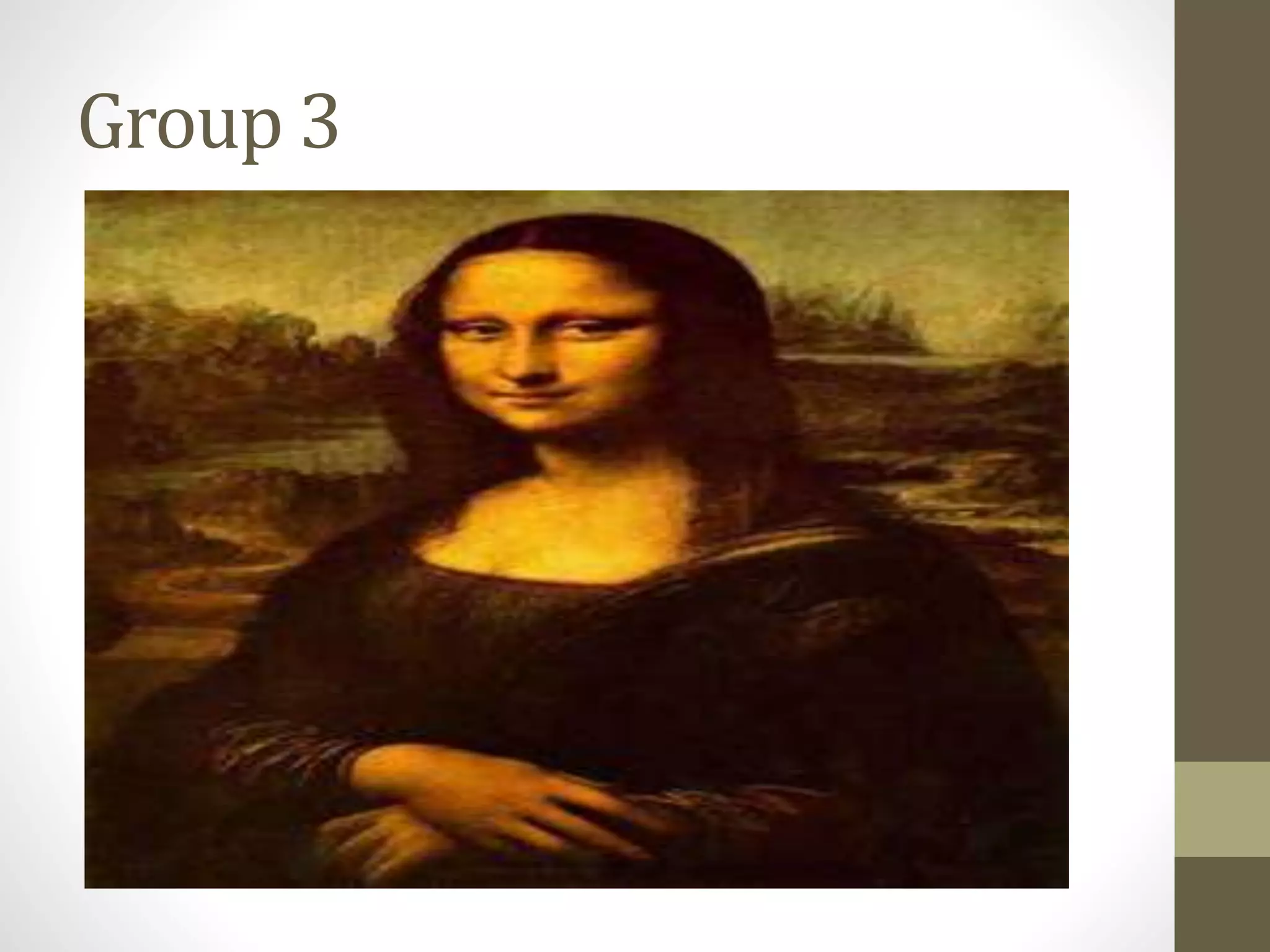
Group 3
Group 4
Renaissance
•comes from the word,
“renaitre”, which means,
“rebirth.”
•It pertains to arts, particularly in
Italy, such as sculptures,
paintings, music, architecture,
and literature.
Renaissance Period (1400-1600)
• The period stirred enthusiasm for the
study of ancient philosophy and artistic
values.
• Italian Renaissance began in the late
14th century. It was an era of great
artistic and intellectual achievement
with the birth of secular art. The focus
was on realistic and humanistic art.
• Renaissance art was characterized by
accurate anatomy, scientific
perspective, and deeper landscape.
• Renaissance painters depicted real-
life figures and their sculptures were
naturalistic portraits of human beings.
• Architecture during this period was
characterized by its symmetry and
balance.
Famous RenaissanceArtworks and
Artists
1. Michelangelo di Lodovico Buonarroti
Simoni (1475-1564)
• was an Italian sculptor, painter,
architect, and poet.
• He was considered the greatest living
artist in his lifetime, and since then he
was considered as one of the greatest
artists of all time.
Among his
outstanding works
were the following:
Pieta
•Michelangelo approached the
subject which until then had been
given form mostly from north of the
Alps, where the portrayal of pain
had always been connected with
the idea of redemption as
represented by the seated
Madonna holding Christ’s body in
her arms.
•He convinces himself and his
spectators of the divine quality and
the significance of these figures by
means of earthly and perfect
beauty, but of course, these are
human standards.
Bacchu
s
Moses
David
Dawn
Dusk
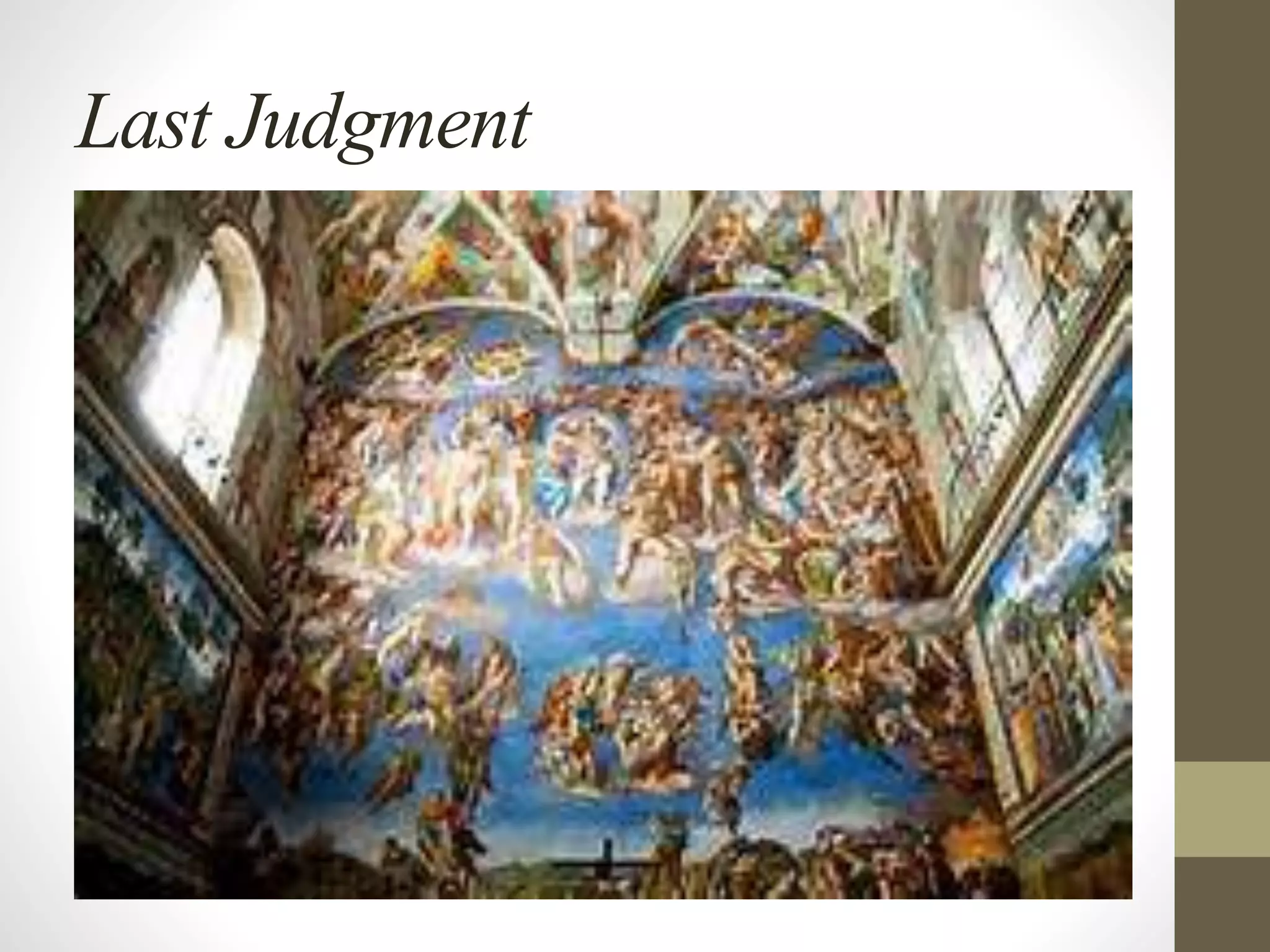
•He also created two of the
most influential works in fresco
in the history of Western art:
the scenes from Genesis on
the ceiling and the Last
Judgment on the altar wall of
the Sistine Chapel in Rome.
Last Judgment
2. Leonardo di ser Piero Da Vinci
(1452- 1519)
•was a painter, architect, scientist,
and mathematician.
•He was known as the ultimate
“Renaissance man” because of
his intellect, interest, talent and
his expression of humanist and
classical values.
•He was popularized in present
times through the novel and
movie, “Da Vinci Code.”
•He was also considered to be
one of the greatest painters of
all time and perhaps the most
diversely talented person to
have ever lived.
His well known works were:
•The Last Supper (the most
reproduced religious painting of all
time), and the Mona Lisa (the
most famous and most parodied
portrait).
•His other works were:
• The Vitruvian Mar, The
Adoration of the Magi, and the
Virgin of the Rocks.
Last Supper
Mona
Lisa
Mona Lisa
•Mona Lisa” stems from a
description by Renaissance art
historian Giorgio Vasari, who
wrote, “Leonardo undertook to
paint for Francesco del
Giocondo the portrait of Mona
Lisa, his wife.”
•Mona, in Italian, is a polite form of
address originating as Madonna-
similar to Ma’am, madamme, or
My Lady in English. This became
Madonna and its contraction
Mona. The title of the painting,
though traditionally spelled
“Mona”, is also commonly spelled
in Modern Italian as “Monna Lisa”.
The Vitruvian Mar
The Adoration of the Magi
Virgin of the Rocks
3. Raffaello Sanzio da Urbino
(Raphael) (1483-1520)
• was an Italian painter and architect of
the High Renaissance period.
• His work was admired for its clarity of
form and ease of composition and for
its visual achievement of interpreting
the Divine and incorporating Christian
doctrines.
His famous works were:
•The Sistine Madonna
•The School of Athens
•The Transfiguration
The Sistine Madonna
The School of Athens
The Transfiguration
The Transfiguration
•was Raphael’s last painting
which he worked on up to his
death. Commissioned by
Cardinal Giulio de Medici, the
late Pope Clement VII, the
painting was conceived as an
altarpiece for the Narbonne
Cathedral in France.
•The painting exemplifies
Raphael’s development as an
artist and the culmination of his
career. The subject was
combined with an additional
episode from the Gospel in the
lower part of the painting.
4. Donato di Niccolo di Betto
Bardi (Donatello) (1386- 1466)
• He was one of the Italian great
artists of the period. He was an
early Renaissance Italian sculptor
from Florence. He is known for his
work in bas- relief, a form of
shallow relief sculpture.
His works included the following
statues and relief:
•David
•Statue of St. George
•Equestrian Monument of
Gattamelata
•Prophet Habacuc
• The Feast of Herod
David
Statue of St. George
Equestrian Monument of
Gattamelata
Prophet Habacuc
The Feast of Herod
• Renaissance art is the art of calm and
beauty.
• Its creations are perfect-they reveal nothing
forced or inhibited, uneasy or agitated.
• Each form has been born easily, free and
complete.
• Everything breathes satisfaction, and we are
surely not mistaken in seeing in this
heavenly calm and content the highest
artistic expression and spirit of that age.

ARTS OF THE RENAISSANCE PERIOD.pptx

  • 1.
  • 2.
    ACTIVITY 1 • Divideyour group into 4. • Based on the different examples of artworks given, Each group will be given one painting/ sculpture during the Renaissance Period. • Each group will have to answer the following questions. What is the subject of the art? What could be the reason why the artist made such an art? • Describe the characteristics of the artworks.
  • 3.
  • 4.
  • 5.
  • 6.
  • 7.
    Renaissance •comes from theword, “renaitre”, which means, “rebirth.” •It pertains to arts, particularly in Italy, such as sculptures, paintings, music, architecture, and literature.
  • 8.
    Renaissance Period (1400-1600) •The period stirred enthusiasm for the study of ancient philosophy and artistic values. • Italian Renaissance began in the late 14th century. It was an era of great artistic and intellectual achievement with the birth of secular art. The focus was on realistic and humanistic art.
  • 9.
    • Renaissance artwas characterized by accurate anatomy, scientific perspective, and deeper landscape. • Renaissance painters depicted real- life figures and their sculptures were naturalistic portraits of human beings. • Architecture during this period was characterized by its symmetry and balance.
  • 10.
    Famous RenaissanceArtworks and Artists 1.Michelangelo di Lodovico Buonarroti Simoni (1475-1564) • was an Italian sculptor, painter, architect, and poet. • He was considered the greatest living artist in his lifetime, and since then he was considered as one of the greatest artists of all time.
  • 11.
  • 12.
  • 13.
    •Michelangelo approached the subjectwhich until then had been given form mostly from north of the Alps, where the portrayal of pain had always been connected with the idea of redemption as represented by the seated Madonna holding Christ’s body in her arms.
  • 14.
    •He convinces himselfand his spectators of the divine quality and the significance of these figures by means of earthly and perfect beauty, but of course, these are human standards.
  • 15.
  • 16.
  • 17.
  • 18.
  • 19.
  • 20.
    •He also createdtwo of the most influential works in fresco in the history of Western art: the scenes from Genesis on the ceiling and the Last Judgment on the altar wall of the Sistine Chapel in Rome.
  • 21.
  • 22.
    2. Leonardo diser Piero Da Vinci (1452- 1519) •was a painter, architect, scientist, and mathematician. •He was known as the ultimate “Renaissance man” because of his intellect, interest, talent and his expression of humanist and classical values.
  • 23.
    •He was popularizedin present times through the novel and movie, “Da Vinci Code.” •He was also considered to be one of the greatest painters of all time and perhaps the most diversely talented person to have ever lived.
  • 24.
    His well knownworks were: •The Last Supper (the most reproduced religious painting of all time), and the Mona Lisa (the most famous and most parodied portrait). •His other works were: • The Vitruvian Mar, The Adoration of the Magi, and the Virgin of the Rocks.
  • 25.
  • 26.
  • 27.
    Mona Lisa •Mona Lisa”stems from a description by Renaissance art historian Giorgio Vasari, who wrote, “Leonardo undertook to paint for Francesco del Giocondo the portrait of Mona Lisa, his wife.”
  • 28.
    •Mona, in Italian,is a polite form of address originating as Madonna- similar to Ma’am, madamme, or My Lady in English. This became Madonna and its contraction Mona. The title of the painting, though traditionally spelled “Mona”, is also commonly spelled in Modern Italian as “Monna Lisa”.
  • 29.
  • 30.
  • 31.
  • 32.
    3. Raffaello Sanzioda Urbino (Raphael) (1483-1520) • was an Italian painter and architect of the High Renaissance period. • His work was admired for its clarity of form and ease of composition and for its visual achievement of interpreting the Divine and incorporating Christian doctrines.
  • 33.
    His famous workswere: •The Sistine Madonna •The School of Athens •The Transfiguration
  • 34.
  • 35.
  • 36.
  • 37.
    The Transfiguration •was Raphael’slast painting which he worked on up to his death. Commissioned by Cardinal Giulio de Medici, the late Pope Clement VII, the painting was conceived as an altarpiece for the Narbonne Cathedral in France.
  • 38.
    •The painting exemplifies Raphael’sdevelopment as an artist and the culmination of his career. The subject was combined with an additional episode from the Gospel in the lower part of the painting.
  • 39.
    4. Donato diNiccolo di Betto Bardi (Donatello) (1386- 1466) • He was one of the Italian great artists of the period. He was an early Renaissance Italian sculptor from Florence. He is known for his work in bas- relief, a form of shallow relief sculpture.
  • 40.
    His works includedthe following statues and relief: •David •Statue of St. George •Equestrian Monument of Gattamelata •Prophet Habacuc • The Feast of Herod
  • 41.
  • 42.
  • 43.
  • 44.
  • 45.
  • 46.
    • Renaissance artis the art of calm and beauty. • Its creations are perfect-they reveal nothing forced or inhibited, uneasy or agitated. • Each form has been born easily, free and complete. • Everything breathes satisfaction, and we are surely not mistaken in seeing in this heavenly calm and content the highest artistic expression and spirit of that age.