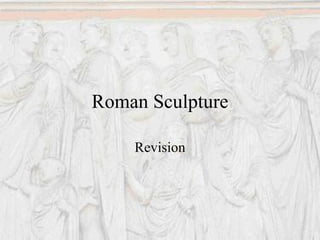
Roman Sculpture Revision
Introduction Roman sculpture had a public target: Make known Roman heroes Reflect Rome’s History The main characteristics are: Detail Fidelity to the model Respect of the canon Beauty is lost in favour of the truth The two main genres were: Portrait Historical relief
Influences Roman sculpture received influences from Etruria Funerary portrait Realistic depiction of the people Greece Portraits of famous people Representation of the psychology in addition to physical characteristics Taste for collections (Greek works were admired and collected).
Roman Portrait Origins: Wax portraits of dead member of the family to put in the houses (lares) Portraits of the emperor to send to the provinces
Roman Portrait Republic Imagines Maiorum: there were the masques of the ancestors made of wax They were “positivated” in different materials It was forbidden to depict people who did not have a public job.
Roman Portrait The first images had only the head, but without any part of the body. Due to superstitious believes, they so be very realistic and capsize the features of the dead person.
Roman Portrait Portraits are realistic, imitating even defects They aim at glorying authorities, not the artists, so they are anonymous Bear witnesses of things that happened.
Roman Portrait Evolution Simplified Realistic Idealised Realistic Low Empire IV- V Empire I-III AD High Republic VI-I BC
Roman Portrait Republic: Until 1st century BC Only head and neck Bronze or polychrome stone Grave and serene expressions Individualization of the  character Trend to idealise public  characters.
Roman Portrait High Empire (1st-3rd centuries AD) Official portrait is idealized They aim at underlining the importance of the character Individual features Expression of character Face without beard
Roman Portrait With the Flavian dynasty (2nd century AD) Realism Hair gains volume Beard appears Chiaroscuro effects
Roman Portrait Low Empire (4 th -5 th  centuries AD)  Anticlassicism Lineal and hieratic Lost humanity Monumental Schematic
Women Portrait It was the reflect of fashions It is a realistic depiction of woman Special attention to hair style.
Portrait Typology  Thoracatae: victorious emperor Apoteosic: as a good, naked and crowned
Portrait Typology Togatae: as a civilian, wearing the toga. Pontifex Maximus: wearing the toga and with head covered
Imperial Portrait Was used as propagandistic It used the Greek canon A bit idealised  Inspired in classical images (Doriforo) Psychological portrait Barefoot = divinity Use of symbols Polychrome
Equestrian Portrait Depicted as military addressing to the citizens Pacific character wearing as a philosopher Influenced in Renaissance Psychological portrait Equilibrated image
Historical Relief It appeared in different locations: Altars Triumphal arches Commemorative columns Sarcophagus
Historical Relief Characteristics: It aimed at glorifying immortality They wanted to commemorate something important Propaganda
Historical Relief Technical characteristics: Pictorial effects Perspective and different plans Movement and volume Landscape elements Evolution from naturalism to realism Influenced on Renaissance
Historical Relief Altars The Ara Pacis is the most famous It reflects traditions of Augustus times Remains the friezes of the Parthenon
Historical Relief Triumphal Arches Two of the most famous are those of Tito and Constantine They explain a historical event Realistic with spatial references Different plans.
Historical Relief Commemorative Columns The most famous is Trajan’s Column Helicoidally organised  It narrates the campaign against  the Dacians  Numerous characters War scenes Perspective Landscape
Historical Relief Sarcophagus The relieves are ornamental and memoirist  Continuous depictions At least the frontal part is worked It can be completely full of images Characters may appear lying on the top

Roman Sculpture

  • 1.
  • 2.
    Introduction Roman sculpturehad a public target: Make known Roman heroes Reflect Rome’s History The main characteristics are: Detail Fidelity to the model Respect of the canon Beauty is lost in favour of the truth The two main genres were: Portrait Historical relief
  • 3.
    Influences Roman sculpturereceived influences from Etruria Funerary portrait Realistic depiction of the people Greece Portraits of famous people Representation of the psychology in addition to physical characteristics Taste for collections (Greek works were admired and collected).
  • 4.
    Roman Portrait Origins:Wax portraits of dead member of the family to put in the houses (lares) Portraits of the emperor to send to the provinces
  • 5.
    Roman Portrait RepublicImagines Maiorum: there were the masques of the ancestors made of wax They were “positivated” in different materials It was forbidden to depict people who did not have a public job.
  • 6.
    Roman Portrait Thefirst images had only the head, but without any part of the body. Due to superstitious believes, they so be very realistic and capsize the features of the dead person.
  • 7.
    Roman Portrait Portraitsare realistic, imitating even defects They aim at glorying authorities, not the artists, so they are anonymous Bear witnesses of things that happened.
  • 8.
    Roman Portrait EvolutionSimplified Realistic Idealised Realistic Low Empire IV- V Empire I-III AD High Republic VI-I BC
  • 9.
    Roman Portrait Republic:Until 1st century BC Only head and neck Bronze or polychrome stone Grave and serene expressions Individualization of the character Trend to idealise public characters.
  • 10.
    Roman Portrait HighEmpire (1st-3rd centuries AD) Official portrait is idealized They aim at underlining the importance of the character Individual features Expression of character Face without beard
  • 11.
    Roman Portrait Withthe Flavian dynasty (2nd century AD) Realism Hair gains volume Beard appears Chiaroscuro effects
  • 12.
    Roman Portrait LowEmpire (4 th -5 th centuries AD) Anticlassicism Lineal and hieratic Lost humanity Monumental Schematic
  • 13.
    Women Portrait Itwas the reflect of fashions It is a realistic depiction of woman Special attention to hair style.
  • 14.
    Portrait Typology Thoracatae: victorious emperor Apoteosic: as a good, naked and crowned
  • 15.
    Portrait Typology Togatae:as a civilian, wearing the toga. Pontifex Maximus: wearing the toga and with head covered
  • 16.
    Imperial Portrait Wasused as propagandistic It used the Greek canon A bit idealised Inspired in classical images (Doriforo) Psychological portrait Barefoot = divinity Use of symbols Polychrome
  • 17.
    Equestrian Portrait Depictedas military addressing to the citizens Pacific character wearing as a philosopher Influenced in Renaissance Psychological portrait Equilibrated image
  • 18.
    Historical Relief Itappeared in different locations: Altars Triumphal arches Commemorative columns Sarcophagus
  • 19.
    Historical Relief Characteristics:It aimed at glorifying immortality They wanted to commemorate something important Propaganda
  • 20.
    Historical Relief Technicalcharacteristics: Pictorial effects Perspective and different plans Movement and volume Landscape elements Evolution from naturalism to realism Influenced on Renaissance
  • 21.
    Historical Relief AltarsThe Ara Pacis is the most famous It reflects traditions of Augustus times Remains the friezes of the Parthenon
  • 22.
    Historical Relief TriumphalArches Two of the most famous are those of Tito and Constantine They explain a historical event Realistic with spatial references Different plans.
  • 23.
    Historical Relief CommemorativeColumns The most famous is Trajan’s Column Helicoidally organised It narrates the campaign against the Dacians Numerous characters War scenes Perspective Landscape
  • 24.
    Historical Relief SarcophagusThe relieves are ornamental and memoirist Continuous depictions At least the frontal part is worked It can be completely full of images Characters may appear lying on the top