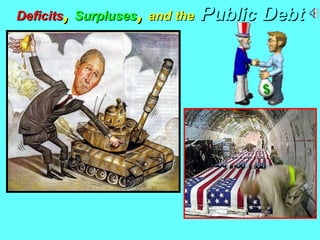
Deficits ,  Surpluses   and the   Public Debt
Is Debt a four letter word?
What is the difference  between debt and deficit?
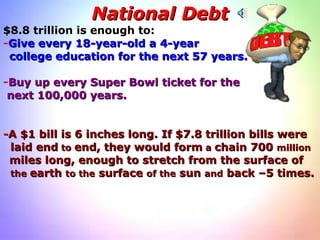
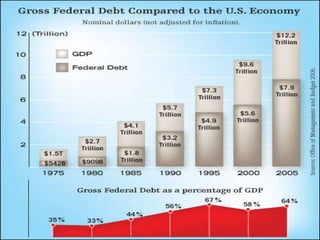
National Debt $8.8 trillion is enough to: - Give every 18-year-old a 4-year  college education for the next 57 years. - Buy up every Super Bowl ticket for the  next 100,000 years.   - A $1 bill is 6 inches long. If $7.8 trillion bills were laid end  to  end, they would form  a  chain 700  million miles long, enough to stretch from the surface of the  earth  to the  surface  of the  sun  and  back –5 times.
Debt  is the accumulation of yearly deficits plus surpluses.  The obvious question is, Is Debt good or bad?  IT DEPENDS
For Example, my wife and I own a home.  Well, we really don’t own our home, the bank owns the home until we pay off the loan (mortgage) We are happy in debt, our house gives us a nice place to live and we know our loan will be paid off sometime in the future.
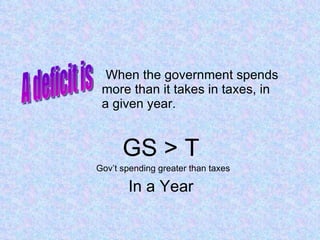
When the government spends    more than it takes in taxes, in    a given year.  GS > T Gov’t spending greater than taxes In a Year A deficit is
Deficits ,   Surpluses ,   and the   P ublic  D ebt
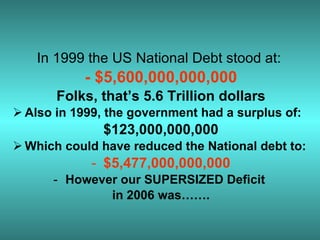
In 1999 the US National Debt stood at:  - $5,600,000,000,000 Folks, that’s 5.6 Trillion dollars Also in 1999, the government had a surplus of: $123,000,000,000 Which could have reduced the National debt to:  $5,477,000,000,000 However our SUPERSIZED Deficit  in 2006 was…….
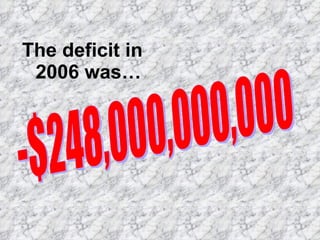
The deficit in 2006 was… -$248,000,000,000
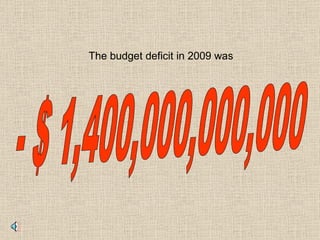
The budget deficit in 2009 was - $ 1,400,000,000,000
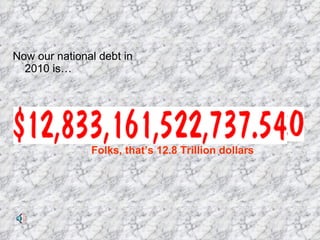
Now our national debt in 2010 is… Folks, that’s 12.8 Trillion dollars                                                                                                                         
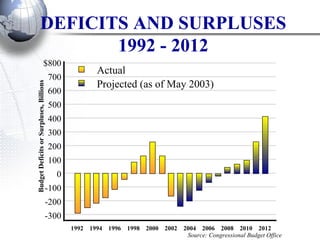
DEFICITS AND SURPLUSES 1992 - 2012 Source: Congressional Budget Office $800 700 600 500 400 300 200 100 0 -100 -200 -300 Budget Deficits or Surpluses, Billions 1992  1994  1996  1998  2000  2002  2004  2006  2008  2010  2012 Actual Projected (as of May 2003)
 
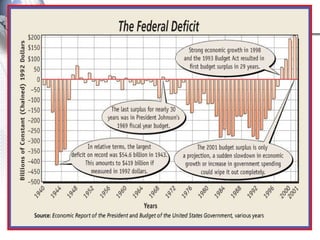
So again,  debt  is the accumulation of all our deficits and surpluses.  Yearly  deficits  are added to the  debt A  surplus  may help pay down the  debt ,  but it may not .
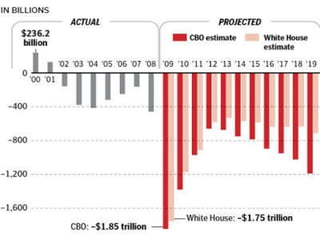
The  “ Debt ”  and The  “Deficit ” Deficit ($1.4 T .) Debt ($12.3  trillion) Reasons for Debt 1. Lack of political will 2. Tax cuts 3. Recessions  (transfers) 4. Wartime financing Attention  Deficit Hyperactivity Disorder  [ADHD] Congressmen have  trouble focusing  attention  on the  deficit. $ 12.3
 
 
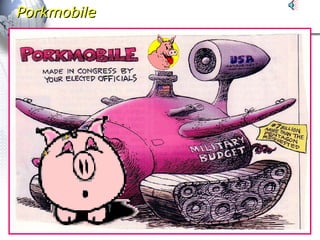
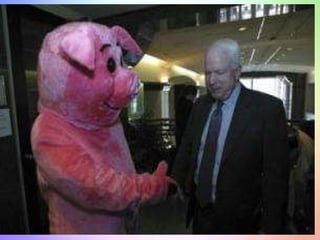
Porkmobile
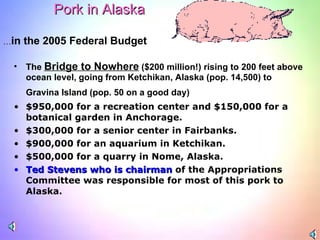
Pork in Alaska The  Bridge to Nowhere  ($200 million!) rising to 200 feet above ocean level, going from Ketchikan, Alaska (pop. 14,500) to Gravina Island (pop. 50 on a good day)   $950,000 for a recreation center and $150,000 for a botanical garden in Anchorage.  $300,000 for a senior center in Fairbanks. $900,000 for an aquarium in Ketchikan. $500,000 for a quarry in Nome, Alaska. Ted Stevens who is chairman  of the Appropriations Committee was responsible for most of this pork to Alaska.  … in the 2005 Federal Budget
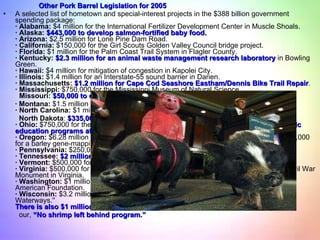
Other Pork Barrel Legislation for 2005 A selected list of hometown and special-interest projects in the $388 billion government spending package: · Alabama:  $4 million for the International Fertilizer Development Center in Muscle Shoals. · Alaska:   $443,000 to develop salmon-fortified baby food. · Arizona:  $2.5 million for Lone Pine Dam Road. · California:  $150,000 for the Girl Scouts Golden Valley Council bridge project. · Florida:  $1 million for the Palm Coast Trail System in Flagler County. · Kentucky:   $2.3 million for an animal waste management research laboratory  in Bowling Green. · Hawaii:  $4 million for mitigation of congestion in Kapolei City. · Illinois:  $1.4 million for an Interstate-55 sound barrier in Darien. · Massachusetts:   $1.2 million for Cape Cod Seashore Eastham/Dennis Bike Trail Repair . · Mississippi:  $750,000 for the Mississippi Museum of Natural Science.   Missouri:   $50,000 to control wild hogs in Missouri · Montana:  $1.5 million for a ''fuels-in-schools'' biomass project. · North Carolina:  $1 million for Garden Parkway in Gaston and Mecklenburg counties. North Dakota :  $335,000 to protect North Dakota’s sunflowers from blackbirds . · Ohio:  $750,000 for the city of Circleville's sewer construction project;  $350,000 for music  education programs at the Rock and Roll Hall of Fame in Cleveland. · Oregon:  $6.28 million to Oregon State University for wood utilization research and $688,000 for a barley gene-mapping project. · Pennsylvania:  $250,000 to promote tourism in the Allegheny National Forest area. · Tennessee:   $2 million for the Fiery Gizzard Trail. · Vermont:  $500,000 for a wood products program. · Virginia:  $500,000 for the Amherst County River Walk Trail; $200,000 for a Vermont Civil War Monument in Virginia. · Washington:  $1 million for the Enumclaw welcome center; $1 million for the Norwegian American Foundation. · Wisconsin:  $3.2 million for the Chequamego-Nicolet National Forest ''Wisconsin Wild Waterways.'' There is also $1 million for a “Wild American Shrimp Initiative”  so we might call this our,  “No shrimp left behind program.”
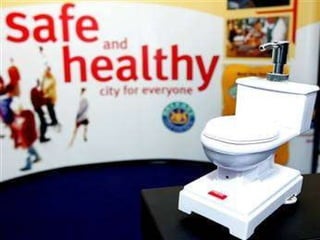
Congressional pork includes some real stinkers  Federal government earmarks $29 billion for pet projects, watchdog says The World Toilet Summit in Belfast, Northern Ireland, is one beneficiary of U.S. spending on so-called “pork” projects. Congress allocated $13.5 million for the International Fund for Ireland, which helps fund the summit. …  msnbc.com Arpri 5 th  2006 Congressional pork includes some real stinkers  Federal government earmarks $29 billion for pet projects, watchdog says                                                                                                                                                       The World Toilet Summit in Belfast, Northern Ireland, is one beneficiary of U.S. spending on so-called “pork” projects. Congress allocated $13.5 million for the International Fund for Ireland, which helps fund the summit.
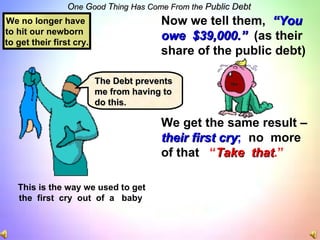
O ne  G ood  T hing   Has Come From the  Public Debt This is the way we used to get the  first  cry  out  of  a  baby Now we tell them,  “You owe   $39,000.”   (as their share of the public debt) We get the same result – their first cry ;   no  more  of that  “ Take  that .” We no longer have  to hit our newborn  to get their first cry. The Debt prevents me from having to do this.
The  “no”  answer  entails three points . 1.  Refinancing  –It  refinances the debt  by selling new bonds and uses the proceeds to pay off holders of the bonds. 2.  Taxation  – if bankruptcy were imminent the G could always raise taxes. 3.  Creating Money  – bankruptcy could be avoided by printing the money ( inflationary ).   I’m  not paying no $39,000 and I hope you will not either.  Economic Implications of the Debt: False Issues [The  “G”  doesn’t have to pay the entire debt off because it never  “dies.” ] [The  “G”  will live forever so it will keep  “rolling it over in perpetuity” ] Going Bankrupt? Whew! $39,000 each. Where our debt comes from?
Negative Impact of the Debt A problem is interest must be paid to the debt holders as the debt continues to grow.  This is the third largest federal budget expenditure.  Interest on the national debt projected to be 800 Billion $$ by 2019.  This takes away from other government programs, or increases the debt and/or taxes
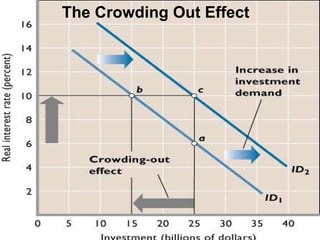
Crowding Out Effect:  Future generations will likely have to pay higher rates to borrow money (the interest rate).  Thus, there will be less investment in our economy, less capital stock, and leading to a lower standard of living in the future
Chapter 18 Figure 18.2 The Crowding Out Effect
Income Distribution  [the debt is transferred from all taxpayers to the bond holders [ the  rich], so more income disparity] Incentives  – larger taxes dampen incentives to bear risk, to innovate, to invest, or just to work. * Children  will not inherit as large of a “national factory”  Foreign-Owned Public Debt External Public Debt Economic Issues F rom  T he  Debt Abe Lincoln, with the Debt at $1 billion in 1864, said,  “Men can readily  perceive  that  they  cannot  be  much oppressed by a debt which they owe themselves.”
 
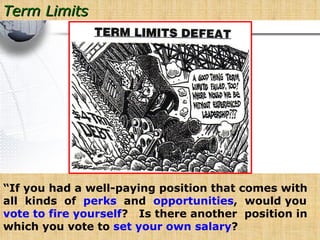
Term Limits “ If you had a well-paying position that comes with all  kinds  of  perks   and  opportunities ,  would you vote to fire yourself ?  Is there another  position in which you vote to  set your own salary ?
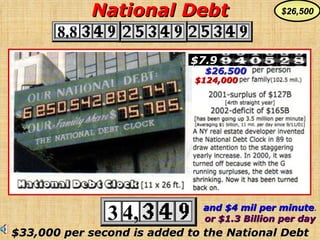
National Debt Clock 8 $24,000 National Debt Clock $7.9 $26,500 National Debt 8.8 $33,000 per second is added to the National Debt 3 4, and $4 mil per minute . or $1.3 Billion per day $124,000 $26,500
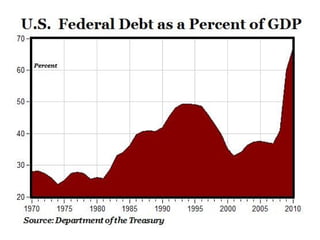
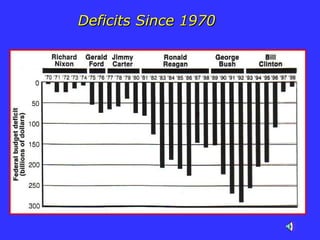
Deficits Since 1970
 
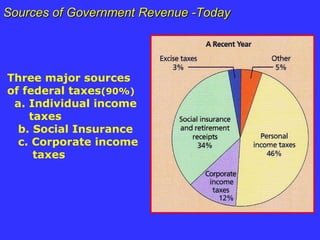
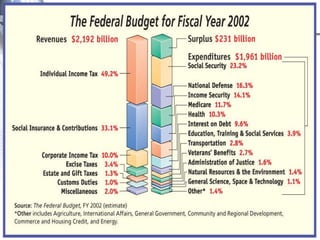
Sources of Government Revenue -Today Three major sources of federal taxes (90%) a. Individual income taxes  b. Social Insurance c. Corporate income taxes
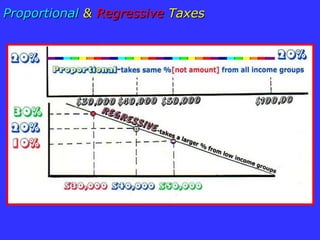
Proportional  &   Regressive   Taxes
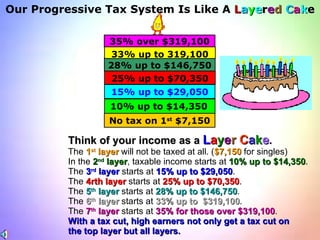
Think of your income as a  L a y e r   C a k e . The  1 st  layer  will not be taxed at all. ( $7,150  for singles) In the  2 nd  layer , taxable income starts at  10% up to $14,350 . The  3 rd  layer  starts at  15% up to $29,050 . The  4rth layer  starts at  25% up to $70,350 . The  5 th  layer  starts at  28% up to $146,750 . The  6 th  layer  starts at  33% up to  $319,100 . The  7 th  layer  starts at  35% for those over $319,100 . With a tax cut, high earners not only get a tax cut on  the top layer but all layers. Our Progressive Tax System Is Like A  L a y e r e d   C a k e 35% over $319,100 No tax on 1 st  $7,150 10% up to $14,350   15% up to $29,050 25% up to $70,350 28% up to $146,750 33% up to 319,100
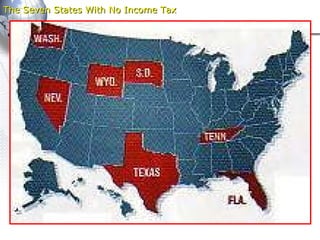
The Seven States With No Income Tax
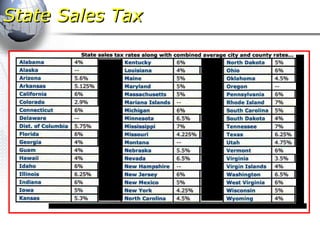
State Sales Tax
Tax Debate   (continued) T ax  B ased  O n  A Proportional  (“Flat Rate”)  T ax  [“20%”] $ 200 (tax  of  $ 40   so  $ 160  to live on) [ now less likely to get  in crime] $ 350 (tax of $ 70  so  +$ 280   to live on) [ also lessens crime potential] $ 500 (tax of $ 100  so  +$ 400  to live on) $ 1,000 (tax of $ 200  so  +$ 800  to live on $ 5,000 (tax of $ 1,000  so  +$ 4,000  to live on)  Progressive Tax System No tax up to $7,150, then 10%(The poor group made $10,400 a year) 0%....................Up to $7,150 10%...........$7,151 - $14,300 15%.........$14,301 - $29,050  25%.........$29,051 - $73,550 28%.......$73,551 - $146,750 33%.....$146,751 - $319,100 35%.....$319,101 +
 
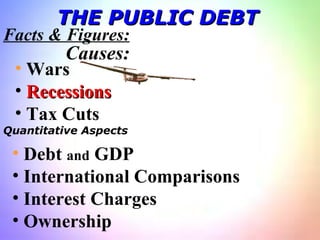
Causes: Wars Recessions Tax Cuts THE PUBLIC DEBT Facts & Figures: Quantitative Aspects Debt  and  GDP International Comparisons Interest Charges Ownership
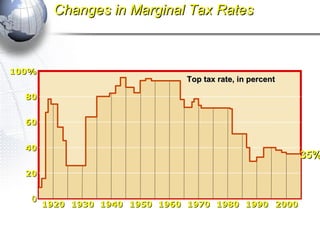
Changes in Marginal Tax Rates 35% 2000 1990 1980 1970 1960 1950 1940 1930 1920 Top tax rate, in percent 100% 80 60 40 20 0
Marginal Tax Rate 1913-2005 Top Marginal Tax Rates Year Tax Rate 1900 No Tax 1914 1%  [over $3,000] [Only 1 in 270 paid this tax at all] 1930 30% [1 in every 32  was now paying  taxes] 1940 81% [1 in every 3 was paying taxes] 1943  * Paycheck withholding  (by the boss) was launched to stop cheating. 1950 91% 1970 70% [E veryone  was paying  with  taxable Y] 1980 70% 2002 38.6% 2005 35% Medicare tax  –  1.45%  for an individual [ 2.9%  for   self employed ]  for every dollar earned . Harrison Ford  – received  $25 million  for 20 days  work on a movie .  1.45%  of $ 25 million =  $362,500   x 2 =  $725,000  medicare tax. [Over his  35  years  on  the Big Screen, his films grossed over  $10 bil . Jim Carrey   –  gets  $20 million  per movie, so his tax is  $580,000 . [1.45% of $20 million = $290,000 x 2 =  $580,000 .]
Nation’s  Wealthiest 5 %  Pay  55 %  of  Income Taxes Ave. Tax Rate Top  1 % ($293,000) paid over 1/3 of all taxes – average 28% Top  5 % (+ $121,000; 6.3 mil.) paid 55% - average 24% Top  10 % (+80,000) paid 62% of all taxes – average 21.4% Top  25 % (+$50,000) paid 81% of all taxes – average 18% Top  50 % (+$25,000) paid 96% of all taxes – average 16% Bottom  50 % (63  mil.  earned -$23,000) paid o nly  4 % of all  taxes. There  are  7.5 million millionaires  &   341 billionaires . [691 in world] 40 millionaires are in the U.S. Senate
Billionaires of the World in 2003 [The U.S. has 50%]   691 in 2004 Worth 2.2 T [341 in U.S.]
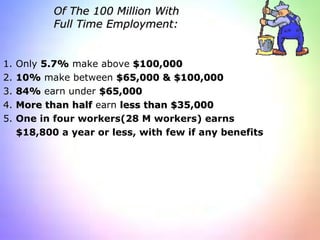
Of The 100 Million With  Full Time Employment: 1. Only  5.7%  make above  $100,000 2.  10%  make between  $65,000 & $100,000 3.  84%  earn under  $65,000 4.  More than half  earn  less than $35,000 5.  One in four workers(28 M workers) earns $18,800 a year or less, with few if any benefits
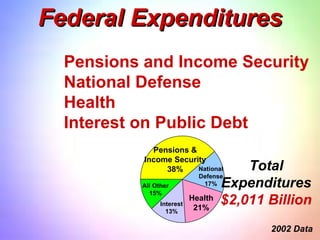
Federal Expenditures Pensions and Income Security National Defense Health Interest on Public Debt Pensions & Income Security 38% National Defense 17% Health 21% All Other 15% Interest 13% 2002 Data Total Expenditures $2,011 Billion
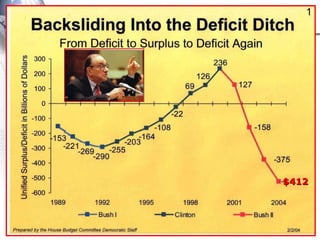
$412
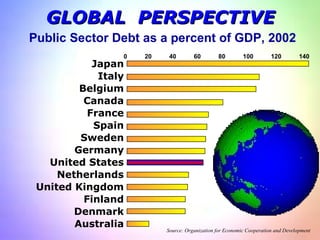
0  20  40  60  80  100  120  140 Japan Italy Belgium Canada France Spain Sweden Germany United States Netherlands United Kingdom Finland Denmark Australia GLOBAL  PERSPECTIVE Public Sector Debt as a percent of GDP, 2002 Source: Organization for Economic Cooperation and Development
THE END

The National Debt

  • 1.
    Deficits , Surpluses and the Public Debt
  • 2.
    Is Debt afour letter word?
  • 3.
    What is thedifference between debt and deficit?
  • 4.
    National Debt $8.8trillion is enough to: - Give every 18-year-old a 4-year college education for the next 57 years. - Buy up every Super Bowl ticket for the next 100,000 years. - A $1 bill is 6 inches long. If $7.8 trillion bills were laid end to end, they would form a chain 700 million miles long, enough to stretch from the surface of the earth to the surface of the sun and back –5 times.
  • 5.
    Debt isthe accumulation of yearly deficits plus surpluses. The obvious question is, Is Debt good or bad? IT DEPENDS
  • 6.
    For Example, mywife and I own a home. Well, we really don’t own our home, the bank owns the home until we pay off the loan (mortgage) We are happy in debt, our house gives us a nice place to live and we know our loan will be paid off sometime in the future.
  • 7.
    When the governmentspends more than it takes in taxes, in a given year. GS > T Gov’t spending greater than taxes In a Year A deficit is
  • 8.
    Deficits , Surpluses , and the P ublic D ebt
  • 9.
    In 1999 theUS National Debt stood at: - $5,600,000,000,000 Folks, that’s 5.6 Trillion dollars Also in 1999, the government had a surplus of: $123,000,000,000 Which could have reduced the National debt to: $5,477,000,000,000 However our SUPERSIZED Deficit in 2006 was…….
  • 10.
    The deficit in2006 was… -$248,000,000,000
  • 11.
    The budget deficitin 2009 was - $ 1,400,000,000,000
  • 12.
    Now our nationaldebt in 2010 is… Folks, that’s 12.8 Trillion dollars                                                                                                                         
  • 13.
    DEFICITS AND SURPLUSES1992 - 2012 Source: Congressional Budget Office $800 700 600 500 400 300 200 100 0 -100 -200 -300 Budget Deficits or Surpluses, Billions 1992 1994 1996 1998 2000 2002 2004 2006 2008 2010 2012 Actual Projected (as of May 2003)
  • 14.
  • 15.
    So again, debt is the accumulation of all our deficits and surpluses. Yearly deficits are added to the debt A surplus may help pay down the debt , but it may not .
  • 16.
    The “Debt ” and The “Deficit ” Deficit ($1.4 T .) Debt ($12.3 trillion) Reasons for Debt 1. Lack of political will 2. Tax cuts 3. Recessions (transfers) 4. Wartime financing Attention Deficit Hyperactivity Disorder [ADHD] Congressmen have trouble focusing attention on the deficit. $ 12.3
  • 17.
  • 18.
  • 19.
  • 20.
    Pork in AlaskaThe Bridge to Nowhere ($200 million!) rising to 200 feet above ocean level, going from Ketchikan, Alaska (pop. 14,500) to Gravina Island (pop. 50 on a good day) $950,000 for a recreation center and $150,000 for a botanical garden in Anchorage. $300,000 for a senior center in Fairbanks. $900,000 for an aquarium in Ketchikan. $500,000 for a quarry in Nome, Alaska. Ted Stevens who is chairman of the Appropriations Committee was responsible for most of this pork to Alaska. … in the 2005 Federal Budget
  • 21.
    Other Pork BarrelLegislation for 2005 A selected list of hometown and special-interest projects in the $388 billion government spending package: · Alabama: $4 million for the International Fertilizer Development Center in Muscle Shoals. · Alaska: $443,000 to develop salmon-fortified baby food. · Arizona: $2.5 million for Lone Pine Dam Road. · California: $150,000 for the Girl Scouts Golden Valley Council bridge project. · Florida: $1 million for the Palm Coast Trail System in Flagler County. · Kentucky: $2.3 million for an animal waste management research laboratory in Bowling Green. · Hawaii: $4 million for mitigation of congestion in Kapolei City. · Illinois: $1.4 million for an Interstate-55 sound barrier in Darien. · Massachusetts: $1.2 million for Cape Cod Seashore Eastham/Dennis Bike Trail Repair . · Mississippi: $750,000 for the Mississippi Museum of Natural Science. Missouri: $50,000 to control wild hogs in Missouri · Montana: $1.5 million for a ''fuels-in-schools'' biomass project. · North Carolina: $1 million for Garden Parkway in Gaston and Mecklenburg counties. North Dakota : $335,000 to protect North Dakota’s sunflowers from blackbirds . · Ohio: $750,000 for the city of Circleville's sewer construction project; $350,000 for music education programs at the Rock and Roll Hall of Fame in Cleveland. · Oregon: $6.28 million to Oregon State University for wood utilization research and $688,000 for a barley gene-mapping project. · Pennsylvania: $250,000 to promote tourism in the Allegheny National Forest area. · Tennessee: $2 million for the Fiery Gizzard Trail. · Vermont: $500,000 for a wood products program. · Virginia: $500,000 for the Amherst County River Walk Trail; $200,000 for a Vermont Civil War Monument in Virginia. · Washington: $1 million for the Enumclaw welcome center; $1 million for the Norwegian American Foundation. · Wisconsin: $3.2 million for the Chequamego-Nicolet National Forest ''Wisconsin Wild Waterways.'' There is also $1 million for a “Wild American Shrimp Initiative” so we might call this our, “No shrimp left behind program.”
  • 22.
    Congressional pork includessome real stinkers Federal government earmarks $29 billion for pet projects, watchdog says The World Toilet Summit in Belfast, Northern Ireland, is one beneficiary of U.S. spending on so-called “pork” projects. Congress allocated $13.5 million for the International Fund for Ireland, which helps fund the summit. … msnbc.com Arpri 5 th 2006 Congressional pork includes some real stinkers Federal government earmarks $29 billion for pet projects, watchdog says                                                                                                                                                       The World Toilet Summit in Belfast, Northern Ireland, is one beneficiary of U.S. spending on so-called “pork” projects. Congress allocated $13.5 million for the International Fund for Ireland, which helps fund the summit.
  • 23.
    O ne G ood T hing Has Come From the Public Debt This is the way we used to get the first cry out of a baby Now we tell them, “You owe $39,000.” (as their share of the public debt) We get the same result – their first cry ; no more of that “ Take that .” We no longer have to hit our newborn to get their first cry. The Debt prevents me from having to do this.
  • 24.
    The “no” answer entails three points . 1. Refinancing –It refinances the debt by selling new bonds and uses the proceeds to pay off holders of the bonds. 2. Taxation – if bankruptcy were imminent the G could always raise taxes. 3. Creating Money – bankruptcy could be avoided by printing the money ( inflationary ). I’m not paying no $39,000 and I hope you will not either. Economic Implications of the Debt: False Issues [The “G” doesn’t have to pay the entire debt off because it never “dies.” ] [The “G” will live forever so it will keep “rolling it over in perpetuity” ] Going Bankrupt? Whew! $39,000 each. Where our debt comes from?
  • 25.
    Negative Impact ofthe Debt A problem is interest must be paid to the debt holders as the debt continues to grow. This is the third largest federal budget expenditure. Interest on the national debt projected to be 800 Billion $$ by 2019. This takes away from other government programs, or increases the debt and/or taxes
  • 26.
    Crowding Out Effect: Future generations will likely have to pay higher rates to borrow money (the interest rate). Thus, there will be less investment in our economy, less capital stock, and leading to a lower standard of living in the future
  • 27.
    Chapter 18 Figure18.2 The Crowding Out Effect
  • 28.
    Income Distribution [the debt is transferred from all taxpayers to the bond holders [ the rich], so more income disparity] Incentives – larger taxes dampen incentives to bear risk, to innovate, to invest, or just to work. * Children will not inherit as large of a “national factory” Foreign-Owned Public Debt External Public Debt Economic Issues F rom T he Debt Abe Lincoln, with the Debt at $1 billion in 1864, said, “Men can readily perceive that they cannot be much oppressed by a debt which they owe themselves.”
  • 29.
  • 30.
    Term Limits “If you had a well-paying position that comes with all kinds of perks and opportunities , would you vote to fire yourself ? Is there another position in which you vote to set your own salary ?
  • 31.
    National Debt Clock8 $24,000 National Debt Clock $7.9 $26,500 National Debt 8.8 $33,000 per second is added to the National Debt 3 4, and $4 mil per minute . or $1.3 Billion per day $124,000 $26,500
  • 32.
  • 33.
  • 34.
    Sources of GovernmentRevenue -Today Three major sources of federal taxes (90%) a. Individual income taxes b. Social Insurance c. Corporate income taxes
  • 35.
    Proportional & Regressive Taxes
  • 36.
    Think of yourincome as a L a y e r C a k e . The 1 st layer will not be taxed at all. ( $7,150 for singles) In the 2 nd layer , taxable income starts at 10% up to $14,350 . The 3 rd layer starts at 15% up to $29,050 . The 4rth layer starts at 25% up to $70,350 . The 5 th layer starts at 28% up to $146,750 . The 6 th layer starts at 33% up to $319,100 . The 7 th layer starts at 35% for those over $319,100 . With a tax cut, high earners not only get a tax cut on the top layer but all layers. Our Progressive Tax System Is Like A L a y e r e d C a k e 35% over $319,100 No tax on 1 st $7,150 10% up to $14,350 15% up to $29,050 25% up to $70,350 28% up to $146,750 33% up to 319,100
  • 37.
    The Seven StatesWith No Income Tax
  • 38.
  • 39.
    Tax Debate (continued) T ax B ased O n A Proportional (“Flat Rate”) T ax [“20%”] $ 200 (tax of $ 40 so $ 160 to live on) [ now less likely to get in crime] $ 350 (tax of $ 70 so +$ 280 to live on) [ also lessens crime potential] $ 500 (tax of $ 100 so +$ 400 to live on) $ 1,000 (tax of $ 200 so +$ 800 to live on $ 5,000 (tax of $ 1,000 so +$ 4,000 to live on) Progressive Tax System No tax up to $7,150, then 10%(The poor group made $10,400 a year) 0%....................Up to $7,150 10%...........$7,151 - $14,300 15%.........$14,301 - $29,050 25%.........$29,051 - $73,550 28%.......$73,551 - $146,750 33%.....$146,751 - $319,100 35%.....$319,101 +
  • 40.
  • 41.
    Causes: Wars RecessionsTax Cuts THE PUBLIC DEBT Facts & Figures: Quantitative Aspects Debt and GDP International Comparisons Interest Charges Ownership
  • 42.
    Changes in MarginalTax Rates 35% 2000 1990 1980 1970 1960 1950 1940 1930 1920 Top tax rate, in percent 100% 80 60 40 20 0
  • 43.
    Marginal Tax Rate1913-2005 Top Marginal Tax Rates Year Tax Rate 1900 No Tax 1914 1% [over $3,000] [Only 1 in 270 paid this tax at all] 1930 30% [1 in every 32 was now paying taxes] 1940 81% [1 in every 3 was paying taxes] 1943 * Paycheck withholding (by the boss) was launched to stop cheating. 1950 91% 1970 70% [E veryone was paying with taxable Y] 1980 70% 2002 38.6% 2005 35% Medicare tax – 1.45% for an individual [ 2.9% for self employed ] for every dollar earned . Harrison Ford – received $25 million for 20 days work on a movie . 1.45% of $ 25 million = $362,500 x 2 = $725,000 medicare tax. [Over his 35 years on the Big Screen, his films grossed over $10 bil . Jim Carrey – gets $20 million per movie, so his tax is $580,000 . [1.45% of $20 million = $290,000 x 2 = $580,000 .]
  • 44.
    Nation’s Wealthiest5 % Pay 55 % of Income Taxes Ave. Tax Rate Top 1 % ($293,000) paid over 1/3 of all taxes – average 28% Top 5 % (+ $121,000; 6.3 mil.) paid 55% - average 24% Top 10 % (+80,000) paid 62% of all taxes – average 21.4% Top 25 % (+$50,000) paid 81% of all taxes – average 18% Top 50 % (+$25,000) paid 96% of all taxes – average 16% Bottom 50 % (63 mil. earned -$23,000) paid o nly 4 % of all taxes. There are 7.5 million millionaires & 341 billionaires . [691 in world] 40 millionaires are in the U.S. Senate
  • 45.
    Billionaires of theWorld in 2003 [The U.S. has 50%] 691 in 2004 Worth 2.2 T [341 in U.S.]
  • 46.
    Of The 100Million With Full Time Employment: 1. Only 5.7% make above $100,000 2. 10% make between $65,000 & $100,000 3. 84% earn under $65,000 4. More than half earn less than $35,000 5. One in four workers(28 M workers) earns $18,800 a year or less, with few if any benefits
  • 47.
    Federal Expenditures Pensionsand Income Security National Defense Health Interest on Public Debt Pensions & Income Security 38% National Defense 17% Health 21% All Other 15% Interest 13% 2002 Data Total Expenditures $2,011 Billion
  • 48.
  • 49.
    0 20 40 60 80 100 120 140 Japan Italy Belgium Canada France Spain Sweden Germany United States Netherlands United Kingdom Finland Denmark Australia GLOBAL PERSPECTIVE Public Sector Debt as a percent of GDP, 2002 Source: Organization for Economic Cooperation and Development
  • 50.