Monopolistic
Competition
and Oligopoly
25C H A P T E R
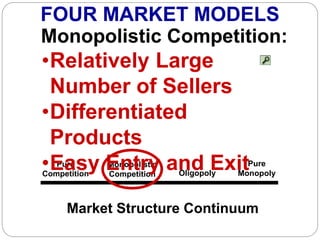
Market Structure Continuum
Pure
Competition
Pure
Monopoly
Monopolistic
Competition Oligopoly
FOUR MARKET MODELS
Monopolistic Competition:
•Relatively Large
Number of Sellers
•Differentiated
Products
•Easy Entry and Exit
CHARACTERISTICS
Relatively Large
Number of Sellers
•Small Market
Shares
•Independent
Action
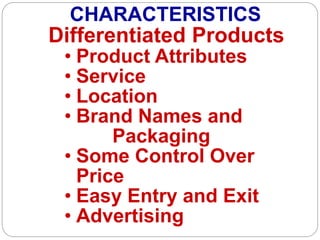
Differentiated Products
• Product Attributes
• Service
• Location
• Brand Names and
Packaging
• Some Control Over
Price
• Easy Entry and Exit
• Advertising
CHARACTERISTICS
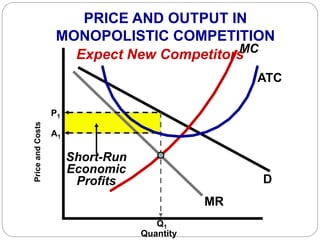
D
MR
P1
ATC
PriceandCosts
Q1
Short-Run
Economic
Profits
Expect New Competitors
PRICE AND OUTPUT IN
MONOPOLISTIC COMPETITION
Quantity
A1
MC
D
MR
P1
ATC
PriceandCosts
Q1
Expect New Competitors
PRICE AND OUTPUT IN
MONOPOLISTIC COMPETITION
Quantity
A1
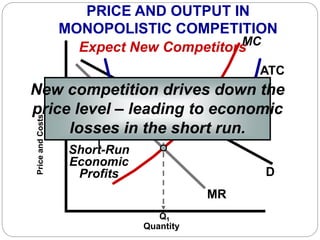
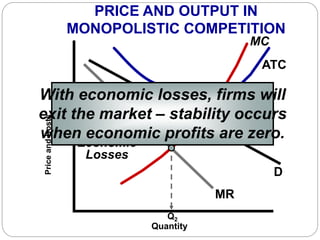
New competition drives down the
price level – leading to economic
losses in the short run.
MC
Short-Run
Economic
Profits
D
MR
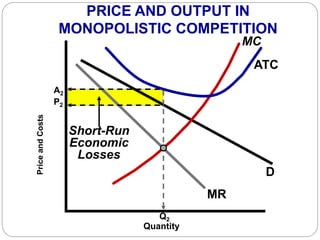
MC
P2
ATC
PriceandCosts
Q2
Short-Run
Economic
Losses
PRICE AND OUTPUT IN
MONOPOLISTIC COMPETITION
Quantity
A2
Short-Run
Economic
Losses
D
MR
MC
P2
ATC
PriceandCosts
Q2
PRICE AND OUTPUT IN
MONOPOLISTIC COMPETITION
Quantity
A2
With economic losses, firms will
exit the market – stability occurs
when economic profits are zero.
D
MR
MC
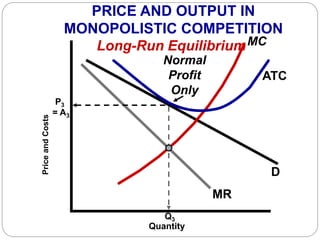
P3
= A3
ATC
PriceandCosts
Q3
PRICE AND OUTPUT IN
MONOPOLISTIC COMPETITION
Quantity
Long-Run Equilibrium
Normal
Profit
Only
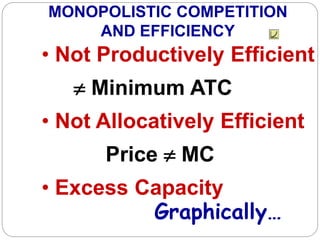
MONOPOLISTIC COMPETITION
AND EFFICIENCY
• Not Productively Efficient
 Minimum ATC
• Not Allocatively Efficient
Price  MC
• Excess Capacity
Graphically…
D
MR
MC
P3
= A3
ATC
PriceandCosts
Q3
Quantity
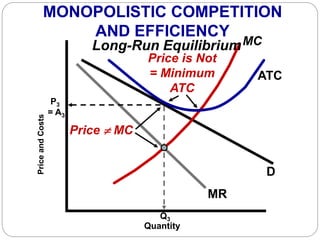
Long-Run Equilibrium
Price is Not
= Minimum
ATC
Price  MC
MONOPOLISTIC COMPETITION
AND EFFICIENCY
MONOPOLISTIC COMPETITION
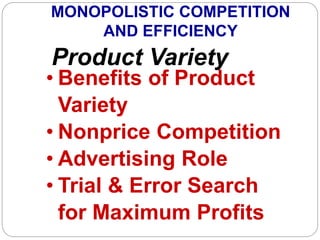
AND EFFICIENCY
Product Variety
• Benefits of Product
Variety
• Nonprice Competition
• Advertising Role
• Trial & Error Search
for Maximum Profits
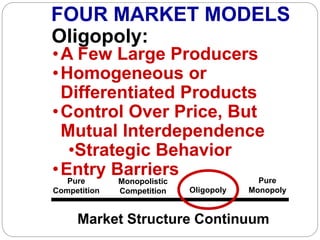
Market Structure Continuum
Pure
Competition
Pure
Monopoly
Monopolistic
Competition Oligopoly
FOUR MARKET MODELS
Oligopoly:
•A Few Large Producers
•Homogeneous or
Differentiated Products
•Control Over Price, But
Mutual Interdependence
•Strategic Behavior
•Entry Barriers
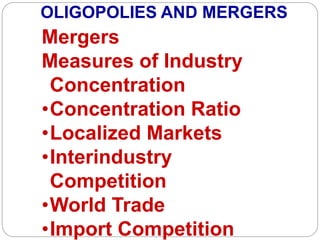
OLIGOPOLIES AND MERGERS
Mergers
Measures of Industry
Concentration
•Concentration Ratio
•Localized Markets
•Interindustry
Competition
•World Trade
•Import Competition
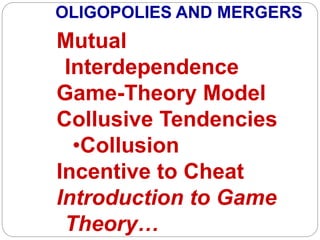
OLIGOPOLIES AND MERGERS
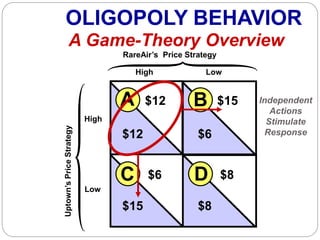
Mutual
Interdependence
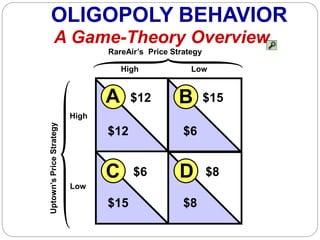
Game-Theory Model
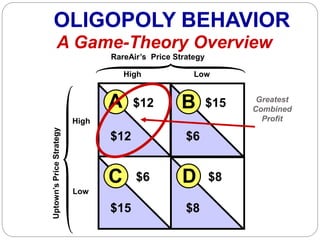
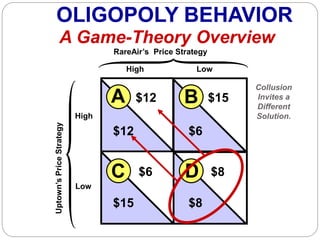
Collusive Tendencies
•Collusion
Incentive to Cheat
Introduction to Game
Theory…
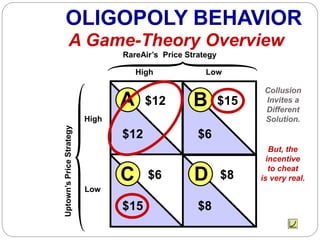
OLIGOPOLY BEHAVIOR
A Game-Theory Overview
High
Low
High Low
Uptown’sPriceStrategy RareAir’s Price Strategy
BA
DC
$12 $15
$12 $6
$6 $8
$8$15
OLIGOPOLY BEHAVIOR
A Game-Theory Overview
High
Low
High Low
Uptown’sPriceStrategy RareAir’s Price Strategy
BA
DC
$12 $15
$12 $6
$6 $8
$8$15
Greatest
Combined
Profit
OLIGOPOLY BEHAVIOR
A Game-Theory Overview
High
Low
High Low
Uptown’sPriceStrategy
RareAir’s Price Strategy
BA
DC
$12 $15
$12 $6
$6 $8
$8$15
Independent
Actions
Stimulate
Response
OLIGOPOLY BEHAVIOR
A Game-Theory Overview
High
Low
High Low
Uptown’sPriceStrategy
RareAir’s Price Strategy
BA
DC
$12 $15
$12 $6
$6 $8
$8$15
Independent
Actions
Stimulate
Response
Gravitating
to the
Worst Case
OLIGOPOLY BEHAVIOR
A Game-Theory Overview
High
Low
High Low
Uptown’sPriceStrategy
RareAir’s Price Strategy
BA
DC
$12 $15
$12 $6
$6 $8
$8$15
Collusion
Invites a
Different
Solution.
OLIGOPOLY BEHAVIOR
A Game-Theory Overview
High
Low
High Low
Uptown’sPriceStrategy
RareAir’s Price Strategy
BA
DC
$12 $15
$12 $6
$6 $8
$8$15
Collusion
Invites a
Different
Solution.
OLIGOPOLY BEHAVIOR
A Game-Theory Overview
High
Low
High Low
Uptown’sPriceStrategy
RareAir’s Price Strategy
BA
DC
$12 $15
$12 $6
$6 $8
$8$15
But, the
incentive
to cheat
is very real.
Collusion
Invites a
Different
Solution.
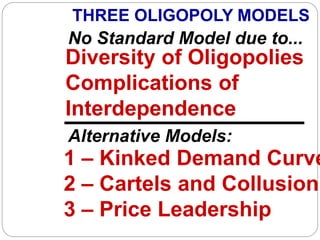
No Standard Model due to...
Diversity of Oligopolies
Complications of
Interdependence
1 – Kinked Demand Curve
2 – Cartels and Collusion
3 – Price Leadership
THREE OLIGOPOLY MODELS
Alternative Models:
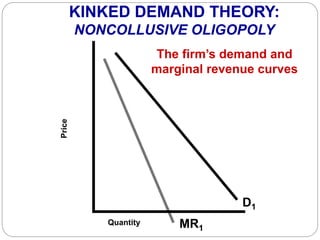
D1
MR1
Quantity
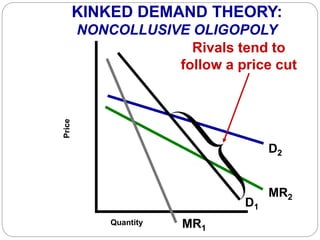
The firm’s demand and
marginal revenue curves
KINKED DEMAND THEORY:
NONCOLLUSIVE OLIGOPOLY
Price
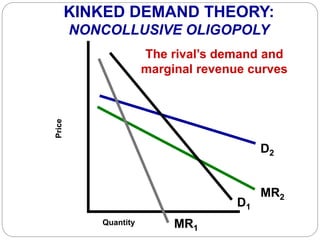
MR2
D1
D2
MR1
Quantity
The rival’s demand and
marginal revenue curves
KINKED DEMAND THEORY:
NONCOLLUSIVE OLIGOPOLY
Price
MR2
D1
D2
MR1
Quantity
KINKED DEMAND THEORY:
NONCOLLUSIVE OLIGOPOLY
Price
Rivals tend to
follow a price cut
MR2
D1
D2
MR1
Quantity
KINKED DEMAND THEORY:
NONCOLLUSIVE OLIGOPOLY
Price
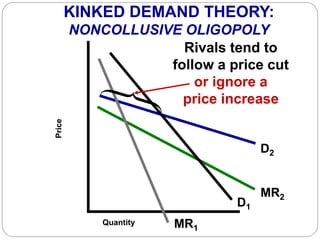
Rivals tend to
follow a price cut
or ignore a
price increase
MR2
D1
D2
MR1
Quantity
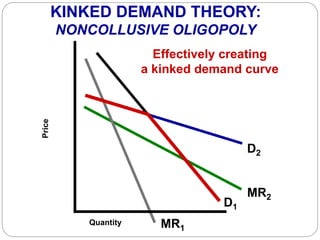
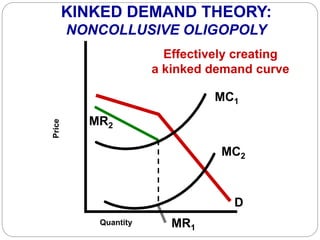
Effectively creating
a kinked demand curve
KINKED DEMAND THEORY:
NONCOLLUSIVE OLIGOPOLY
Price
D
Quantity
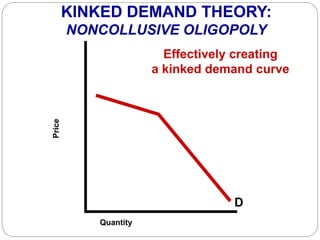
Effectively creating
a kinked demand curve
KINKED DEMAND THEORY:
NONCOLLUSIVE OLIGOPOLY
Price
D
MR1
Quantity
Effectively creating
a kinked demand curve
KINKED DEMAND THEORY:
NONCOLLUSIVE OLIGOPOLY
Price
MC2
MC1
MR2
D
Quantity
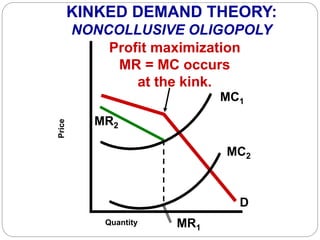
Profit maximization
MR = MC occurs
at the kink.
KINKED DEMAND THEORY:
NONCOLLUSIVE OLIGOPOLY
Price
MC2
MC1
MR2
MR1
D
Quantity
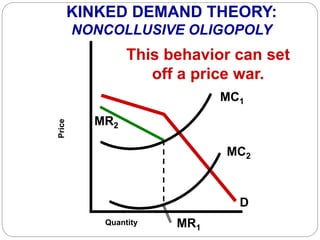
This behavior can set
off a price war.
KINKED DEMAND THEORY:
NONCOLLUSIVE OLIGOPOLY
Price
MC2
MC1
MR2
MR1
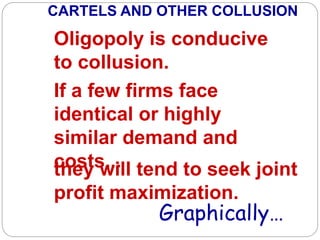
If a few firms face
identical or highly
similar demand and
costs...
Oligopoly is conducive
to collusion.
they will tend to seek joint
profit maximization.
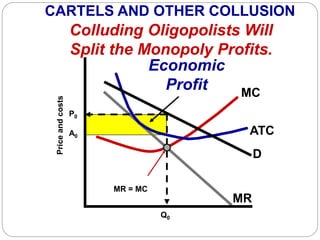
CARTELS AND OTHER COLLUSION
Graphically…
Colluding Oligopolists Will
Split the Monopoly Profits.
D
MC
ATC
MR
Economic
Profit
MR = MC
Priceandcosts
Q0
P0
A0
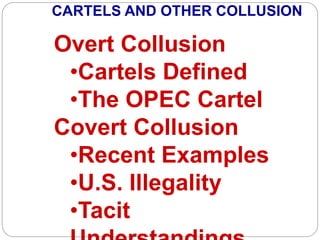
CARTELS AND OTHER COLLUSION
Overt Collusion
•Cartels Defined
•The OPEC Cartel
Covert Collusion
•Recent Examples
•U.S. Illegality
•Tacit
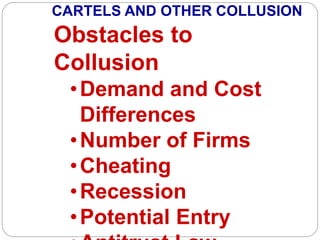
CARTELS AND OTHER COLLUSION
Obstacles to
Collusion
•Demand and Cost
Differences
•Number of Firms
•Cheating
•Recession
•Potential Entry
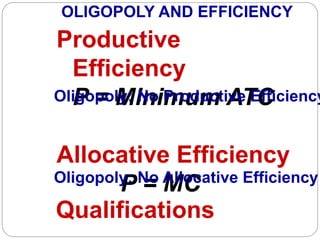
CARTELS AND OTHER COLLUSION
OLIGOPOLY AND EFFICIENCY
Productive
Efficiency
P = Minimum ATC
Allocative Efficiency
P = MC
Oligopoly: No Productive Efficiency
Oligopoly: No Allocative Efficiency
Qualifications
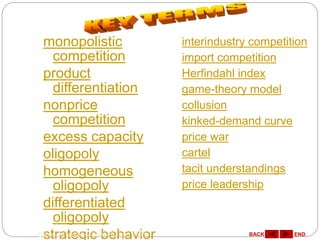
monopolistic
competition
product
differentiation
nonprice
competition
excess capacity
oligopoly
homogeneous
oligopoly
differentiated
oligopoly
strategic behavior
interindustry competition
import competition
Herfindahl index
game-theory model
collusion
kinked-demand curve
price war
cartel
tacit understandings
price leadership
ENDBACKCopyright McGraw-Hill/Irwin, Inc. 2005
Next...
Chapter 26
Technology,
R&D,
and
Efficiency

AP MIcro Monopolistic Competition and Oligolopy