Agenda
!    Art Rx
!    Medieval Art Notes
!    Worktime!
!    Next Class: Full Workday on Roman Tunnel
     Book
Art RX
!  Which movement (Prehistoric; Egyptian;
   Greek or Roman) had sculptures that
   followed the law of frontality?

!  Which movement painted with crushed
   berries; rocks and twigs?

!  Which movement created the sculpture
   titled ‘The Discus Thrower?’
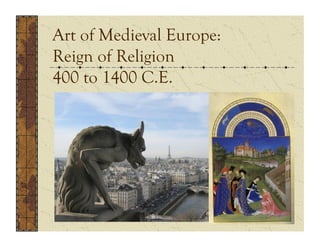
Art of Medieval Europe:
Reign of Religion
400 to 1400 C.E.
Art of Medieval Europe:
 400 C.E. to 1400 C.E.
!  A mixture of Roman, Middle Eastern and
   European influences
!  Art is primarily made for the church
!  Begins with Fall of the Roman Empire; Ends
   with the Renaissance
Art of Medieval Europe:
 400 C.E. to 1400 C.E.
!  Divided into different periods with different
   styles: All are part of Medieval period
    !  Europe
       !  Gothic
    !  The East
       !  Golden Age of Islam
    !  Europe and the East:
       !  Byzantine
Art of Medieval Europe:
  400 C.E. to 1400 C.E.
!   Foreign invaders from
    Northern Europe see
    weakness of ineffective
    Roman emperors.
!   Take opportunity to
    invade Rome
!   Opens the door for
    other groups to
    invade/take over other
    parts of the Empire
Art of Medieval Europe:
 400 C.E. to 1400 C.E.
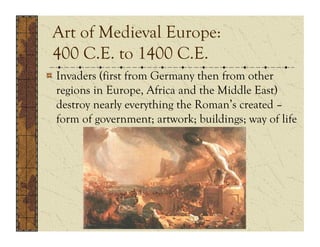
!  Invaders (first from Germany then from other
   regions in Europe, Africa and the Middle East)
   destroy nearly everything the Roman’s created –
   form of government; artwork; buildings; way of life
What do you think?
!  How would life change after invaders take
   over the traditional Roman way of life?
  !  Social Changes?
  !  Government Changes?
  !  Religious Changes?
Art of Medieval Europe:
 400 C.E. to 1400 C.E.
!  Social Changes of the Medieval Period:
    !  The center of art and innovation moves away
       from Rome to the North of Europe – Britain,
       France, Germany
    !  There is no central base of power coming from
       Rome
    !  Empire divided into many different regions;
       each with own ruler fighting for power and
       more land.
Roman Empire vs. Post-Empire
Art of Medieval Europe:
  400 C.E. to 1400 C.E.
!  Religious Changes of Medieval Period
   !  Focus of life changes from here and now to
      life hereafter (what happens after Death)
   !  Focus on gaining acceptance into a Christian
      or Muslim afterlife (Heaven)
   !  Human body no longer celebrated as a
      beautiful thing. It’s now sinful and corrupt
   !  Question: How will this change art?
Art of Medieval Europe:
   400 C.E. to 1400 C.E.
!  Art Changes of Medieval Period
   !  Art no longer concerned with harmony,
      balance and realism…art now concerned with
      worshipping God and converting people to
      Christianity
   !  Greco-Roman interest in realism dies. Art
      shows ignorance of anatomy
   !  Because human body is no longer celebrated
      and now thought sinful, nudes are forbidden
   !  Art becomes the servant of the Church
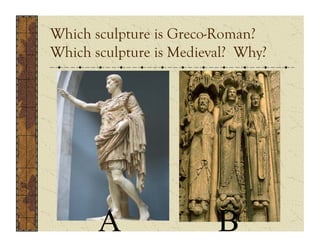
Which sculpture is Greco-Roman?
Which sculpture is Medieval? Why?


       A                 B
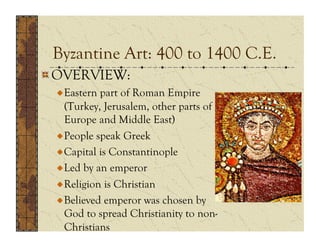
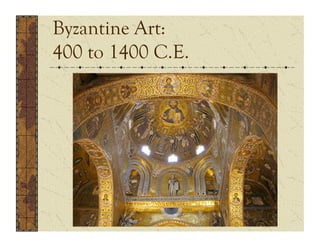
Byzantine Art: 400 to 1400 C.E.
!  OVERVIEW:
 !  Eastern part of Roman Empire
    (Turkey, Jerusalem, other parts of
    Europe and Middle East)
 !  People speak Greek
 !  Capital is Constantinople
 !  Led by an emperor
 !  Religion is Christian
 !  Believed emperor was chosen by
    God to spread Christianity to non-
    Christians
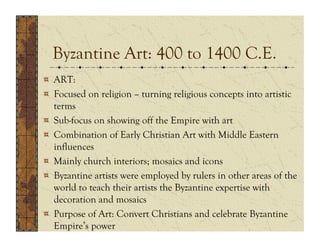
Byzantine Art: 400 to 1400 C.E.
!   ART:
!   Focused on religion – turning religious concepts into artistic
    terms
!   Sub-focus on showing off the Empire with art
!   Combination of Early Christian Art with Middle Eastern
    influences
!   Mainly church interiors; mosaics and icons
!   Byzantine artists were employed by rulers in other areas of the
    world to teach their artists the Byzantine expertise with
    decoration and mosaics
!   Purpose of Art: Convert Christians and celebrate Byzantine
    Empire’s power
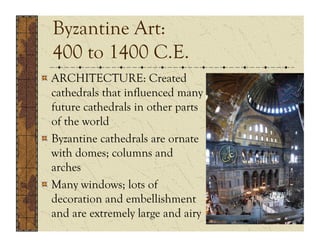
Byzantine Art:
  400 to 1400 C.E.
!  ARCHITECTURE: Created
   cathedrals that influenced many
   future cathedrals in other parts
   of the world
!  Byzantine cathedrals are ornate
   with domes; columns and
   arches
!  Many windows; lots of
   decoration and embellishment
   and are extremely large and airy
Byzantine Art:
400 to 1400 C.E.
Byzantine Art:
400 to 1400 C.E.
Byzantine Art:
 400 to 1400 C.E.
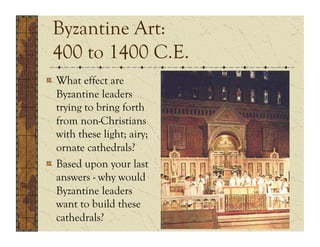
!   What effect are
    Byzantine leaders
    trying to bring forth
    from non-Christians
    with these light; airy;
    ornate cathedrals?
!   Based upon your last
    answers - why would
    Byzantine leaders
    want to build these
    cathedrals?
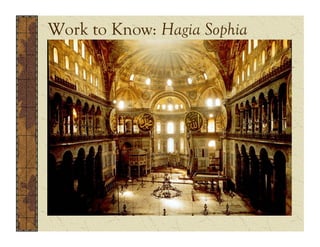
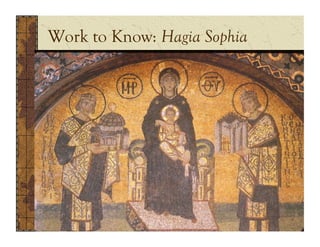
WORK TO KNOW:
Hagia Sophia, Turkey, 530 C.E.
Work to Know: Hagia Sophia
Byzantine Art:
  400 to 1400 C.E.
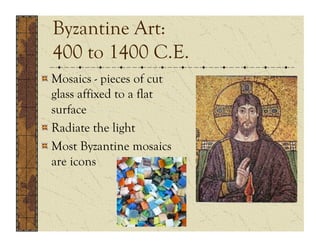
!  Mosaics - pieces of cut
   glass affixed to a flat
   surface
!  Radiate the light
!  Most Byzantine mosaics
   are icons
Byzantine Art:
  400 to 1400 C.E.
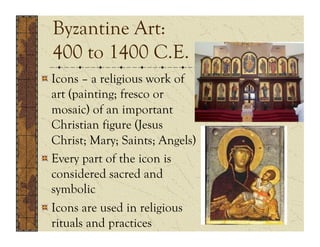
!  Icons – a religious work of
   art (painting; fresco or
   mosaic) of an important
   Christian figure (Jesus
   Christ; Mary; Saints; Angels)
!  Every part of the icon is
   considered sacred and
   symbolic
!  Icons are used in religious
   rituals and practices
Byzantine Art:
  400 to 1400 C.E.
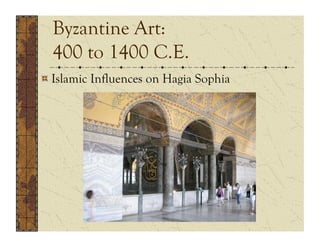
!  Islamic Influences on Hagia Sophia
Golden Age of Islamic Art
   600 C.E. to 1250 C.E.
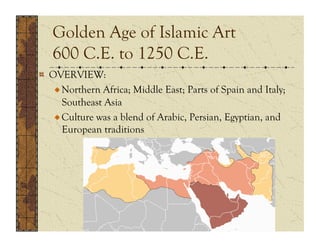
!   OVERVIEW:
    !  Northern Africa; Middle East; Parts of Spain and Italy;
       Southeast Asia
    !  Culture was a blend of Arabic, Persian, Egyptian, and
       European traditions
Golden Age of Islamic Art
  600 C.E. to 1250 C.E.
!  Religion is Muslim – monotheistic with Allah as
   their God, Mohammed as the only prophet
!  Many different ethnic groups centered around cities
   (caliphates)
!  Each caliphate ruled by a caliph (male leader,
   believed to be appointed by Mohammed
!  Laws based on the Q’uran, the Islamic Holy book
!  Members of the caliphates spoke Arabic to be able
   to read Q’uran – this helped unify the different
   ethnic groups
Golden Age of Islamic Art
   600 C.E. to 1250 C.E.
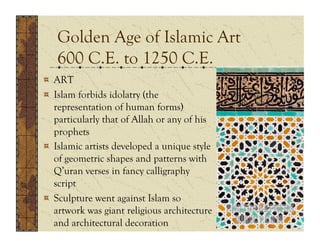
!   ART
!   Islam forbids idolatry (the
    representation of human forms)
    particularly that of Allah or any of his
    prophets
!   Islamic artists developed a unique style
    of geometric shapes and patterns with
    Q’uran verses in fancy calligraphy
    script
!   Sculpture went against Islam so
    artwork was giant religious architecture
    and architectural decoration
Golden Age of Islamic Art
600 C.E. to 1250 C.E.
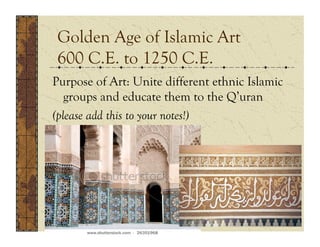
Purpose of Art: Unite different ethnic Islamic
   groups and educate them to the Q’uran
(please add this to your notes!)
Golden Age of Islamic Art
  600 C.E. to 1250 C.E.
!  Most famous Islamic
   artworks are shrines
   and mosques –
   Muslim place of
   worship
!  Best example of
   Golden Age of Islamic
   Art: Work to Know:
   Dome of the Rock,
   Jerusalem, 7th century
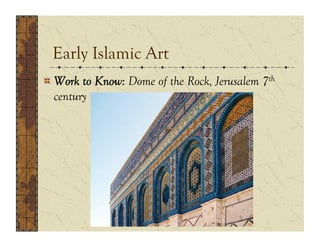
Early Islamic Art
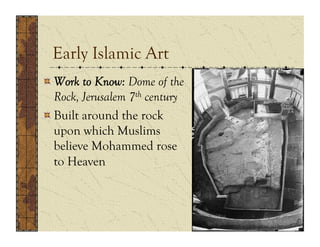
!  Work to Know: Dome of the
   Rock, Jerusalem 7th century
!  Built around the rock
   upon which Muslims
   believe Mohammed rose
   to Heaven
Early Islamic Art
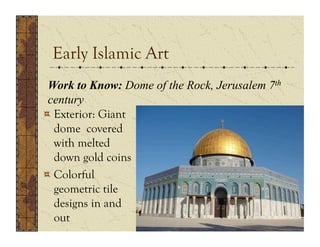
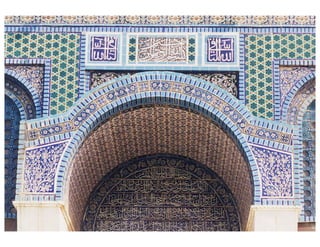
 Work to Know: Dome of the Rock, Jerusalem 7th
 century
!  Exterior: Giant
   dome covered
   with melted
   down gold coins
!  Colorful
   geometric tile
   designs in and
   out
Early Islamic Art
!  Work to Know: Dome of the Rock, Jerusalem 7th
   century
Gothic Art
1200 to 1400 C.E
Gothic Art
 1200 to 1400 C.E.
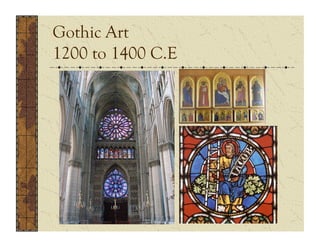
!  OVERVIEW:
!  Northern European (Germany, England, Parts
   of France)
!  Art is primarily highly decorated cathedrals,
   stained glass windows, skinny sculptures, altar
   piece paintings and illuminated manuscript
   paintings of saints, Jesus Christ and Mary
!  Purpose of Art: Believed a beautiful church
   filled with beautiful art would inspire church
   goers to be good or convert to Christianity
Gothic Art: 1200 to 1500 C.E.
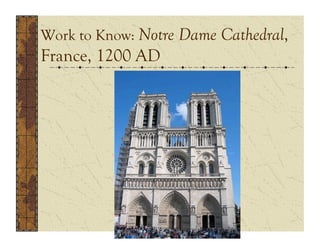
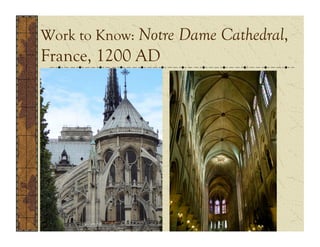
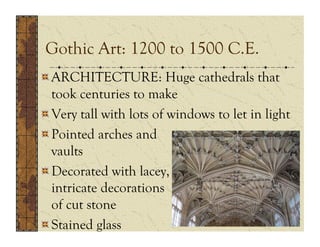
!  ARCHITECTURE: Huge cathedrals that
   took centuries to make
!  Very tall with lots of windows to let in light
!  Pointed arches and
   vaults
!  Decorated with lacey,
   intricate decorations
   of cut stone
!  Stained glass
Work to Know: Notre Dame Cathedral,
France, 1200 AD
Work to Know: Notre Dame Cathedral,
France, 1200 AD
Work to Know: Notre Dame Cathedral,
France, 1200 AD
Work to Know: Notre Dame Cathedral,
France, 1200 AD
Gothic Art
1200 to 1400 C.E.
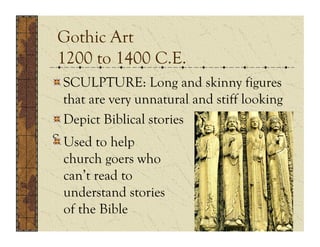
!  SCULPTURE: Long and skinny figures
   that are very unnatural and stiff looking
!  Depict Biblical stories
S  Used to help
!
   church goers who
   can’t read to
   understand stories
   of the Bible
Gothic Art
 1200 to 1400 C.E.
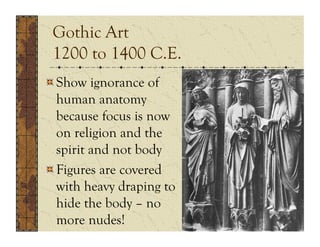
!  Show ignorance of
   human anatomy
   because focus is now
   on religion and the
   spirit and not body
!  Figures are covered
   with heavy draping to
   hide the body – no
   more nudes!
Gothic Art
     1200 to 1400 C.E.
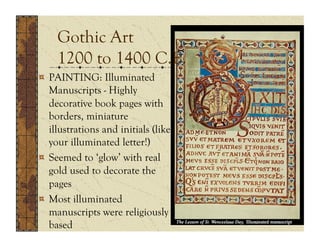
!   PAINTING: Illuminated
    Manuscripts - Highly
    decorative book pages with
    borders, miniature
    illustrations and initials (like
    your illuminated letter!)
!   Seemed to ‘glow’ with real
    gold used to decorate the
    pages
!   Most illuminated
    manuscripts were religiously
    based
Gothic Art
1200 to 1400 C.E.
Gothic Art
 1200 to 1400 C.E.
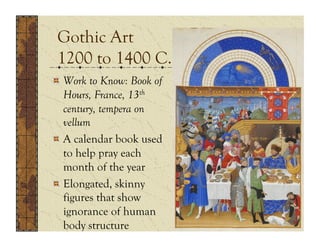
!   Work to Know: Book of
    Hours, France, 13th
    century, tempera on
    vellum
!   A calendar book used
    to help pray each
    month of the year
!   Elongated, skinny
    figures that show
    ignorance of human
    body structure
Gothic Art
1200 to 1400 C.E.
Where are we going with
Medieval Art?
!  After Regents week:
  !  Learning color mixing by making stained glass
     windows and Islamic geometric designs
  !  Medieval beasts made of clay after we finish our
     tunnel books
Rest of the Day
!  Workday!
!  Finish Stage 1:Planning - Steps 1 through 7
   (follow directions as they are written in the
   binder!)
!  Begin drawing by following Stage 2: Drafting
   – Steps 8 through 13 (follow directions as
   they are written in the binder!)
!  Homework: Study for the mid-term exam
   next week!
Agenda
!    Art Rx
!    Weekly Process Grades
!    Workday!
!    Homework: Study for Mid-term Exam that is
     NEXT WEEK!!!!! Know your art history
     inside and out!!
Art Rx 1/12
!  What was the purpose of Art during the
   Medieval Byzantine time period?
!  What is an icon?
!  What Roman building was famous for its
   Corinthian columns; pediment and large
   oculus which let light in, heated the space in
   the winter and cooled it in the summer?
Art Rx 1/12
!  To spread Christianity and show off the
   power of the Byzantine Empire?

!  A sacred and symbolic religious work of art
   of an important Christian figure

!  Pantheon
Nearing the 2nd Marking Period
  = Greater Expectations
!   If you do everything that is asked of you but fail to
    volunteer: 18 out of 20 points
!   If you work on work other than art in classroom:
    automatically deduct 10 points on weekly process grade
!   If you constantly leave the classroom for bathroom,
    nurse, locker, out of seat or assigned seat, automatically
    deduct 5 points on weekly process grade
!   Those that do not clean up their materials properly
    automatically deduct 5 points on weekly process grade
!   Lack of effort and working in class results in deduction
    of points
Sample Grades
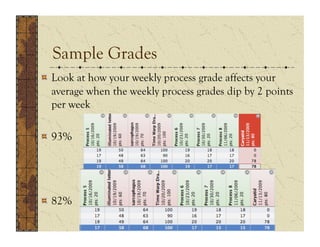
!   Look at how your weekly process grade affects your
    average when the weekly process grades dip by 2 points
    per week

!   93%


!   82%
Weekly Process Grade
!  So….stay awake, volunteer, hand in work on
   time, concentrate on your work, cleanup and
   generate QUALITY for a perfect 20 out of
   20!
!  Check those grades online to see how you’re
   doing
!  Those of you receiving those 18’s, 19’s and
   20’s – congratulations. Keep up the great
   work!
Agenda
!  Art Rx
!  Passport to Art – Medieval Art
!  Review
!  Workday! You should be well into Stage 2:
   Drafting
!  Homework – Study for MIDTERM Part 1
   that starts NEXT CLASS!
    !  Must have pencil and your own calculator for
       the 100 Multiple Choice.
Art Rx 1/14; 1/18
!  The imaginary line located at eye
   level upon which the vanishing
   points are placed is called the
   ______________.
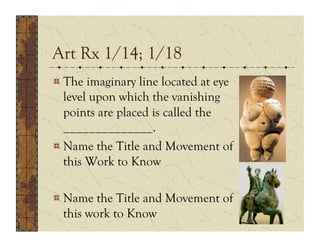
!  Name the Title and Movement of
   this Work to Know

!  Name the Title and Movement of
   this work to Know
Art Rx 1/14; 1/18
!  Horizon Line

!  Venus of Willendorf - Prehistoric


!  Marcus Aurelius - Roman
Passport to Art
!  Please fill out your passport to art.
   Remember that this will be graded based
   upon
  !  Writing down all of the information
  !  Quality of your drawings
  !  Having the provenance on your drawings
Review
!  Please complete the review sheets in the on
   your OWN piece of paper – DO NOT
   WRITE ON THE REVIEW SHEETS!
!  We will correct them in a half hour. If you
   finish early move ahead to your tunnel book.

Medieval art

  • 1.
    Agenda !  Art Rx !  Medieval Art Notes !  Worktime! !  Next Class: Full Workday on Roman Tunnel Book
  • 2.
    Art RX !  Whichmovement (Prehistoric; Egyptian; Greek or Roman) had sculptures that followed the law of frontality? !  Which movement painted with crushed berries; rocks and twigs? !  Which movement created the sculpture titled ‘The Discus Thrower?’
  • 3.
    Art of MedievalEurope: Reign of Religion 400 to 1400 C.E.
  • 4.
    Art of MedievalEurope: 400 C.E. to 1400 C.E. !  A mixture of Roman, Middle Eastern and European influences !  Art is primarily made for the church !  Begins with Fall of the Roman Empire; Ends with the Renaissance
  • 5.
    Art of MedievalEurope: 400 C.E. to 1400 C.E. !  Divided into different periods with different styles: All are part of Medieval period !  Europe !  Gothic !  The East !  Golden Age of Islam !  Europe and the East: !  Byzantine
  • 6.
    Art of MedievalEurope: 400 C.E. to 1400 C.E. !   Foreign invaders from Northern Europe see weakness of ineffective Roman emperors. !   Take opportunity to invade Rome !   Opens the door for other groups to invade/take over other parts of the Empire
  • 7.
    Art of MedievalEurope: 400 C.E. to 1400 C.E. !  Invaders (first from Germany then from other regions in Europe, Africa and the Middle East) destroy nearly everything the Roman’s created – form of government; artwork; buildings; way of life
  • 8.
    What do youthink? !  How would life change after invaders take over the traditional Roman way of life? !  Social Changes? !  Government Changes? !  Religious Changes?
  • 9.
    Art of MedievalEurope: 400 C.E. to 1400 C.E. !  Social Changes of the Medieval Period: !  The center of art and innovation moves away from Rome to the North of Europe – Britain, France, Germany !  There is no central base of power coming from Rome !  Empire divided into many different regions; each with own ruler fighting for power and more land.
  • 10.
    Roman Empire vs.Post-Empire
  • 11.
    Art of MedievalEurope: 400 C.E. to 1400 C.E. !  Religious Changes of Medieval Period !  Focus of life changes from here and now to life hereafter (what happens after Death) !  Focus on gaining acceptance into a Christian or Muslim afterlife (Heaven) !  Human body no longer celebrated as a beautiful thing. It’s now sinful and corrupt !  Question: How will this change art?
  • 12.
    Art of MedievalEurope: 400 C.E. to 1400 C.E. !  Art Changes of Medieval Period !  Art no longer concerned with harmony, balance and realism…art now concerned with worshipping God and converting people to Christianity !  Greco-Roman interest in realism dies. Art shows ignorance of anatomy !  Because human body is no longer celebrated and now thought sinful, nudes are forbidden !  Art becomes the servant of the Church
  • 13.
    Which sculpture isGreco-Roman? Which sculpture is Medieval? Why? A B
  • 14.
    Byzantine Art: 400to 1400 C.E.
  • 15.
    Byzantine Art: 400to 1400 C.E. !  OVERVIEW: !  Eastern part of Roman Empire (Turkey, Jerusalem, other parts of Europe and Middle East) !  People speak Greek !  Capital is Constantinople !  Led by an emperor !  Religion is Christian !  Believed emperor was chosen by God to spread Christianity to non- Christians
  • 16.
    Byzantine Art: 400to 1400 C.E. !   ART: !   Focused on religion – turning religious concepts into artistic terms !   Sub-focus on showing off the Empire with art !   Combination of Early Christian Art with Middle Eastern influences !   Mainly church interiors; mosaics and icons !   Byzantine artists were employed by rulers in other areas of the world to teach their artists the Byzantine expertise with decoration and mosaics !   Purpose of Art: Convert Christians and celebrate Byzantine Empire’s power
  • 17.
    Byzantine Art: 400 to 1400 C.E. !  ARCHITECTURE: Created cathedrals that influenced many future cathedrals in other parts of the world !  Byzantine cathedrals are ornate with domes; columns and arches !  Many windows; lots of decoration and embellishment and are extremely large and airy
  • 18.
  • 19.
  • 20.
    Byzantine Art: 400to 1400 C.E. !   What effect are Byzantine leaders trying to bring forth from non-Christians with these light; airy; ornate cathedrals? !   Based upon your last answers - why would Byzantine leaders want to build these cathedrals?
  • 21.
    WORK TO KNOW: HagiaSophia, Turkey, 530 C.E.
  • 22.
    Work to Know:Hagia Sophia
  • 23.
    Work to Know:Hagia Sophia
  • 24.
    Work to Know:Hagia Sophia
  • 25.
    Byzantine Art: 400 to 1400 C.E. !  Mosaics - pieces of cut glass affixed to a flat surface !  Radiate the light !  Most Byzantine mosaics are icons
  • 26.
    Byzantine Art: 400 to 1400 C.E. !  Icons – a religious work of art (painting; fresco or mosaic) of an important Christian figure (Jesus Christ; Mary; Saints; Angels) !  Every part of the icon is considered sacred and symbolic !  Icons are used in religious rituals and practices
  • 27.
    Byzantine Art: 400 to 1400 C.E. !  Islamic Influences on Hagia Sophia
  • 28.
    Golden Age ofIslamic Art 600 C.E. to 1250 C.E. !   OVERVIEW: !  Northern Africa; Middle East; Parts of Spain and Italy; Southeast Asia !  Culture was a blend of Arabic, Persian, Egyptian, and European traditions
  • 29.
    Golden Age ofIslamic Art 600 C.E. to 1250 C.E. !  Religion is Muslim – monotheistic with Allah as their God, Mohammed as the only prophet !  Many different ethnic groups centered around cities (caliphates) !  Each caliphate ruled by a caliph (male leader, believed to be appointed by Mohammed !  Laws based on the Q’uran, the Islamic Holy book !  Members of the caliphates spoke Arabic to be able to read Q’uran – this helped unify the different ethnic groups
  • 30.
    Golden Age ofIslamic Art 600 C.E. to 1250 C.E. !   ART !   Islam forbids idolatry (the representation of human forms) particularly that of Allah or any of his prophets !   Islamic artists developed a unique style of geometric shapes and patterns with Q’uran verses in fancy calligraphy script !   Sculpture went against Islam so artwork was giant religious architecture and architectural decoration
  • 31.
    Golden Age ofIslamic Art 600 C.E. to 1250 C.E. Purpose of Art: Unite different ethnic Islamic groups and educate them to the Q’uran (please add this to your notes!)
  • 32.
    Golden Age ofIslamic Art 600 C.E. to 1250 C.E. !  Most famous Islamic artworks are shrines and mosques – Muslim place of worship !  Best example of Golden Age of Islamic Art: Work to Know: Dome of the Rock, Jerusalem, 7th century
  • 33.
    Early Islamic Art ! Work to Know: Dome of the Rock, Jerusalem 7th century !  Built around the rock upon which Muslims believe Mohammed rose to Heaven
  • 34.
    Early Islamic Art Work to Know: Dome of the Rock, Jerusalem 7th century !  Exterior: Giant dome covered with melted down gold coins !  Colorful geometric tile designs in and out
  • 35.
    Early Islamic Art ! Work to Know: Dome of the Rock, Jerusalem 7th century
  • 37.
  • 38.
    Gothic Art 1200to 1400 C.E. !  OVERVIEW: !  Northern European (Germany, England, Parts of France) !  Art is primarily highly decorated cathedrals, stained glass windows, skinny sculptures, altar piece paintings and illuminated manuscript paintings of saints, Jesus Christ and Mary !  Purpose of Art: Believed a beautiful church filled with beautiful art would inspire church goers to be good or convert to Christianity
  • 39.
    Gothic Art: 1200to 1500 C.E. !  ARCHITECTURE: Huge cathedrals that took centuries to make !  Very tall with lots of windows to let in light !  Pointed arches and vaults !  Decorated with lacey, intricate decorations of cut stone !  Stained glass
  • 40.
    Work to Know:Notre Dame Cathedral, France, 1200 AD
  • 41.
    Work to Know:Notre Dame Cathedral, France, 1200 AD
  • 42.
    Work to Know:Notre Dame Cathedral, France, 1200 AD
  • 43.
    Work to Know:Notre Dame Cathedral, France, 1200 AD
  • 44.
    Gothic Art 1200 to1400 C.E. !  SCULPTURE: Long and skinny figures that are very unnatural and stiff looking !  Depict Biblical stories S  Used to help ! church goers who can’t read to understand stories of the Bible
  • 45.
    Gothic Art 1200to 1400 C.E. !  Show ignorance of human anatomy because focus is now on religion and the spirit and not body !  Figures are covered with heavy draping to hide the body – no more nudes!
  • 46.
    Gothic Art 1200 to 1400 C.E. !   PAINTING: Illuminated Manuscripts - Highly decorative book pages with borders, miniature illustrations and initials (like your illuminated letter!) !   Seemed to ‘glow’ with real gold used to decorate the pages !   Most illuminated manuscripts were religiously based
  • 47.
  • 48.
    Gothic Art 1200to 1400 C.E. !   Work to Know: Book of Hours, France, 13th century, tempera on vellum !   A calendar book used to help pray each month of the year !   Elongated, skinny figures that show ignorance of human body structure
  • 49.
  • 50.
    Where are wegoing with Medieval Art? !  After Regents week: !  Learning color mixing by making stained glass windows and Islamic geometric designs !  Medieval beasts made of clay after we finish our tunnel books
  • 51.
    Rest of theDay !  Workday! !  Finish Stage 1:Planning - Steps 1 through 7 (follow directions as they are written in the binder!) !  Begin drawing by following Stage 2: Drafting – Steps 8 through 13 (follow directions as they are written in the binder!) !  Homework: Study for the mid-term exam next week!
  • 52.
    Agenda !  Art Rx !  Weekly Process Grades !  Workday! !  Homework: Study for Mid-term Exam that is NEXT WEEK!!!!! Know your art history inside and out!!
  • 53.
    Art Rx 1/12 ! What was the purpose of Art during the Medieval Byzantine time period? !  What is an icon? !  What Roman building was famous for its Corinthian columns; pediment and large oculus which let light in, heated the space in the winter and cooled it in the summer?
  • 54.
    Art Rx 1/12 ! To spread Christianity and show off the power of the Byzantine Empire? !  A sacred and symbolic religious work of art of an important Christian figure !  Pantheon
  • 55.
    Nearing the 2ndMarking Period = Greater Expectations !   If you do everything that is asked of you but fail to volunteer: 18 out of 20 points !   If you work on work other than art in classroom: automatically deduct 10 points on weekly process grade !   If you constantly leave the classroom for bathroom, nurse, locker, out of seat or assigned seat, automatically deduct 5 points on weekly process grade !   Those that do not clean up their materials properly automatically deduct 5 points on weekly process grade !   Lack of effort and working in class results in deduction of points
  • 56.
    Sample Grades !  Look at how your weekly process grade affects your average when the weekly process grades dip by 2 points per week !   93% !   82%
  • 57.
    Weekly Process Grade ! So….stay awake, volunteer, hand in work on time, concentrate on your work, cleanup and generate QUALITY for a perfect 20 out of 20! !  Check those grades online to see how you’re doing !  Those of you receiving those 18’s, 19’s and 20’s – congratulations. Keep up the great work!
  • 58.
    Agenda !  Art Rx ! Passport to Art – Medieval Art !  Review !  Workday! You should be well into Stage 2: Drafting !  Homework – Study for MIDTERM Part 1 that starts NEXT CLASS! !  Must have pencil and your own calculator for the 100 Multiple Choice.
  • 59.
    Art Rx 1/14;1/18 !  The imaginary line located at eye level upon which the vanishing points are placed is called the ______________. !  Name the Title and Movement of this Work to Know !  Name the Title and Movement of this work to Know
  • 60.
    Art Rx 1/14;1/18 !  Horizon Line !  Venus of Willendorf - Prehistoric !  Marcus Aurelius - Roman
  • 61.
    Passport to Art ! Please fill out your passport to art. Remember that this will be graded based upon !  Writing down all of the information !  Quality of your drawings !  Having the provenance on your drawings
  • 62.
    Review !  Please completethe review sheets in the on your OWN piece of paper – DO NOT WRITE ON THE REVIEW SHEETS! !  We will correct them in a half hour. If you finish early move ahead to your tunnel book.