Pure
Monopol
y
24C H A P T E R
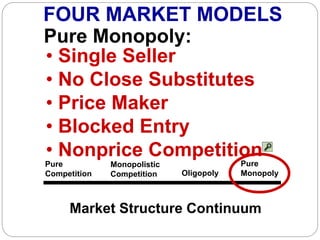
Market Structure Continuum
Pure
Competition
Pure
Monopoly
Monopolistic
Competition Oligopoly
FOUR MARKET MODELS
Pure Monopoly:
• Single Seller
• No Close Substitutes
• Price Maker
• Blocked Entry
• Nonprice Competition
MONOPOLY EXAMPLES
Pure Monopoly
Regulated Monopoly
Near Monopolies
Dual Objectives of the
Study
• Monopoly as a Market
Structure
• To Better Understand
Other Market
BARRIERS TO ENTRY
Economies of Scale
• The Natural Monopoly
Case
• Minimum Efficient Scale
Legal Barriers to Entry
• Patents
• Licenses
Ownership or Control of
Essential Resources
Pricing and Other
Strategic Barriers to Entry
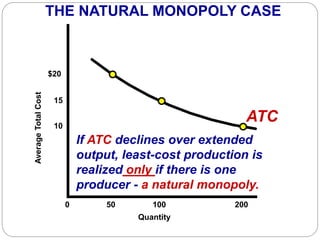
AverageTotalCost
Quantity
$20
15
10
0 50 100 200
ATC
If ATC declines over extended
output, least-cost production is
realized only if there is one
producer - a natural monopoly.
THE NATURAL MONOPOLY CASE
MONOPOLY DEMAND
3 Basic Assumptions:
• Monopoly Status is
Secure
• No Governmental
Regulation
• Firm Charges the Same
Price for all Units Sold
Market Demand Curve is
the Firm’s Demand Curve
MONOPOLY DEMAND
1 2 3 4 5 6
P
Q
$142
132
D
As price decreases from
$142 to $132...
Loss = $30
Gain = $132
but revenue will
increase with the
additional
unit sold.
MONOPOLY DEMAND
1 2 3 4 5 6
P
Q
$142
132
D
As price decreases from
$142 to $132...
Loss = $30
Gain = $132
but revenue will
increase with the
additional
unit sold.
Marginal Revenue
$142 - $30 = $102
will necessarily be
less than price $132
MONOPOLY REVENUES & COSTS
Marginal
Revenue
0
Quantity
of
Output
Price
(Average
Revenue)
Total
Revenue
Marginal
Cost
Profit +
or
loss -
$172 $ 0 - $100
Average
Total
Cost
Total
Cost
$100
Revenue Data Cost Data
x = - =
0 $172 $ 0 - $100$100
MONOPOLY REVENUES & COSTS
Marginal
Revenue
0
1
90
Quantity
of
Output
Price
(Average
Revenue)
Total
Revenue
Marginal
Cost
Profit +
or
loss -
$172
162
$ 0
162
$162
- $100
- 28
Average
Total
Cost
$190.00
Total
Cost
$100
190
] ]
Revenue Data Cost Data
x = - =
MR = $162 – 0 = $162 MC = $190 – 100 = $90
MR > MC
Loss Improvement
from -$100 to -$28
Check next unit of
output!
MONOPOLY REVENUES & COSTS
Marginal
Revenue
0
1
2
3
4
5
6
7
8
9
10
90
80
70
60
70
80
90
110
130
150
Quantity
of
Output
Price
(Average
Revenue)
Total
Revenue
Marginal
Cost
Profit +
or
loss -
$172
162
152
142
132
122
112
102
92
82
72
$ 0
162
304
426
528
610
672
714
736
738
720
$162
142
122
102
82
62
42
22
2
- 18
- $100
- 28
+ 34
+ 86
+ 128
+ 140
+ 122
+ 74
- 14
- 142
- 310
Average
Total
Cost
$190.00
135.00
113.33
100.00
94.00
91.67
91.43
93.73
97.78
103.00
Total
Cost
$100
190
270
340
400
470
550
640
750
880
1030
]
]
]
]
]
]
]
]
]
]
]
]
]
]
]
]
]
]
]
]
Revenue Data Cost Data
MONOPOLY REVENUES & COSTS
Marginal
Revenue
0
1
2
3
4
5
6
7
8
9
10
90
80
70
60
70
80
90
110
130
150
Quantity
of
Output
Price
(Average
Revenue)
Total
Revenue
Marginal
Cost
Profit +
or
loss -
$172
162
152
142
132
122
112
102
92
82
72
$ 0
162
304
426
528
610
672
714
736
738
720
$162
142
122
102
82
62
42
22
2
- 18
- $100
- 28
+ 34
+ 86
+ 128
+ 140
+ 122
+ 74
- 14
- 142
- 310
Average
Total
Cost
$190.00
135.00
113.33
100.00
94.00
91.67
91.43
93.73
97.78
103.00
Total
Cost
$100
190
270
340
400
470
550
640
750
880
1030
]
]
]
]
]
]
]
]
]
]
]
]
]
]
]
]
]
]
]
]
Revenue Data Cost Data
Can you see profit
maximization? MR > = MC
MONOPOLY REVENUES & COSTS
Marginal
Revenue
0
1
2
3
4
5
6
7
8
9
10
90
80
70
60
70
80
90
110
130
150
Quantity
of
Output
Price
(Average
Revenue)
Total
Revenue
Marginal
Cost
Profit +
or
loss -
$172
162
152
142
132
122
112
102
92
82
72
$ 0
162
304
426
528
610
672
714
736
738
720
$162
142
122
102
82
62
42
22
2
- 18
- $100
- 28
+ 34
+ 86
+ 128
+ 140
+ 122
+ 74
- 14
- 142
- 310
Average
Total
Cost
$190.00
135.00
113.33
100.00
94.00
91.67
91.43
93.73
97.78
103.00
Total
Cost
$100
190
270
340
400
470
550
640
750
880
1030
]
]
]
]
]
]
]
]
]
]
]
]
]
]
]
]
]
]
]
]
Revenue Data Cost Data
MONOPOLY REVENUES & COSTS
DollarsDollars
$200
150
200
50
$750
500
250
0 1 2 3 4 5 6 7 8 9 10 11 12 13 14 15 16 17 18
Q
0 1 2 3 4 5 6 7 8 9 10 11 12 13 14 15 16 17 18
Q
MONOPOLY REVENUES & COSTS
DollarsDollars
$200
150
200
50
$750
500
250
MR
Elastic
0 1 2 3 4 5 6 7 8 9 10 11 12 13 14 15 16 17 18
D
Q
0 1 2 3 4 5 6 7 8 9 10 11 12 13 14 15 16 17 18
TR
Q
MONOPOLY REVENUES & COSTS
Q
DollarsDollars
$200
150
200
50
$750
500
250
TR
MR D
InelasticElastic
0 1 2 3 4 5 6 7 8 9 10 11 12 13 14 15 16 17 18
Q
0 1 2 3 4 5 6 7 8 9 10 11 12 13 14 15 16 17 18
OUTPUT AND PRICE DETERMINATION
Cost Data
MR = MC Rule
No Monopoly Supply Curve
Monopoly Pricing
Misconceptions
• Not Highest Price
• Total, Not Unit, Profit
• Possibility of Losses
Graphically…
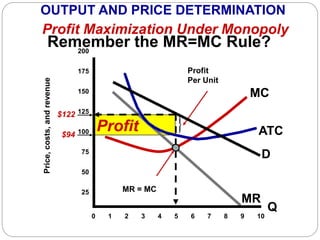
Profit Maximization Under Monopoly
D
MC
ATC
MR
$94
$122
Profit
MR = MC
Profit
Per Unit
OUTPUT AND PRICE DETERMINATION
Q
200
175
150
125
100
75
50
25
0 1 2 3 4 5 6 7 8 9 10
Price,costs,andrevenueRemember the MR=MC Rule?
Profit Maximization Under Monopoly
D
MC
ATC
MR
$94
$122
Profit
MR = MC
Profit
Per Unit
OUTPUT AND PRICE DETERMINATION
Q
200
175
150
125
100
75
50
25
0 1 2 3 4 5 6 7 8 9 10
Price,costs,andrevenue
Loss Minimization Under Monopoly
D
MC
ATC
MR
A
Pm
Loss
MR = MC
Loss
Per Unit
OUTPUT AND PRICE DETERMINATION
Q
200
175
150
125
100
75
50
25
0 1 2 3 4 5 6 7 8 9 10
Price,costs,andrevenue
AVC
Qm
V
Since Pm exceeds AVC,
the firm will produce
Loss Minimization Under Monopoly
D
MC
ATC
MR
A
Pm
Loss
MR = MC
Loss
Per Unit
OUTPUT AND PRICE DETERMINATION
Q
200
175
150
125
100
75
50
25
0 1 2 3 4 5 6 7 8 9 10
Price,costs,andrevenue
AVC
Qm
V
What are the
Economic Effects
of Monopoly?
Q
INEFFICIENCY OF PURE MONOPOLY
P
D
MR
S = MC
Pc
Pm
QcQm
At MR=MC
A monopolist
will sell less
units at a
higher price
than in
competition
An industry in pure competition
sells where supply and
demand are equal
Q
INEFFICIENCY OF PURE MONOPOLY
P
D
MR
S = MC
Pc
Pm
QcQm
At MR=MC
A monopolist
will sell less
units at a
higher price
than in
competition
Monopoly pricing effectively
creates an income transfer from
buyers to the seller!
COST COMPLICATIONS
Averagetotalcosts
Quantity
Average
Total Costs
X
X’
Q1 Q2
ATCx
ATC1
ATC2
ATCx’
Economies of Scale
Simultaneous Consumption
Network Effects
X-Inefficiency Inefficient internal
operation leads to
higher-than-
necessary costs
COST COMPLICATIONS
Economies of Scale
Simultaneous Consumption
Network Effects
X-Inefficiency
Rent-Seeking Expenditures
Rent-Seeking Behavior
Technological Advance
Assessment and Policy Option
Antitrust Action
Regulate Natural Monopoly
Ignore it, if it is Short-Lived
Conditions
Monopoly Power
Market Segregation
No Resale
Consequences
More Profit
More Production
PRICE DISCRIMINATION
Graphically…
Q
D
MR
MC
ATC
P
Q1
PriceandCosts
Economic profits with
a single MR=MC
price
PRICE DISCRIMINATION
Q
D
MC
ATC
P
Q1
PriceandCosts
PRICE DISCRIMINATION
Q2
A perfectly discriminating
monopolist has MR=D,
producing more product
and more profit!
MR=D
Q
D
MC
ATC
P
Q1
PriceandCosts
Economic profits with
price discrimination
PRICE DISCRIMINATION
Q2
MR=D
Natural Monopolies
Rate Regulation
Socially Optimum Price
P = MC
Fair-Return Price
P = ATC
Dilemma of Regulation
REGULATED MONOPOLY
Graphically…
REGULATED MONOPOLY
Q
D
MR
MC
ATC
P
PriceandCosts
Monopoly Price
MR = MC
Qm
Pm
REGULATED MONOPOLY
Q
D
MR
MC
ATC
P
PriceandCosts
Fair-Return Price
Normal Profit Only
Qf
Pf
REGULATED MONOPOLY
Q
D
MR
MC
ATC
P
PriceandCosts
Socially-Optimum
Price
P = MC
Qr
Pr
REGULATED MONOPOLY
Q
D
MR
MC
ATC
PPriceandCosts
MR = MC
Fair-Return Price
Socially-Optimum
Price
Qm Qf Qr
Dilemma of Regulation
Which Price?
Pm
Pf
Pr
Monopolistic
Competition
& Oligopoly
Chapter 25
Next

AP Micro Pure Monopoly

  • 1.
  • 2.
    Market Structure Continuum Pure Competition Pure Monopoly Monopolistic CompetitionOligopoly FOUR MARKET MODELS Pure Monopoly: • Single Seller • No Close Substitutes • Price Maker • Blocked Entry • Nonprice Competition
  • 3.
    MONOPOLY EXAMPLES Pure Monopoly RegulatedMonopoly Near Monopolies Dual Objectives of the Study • Monopoly as a Market Structure • To Better Understand Other Market
  • 4.
    BARRIERS TO ENTRY Economiesof Scale • The Natural Monopoly Case • Minimum Efficient Scale Legal Barriers to Entry • Patents • Licenses Ownership or Control of Essential Resources Pricing and Other Strategic Barriers to Entry
  • 5.
    AverageTotalCost Quantity $20 15 10 0 50 100200 ATC If ATC declines over extended output, least-cost production is realized only if there is one producer - a natural monopoly. THE NATURAL MONOPOLY CASE
  • 6.
    MONOPOLY DEMAND 3 BasicAssumptions: • Monopoly Status is Secure • No Governmental Regulation • Firm Charges the Same Price for all Units Sold Market Demand Curve is the Firm’s Demand Curve
  • 7.
    MONOPOLY DEMAND 1 23 4 5 6 P Q $142 132 D As price decreases from $142 to $132... Loss = $30 Gain = $132 but revenue will increase with the additional unit sold.
  • 8.
    MONOPOLY DEMAND 1 23 4 5 6 P Q $142 132 D As price decreases from $142 to $132... Loss = $30 Gain = $132 but revenue will increase with the additional unit sold. Marginal Revenue $142 - $30 = $102 will necessarily be less than price $132
  • 9.
    MONOPOLY REVENUES &COSTS Marginal Revenue 0 Quantity of Output Price (Average Revenue) Total Revenue Marginal Cost Profit + or loss - $172 $ 0 - $100 Average Total Cost Total Cost $100 Revenue Data Cost Data x = - =
  • 10.
    0 $172 $0 - $100$100 MONOPOLY REVENUES & COSTS Marginal Revenue 0 1 90 Quantity of Output Price (Average Revenue) Total Revenue Marginal Cost Profit + or loss - $172 162 $ 0 162 $162 - $100 - 28 Average Total Cost $190.00 Total Cost $100 190 ] ] Revenue Data Cost Data x = - = MR = $162 – 0 = $162 MC = $190 – 100 = $90 MR > MC Loss Improvement from -$100 to -$28 Check next unit of output!
  • 11.
    MONOPOLY REVENUES &COSTS Marginal Revenue 0 1 2 3 4 5 6 7 8 9 10 90 80 70 60 70 80 90 110 130 150 Quantity of Output Price (Average Revenue) Total Revenue Marginal Cost Profit + or loss - $172 162 152 142 132 122 112 102 92 82 72 $ 0 162 304 426 528 610 672 714 736 738 720 $162 142 122 102 82 62 42 22 2 - 18 - $100 - 28 + 34 + 86 + 128 + 140 + 122 + 74 - 14 - 142 - 310 Average Total Cost $190.00 135.00 113.33 100.00 94.00 91.67 91.43 93.73 97.78 103.00 Total Cost $100 190 270 340 400 470 550 640 750 880 1030 ] ] ] ] ] ] ] ] ] ] ] ] ] ] ] ] ] ] ] ] Revenue Data Cost Data
  • 12.
    MONOPOLY REVENUES &COSTS Marginal Revenue 0 1 2 3 4 5 6 7 8 9 10 90 80 70 60 70 80 90 110 130 150 Quantity of Output Price (Average Revenue) Total Revenue Marginal Cost Profit + or loss - $172 162 152 142 132 122 112 102 92 82 72 $ 0 162 304 426 528 610 672 714 736 738 720 $162 142 122 102 82 62 42 22 2 - 18 - $100 - 28 + 34 + 86 + 128 + 140 + 122 + 74 - 14 - 142 - 310 Average Total Cost $190.00 135.00 113.33 100.00 94.00 91.67 91.43 93.73 97.78 103.00 Total Cost $100 190 270 340 400 470 550 640 750 880 1030 ] ] ] ] ] ] ] ] ] ] ] ] ] ] ] ] ] ] ] ] Revenue Data Cost Data Can you see profit maximization? MR > = MC
  • 13.
    MONOPOLY REVENUES &COSTS Marginal Revenue 0 1 2 3 4 5 6 7 8 9 10 90 80 70 60 70 80 90 110 130 150 Quantity of Output Price (Average Revenue) Total Revenue Marginal Cost Profit + or loss - $172 162 152 142 132 122 112 102 92 82 72 $ 0 162 304 426 528 610 672 714 736 738 720 $162 142 122 102 82 62 42 22 2 - 18 - $100 - 28 + 34 + 86 + 128 + 140 + 122 + 74 - 14 - 142 - 310 Average Total Cost $190.00 135.00 113.33 100.00 94.00 91.67 91.43 93.73 97.78 103.00 Total Cost $100 190 270 340 400 470 550 640 750 880 1030 ] ] ] ] ] ] ] ] ] ] ] ] ] ] ] ] ] ] ] ] Revenue Data Cost Data
  • 14.
    MONOPOLY REVENUES &COSTS DollarsDollars $200 150 200 50 $750 500 250 0 1 2 3 4 5 6 7 8 9 10 11 12 13 14 15 16 17 18 Q 0 1 2 3 4 5 6 7 8 9 10 11 12 13 14 15 16 17 18 Q
  • 15.
    MONOPOLY REVENUES &COSTS DollarsDollars $200 150 200 50 $750 500 250 MR Elastic 0 1 2 3 4 5 6 7 8 9 10 11 12 13 14 15 16 17 18 D Q 0 1 2 3 4 5 6 7 8 9 10 11 12 13 14 15 16 17 18 TR Q
  • 16.
    MONOPOLY REVENUES &COSTS Q DollarsDollars $200 150 200 50 $750 500 250 TR MR D InelasticElastic 0 1 2 3 4 5 6 7 8 9 10 11 12 13 14 15 16 17 18 Q 0 1 2 3 4 5 6 7 8 9 10 11 12 13 14 15 16 17 18
  • 17.
    OUTPUT AND PRICEDETERMINATION Cost Data MR = MC Rule No Monopoly Supply Curve Monopoly Pricing Misconceptions • Not Highest Price • Total, Not Unit, Profit • Possibility of Losses Graphically…
  • 18.
    Profit Maximization UnderMonopoly D MC ATC MR $94 $122 Profit MR = MC Profit Per Unit OUTPUT AND PRICE DETERMINATION Q 200 175 150 125 100 75 50 25 0 1 2 3 4 5 6 7 8 9 10 Price,costs,andrevenueRemember the MR=MC Rule?
  • 19.
    Profit Maximization UnderMonopoly D MC ATC MR $94 $122 Profit MR = MC Profit Per Unit OUTPUT AND PRICE DETERMINATION Q 200 175 150 125 100 75 50 25 0 1 2 3 4 5 6 7 8 9 10 Price,costs,andrevenue
  • 20.
    Loss Minimization UnderMonopoly D MC ATC MR A Pm Loss MR = MC Loss Per Unit OUTPUT AND PRICE DETERMINATION Q 200 175 150 125 100 75 50 25 0 1 2 3 4 5 6 7 8 9 10 Price,costs,andrevenue AVC Qm V Since Pm exceeds AVC, the firm will produce
  • 21.
    Loss Minimization UnderMonopoly D MC ATC MR A Pm Loss MR = MC Loss Per Unit OUTPUT AND PRICE DETERMINATION Q 200 175 150 125 100 75 50 25 0 1 2 3 4 5 6 7 8 9 10 Price,costs,andrevenue AVC Qm V What are the Economic Effects of Monopoly?
  • 22.
    Q INEFFICIENCY OF PUREMONOPOLY P D MR S = MC Pc Pm QcQm At MR=MC A monopolist will sell less units at a higher price than in competition An industry in pure competition sells where supply and demand are equal
  • 23.
    Q INEFFICIENCY OF PUREMONOPOLY P D MR S = MC Pc Pm QcQm At MR=MC A monopolist will sell less units at a higher price than in competition Monopoly pricing effectively creates an income transfer from buyers to the seller!
  • 24.
    COST COMPLICATIONS Averagetotalcosts Quantity Average Total Costs X X’ Q1Q2 ATCx ATC1 ATC2 ATCx’ Economies of Scale Simultaneous Consumption Network Effects X-Inefficiency Inefficient internal operation leads to higher-than- necessary costs
  • 25.
    COST COMPLICATIONS Economies ofScale Simultaneous Consumption Network Effects X-Inefficiency Rent-Seeking Expenditures Rent-Seeking Behavior Technological Advance Assessment and Policy Option Antitrust Action Regulate Natural Monopoly Ignore it, if it is Short-Lived
  • 26.
    Conditions Monopoly Power Market Segregation NoResale Consequences More Profit More Production PRICE DISCRIMINATION Graphically…
  • 27.
    Q D MR MC ATC P Q1 PriceandCosts Economic profits with asingle MR=MC price PRICE DISCRIMINATION
  • 28.
    Q D MC ATC P Q1 PriceandCosts PRICE DISCRIMINATION Q2 A perfectlydiscriminating monopolist has MR=D, producing more product and more profit! MR=D
  • 29.
    Q D MC ATC P Q1 PriceandCosts Economic profits with pricediscrimination PRICE DISCRIMINATION Q2 MR=D
  • 30.
    Natural Monopolies Rate Regulation SociallyOptimum Price P = MC Fair-Return Price P = ATC Dilemma of Regulation REGULATED MONOPOLY Graphically…
  • 31.
  • 32.
  • 33.
  • 34.
    REGULATED MONOPOLY Q D MR MC ATC PPriceandCosts MR =MC Fair-Return Price Socially-Optimum Price Qm Qf Qr Dilemma of Regulation Which Price? Pm Pf Pr
  • 35.