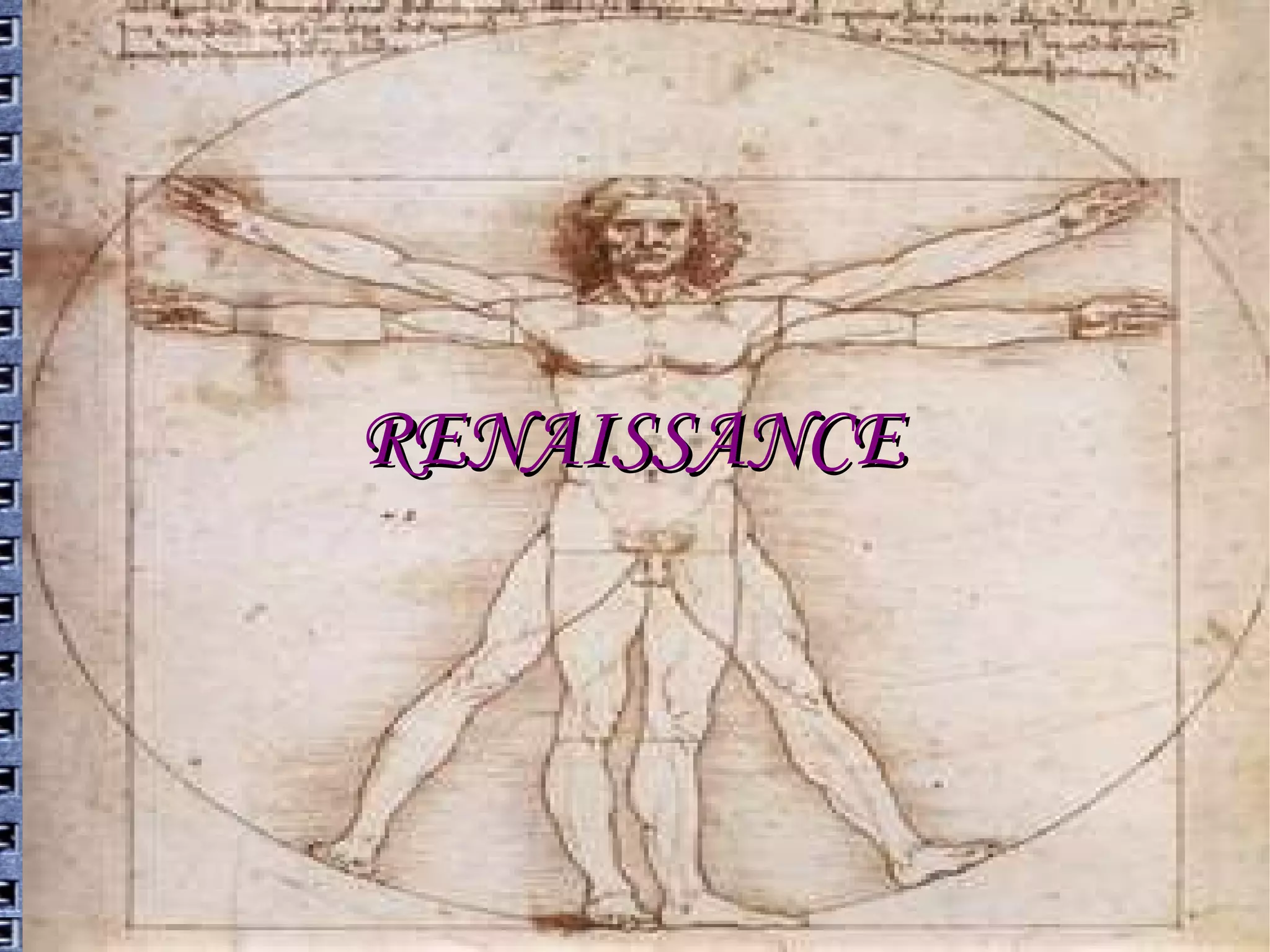
RENAISSANCE
Renaissance has been to start the era around 1400, with the end of the medieval era, and close it around 1600, with the beginning of the Baroque period.
The music of the period was significantly influenced by: the rise of humanistic thought
the recovery of the literary and artistic heritage of ancient Greece and Rome
the growth of commercial enterprise
the rise of a bourgeois class
the Protestant Reformation
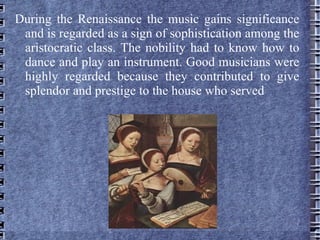
During the Renaissance the music gains significance and is regarded as a sign of sophistication among the aristocratic class. The nobility had to know how to dance and play an instrument. Good musicians were highly regarded because they contributed to give splendor and prestige to the house who served
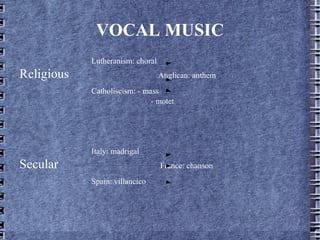
VOCAL MUSIC Lutheranism: choral Religious  Anglican: anthem Catholiscism: - mass - motet Italy: madrigal Secular   France: chanson Spain: villancico
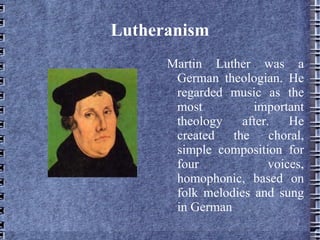
Lutheranism Martin Luther was a German theologian. He regarded music as the most important theology after. He created the choral, simple composition for four voices, homophonic, based on folk melodies and sung in German
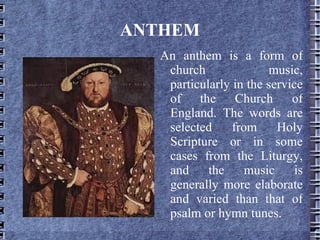
ANTHEM An anthem is a form of church music, particularly in the service of the Church of England. The words are selected from Holy Scripture or in some cases from the Liturgy, and the music is generally more elaborate and varied than that of psalm or hymn tunes.
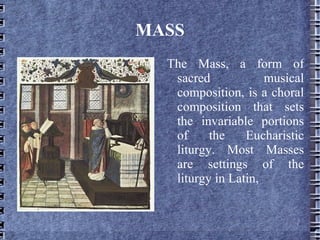
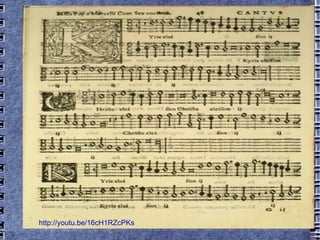
MASS The Mass, a form of sacred musical composition, is a choral composition that sets the invariable portions of the Eucharistic liturgy. Most Masses are settings of the liturgy in Latin,
http://youtu.be/16cH1RZcPKs
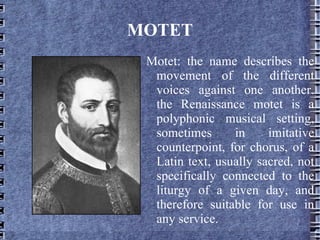
Motet: the name describes the movement of the different voices against one another. the Renaissance motet is a polyphonic musical setting, sometimes in imitative counterpoint, for chorus, of a Latin text, usually sacred, not specifically connected to the liturgy of a given day, and therefore suitable for use in any service. MOTET
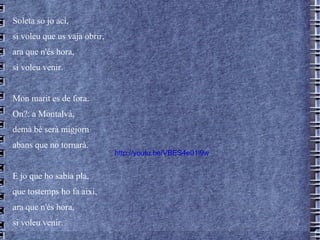
VILLANCICO A  villancico  is a musical and poetic form associated traditional Spain and Portugal. These pieces were popular between the XV and XVIII. The villancicos were originally secular songs with chorus and harmonized several voices. Then began to sing in churches and specifically associated with Christmas. Its name probably has its origin in that they are compositions of a popular nature, sung by villains or inhabitants of the villages, typically farmers and other rural dwellers. They were sung at festivals, originally without specifically religious themes, the main topics of events in the village or region. The genus was later expanded to include issues of various kinds.

Renaissance

  • 1.
  • 2.
    Renaissance has beento start the era around 1400, with the end of the medieval era, and close it around 1600, with the beginning of the Baroque period.
  • 3.
    The music ofthe period was significantly influenced by: the rise of humanistic thought
  • 4.
    the recovery ofthe literary and artistic heritage of ancient Greece and Rome
  • 5.
    the growth ofcommercial enterprise
  • 6.
    the rise ofa bourgeois class
  • 7.
  • 8.
    During the Renaissancethe music gains significance and is regarded as a sign of sophistication among the aristocratic class. The nobility had to know how to dance and play an instrument. Good musicians were highly regarded because they contributed to give splendor and prestige to the house who served
  • 9.
    VOCAL MUSIC Lutheranism:choral Religious Anglican: anthem Catholiscism: - mass - motet Italy: madrigal Secular France: chanson Spain: villancico
  • 10.
    Lutheranism Martin Lutherwas a German theologian. He regarded music as the most important theology after. He created the choral, simple composition for four voices, homophonic, based on folk melodies and sung in German
  • 11.
    ANTHEM An anthemis a form of church music, particularly in the service of the Church of England. The words are selected from Holy Scripture or in some cases from the Liturgy, and the music is generally more elaborate and varied than that of psalm or hymn tunes.
  • 12.
    MASS The Mass,a form of sacred musical composition, is a choral composition that sets the invariable portions of the Eucharistic liturgy. Most Masses are settings of the liturgy in Latin,
  • 13.
  • 14.
    Motet: the namedescribes the movement of the different voices against one another. the Renaissance motet is a polyphonic musical setting, sometimes in imitative counterpoint, for chorus, of a Latin text, usually sacred, not specifically connected to the liturgy of a given day, and therefore suitable for use in any service. MOTET
  • 15.
    VILLANCICO A villancico is a musical and poetic form associated traditional Spain and Portugal. These pieces were popular between the XV and XVIII. The villancicos were originally secular songs with chorus and harmonized several voices. Then began to sing in churches and specifically associated with Christmas. Its name probably has its origin in that they are compositions of a popular nature, sung by villains or inhabitants of the villages, typically farmers and other rural dwellers. They were sung at festivals, originally without specifically religious themes, the main topics of events in the village or region. The genus was later expanded to include issues of various kinds.