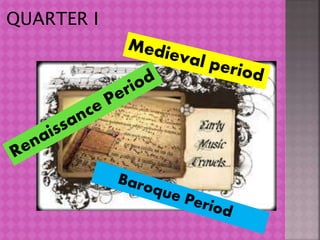
QUARTER I
The learner demonstrates understanding of
characteristic features of the Medieval,
Renaissance and Baroque period music
CONTENT STANDARDS:
performs selected songs from Medieval, renaissance and
baroque periods
a) Chants;
b) Madrigals;
c) excerpts from oratorio;
d) chorales;
e) troubadour
PERFORMACE STANDARDS:
LEARNING COMPETENCIES
2. explains the performance practice
(setting, composition, role of
composers/performers, and audience)
during Medieval, Renaissance and
Baroque periods;
1. listens perceptively to selected vocal
and instrumental music of Medieval,
Renaissance and Baroque music;
3. relates Medieval, Renaissance and Baroque
music to its historical and cultural background
through dramatization;
4. sings Medieval chant, troubadour song,
madrigal, chorale and selections from oratorio
with correct pitch, rhythm, expression and
style;
5. describes musical elements of given
Medieval, Renaissance and Baroque music;
6. explores other arts and media that portray
Medieval, Renaissance and Baroque elements;
6. explores other arts and media that
portray Medieval, Renaissance and
Baroque elements;
7. improvises appropriate
accompaniment to given Medieval and
Renaissance songs;
8. create and or perform songs in
Gregorian and troubadour styles
9. play simple melodies of a chorale and
provide accompaniment.
 Understand the framework of
the Grade 9 MUSIC (Unit 1) by
learning the competencies.
 Engage in activities that will
be taught to the Grade 9
students through active
participation.
 Analyze the difficult learning
competencies by creating a
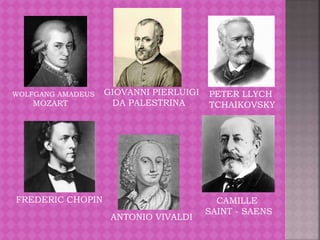
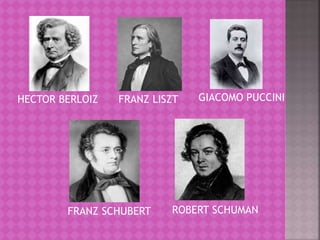
Activity 1
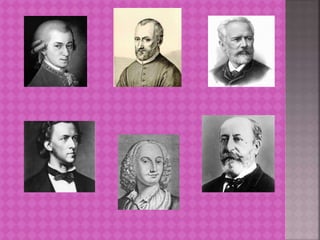
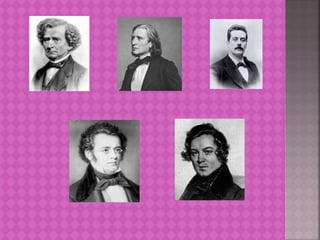
Guess Who?
WOLFGANG AMADEUS
MOZART
GIOVANNI PIERLUIGI
DA PALESTRINA
PETER LLYCH
TCHAIKOVSKY
FREDERIC CHOPIN
ANTONIO VIVALDI
CAMILLE
SAINT - SAENS
HECTOR BERLOIZ FRANZ LISZT GIACOMO PUCCINI
FRANZ SCHUBERT ROBERT SCHUMAN
Activity 2
1. Music A
2. Music B
3. MUSIC C
4. MUSIC D
5. MUSIC E
6. MUSIC F
ANALYSIS:
1.How did you find the activity?
2.Were you aware that those music were
composed centuries ago?
3. How was it used as background music?
4. Do you think they were used creatively?
5. Was the music used appropriately?
6. If you were one of the original composers,
would you allow your compositions
to be used as they are used today?
Why or Why not?
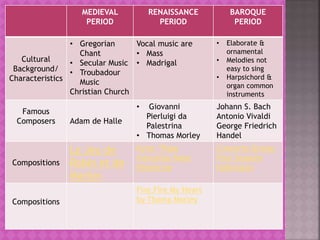
MEDIEVAL
PERIOD
RENAISSANCE
PERIOD
BAROQUE
PERIOD
Cultural
Background/
Characteristics
• Gregorian
Chant
• Secular Music
• Troubadour
Music
Christian Church
Vocal music are
• Mass
• Madrigal
• Elaborate &
ornamental
• Melodies not
easy to sing
• Harpsichord &
organ common
instruments
Famous
Composers Adam de Halle
• Giovanni
Pierluigi da
Palestrina
• Thomas Morley
Johann S. Bach
Antonio Vivaldi
George Friedrich
Handel
Compositions
Le Jeu de
Robin et de
Marion
Kyrie “Pope
marcellus Mass–
Palestrina
Concerto Grosso
Four Seasons
Hallelujah
Compositions
Fire,Fire My Heart
by Thoma Morley
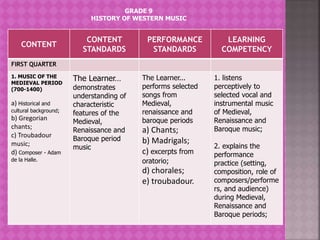
CONTENT
CONTENT
STANDARDS
PERFORMANCE
STANDARDS
LEARNING
COMPETENCY
FIRST QUARTER
1. MUSIC OF THE
MEDIEVAL PERIOD
(700-1400)
a) Historical and
cultural background;
b) Gregorian
chants;
c) Troubadour
music;
d) Composer - Adam
de la Halle.
The Learner…
demonstrates
understanding of
characteristic
features of the
Medieval,
Renaissance and
Baroque period
music
The Learner...
performs selected
songs from
Medieval,
renaissance and
baroque periods
a) Chants;
b) Madrigals;
c) excerpts from
oratorio;
d) chorales;
e) troubadour.
1. listens
perceptively to
selected vocal and
instrumental music
of Medieval,
Renaissance and
Baroque music;
2. explains the
performance
practice (setting,
composition, role of
composers/performe
rs, and audience)
during Medieval,
Renaissance and
Baroque periods;
GRADE 9
HISTORY OF WESTERN MUSIC
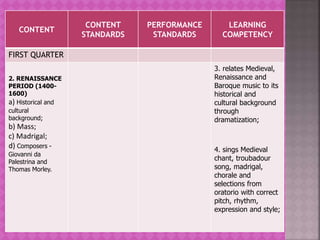
CONTENT
CONTENT
STANDARDS
PERFORMANCE
STANDARDS
LEARNING
COMPETENCY
FIRST QUARTER
2. RENAISSANCE
PERIOD (1400-
1600)
a) Historical and
cultural
background;
b) Mass;
c) Madrigal;
d) Composers -
Giovanni da
Palestrina and
Thomas Morley.
3. relates Medieval,
Renaissance and
Baroque music to its
historical and
cultural background
through
dramatization;
4. sings Medieval
chant, troubadour
song, madrigal,
chorale and
selections from
oratorio with correct
pitch, rhythm,
expression and style;
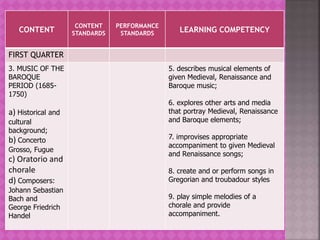
CONTENT
CONTENT
STANDARDS
PERFORMANCE
STANDARDS LEARNING COMPETENCY
FIRST QUARTER
3. MUSIC OF THE
BAROQUE
PERIOD (1685-
1750)
a) Historical and
cultural
background;
b) Concerto
Grosso, Fugue
c) Oratorio and
chorale
d) Composers:
Johann Sebastian
Bach and
George Friedrich
Handel
5. describes musical elements of
given Medieval, Renaissance and
Baroque music;
6. explores other arts and media
that portray Medieval, Renaissance
and Baroque elements;
7. improvises appropriate
accompaniment to given Medieval
and Renaissance songs;
8. create and or perform songs in
Gregorian and troubadour styles
9. play simple melodies of a
chorale and provide
accompaniment.
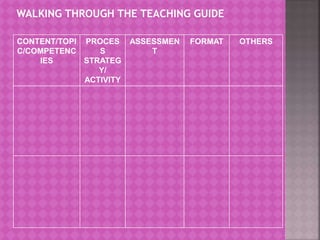
CONTENT/TOPI
C/COMPETENC
IES
PROCES
S
STRATEG
Y/
ACTIVITY
ASSESSMEN
T
FORMAT OTHERS
WALKING THROUGH THE TEACHING GUIDE
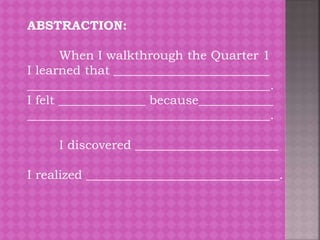
ABSTRACTION:
When I walkthrough the Quarter 1
I learned that _________________________
_______________________________________.
I felt ______________ because____________
_______________________________________.
I discovered _______________________
I realized _______________________________.
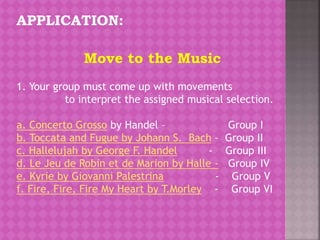
APPLICATION:
1. Your group must come up with movements
to interpret the assigned musical selection.
a. Concerto Grosso by Handel – Group I
b. Toccata and Fugue by Johann S. Bach – Group II
c. Hallelujah by George F. Handel - Group III
d. Le Jeu de Robin et de Marion by Halle - Group IV
e. Kyrie by Giovanni Palestrina - Group V
f. Fire, Fire, Fire My Heart by T.Morley - Group VI
Move to the Music
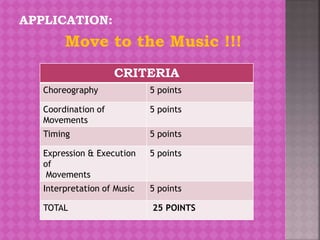
APPLICATION:
CRITERIA
Choreography 5 points
Coordination of
Movements
5 points
Timing 5 points
Expression & Execution
of
Movements
5 points
Interpretation of Music 5 points
TOTAL 25 POINTS
Move to the Music !!!
THANK YOU !!!

Music g9 q1

  • 1.
  • 2.
    The learner demonstratesunderstanding of characteristic features of the Medieval, Renaissance and Baroque period music CONTENT STANDARDS: performs selected songs from Medieval, renaissance and baroque periods a) Chants; b) Madrigals; c) excerpts from oratorio; d) chorales; e) troubadour PERFORMACE STANDARDS:
  • 3.
    LEARNING COMPETENCIES 2. explainsthe performance practice (setting, composition, role of composers/performers, and audience) during Medieval, Renaissance and Baroque periods; 1. listens perceptively to selected vocal and instrumental music of Medieval, Renaissance and Baroque music;
  • 4.
    3. relates Medieval,Renaissance and Baroque music to its historical and cultural background through dramatization; 4. sings Medieval chant, troubadour song, madrigal, chorale and selections from oratorio with correct pitch, rhythm, expression and style; 5. describes musical elements of given Medieval, Renaissance and Baroque music; 6. explores other arts and media that portray Medieval, Renaissance and Baroque elements;
  • 5.
    6. explores otherarts and media that portray Medieval, Renaissance and Baroque elements; 7. improvises appropriate accompaniment to given Medieval and Renaissance songs; 8. create and or perform songs in Gregorian and troubadour styles 9. play simple melodies of a chorale and provide accompaniment.
  • 6.
     Understand theframework of the Grade 9 MUSIC (Unit 1) by learning the competencies.  Engage in activities that will be taught to the Grade 9 students through active participation.  Analyze the difficult learning competencies by creating a
  • 7.
  • 10.
    WOLFGANG AMADEUS MOZART GIOVANNI PIERLUIGI DAPALESTRINA PETER LLYCH TCHAIKOVSKY FREDERIC CHOPIN ANTONIO VIVALDI CAMILLE SAINT - SAENS
  • 11.
    HECTOR BERLOIZ FRANZLISZT GIACOMO PUCCINI FRANZ SCHUBERT ROBERT SCHUMAN
  • 12.
    Activity 2 1. MusicA 2. Music B 3. MUSIC C 4. MUSIC D 5. MUSIC E 6. MUSIC F
  • 13.
    ANALYSIS: 1.How did youfind the activity? 2.Were you aware that those music were composed centuries ago? 3. How was it used as background music? 4. Do you think they were used creatively? 5. Was the music used appropriately? 6. If you were one of the original composers, would you allow your compositions to be used as they are used today? Why or Why not?
  • 14.
    MEDIEVAL PERIOD RENAISSANCE PERIOD BAROQUE PERIOD Cultural Background/ Characteristics • Gregorian Chant • SecularMusic • Troubadour Music Christian Church Vocal music are • Mass • Madrigal • Elaborate & ornamental • Melodies not easy to sing • Harpsichord & organ common instruments Famous Composers Adam de Halle • Giovanni Pierluigi da Palestrina • Thomas Morley Johann S. Bach Antonio Vivaldi George Friedrich Handel Compositions Le Jeu de Robin et de Marion Kyrie “Pope marcellus Mass– Palestrina Concerto Grosso Four Seasons Hallelujah Compositions Fire,Fire My Heart by Thoma Morley
  • 15.
    CONTENT CONTENT STANDARDS PERFORMANCE STANDARDS LEARNING COMPETENCY FIRST QUARTER 1. MUSICOF THE MEDIEVAL PERIOD (700-1400) a) Historical and cultural background; b) Gregorian chants; c) Troubadour music; d) Composer - Adam de la Halle. The Learner… demonstrates understanding of characteristic features of the Medieval, Renaissance and Baroque period music The Learner... performs selected songs from Medieval, renaissance and baroque periods a) Chants; b) Madrigals; c) excerpts from oratorio; d) chorales; e) troubadour. 1. listens perceptively to selected vocal and instrumental music of Medieval, Renaissance and Baroque music; 2. explains the performance practice (setting, composition, role of composers/performe rs, and audience) during Medieval, Renaissance and Baroque periods; GRADE 9 HISTORY OF WESTERN MUSIC
  • 16.
    CONTENT CONTENT STANDARDS PERFORMANCE STANDARDS LEARNING COMPETENCY FIRST QUARTER 2. RENAISSANCE PERIOD(1400- 1600) a) Historical and cultural background; b) Mass; c) Madrigal; d) Composers - Giovanni da Palestrina and Thomas Morley. 3. relates Medieval, Renaissance and Baroque music to its historical and cultural background through dramatization; 4. sings Medieval chant, troubadour song, madrigal, chorale and selections from oratorio with correct pitch, rhythm, expression and style;
  • 17.
    CONTENT CONTENT STANDARDS PERFORMANCE STANDARDS LEARNING COMPETENCY FIRSTQUARTER 3. MUSIC OF THE BAROQUE PERIOD (1685- 1750) a) Historical and cultural background; b) Concerto Grosso, Fugue c) Oratorio and chorale d) Composers: Johann Sebastian Bach and George Friedrich Handel 5. describes musical elements of given Medieval, Renaissance and Baroque music; 6. explores other arts and media that portray Medieval, Renaissance and Baroque elements; 7. improvises appropriate accompaniment to given Medieval and Renaissance songs; 8. create and or perform songs in Gregorian and troubadour styles 9. play simple melodies of a chorale and provide accompaniment.
  • 18.
  • 19.
    ABSTRACTION: When I walkthroughthe Quarter 1 I learned that _________________________ _______________________________________. I felt ______________ because____________ _______________________________________. I discovered _______________________ I realized _______________________________.
  • 20.
    APPLICATION: 1. Your groupmust come up with movements to interpret the assigned musical selection. a. Concerto Grosso by Handel – Group I b. Toccata and Fugue by Johann S. Bach – Group II c. Hallelujah by George F. Handel - Group III d. Le Jeu de Robin et de Marion by Halle - Group IV e. Kyrie by Giovanni Palestrina - Group V f. Fire, Fire, Fire My Heart by T.Morley - Group VI Move to the Music
  • 21.
    APPLICATION: CRITERIA Choreography 5 points Coordinationof Movements 5 points Timing 5 points Expression & Execution of Movements 5 points Interpretation of Music 5 points TOTAL 25 POINTS Move to the Music !!!
  • 23.