Music in the Renaissance
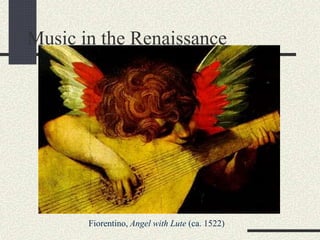
Fiorentino, Angel with Lute (ca. 1522)
Rebirth
Classical (Greco-Roman) ideas rediscovered
Music begins to be seen as a fine art
Music (and all art) becomes more expressive
Rise of humanism
 Recognizing unique contributions of individuals
 Composers no longer anonymous
 Greater appreciation of aesthetic qualities of art
Renaissance Sacred Music
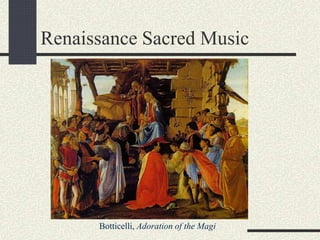
Botticelli, Adoration of the Magi
The Renaissance Motet
Choral music
Generally three or four voices
Latin text, sacred subject
Texts usually from Old Testament
 Often from Psalms or Lamentations
 Expressive texts call for expressive music
Usually performed a cappella (no accomp.)
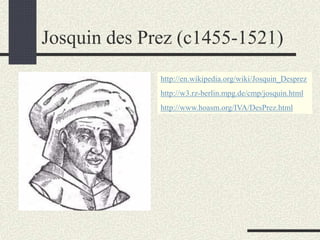
Josquin des Prez (c1455-1521)
http://en.wikipedia.org/wiki/Josquin_Desprez
http://w3.rz-berlin.mpg.de/cmp/josquin.html
http://www.hoasm.org/IVA/DesPrez.html
Josquin des Prez
Born northern France/Belgium border area
Probably began career as choirboy (1460)
Held posts in France and Italy
Sang in choir of Sistine Chapel
 Singers carved their names on the wall
 “JOSQUINJ” was probably his own “graffito”
Honored by contemporaries as a genius
 Martin Luther, Rabelais, Bartoli
Josquin des Prez
Composed all the genres of his era
Known especially for his motets
Use of contrasting textures – sectional
Combined different styles into a new sound
 Franco-flemish complexity
 Italian lyricism
 Leading figure in new international sound
 This new style later perfected by Palestrina
Listening Example:
Title: Ave Maria
Composer Josquin des Prez
Genre Motet
Notes on Ave maria…
4-voices (SATB)
A cappella performance (no instruments)
Contrasting textures and settings
 Imitation
 Paired imitation (TB imitating SA)
 Homophony
Expressively personal final text
Changing meters
Council of Trent (1545-1563)
Part of the Counter-Reformation
Regulated of all aspects of church discipline
Objected to trends in church music
 Elaborate counterpoint obscures text
 Too much embellishment of chant melodies
 Use of instruments in services
 Incorporation of popular songs into music
 Secular spirit invading sacred music
 Irreverent attitude of church musicians
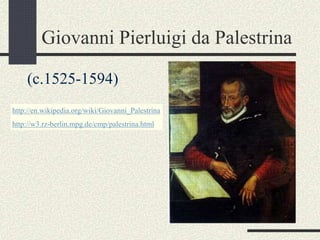
Giovanni Pierluigi da Palestrina
(c.1525-1594)
http://en.wikipedia.org/wiki/Giovanni_Palestrina
http://w3.rz-berlin.mpg.de/cmp/palestrina.html
Giovanni Pierluigi da Palestrina
Born near and spent most of career in Rome
Held positions in many Vatican chapels
 Singer in the Sistine Chapel
 Maestro compositore St. Peter’s Basilica
Lost many family members to the plague
Very conscious of counter-reformation
Known as “savior of church music”
Giovanni Pierluigi da Palestrina
Palestrina’s style seen as the culmination of
Renaissance composition
Avoidance of dissonance
Balance of the voices
Seamless sound – rhythmically smooth
Codified by Johannes Fux
Still studied today as model of counterpoint
Listening Example
Title Gloria from Missa Papae Marcelli
Composer Palestrina
Genre Mass
Notes on Gloria from Missa Papae
Marcelli
A cappella performance (no instruments)
Brief opening chant
Homophonic texture
Smooth (conjunct) melody
Regular rhythms
Note the serene, celestial quality
Listening Example
Title Agnus Dei from Missa Papae Marcelli
Composer Palestrina
Genre Mass
Notes on Agnus Dei from Missa
Papae Marcelli
A cappella performance (no instruments)
Polyphonic texture - Imitation
Palestrina writes the imitation in a way that
listeners can still understand the text
Palestrina’s style still evident
 Smooth (conjunct) melody and regular rhythms
 Serene, celestial quality
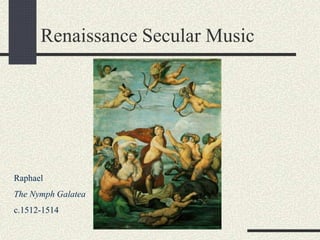
Renaissance Secular Music
Raphael
The Nymph Galatea
c.1512-1514
Popular Music Advances
Advent of the printing press
Rise of middle class
 New market for music, esp. printed music
 Many were amateur musicians themselves
 Music in the vernacular (language of the people
– not Latin)
Madrigal
New genre becomes internationally popular
 Begins in Italy and spreads through Europe
 Remains popular in England even after the
genre falls out of favor in Italy
Typically 4-5 solo singers, mixed voices
Secular poem, often on subject of love
Music expresses the emotion of the text
Word painting
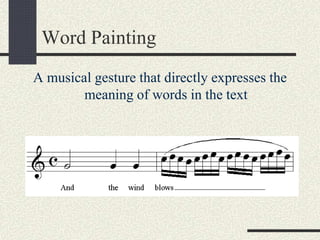
Word Painting
A musical gesture that directly expresses the
meaning of words in the text
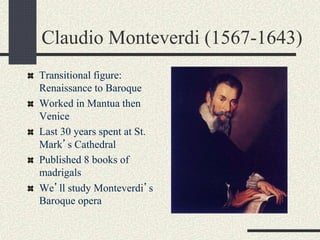
Claudio Monteverdi (1567-1643)
Transitional figure:
Renaissance to Baroque
Worked in Mantua then
Venice
Last 30 years spent at St.
Mark’s Cathedral
Published 8 books of
madrigals
We’ll study Monteverdi’s
Baroque opera
Listening Example
Title Ecco mormorar l’onde
Composer Monteverdi
Genre Italian madrigal
Notes on Ecco mormorar l’onde
A cappella performance (no instruments)
Homophonic texture overall
Word painting
 The melody moves up and down quickly on
“tremolar le fronde” (trembling branches)
 Nimble counterpoint when text describes birds
singing is meant to suggest actual birdsong
English Madrigals
English poets adopted the Italian sonnet
English composers adopted the madrigal
Nicolas Yonge’s Musica Transalpina
(1588)
Texts were “Englished” (translated)
Later composers wrote their own madrigals
A distinctly English style evolved
This is the era of Shakespeare
Thomas Weelkes (1576-1623)
Born near Elsted, Sussex (England)
Begins as organist - Winchester College
Career as choirmaster at Chichester Cathedral
Composes four volumes of madrigals
Trouble with alcohol
Spends time in London near end of life
Listening Example
Title: As Vesta Was from Latmos Hill Descending
Composer: Thomas Weelkes
Genre: English Madrigal
Notes on As Vesta Was…
Composed as part of tribute to Queen
Elizabeth I (The Triumphs of Oriana)
Odd text serves as fodder for word painting
 Descending lines as Vesta descends Latmos
 Ascending lines as Oriana climbs the hill
 Solo lines for Diana (virgin goddess)
Note the lighthearted quality
6-voices
Dance Music
Publishers issued collections of dance music
aimed at the middle class
Shawms, sackbuts, and drums were most
commonly used for dance music
Pavane was most popular dance of mid-16th
century
Usually followed by Galliard for contrast
Listening Example
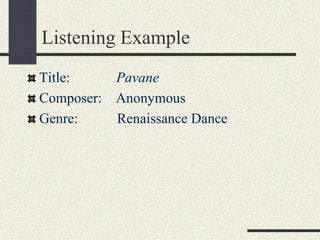
Title: Pavane
Composer: Anonymous
Genre: Renaissance Dance
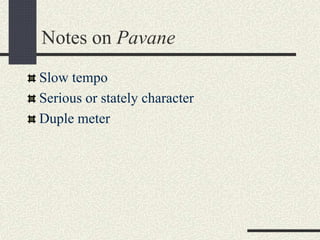
Notes on Pavane
Slow tempo
Serious or stately character
Duple meter
Listening Example
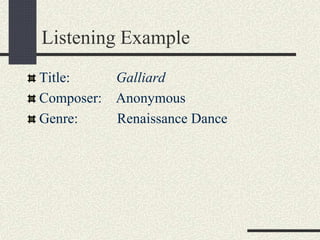
Title: Galliard
Composer: Anonymous
Genre: Renaissance Dance
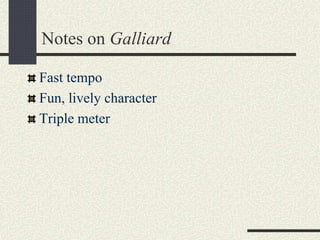
Notes on Galliard
Fast tempo
Fun, lively character
Triple meter

Music in the Renaissance

  • 1.
    Music in theRenaissance Fiorentino, Angel with Lute (ca. 1522)
  • 2.
    Rebirth Classical (Greco-Roman) ideasrediscovered Music begins to be seen as a fine art Music (and all art) becomes more expressive Rise of humanism  Recognizing unique contributions of individuals  Composers no longer anonymous  Greater appreciation of aesthetic qualities of art
  • 3.
  • 4.
    The Renaissance Motet Choralmusic Generally three or four voices Latin text, sacred subject Texts usually from Old Testament  Often from Psalms or Lamentations  Expressive texts call for expressive music Usually performed a cappella (no accomp.)
  • 5.
    Josquin des Prez(c1455-1521) http://en.wikipedia.org/wiki/Josquin_Desprez http://w3.rz-berlin.mpg.de/cmp/josquin.html http://www.hoasm.org/IVA/DesPrez.html
  • 6.
    Josquin des Prez Bornnorthern France/Belgium border area Probably began career as choirboy (1460) Held posts in France and Italy Sang in choir of Sistine Chapel  Singers carved their names on the wall  “JOSQUINJ” was probably his own “graffito” Honored by contemporaries as a genius  Martin Luther, Rabelais, Bartoli
  • 7.
    Josquin des Prez Composedall the genres of his era Known especially for his motets Use of contrasting textures – sectional Combined different styles into a new sound  Franco-flemish complexity  Italian lyricism  Leading figure in new international sound  This new style later perfected by Palestrina
  • 8.
    Listening Example: Title: AveMaria Composer Josquin des Prez Genre Motet
  • 9.
    Notes on Avemaria… 4-voices (SATB) A cappella performance (no instruments) Contrasting textures and settings  Imitation  Paired imitation (TB imitating SA)  Homophony Expressively personal final text Changing meters
  • 10.
    Council of Trent(1545-1563) Part of the Counter-Reformation Regulated of all aspects of church discipline Objected to trends in church music  Elaborate counterpoint obscures text  Too much embellishment of chant melodies  Use of instruments in services  Incorporation of popular songs into music  Secular spirit invading sacred music  Irreverent attitude of church musicians
  • 11.
    Giovanni Pierluigi daPalestrina (c.1525-1594) http://en.wikipedia.org/wiki/Giovanni_Palestrina http://w3.rz-berlin.mpg.de/cmp/palestrina.html
  • 12.
    Giovanni Pierluigi daPalestrina Born near and spent most of career in Rome Held positions in many Vatican chapels  Singer in the Sistine Chapel  Maestro compositore St. Peter’s Basilica Lost many family members to the plague Very conscious of counter-reformation Known as “savior of church music”
  • 13.
    Giovanni Pierluigi daPalestrina Palestrina’s style seen as the culmination of Renaissance composition Avoidance of dissonance Balance of the voices Seamless sound – rhythmically smooth Codified by Johannes Fux Still studied today as model of counterpoint
  • 14.
    Listening Example Title Gloriafrom Missa Papae Marcelli Composer Palestrina Genre Mass
  • 15.
    Notes on Gloriafrom Missa Papae Marcelli A cappella performance (no instruments) Brief opening chant Homophonic texture Smooth (conjunct) melody Regular rhythms Note the serene, celestial quality
  • 16.
    Listening Example Title AgnusDei from Missa Papae Marcelli Composer Palestrina Genre Mass
  • 17.
    Notes on AgnusDei from Missa Papae Marcelli A cappella performance (no instruments) Polyphonic texture - Imitation Palestrina writes the imitation in a way that listeners can still understand the text Palestrina’s style still evident  Smooth (conjunct) melody and regular rhythms  Serene, celestial quality
  • 18.
    Renaissance Secular Music Raphael TheNymph Galatea c.1512-1514
  • 19.
    Popular Music Advances Adventof the printing press Rise of middle class  New market for music, esp. printed music  Many were amateur musicians themselves  Music in the vernacular (language of the people – not Latin)
  • 20.
    Madrigal New genre becomesinternationally popular  Begins in Italy and spreads through Europe  Remains popular in England even after the genre falls out of favor in Italy Typically 4-5 solo singers, mixed voices Secular poem, often on subject of love Music expresses the emotion of the text Word painting
  • 21.
    Word Painting A musicalgesture that directly expresses the meaning of words in the text
  • 22.
    Claudio Monteverdi (1567-1643) Transitionalfigure: Renaissance to Baroque Worked in Mantua then Venice Last 30 years spent at St. Mark’s Cathedral Published 8 books of madrigals We’ll study Monteverdi’s Baroque opera
  • 23.
    Listening Example Title Eccomormorar l’onde Composer Monteverdi Genre Italian madrigal
  • 24.
    Notes on Eccomormorar l’onde A cappella performance (no instruments) Homophonic texture overall Word painting  The melody moves up and down quickly on “tremolar le fronde” (trembling branches)  Nimble counterpoint when text describes birds singing is meant to suggest actual birdsong
  • 25.
    English Madrigals English poetsadopted the Italian sonnet English composers adopted the madrigal Nicolas Yonge’s Musica Transalpina (1588) Texts were “Englished” (translated) Later composers wrote their own madrigals A distinctly English style evolved This is the era of Shakespeare
  • 26.
    Thomas Weelkes (1576-1623) Bornnear Elsted, Sussex (England) Begins as organist - Winchester College Career as choirmaster at Chichester Cathedral Composes four volumes of madrigals Trouble with alcohol Spends time in London near end of life
  • 27.
    Listening Example Title: AsVesta Was from Latmos Hill Descending Composer: Thomas Weelkes Genre: English Madrigal
  • 28.
    Notes on AsVesta Was… Composed as part of tribute to Queen Elizabeth I (The Triumphs of Oriana) Odd text serves as fodder for word painting  Descending lines as Vesta descends Latmos  Ascending lines as Oriana climbs the hill  Solo lines for Diana (virgin goddess) Note the lighthearted quality 6-voices
  • 29.
    Dance Music Publishers issuedcollections of dance music aimed at the middle class Shawms, sackbuts, and drums were most commonly used for dance music Pavane was most popular dance of mid-16th century Usually followed by Galliard for contrast
  • 30.
    Listening Example Title: Pavane Composer:Anonymous Genre: Renaissance Dance
  • 31.
    Notes on Pavane Slowtempo Serious or stately character Duple meter
  • 32.
    Listening Example Title: Galliard Composer:Anonymous Genre: Renaissance Dance
  • 33.
    Notes on Galliard Fasttempo Fun, lively character Triple meter