Baroque Period
Featuring
Georg Phillpp Telemann
The Baroque Period
 Derived from the Portuguese barroco, or “oddly shaped
pearl,” the term “baroque” has been widely used since
the nineteenth century to describe the period in
Western European art music from about 1600 to 1750.
Comparing some of music history’s greatest
masterpieces to a misshapen pearl might seem strange
to us today, but to the nineteenth century critics who
applied the term, the music of Bach and Handel’s era
sounded overly ornamented and exaggerated. Having
long since shed its derogatory connotations, “baroque”
is now simply a convenient catch-all for one of the
richest and most diverse periods in music history.
Characteristics
 Contrast is an important ingredient in the drama of a
baroque composition. The differences between loud
and soft, solo and ensemble (as in the concerto),
different instruments and timbres all play an important
role in many baroque compositions.
 Composers began to be more precise about
instrumentation, often specifying the instruments on
which a piece should be played instead of allowing the
performer to choose. Brilliant instruments like the
trumpet and violin also grew in popularity.
Characteristics Pg. 2
 In previous musical eras, a piece of music tended to
consist of a single melody, perhaps with an improvised
accompaniment, or several melodies played
simultaneously. Not until the baroque period did the
concept of “melody” and “harmony” truly begin to be
articulated. As part of the effort to imitate ancient
music, composers started focusing less on the
complicated polyphony that dominated the fifteenth
and sixteenth centuries and more on a single voice
with a simplified accompaniment, or monody.
Musical Forms
(Vocal)
 Opera - A drama that is primarily sung, accompanied
by instruments, and presented on stage. Operas
typically alternate between recitative, speech-like song
that advances the plot, and arias, songs in which
characters express feelings at particular points in the
action.
 Oratorio - an extended musical drama with a text
based on religious subject matter, intended for
performance without scenery, costume or action
 Cantata - an extended piece consisting of a succession
of recitatives and set pieces such as arias, duets and
choruses.
Musical Forms
(Instrumental)
 Sonata - Used to describe several types of pieces in the
baroque era, the term sonata most commonly
designated a work in several movements for one or
more instruments.
 Concerto - Derived from the Italian concertare (to join
together, unite), the concerto took several forms during
the baroque era.
 Suite - Based on the traditional pairing of dances in the
Renaissance, the suite was the first multi-movement
work for instruments.
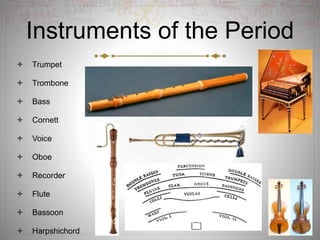
Instruments of the Period
 Trumpet
 Trombone
 Bass
 Cornett
 Voice
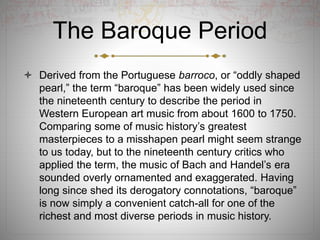
 Oboe
 Recorder
 Flute
 Bassoon
 Harpshichord
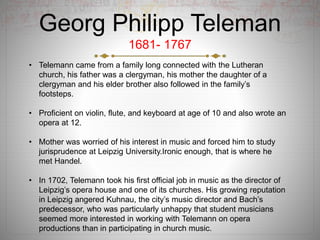
Georg Philipp Teleman
1681- 1767
• Telemann came from a family long connected with the Lutheran
church, his father was a clergyman, his mother the daughter of a
clergyman and his elder brother also followed in the family’s
footsteps.
• Proficient on violin, flute, and keyboard at age of 10 and also wrote an
opera at 12.
• Mother was worried of his interest in music and forced him to study
jurisprudence at Leipzig University.Ironic enough, that is where he
met Handel.
• In 1702, Telemann took his first official job in music as the director of
Leipzig’s opera house and one of its churches. His growing reputation
in Leipzig angered Kuhnau, the city’s music director and Bach’s
predecessor, who was particularly unhappy that student musicians
seemed more interested in working with Telemann on opera
productions than in participating in church music.
Georg Philipp Telemann
 During his lifetime, Telemann enjoyed a fame that far
surpassed that of his contemporary, J. S. Bach. Not only
was he considered to be the better musician—and was
compensated accordingly with a salary in Hamburg at least
three times larger than Bach’s in Leipzig – but by all
accounts he was well liked, admired for his driving
ambition, impressive talent and excellent sense of humor.
Often called the most prolific composer in history,
Telemann’s surviving repertoire is massive, including 1043
church cantatas, 46 Passions and many operas. He also
composed a large amount of instrumental music; in an
autobiographical article from 1740, Telemann estimated
that he had written 600 suites, about a quarter of which are
extant today.
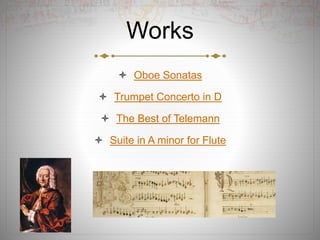
Works
 Oboe Sonatas
 Trumpet Concerto in D
 The Best of Telemann
 Suite in A minor for Flute
Sources
 http://www.baroque.org/baroque/
 http://www.baroquemusic.org/bqxtel.html
 http://www.britannica.com/EBchecked/topic/645041/wi
nd-instrument/53813/The-Baroque-and-Classical-
periods

Buckle baroque period

  • 1.
  • 2.
    The Baroque Period Derived from the Portuguese barroco, or “oddly shaped pearl,” the term “baroque” has been widely used since the nineteenth century to describe the period in Western European art music from about 1600 to 1750. Comparing some of music history’s greatest masterpieces to a misshapen pearl might seem strange to us today, but to the nineteenth century critics who applied the term, the music of Bach and Handel’s era sounded overly ornamented and exaggerated. Having long since shed its derogatory connotations, “baroque” is now simply a convenient catch-all for one of the richest and most diverse periods in music history.
  • 3.
    Characteristics  Contrast isan important ingredient in the drama of a baroque composition. The differences between loud and soft, solo and ensemble (as in the concerto), different instruments and timbres all play an important role in many baroque compositions.  Composers began to be more precise about instrumentation, often specifying the instruments on which a piece should be played instead of allowing the performer to choose. Brilliant instruments like the trumpet and violin also grew in popularity.
  • 4.
    Characteristics Pg. 2 In previous musical eras, a piece of music tended to consist of a single melody, perhaps with an improvised accompaniment, or several melodies played simultaneously. Not until the baroque period did the concept of “melody” and “harmony” truly begin to be articulated. As part of the effort to imitate ancient music, composers started focusing less on the complicated polyphony that dominated the fifteenth and sixteenth centuries and more on a single voice with a simplified accompaniment, or monody.
  • 5.
    Musical Forms (Vocal)  Opera- A drama that is primarily sung, accompanied by instruments, and presented on stage. Operas typically alternate between recitative, speech-like song that advances the plot, and arias, songs in which characters express feelings at particular points in the action.  Oratorio - an extended musical drama with a text based on religious subject matter, intended for performance without scenery, costume or action  Cantata - an extended piece consisting of a succession of recitatives and set pieces such as arias, duets and choruses.
  • 6.
    Musical Forms (Instrumental)  Sonata- Used to describe several types of pieces in the baroque era, the term sonata most commonly designated a work in several movements for one or more instruments.  Concerto - Derived from the Italian concertare (to join together, unite), the concerto took several forms during the baroque era.  Suite - Based on the traditional pairing of dances in the Renaissance, the suite was the first multi-movement work for instruments.
  • 7.
    Instruments of thePeriod  Trumpet  Trombone  Bass  Cornett  Voice  Oboe  Recorder  Flute  Bassoon  Harpshichord
  • 8.
    Georg Philipp Teleman 1681-1767 • Telemann came from a family long connected with the Lutheran church, his father was a clergyman, his mother the daughter of a clergyman and his elder brother also followed in the family’s footsteps. • Proficient on violin, flute, and keyboard at age of 10 and also wrote an opera at 12. • Mother was worried of his interest in music and forced him to study jurisprudence at Leipzig University.Ironic enough, that is where he met Handel. • In 1702, Telemann took his first official job in music as the director of Leipzig’s opera house and one of its churches. His growing reputation in Leipzig angered Kuhnau, the city’s music director and Bach’s predecessor, who was particularly unhappy that student musicians seemed more interested in working with Telemann on opera productions than in participating in church music.
  • 9.
    Georg Philipp Telemann During his lifetime, Telemann enjoyed a fame that far surpassed that of his contemporary, J. S. Bach. Not only was he considered to be the better musician—and was compensated accordingly with a salary in Hamburg at least three times larger than Bach’s in Leipzig – but by all accounts he was well liked, admired for his driving ambition, impressive talent and excellent sense of humor. Often called the most prolific composer in history, Telemann’s surviving repertoire is massive, including 1043 church cantatas, 46 Passions and many operas. He also composed a large amount of instrumental music; in an autobiographical article from 1740, Telemann estimated that he had written 600 suites, about a quarter of which are extant today.
  • 10.
    Works  Oboe Sonatas Trumpet Concerto in D  The Best of Telemann  Suite in A minor for Flute
  • 11.
    Sources  http://www.baroque.org/baroque/  http://www.baroquemusic.org/bqxtel.html http://www.britannica.com/EBchecked/topic/645041/wi nd-instrument/53813/The-Baroque-and-Classical- periods