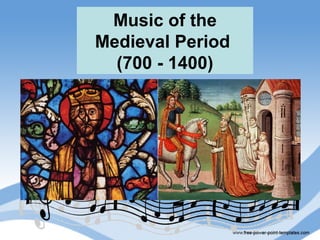
Music of the
Medieval Period
(700 - 1400)
Learning Objectives:
• Listen perceptively to selected vocal and instrumental
music of Medieval, Renaissance and Baroque periods;
• Explain the performance practice (setting, composition,
role of composers/performers and audience) of
Medieval, Renaissance and Baroque Periods;
• Relate Medieval, Renaissance and Baroque music to its
historical and cultural background through dramatization;
and
• Sing selections of medieval chants, troubadour songs,
madrigals, and oratorios with correct pitch, rythm,
expression and style.
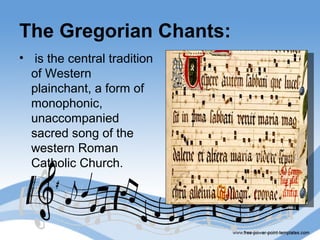
The Gregorian Chants:
• is the central tradition
of Western
plainchant, a form of
monophonic,
unaccompanied
sacred song of the
western Roman
Catholic Church.
Who wrote the Gregorian
Chant?
• This chant was probably named after
Pope Gregory the Great. When
Charlemagne had become Holy Roman
Emperor he made everyone in Europe use
this Gregorian chant.
Characteristics of the Gregorian
Chants:
• Monophonic
- consisting of a single musical line,
without accompaniment.
• Free meter
- is NO regular repeating rhythm.
• Usually based on Latin liturgy
• Use of Neume notation
What is your favorite boy band?
Did you know that ....
- during the latter part of the Medieval
Period, secular music which was not
bound by Catholic traditions emerged.
Most of these songs were performed
across Europe by groups of musicians
called Troubadours.
The Troubadour
• Usually monophonic
• Sometimes with
improvised
accompaniment
• Tells of chivalry and courtly
love
• Originated in France
• Written in French language
Works Adam de la halle:
• Le Jeu de Robin et de Marion
• La Chanson du roi de Sicile
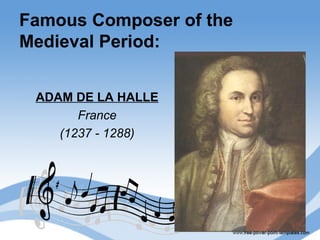
Famous Composer of the
Medieval Period:
ADAM DE LA HALLE
France
(1237 - 1288)
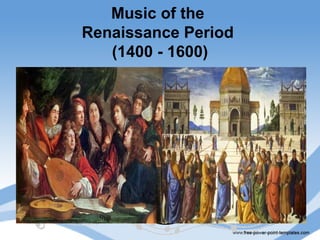
Music of the
Renaissance Period
(1400 - 1600)
FYI:
• the term "Renaissance" comes from the
word "renaitre" which means REBIRTH,
REVIVAL, and REDISCOVERY.
• music became as entertainment and
activity for amateurs and the educated.
• influence of the RCC become to decline
as the new music genre arose.
• "golden age" of a capella choral music.
Characteristics of Renaissance
Music:
• Mostly polyphonic.
• Imitation among the voices is common.
• Use of word painting in texts and music.
• Melodic lines move in a flowing manner.
• Melodies are easier to perform because
these move along a scale with a few large
leaps.
Vocal Music of the Renaissance
Period:
1. Mass - is a form of sacred musical
composition that sets texts of the
Eucharistic liturgy into music.
2. Madrigal - most important secular music
during renaissance peiod. It is written and
expressed in a poetic text and sung during
courtly social gathering.
Characteristics of the Mass:
• Polyphonic
• May be sung a capella or with orchestral
accompaniment.
• Text may be syllabic (one note set to
each syllable), neumatic (a few notes set
to one syllable), or melismatic (many
notes to one syllable).
Other facts during this period:
• discovery of the actual position of the
earth.
• invention of compass.
• Martin Luther's Protestant reformation.
Nicolaus Copernicus
Martin Luther
c
o
m
p
a
s
s
Reflection:
1. Which music are you familiar with? Why?
2. Which songs can you relate with? Sacred
or secular music? Why?
Five Main Sections of Mass:
1. Kyrie (Lord Have Mercy) the only Greek
2. Gloria (Glory to God in the Highest)
3. Credo (I Believe in One God)
4. Sanctus and Benedictus (Holy, holy and
Blessed Is He)
5. Agnus Dei (Lamb of God)
Characteristics of the
Madrigal:
• Polyphonic
• Sung a capella
• Through - composed
• Frequently in 3 to 6 voices
Famous Composers of the
Renaissance Period
Giovanni Pierluigi da
Palestrina
Rome
1525 - February 2, 1594
Famous Composers of the
Renaissance Period
Thomas Morley
England
1557 - 1602
Reflection:
• Which madrigal did you enjoy more?
Why?
• Based on what you have heard, do you
agree that the compositions of Palestrina
and Morley reflect their personalities? Why
or Why not?
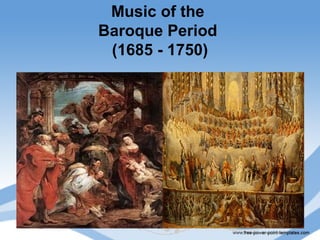
Music of the
Baroque Period
(1685 - 1750)
FYI:
The word Baroque is derived from the
Portuguese word "barroco" which means
"pearl of irregular shape".
During this time, the arts highlighted
grandiose and elaborate ornamentation.
Characteristics of Baroque Music:
• Melodies sound elaborate and ornamental
•  Melodies are not easy to sing or
remember
•  Primarily contrapuntal textures with
some homophony
•  Dynamic contrast – alternation between
loud and soft
•  Music genres—operas, oratorios,
suites, tocatas, concertó grosso, fugue
•  Orchestra consists of strings and
continuo
•  Harpsichord and organ are the
keyboard instruments that are
• commonly used
Music Genres of Baroque Music
1. Concerto - a form of orchestral music
that employs a solo instrument
accompanied by an orchestra.
2. Concerto Grosso - a form of orchestral
music wherein the music is between a
small group of solo instruments called
concertino an the whole orchestra called
tutti.
3. Fugue
• A contrapuntal piece, developed mainly by
imitative counterpoint.
• It is usually written in 3 or 4 parts, with a
main theme called "subject".
• The entire piece grows mainly from a
single brief of strong musical character.
4. Oratorio
• a large scale musical composition for
orchestra and voices that incorporates
narratives on religious themes/
5. Chorale
• musical compositions that resemble a
harmonized version of hymnal tunes of the
Protestant Church during the Baroque era.
Famous Composers of the Baroque
Period
Johann Sebastian Bach
Germany
Birth: March 21, 1685
Death: July 28, 1750
Bach’s Composition
• Fugue: Toccata and Fugue in D minor
• Oratorio: Bach’s ―Christmas Oratorio
• Concerto Grosso: Brandenburg
Concertos
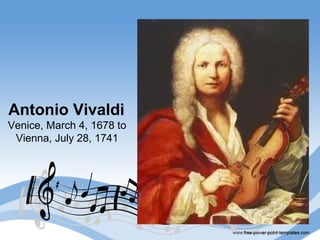
Antonio Vivaldi
Venice, March 4, 1678 to
Vienna, July 28, 1741
Vivaldi’s Composition
• The Four Seasons
George Friedrich Händel
Germany, February 23, 1685
London, April 14, 1759
Handel’s Composition
• Hallelujah
• Samson
• The Messiah
Performance Task
• Group Activity Move to the Music!!!

Grade 9 music

  • 1.
    Music of the MedievalPeriod (700 - 1400)
  • 2.
    Learning Objectives: • Listenperceptively to selected vocal and instrumental music of Medieval, Renaissance and Baroque periods; • Explain the performance practice (setting, composition, role of composers/performers and audience) of Medieval, Renaissance and Baroque Periods; • Relate Medieval, Renaissance and Baroque music to its historical and cultural background through dramatization; and • Sing selections of medieval chants, troubadour songs, madrigals, and oratorios with correct pitch, rythm, expression and style.
  • 3.
    The Gregorian Chants: •is the central tradition of Western plainchant, a form of monophonic, unaccompanied sacred song of the western Roman Catholic Church.
  • 4.
    Who wrote theGregorian Chant? • This chant was probably named after Pope Gregory the Great. When Charlemagne had become Holy Roman Emperor he made everyone in Europe use this Gregorian chant.
  • 5.
    Characteristics of theGregorian Chants: • Monophonic - consisting of a single musical line, without accompaniment. • Free meter - is NO regular repeating rhythm. • Usually based on Latin liturgy • Use of Neume notation
  • 6.
    What is yourfavorite boy band?
  • 7.
    Did you knowthat .... - during the latter part of the Medieval Period, secular music which was not bound by Catholic traditions emerged. Most of these songs were performed across Europe by groups of musicians called Troubadours.
  • 8.
    The Troubadour • Usuallymonophonic • Sometimes with improvised accompaniment • Tells of chivalry and courtly love • Originated in France • Written in French language
  • 9.
    Works Adam dela halle: • Le Jeu de Robin et de Marion • La Chanson du roi de Sicile
  • 10.
    Famous Composer ofthe Medieval Period: ADAM DE LA HALLE France (1237 - 1288)
  • 11.
    Music of the RenaissancePeriod (1400 - 1600)
  • 12.
    FYI: • the term"Renaissance" comes from the word "renaitre" which means REBIRTH, REVIVAL, and REDISCOVERY. • music became as entertainment and activity for amateurs and the educated. • influence of the RCC become to decline as the new music genre arose. • "golden age" of a capella choral music.
  • 13.
    Characteristics of Renaissance Music: •Mostly polyphonic. • Imitation among the voices is common. • Use of word painting in texts and music. • Melodic lines move in a flowing manner. • Melodies are easier to perform because these move along a scale with a few large leaps.
  • 14.
    Vocal Music ofthe Renaissance Period: 1. Mass - is a form of sacred musical composition that sets texts of the Eucharistic liturgy into music. 2. Madrigal - most important secular music during renaissance peiod. It is written and expressed in a poetic text and sung during courtly social gathering.
  • 15.
    Characteristics of theMass: • Polyphonic • May be sung a capella or with orchestral accompaniment. • Text may be syllabic (one note set to each syllable), neumatic (a few notes set to one syllable), or melismatic (many notes to one syllable).
  • 16.
    Other facts duringthis period: • discovery of the actual position of the earth. • invention of compass. • Martin Luther's Protestant reformation.
  • 17.
  • 18.
    Reflection: 1. Which musicare you familiar with? Why? 2. Which songs can you relate with? Sacred or secular music? Why?
  • 19.
    Five Main Sectionsof Mass: 1. Kyrie (Lord Have Mercy) the only Greek 2. Gloria (Glory to God in the Highest) 3. Credo (I Believe in One God) 4. Sanctus and Benedictus (Holy, holy and Blessed Is He) 5. Agnus Dei (Lamb of God)
  • 20.
    Characteristics of the Madrigal: •Polyphonic • Sung a capella • Through - composed • Frequently in 3 to 6 voices
  • 21.
    Famous Composers ofthe Renaissance Period Giovanni Pierluigi da Palestrina Rome 1525 - February 2, 1594
  • 22.
    Famous Composers ofthe Renaissance Period Thomas Morley England 1557 - 1602
  • 23.
    Reflection: • Which madrigaldid you enjoy more? Why? • Based on what you have heard, do you agree that the compositions of Palestrina and Morley reflect their personalities? Why or Why not?
  • 24.
    Music of the BaroquePeriod (1685 - 1750)
  • 25.
    FYI: The word Baroqueis derived from the Portuguese word "barroco" which means "pearl of irregular shape". During this time, the arts highlighted grandiose and elaborate ornamentation.
  • 26.
    Characteristics of BaroqueMusic: • Melodies sound elaborate and ornamental •  Melodies are not easy to sing or remember •  Primarily contrapuntal textures with some homophony •  Dynamic contrast – alternation between loud and soft
  • 27.
    •  Musicgenres—operas, oratorios, suites, tocatas, concertó grosso, fugue •  Orchestra consists of strings and continuo •  Harpsichord and organ are the keyboard instruments that are • commonly used
  • 28.
    Music Genres ofBaroque Music 1. Concerto - a form of orchestral music that employs a solo instrument accompanied by an orchestra. 2. Concerto Grosso - a form of orchestral music wherein the music is between a small group of solo instruments called concertino an the whole orchestra called tutti.
  • 29.
    3. Fugue • Acontrapuntal piece, developed mainly by imitative counterpoint. • It is usually written in 3 or 4 parts, with a main theme called "subject". • The entire piece grows mainly from a single brief of strong musical character.
  • 30.
    4. Oratorio • alarge scale musical composition for orchestra and voices that incorporates narratives on religious themes/
  • 31.
    5. Chorale • musicalcompositions that resemble a harmonized version of hymnal tunes of the Protestant Church during the Baroque era.
  • 32.
    Famous Composers ofthe Baroque Period Johann Sebastian Bach Germany Birth: March 21, 1685 Death: July 28, 1750
  • 33.
    Bach’s Composition • Fugue:Toccata and Fugue in D minor • Oratorio: Bach’s ―Christmas Oratorio • Concerto Grosso: Brandenburg Concertos
  • 34.
    Antonio Vivaldi Venice, March4, 1678 to Vienna, July 28, 1741
  • 35.
  • 36.
    George Friedrich Händel Germany,February 23, 1685 London, April 14, 1759
  • 37.
  • 38.
    Performance Task • GroupActivity Move to the Music!!!