Music of the Baroque Period

(1600-1750)
Baroque Historical Highlights
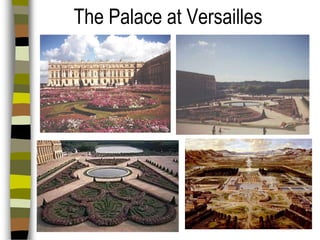
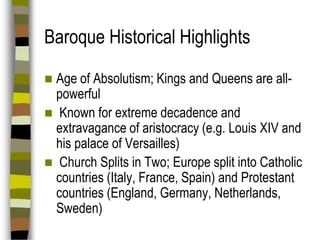
Age of Absolutism; Kings and Queens are allpowerful
 Known for extreme decadence and
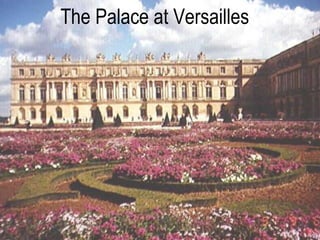
extravagance of aristocracy (e.g. Louis XIV and
his palace of Versailles)
 Church Splits in Two; Europe split into Catholic
countries (Italy, France, Spain) and Protestant
countries (England, Germany, Netherlands,
Sweden)

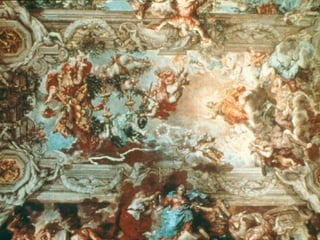
The Palace at Versailles
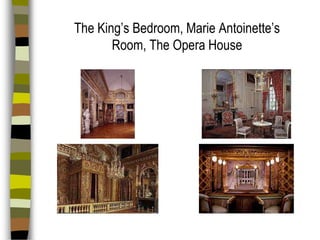
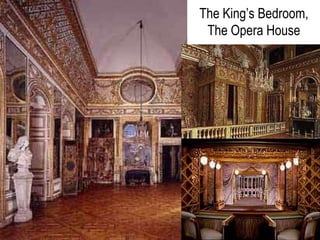
The King’s Bedroom,
The Opera House
“Baroque”
Defined


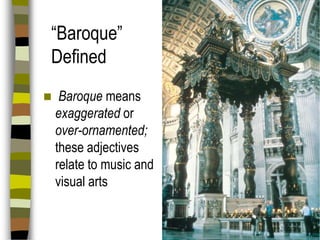
Baroque means
exaggerated or
over-ornamented;
these adjectives
relate to music and
visual arts
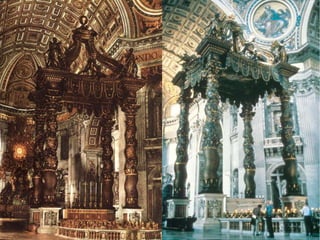
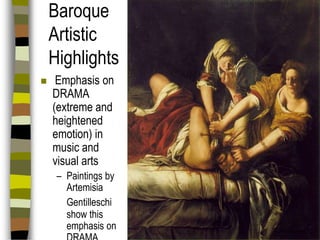
Baroque
Artistic
Highlights


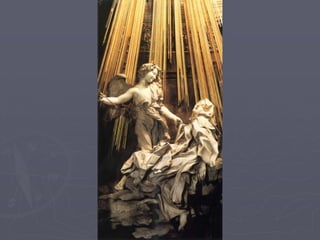
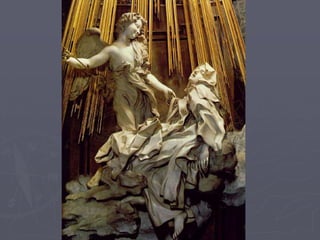
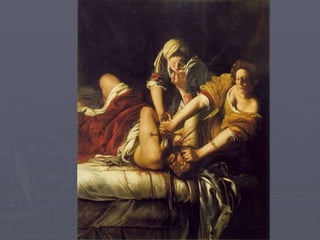
Emphasis on
DRAMA
(extreme and
heightened
emotion) in
music and
visual arts
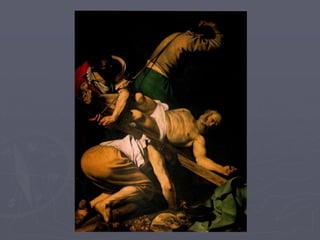
– Paintings by
Artemisia
Gentilleschi
show this
emphasis on
Baroque Musical Highlights
Birth of OPERA - theatrical presentations with
music and elaborate stage spectacle
 New focus on instrumental music and
instrumental accompaniment to voices
 New emphasis on chords and use of BASSO
CONTINUO
 Examples:


– Henry Purcell ”Dido’s Lament " from Dido and
Aeneas
– Claudio Monteverdi “Tu se’ morta” from Orfeo
Basso Continuo


Baroque accompaniment made up of a
bass part usually played by two
instruments
– A keyboard (or other chord-generating
instrument such as the lute, organ, or
harpsichord)
– Plus a low melodic instrument (such as the
cello or bassoon)
Baroque Music Genres


Vocal Music Genres
– Opera
– Oratorio
– Cantata



Instrumental Music
Genres
– Chamber Music
– Concerto Grosso
Opera


Sung theatrical work with orchestral
accompaniment
– Vocal soloists and chorus



Staged with costumes and sets



Example: HENRY PURCELL "Dido's Lament"
from Dido and Aeneas CD#1/69-70
Recitative


Vocal line in a opera, oratorio, or
cantata that imitates the rhythms and
pitch fluctuations of speech, often
serving to lead into an aria



Recitative often gets across mostly plot
information in the opera, while the Aria
communicates the character’s emotions
Aria


Song for solo voice with orchestral
accompaniment, usually expressing an
emotional state through its outpouring of
melody; found in operas, oratorios, and
cantatas
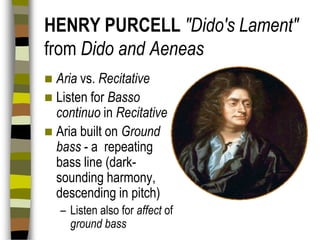
HENRY PURCELL "Dido's Lament"
from Dido and Aeneas
Aria vs. Recitative
 Listen for Basso
continuo in Recitative
 Aria built on Ground
bass - a repeating
bass line (darksounding harmony,
descending in pitch)


– Listen also for affect of
ground bass
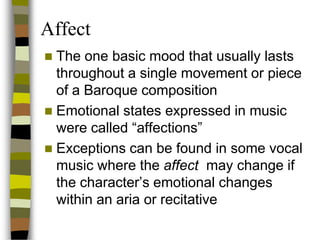
Affect
The one basic mood that usually lasts
throughout a single movement or piece
of a Baroque composition
 Emotional states expressed in music
were called “affections”
 Exceptions can be found in some vocal
music where the affect may change if
the character’s emotional changes
within an aria or recitative

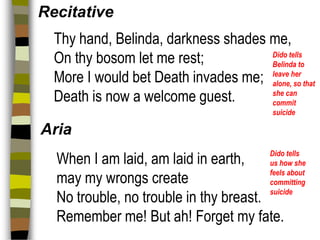
Recitative
Thy hand, Belinda, darkness shades me,
Dido tells
On thy bosom let me rest;
Belinda to
More I would bet Death invades me; leave her that
alone, so
she can
Death is now a welcome guest.
commit
suicide

Aria
Dido tells
us how she
feels about
committing
suicide

When I am laid, am laid in earth,
may my wrongs create
No trouble, no trouble in thy breast.
Remember me! But ah! Forget my fate.
Oratorio


Like opera - [Sung theatrical work with orchestral accompaniment for
vocal soloists and chorus] , but unstaged [without acting, scenery, or
costumes]



Uses a religious story



Example: GEORGE FRIDERIC HANDEL’s Messiah
– "Hallelujah" CD#2/11-16
– "Ev'ry Valley Shall Be Exalted" CD#2/10
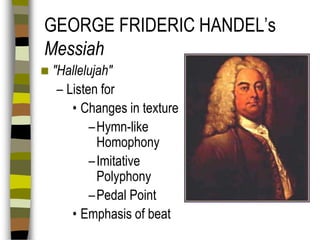
GEORGE FRIDERIC HANDEL’s
Messiah


"Hallelujah"
– Listen for
• Changes in texture
– Hymn-like
Homophony
– Imitative
Polyphony
– Pedal Point
• Emphasis of beat
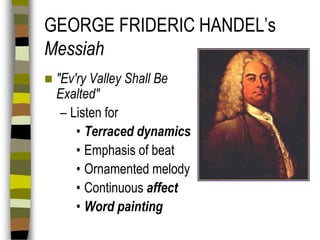
GEORGE FRIDERIC HANDEL’s
Messiah


"Ev'ry Valley Shall Be
Exalted"
– Listen for
• Terraced dynamics
• Emphasis of beat
• Ornamented melody
• Continuous affect
• Word painting
Terraced Dynamics


Abrupt alternation between loud and
soft dynamic levels; characteristic of
Baroque music
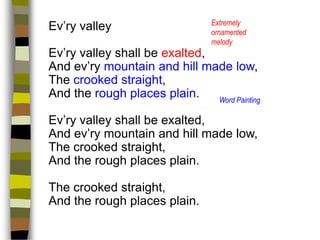
Ev’ry valley

Extremely
ornamented
melody

Ev’ry valley shall be exalted,
And ev’ry mountain and hill made low,
The crooked straight,
And the rough places plain.
Word Painting
Ev’ry valley shall be exalted,
And ev’ry mountain and hill made low,
The crooked straight,
And the rough places plain.

The crooked straight,
And the rough places plain.
Cantata


Like opera, but unstaged,



Usually with religious text & mostly performed in
churches



The church cantata for the Lutheran service in Germany
during the baroque period often includes chorales
– Chorales are hymn tunes set to a German religious text



Example: J.S. BACH Cantata No. 140: Wachet auf, ruft
uns die Stimme (Sleepers Awake) Mvt. 4 [Tenor Chorale]
CD#1/71-73 & Mvt. 7 [Chorale] CD#1/74-75
J.S. BACH Cantata No. 140:
Wachet auf, ruft uns die Stimme
(Sleepers Awake)


Mvt. 4 [Tenor Chorale]
– Listen for
• Extremely ornamented
melody
• Continuous affect



Mvt. 7 [Chorale]
– Listen for
• Hymn-like homophony
• Complete and incomplete
cadences
Chamber Music
Uses a small group of musicians, with one player
to a part
 Meant for smaller, more intimate performance
venues
 Includes music for solo instruments


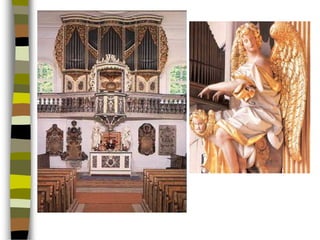
– J.S. Bach’s Organ Fugue in G Minor “The Little”
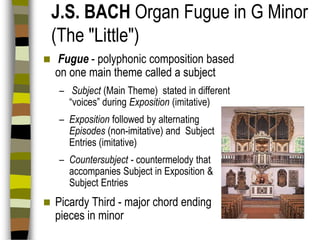
J.S. BACH Organ Fugue in G Minor
(The "Little")


Fugue - polyphonic composition based
on one main theme called a subject
– Subject (Main Theme) stated in different
“voices” during Exposition (imitative)
– Exposition followed by alternating
Episodes (non-imitative) and Subject
Entries (imitative)
– Countersubject - countermelody that
accompanies Subject in Exposition &
Subject Entries



Picardy Third - major chord ending
pieces in minor
Concerto Grosso


Composition for several instrumental soloists
and small orchestra; common in late baroque
music



Tutti vs. Soli groups
– Tutti = “all,” the entire ensemble
– Soli = a small group of featured soloists (2 or 3)



Ritornello form - Ritornello (a homophonic or
polyphonic block of music) alternating with
Episodes (contrasting melodic, softer dynamics,
virtuosic scales and arpeggios)
Examples of Baroque Concerto
Grosso


J.S. Bach
– Brandenburg Concerto No. 5 in
D Major
– Movement 1



Antonio Vivaldi
– Concerto for Violin and String
Orchestra, Op. 8, No. 1, La
Primavera [Spring]
– from The Four Seasons
– Movement 1
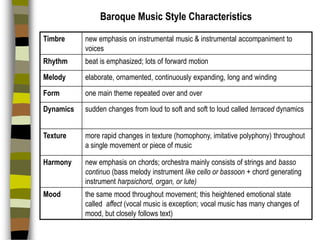
Baroque Music Style Characteristics
Timbre

new emphasis on instrumental music & instrumental accompaniment to
voices

Rhythm

beat is emphasized; lots of forward motion

Melody

elaborate, ornamented, continuously expanding, long and winding

Form

one main theme repeated over and over

Dynamics

sudden changes from loud to soft and soft to loud called terraced dynamics

Texture

more rapid changes in texture (homophony, imitative polyphony) throughout
a single movement or piece of music

Harmony

new emphasis on chords; orchestra mainly consists of strings and basso
continuo (bass melody instrument like cello or bassoon + chord generating
instrument harpsichord, organ, or lute)

Mood

the same mood throughout movement; this heightened emotional state
called affect (vocal music is exception; vocal music has many changes of
mood, but closely follows text)
The Palace at Versailles
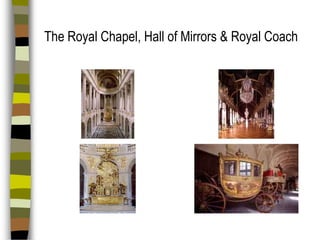
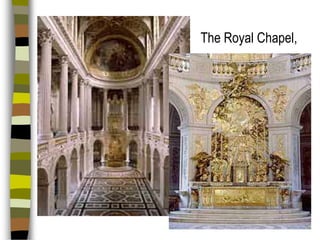
The Royal Chapel, Hall of Mirrors & Royal Coach
The Royal Chapel,
The King’s Bedroom, Marie Antoinette’s
Room, The Opera House
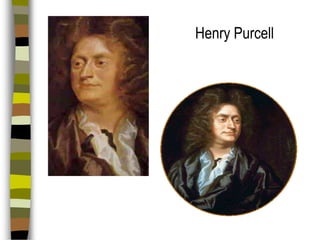
Henry Purcell
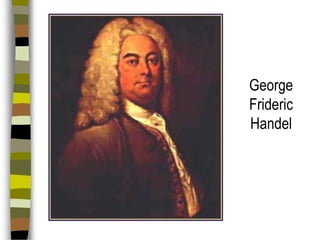
George
Frideric
Handel
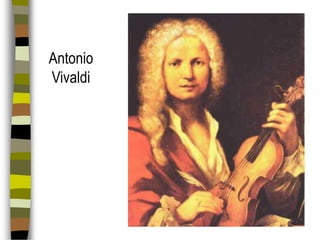
Antonio
Vivaldi
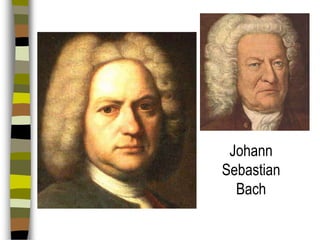
Johann
Sebastian
Bach
Baroque05
Baroque05
Baroque05

Baroque05

  • 1.
    Music of theBaroque Period (1600-1750)
  • 2.
    Baroque Historical Highlights Ageof Absolutism; Kings and Queens are allpowerful  Known for extreme decadence and extravagance of aristocracy (e.g. Louis XIV and his palace of Versailles)  Church Splits in Two; Europe split into Catholic countries (Italy, France, Spain) and Protestant countries (England, Germany, Netherlands, Sweden) 
  • 3.
    The Palace atVersailles
  • 4.
  • 5.
  • 7.
    Baroque Artistic Highlights  Emphasis on DRAMA (extreme and heightened emotion)in music and visual arts – Paintings by Artemisia Gentilleschi show this emphasis on
  • 8.
    Baroque Musical Highlights Birthof OPERA - theatrical presentations with music and elaborate stage spectacle  New focus on instrumental music and instrumental accompaniment to voices  New emphasis on chords and use of BASSO CONTINUO  Examples:  – Henry Purcell ”Dido’s Lament " from Dido and Aeneas – Claudio Monteverdi “Tu se’ morta” from Orfeo
  • 9.
    Basso Continuo  Baroque accompanimentmade up of a bass part usually played by two instruments – A keyboard (or other chord-generating instrument such as the lute, organ, or harpsichord) – Plus a low melodic instrument (such as the cello or bassoon)
  • 10.
    Baroque Music Genres  VocalMusic Genres – Opera – Oratorio – Cantata  Instrumental Music Genres – Chamber Music – Concerto Grosso
  • 11.
    Opera  Sung theatrical workwith orchestral accompaniment – Vocal soloists and chorus  Staged with costumes and sets  Example: HENRY PURCELL "Dido's Lament" from Dido and Aeneas CD#1/69-70
  • 12.
    Recitative  Vocal line ina opera, oratorio, or cantata that imitates the rhythms and pitch fluctuations of speech, often serving to lead into an aria  Recitative often gets across mostly plot information in the opera, while the Aria communicates the character’s emotions
  • 13.
    Aria  Song for solovoice with orchestral accompaniment, usually expressing an emotional state through its outpouring of melody; found in operas, oratorios, and cantatas
  • 14.
    HENRY PURCELL "Dido'sLament" from Dido and Aeneas Aria vs. Recitative  Listen for Basso continuo in Recitative  Aria built on Ground bass - a repeating bass line (darksounding harmony, descending in pitch)  – Listen also for affect of ground bass
  • 15.
    Affect The one basicmood that usually lasts throughout a single movement or piece of a Baroque composition  Emotional states expressed in music were called “affections”  Exceptions can be found in some vocal music where the affect may change if the character’s emotional changes within an aria or recitative 
  • 16.
    Recitative Thy hand, Belinda,darkness shades me, Dido tells On thy bosom let me rest; Belinda to More I would bet Death invades me; leave her that alone, so she can Death is now a welcome guest. commit suicide Aria Dido tells us how she feels about committing suicide When I am laid, am laid in earth, may my wrongs create No trouble, no trouble in thy breast. Remember me! But ah! Forget my fate.
  • 17.
    Oratorio  Like opera -[Sung theatrical work with orchestral accompaniment for vocal soloists and chorus] , but unstaged [without acting, scenery, or costumes]  Uses a religious story  Example: GEORGE FRIDERIC HANDEL’s Messiah – "Hallelujah" CD#2/11-16 – "Ev'ry Valley Shall Be Exalted" CD#2/10
  • 18.
    GEORGE FRIDERIC HANDEL’s Messiah  "Hallelujah" –Listen for • Changes in texture – Hymn-like Homophony – Imitative Polyphony – Pedal Point • Emphasis of beat
  • 19.
    GEORGE FRIDERIC HANDEL’s Messiah  "Ev'ryValley Shall Be Exalted" – Listen for • Terraced dynamics • Emphasis of beat • Ornamented melody • Continuous affect • Word painting
  • 20.
    Terraced Dynamics  Abrupt alternationbetween loud and soft dynamic levels; characteristic of Baroque music
  • 21.
    Ev’ry valley Extremely ornamented melody Ev’ry valleyshall be exalted, And ev’ry mountain and hill made low, The crooked straight, And the rough places plain. Word Painting Ev’ry valley shall be exalted, And ev’ry mountain and hill made low, The crooked straight, And the rough places plain. The crooked straight, And the rough places plain.
  • 22.
    Cantata  Like opera, butunstaged,  Usually with religious text & mostly performed in churches  The church cantata for the Lutheran service in Germany during the baroque period often includes chorales – Chorales are hymn tunes set to a German religious text  Example: J.S. BACH Cantata No. 140: Wachet auf, ruft uns die Stimme (Sleepers Awake) Mvt. 4 [Tenor Chorale] CD#1/71-73 & Mvt. 7 [Chorale] CD#1/74-75
  • 23.
    J.S. BACH CantataNo. 140: Wachet auf, ruft uns die Stimme (Sleepers Awake)  Mvt. 4 [Tenor Chorale] – Listen for • Extremely ornamented melody • Continuous affect  Mvt. 7 [Chorale] – Listen for • Hymn-like homophony • Complete and incomplete cadences
  • 24.
    Chamber Music Uses asmall group of musicians, with one player to a part  Meant for smaller, more intimate performance venues  Includes music for solo instruments  – J.S. Bach’s Organ Fugue in G Minor “The Little”
  • 25.
    J.S. BACH OrganFugue in G Minor (The "Little")  Fugue - polyphonic composition based on one main theme called a subject – Subject (Main Theme) stated in different “voices” during Exposition (imitative) – Exposition followed by alternating Episodes (non-imitative) and Subject Entries (imitative) – Countersubject - countermelody that accompanies Subject in Exposition & Subject Entries  Picardy Third - major chord ending pieces in minor
  • 26.
    Concerto Grosso  Composition forseveral instrumental soloists and small orchestra; common in late baroque music  Tutti vs. Soli groups – Tutti = “all,” the entire ensemble – Soli = a small group of featured soloists (2 or 3)  Ritornello form - Ritornello (a homophonic or polyphonic block of music) alternating with Episodes (contrasting melodic, softer dynamics, virtuosic scales and arpeggios)
  • 27.
    Examples of BaroqueConcerto Grosso  J.S. Bach – Brandenburg Concerto No. 5 in D Major – Movement 1  Antonio Vivaldi – Concerto for Violin and String Orchestra, Op. 8, No. 1, La Primavera [Spring] – from The Four Seasons – Movement 1
  • 28.
    Baroque Music StyleCharacteristics Timbre new emphasis on instrumental music & instrumental accompaniment to voices Rhythm beat is emphasized; lots of forward motion Melody elaborate, ornamented, continuously expanding, long and winding Form one main theme repeated over and over Dynamics sudden changes from loud to soft and soft to loud called terraced dynamics Texture more rapid changes in texture (homophony, imitative polyphony) throughout a single movement or piece of music Harmony new emphasis on chords; orchestra mainly consists of strings and basso continuo (bass melody instrument like cello or bassoon + chord generating instrument harpsichord, organ, or lute) Mood the same mood throughout movement; this heightened emotional state called affect (vocal music is exception; vocal music has many changes of mood, but closely follows text)
  • 31.
    The Palace atVersailles
  • 32.
    The Royal Chapel,Hall of Mirrors & Royal Coach
  • 33.
  • 34.
    The King’s Bedroom,Marie Antoinette’s Room, The Opera House
  • 36.
  • 37.
  • 38.
  • 39.