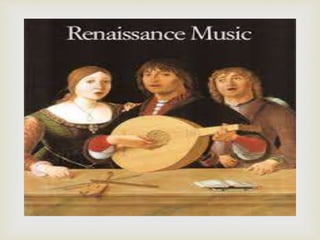
(1450-1600)

Renaissance means rebirth. They
were interested in Ancient Greece
and Rome. There were many
voyages of discovery, and
scientific advances.
Introduction to Renaissance

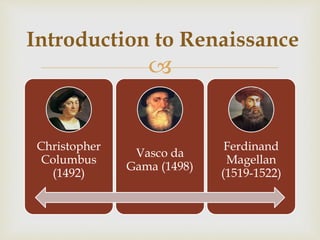
Christopher
Columbus
(1492)
Vasco da
Gama (1498)
Ferdinand
Magellan
(1519-1522)
Introduction to Renaissance

Introduction to Renaissance


Words and Music
• Renaissance composers wrote music to enhance the
meaning and emotion of the text. By contrast,
medieval composers had been relatively
uninterested in expressing the emotions of a text.
“When one of the words expresses weeping, pain,
heartbreak, sighs, and tears and other similar things, let
the harmony be full of sadness.” – Gioseffo Zarlino
Characteristics of Renaissance Music:

Texture
• The texture of the Renaissance is chiefly
polyphonic.
• Is sometimes called the “golden age” of
unaccompanied-a capella-choral music.
Rhythm and Melody
• In Renaissance music, rhythm is more a gentle
flow than a sharply defined beat because each
melodic line has great rhythmic independence.
Characteristics of Renaissance Music:

 Music still based on modes, but gradually more
accidentals creep in.
 Richer texture in four or more parts. Bass part is
added below the tenor.
 Blending rather than contrasting strands in the
musical texture.
 Harmony. Greater concern with the flow and
progression of chords.
Characteristics of Renaissance Music:

 Church music. Some pieces were intended for 'a cappella'
performance. Mainly contrapuntal. Lots of imitation.
Some church music was accompanied by instruments -
for example polychoral pieces in antiphonal style
(Antiphonal - Questions and Answers, Stereo Effect).
 Secular music (none-religious music. Sacred music is to
do with the church) There were lots of vocal pieces and
dances, and lots of instrumental pieces (However a lot of
the instrumentals were in a vocal style, but sonic were
suited to instruments. Vocal music was by far the more
important.)
 The characteristic timbres of Renaissance musical
instruments - many forming families.
Characteristics of Renaissance Music:

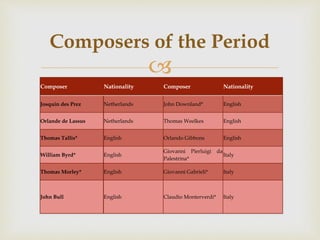
Composer Nationality Composer Nationality
Josquin des Prez Netherlands John Downland* English
Orlande de Lassus Netherlands Thomas Weelkes English
Thomas Tallis* English Orlando Gibbons English
William Byrd* English
Giovanni Pierluigi da
Palestrina*
Italy
Thomas Morley* English Giovanni Gabrieli* Italy
John Bull English Claudio Monterverdi* Italy
Composers of the Period

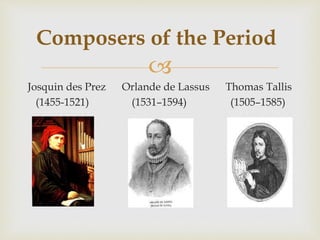
Josquin des Prez Orlande de Lassus Thomas Tallis
(1455-1521) (1531–1594) (1505–1585)
Composers of the Period

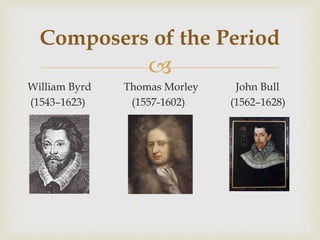
William Byrd Thomas Morley John Bull
(1543–1623) (1557-1602) (1562–1628)
Composers of the Period

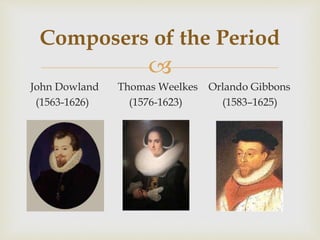
John Dowland Thomas Weelkes Orlando Gibbons
(1563-1626) (1576-1623) (1583–1625)
Composers of the Period

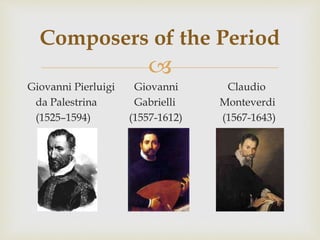
Giovanni Pierluigi Giovanni Claudio
da Palestrina Gabrielli Monteverdi
(1525–1594) (1557-1612) (1567-1643)
Composers of the Period

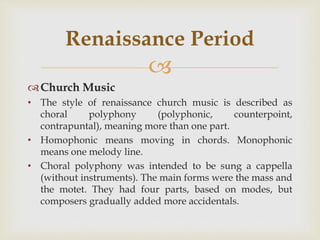
Church Music
• The style of renaissance church music is described as
choral polyphony (polyphonic, counterpoint,
contrapuntal), meaning more than one part.
• Homophonic means moving in chords. Monophonic
means one melody line.
• Choral polyphony was intended to be sung a cappella
(without instruments). The main forms were the mass and
the motet. They had four parts, based on modes, but
composers gradually added more accidentals.
Renaissance Period

German Chorales
• German Chorales are Protestant hymns.
Secular Music
• This was music independent of churches (i.e. none
religious). The main type was the song, lied
(German), frottola (Italian), chanson (French),
madrigal (Italian) and villancico (Spanish).
Renaissance Period


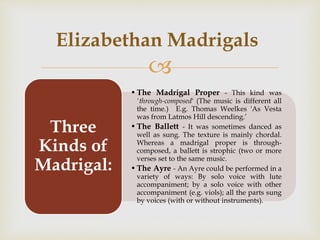
•The Madrigal Proper - This kind was
'through-composed' (The music is different all
the time.) E.g. Thomas Weelkes 'As Vesta
was from Latmos Hill descending.’
•The Ballett - It was sometimes danced as
well as sung. The texture is mainly chordal.
Whereas a madrigal proper is through-
composed, a ballett is strophic (two or more
verses set to the same music.
•The Ayre - An Ayre could be performed in a
variety of ways: By solo voice with lute
accompaniment; by a solo voice with other
accompaniment (e.g. viols); all the parts sung
by voices (with or without instruments).
Three
Kinds of
Madrigal:
Elizabethan Madrigals

Until the beginning of the 16th Century,
instruments were considered to be less
important than voices. They were used for
dances, and to accompany vocal music - but
here they only doubled the voices. During
the 16th Century, however, composers took
greater interest in writing music for
instrument. A lot of these instruments were
intended for outside.
Instrumental Music

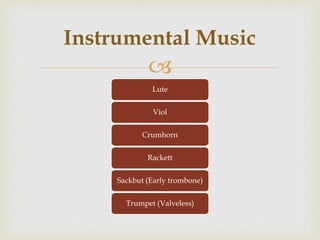
Lute
Viol
Crumhorn
Rackett
Sackbut (Early trombone)
Trumpet (Valveless)
Instrumental Music

English Consorts
• A consort is a group of instruments playing together.
A whole consort consists of instruments all from the
same family, but a broken consort has instruments
from more than one family.
Variations and the Ground Bass
• A ground is a tune repeated over and over in the
bass, with musical material changing above.
Variations are alterations in the tune.
Instrumental Music

Musical Notation

Renaissance period

  • 1.
  • 2.
     Renaissance means rebirth.They were interested in Ancient Greece and Rome. There were many voyages of discovery, and scientific advances. Introduction to Renaissance
  • 3.
  • 4.
  • 5.
  • 6.
     Words and Music •Renaissance composers wrote music to enhance the meaning and emotion of the text. By contrast, medieval composers had been relatively uninterested in expressing the emotions of a text. “When one of the words expresses weeping, pain, heartbreak, sighs, and tears and other similar things, let the harmony be full of sadness.” – Gioseffo Zarlino Characteristics of Renaissance Music:
  • 7.
     Texture • The textureof the Renaissance is chiefly polyphonic. • Is sometimes called the “golden age” of unaccompanied-a capella-choral music. Rhythm and Melody • In Renaissance music, rhythm is more a gentle flow than a sharply defined beat because each melodic line has great rhythmic independence. Characteristics of Renaissance Music:
  • 8.
      Music stillbased on modes, but gradually more accidentals creep in.  Richer texture in four or more parts. Bass part is added below the tenor.  Blending rather than contrasting strands in the musical texture.  Harmony. Greater concern with the flow and progression of chords. Characteristics of Renaissance Music:
  • 9.
      Church music.Some pieces were intended for 'a cappella' performance. Mainly contrapuntal. Lots of imitation. Some church music was accompanied by instruments - for example polychoral pieces in antiphonal style (Antiphonal - Questions and Answers, Stereo Effect).  Secular music (none-religious music. Sacred music is to do with the church) There were lots of vocal pieces and dances, and lots of instrumental pieces (However a lot of the instrumentals were in a vocal style, but sonic were suited to instruments. Vocal music was by far the more important.)  The characteristic timbres of Renaissance musical instruments - many forming families. Characteristics of Renaissance Music:
  • 10.
     Composer Nationality ComposerNationality Josquin des Prez Netherlands John Downland* English Orlande de Lassus Netherlands Thomas Weelkes English Thomas Tallis* English Orlando Gibbons English William Byrd* English Giovanni Pierluigi da Palestrina* Italy Thomas Morley* English Giovanni Gabrieli* Italy John Bull English Claudio Monterverdi* Italy Composers of the Period
  • 11.
     Josquin des PrezOrlande de Lassus Thomas Tallis (1455-1521) (1531–1594) (1505–1585) Composers of the Period
  • 12.
     William Byrd ThomasMorley John Bull (1543–1623) (1557-1602) (1562–1628) Composers of the Period
  • 13.
     John Dowland ThomasWeelkes Orlando Gibbons (1563-1626) (1576-1623) (1583–1625) Composers of the Period
  • 14.
     Giovanni Pierluigi GiovanniClaudio da Palestrina Gabrielli Monteverdi (1525–1594) (1557-1612) (1567-1643) Composers of the Period
  • 15.
     Church Music • Thestyle of renaissance church music is described as choral polyphony (polyphonic, counterpoint, contrapuntal), meaning more than one part. • Homophonic means moving in chords. Monophonic means one melody line. • Choral polyphony was intended to be sung a cappella (without instruments). The main forms were the mass and the motet. They had four parts, based on modes, but composers gradually added more accidentals. Renaissance Period
  • 16.
     German Chorales • GermanChorales are Protestant hymns. Secular Music • This was music independent of churches (i.e. none religious). The main type was the song, lied (German), frottola (Italian), chanson (French), madrigal (Italian) and villancico (Spanish). Renaissance Period
  • 17.
  • 18.
     •The Madrigal Proper- This kind was 'through-composed' (The music is different all the time.) E.g. Thomas Weelkes 'As Vesta was from Latmos Hill descending.’ •The Ballett - It was sometimes danced as well as sung. The texture is mainly chordal. Whereas a madrigal proper is through- composed, a ballett is strophic (two or more verses set to the same music. •The Ayre - An Ayre could be performed in a variety of ways: By solo voice with lute accompaniment; by a solo voice with other accompaniment (e.g. viols); all the parts sung by voices (with or without instruments). Three Kinds of Madrigal: Elizabethan Madrigals
  • 19.
     Until the beginningof the 16th Century, instruments were considered to be less important than voices. They were used for dances, and to accompany vocal music - but here they only doubled the voices. During the 16th Century, however, composers took greater interest in writing music for instrument. A lot of these instruments were intended for outside. Instrumental Music
  • 20.
  • 21.
     English Consorts • Aconsort is a group of instruments playing together. A whole consort consists of instruments all from the same family, but a broken consort has instruments from more than one family. Variations and the Ground Bass • A ground is a tune repeated over and over in the bass, with musical material changing above. Variations are alterations in the tune. Instrumental Music
  • 22.