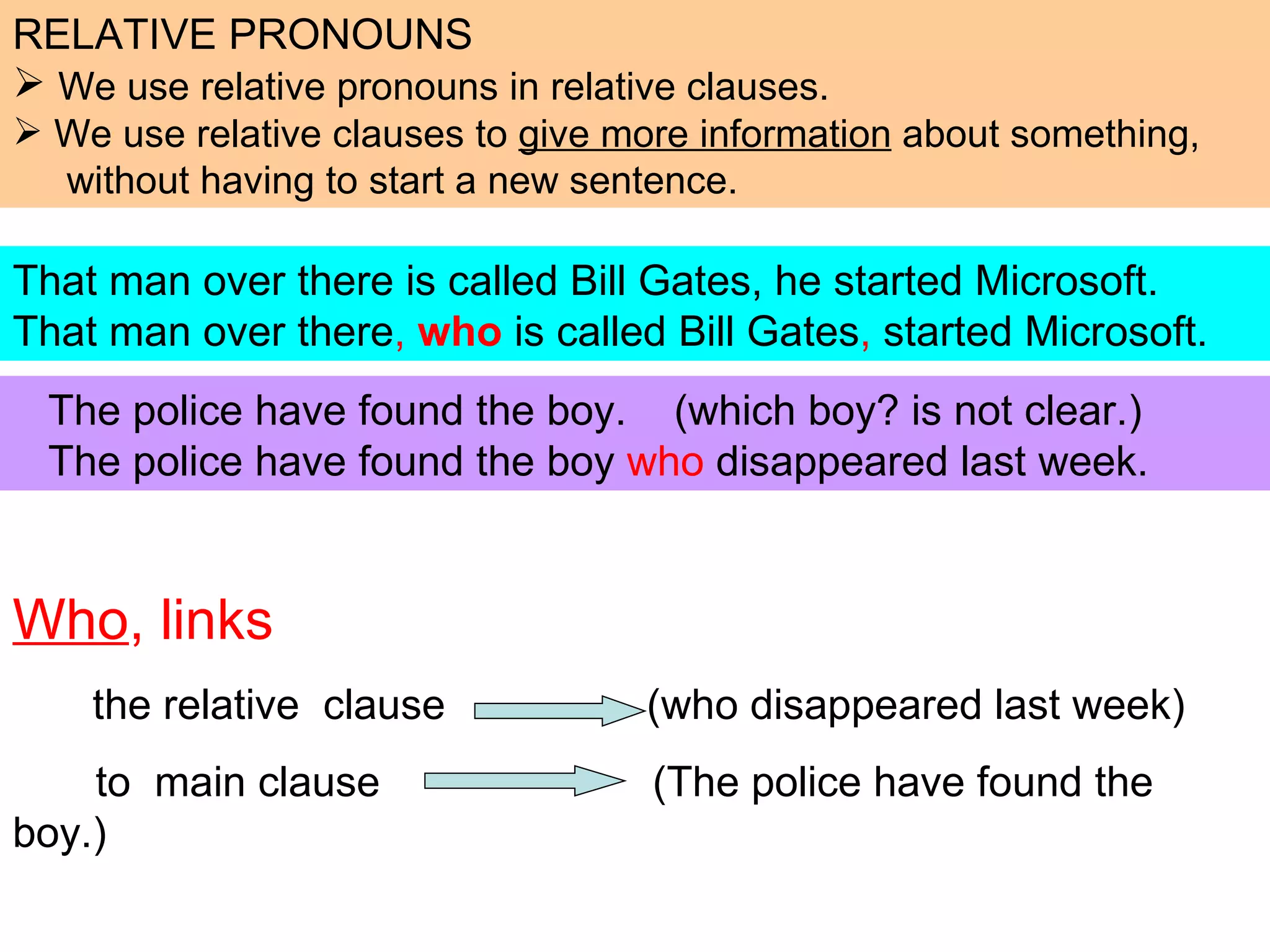
Who , links   the relative  clause  (who disappeared last week)  to  main clause  (The police have found the boy.) That man over there is called Bill Gates, he started Microsoft. That man over there ,   who  is called Bill Gates ,  started Microsoft. RELATIVE PRONOUNS We use relative pronouns in relative clauses. We use relative clauses to  give more information  about something,  without having to start a new sentence. The police have found the boy.  (which boy? is not clear.) The police have found the boy  who  disappeared last week.
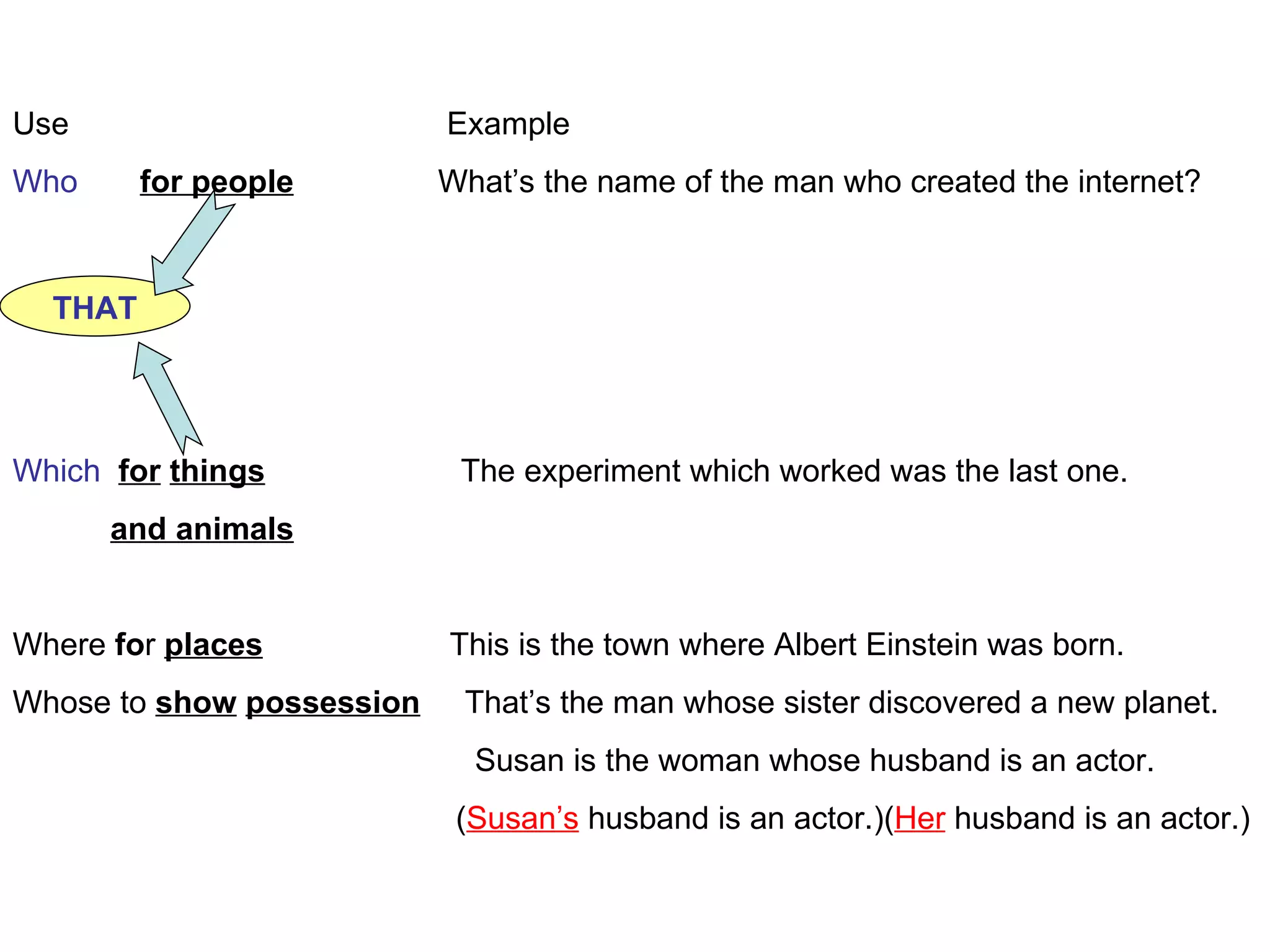
Use    Example Who   for people   What’s the name of the man who created the internet? Which   for   things   The experiment which worked was the last one. and animals Where  fo r  places   This is the town where Albert Einstein was born. Whose to  show   possession   That’s the man whose sister discovered a new planet. Susan is the woman whose husband is an actor.   ( Susan’s  husband is an actor.)( Her  husband is an actor.) THAT
NOTE: We can use  Who  for animals when we give them  personality . Our dog , who’s called Benji, is six months old.
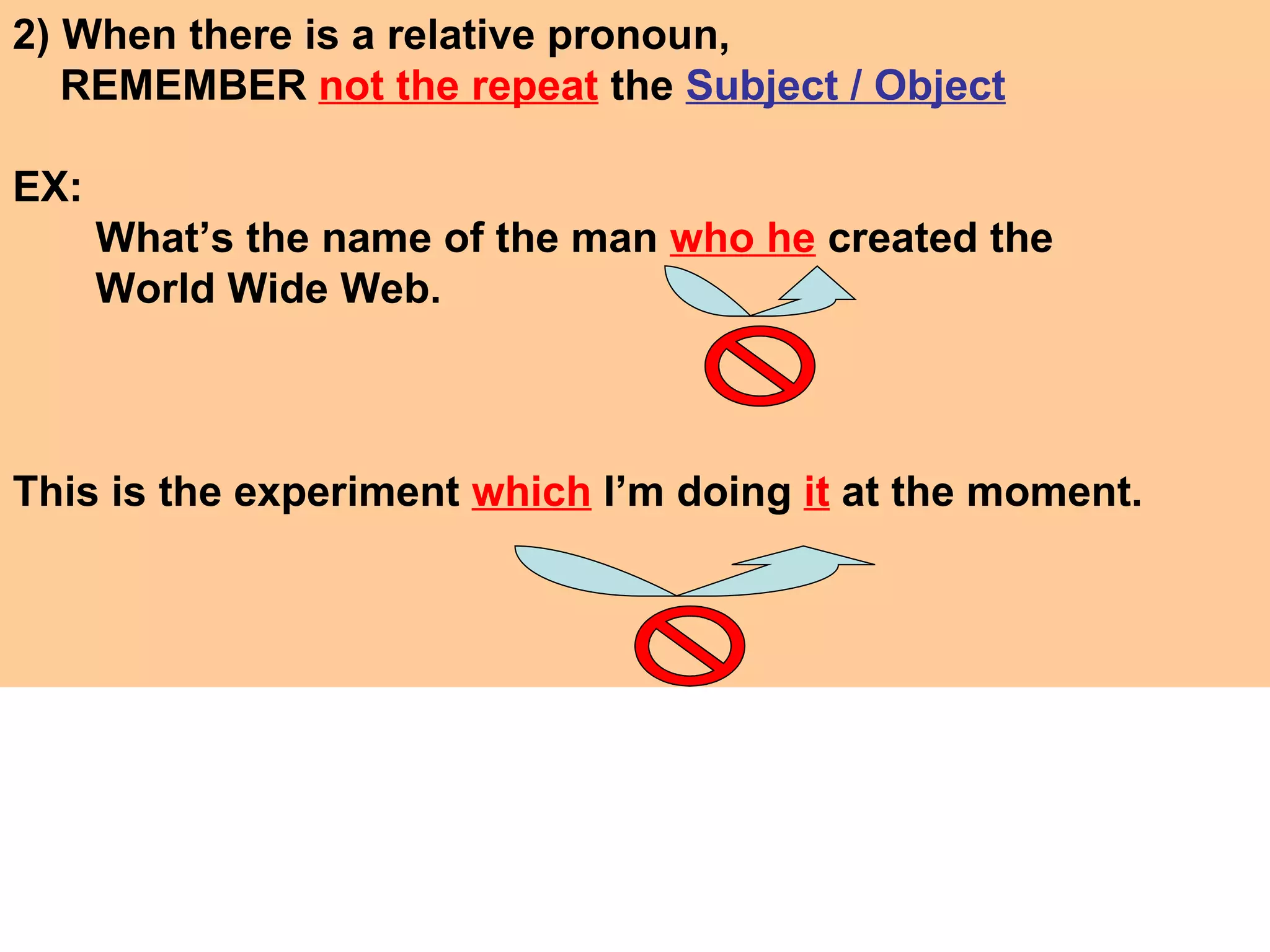
2) When there is a relative pronoun,  REMEMBER  not the repeat  the  Subject / Object EX:  What’s the name of the man  who he  created the  World Wide Web. This is the experiment  which  I’m doing  it  at the moment.
That ,  Who ,  Which  can be the  Subjet  of the Relative clause, like this   SUBJECT I talked to girl  who   won.   The   girl   won That is the dog  that   attacked me. The dog   attacked me. There is no other pronoun (e. g. it, they): Note:That is the dog it attacked me.
That ,  Who  OR  Which  can be the  OBJECT  of the relative clause, like this : OBJECT The card  which  Tom sent was nice. Tom sent  the card. The man  that  I saw was very rude. I  saw  the man. There is no other pronoun (e.g. him, them): Note: The man I saw him was very rude. When  That  ,  Who   OR  Which  is the OBJECT of the relative clause (e.g. The card which Tom sent ,)  WE CAN LEAVE THEM OUT.(OMMIT)
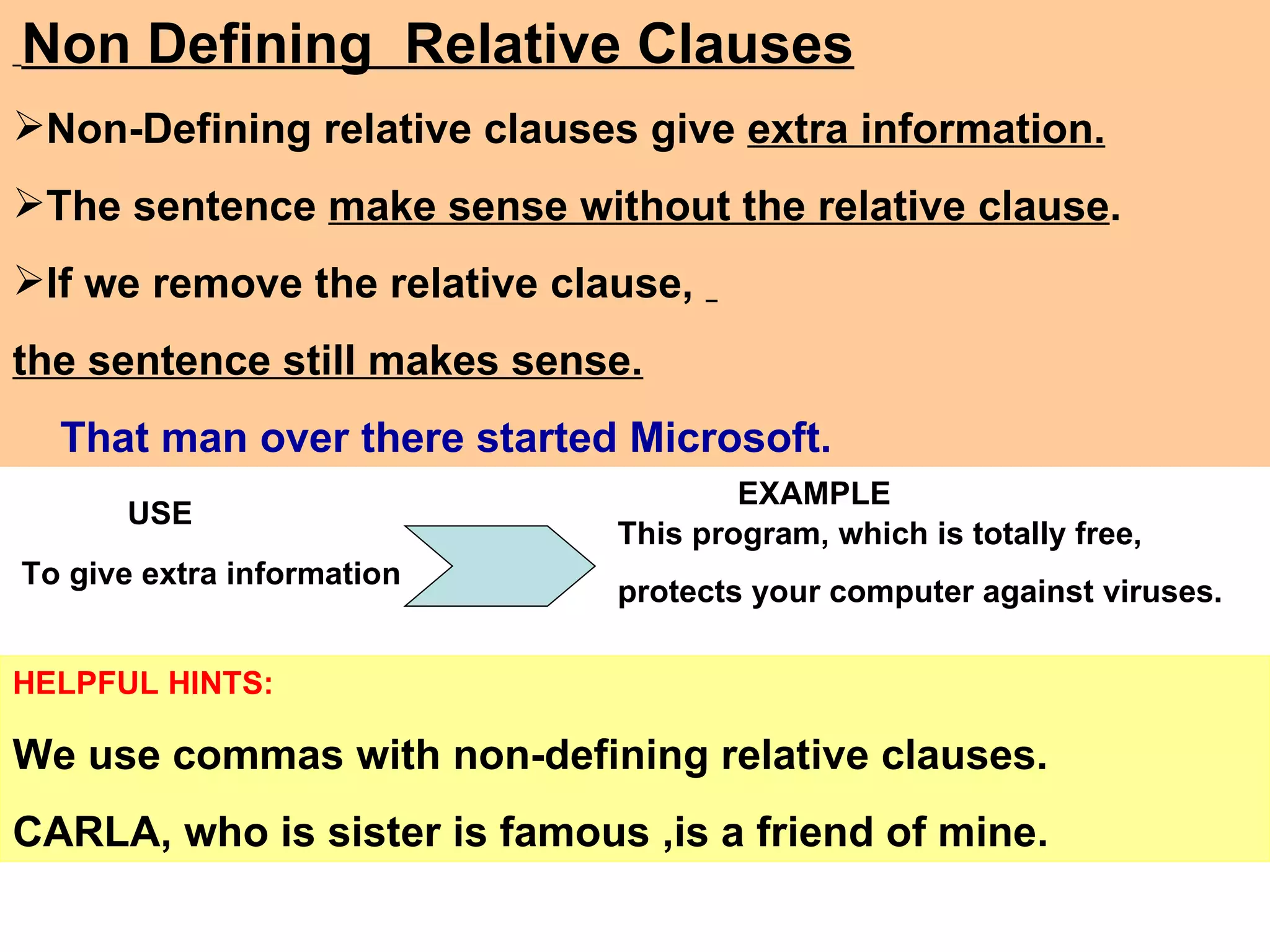
Non Defining  Relative Clauses Non-Defining relative clauses give  extra information. The sentence  make sense without the relative clause . If we remove the relative clause,  the sentence still makes sense. That man over there started Microsoft. To give extra information This program, which is totally free,  protects your computer against viruses. EXAMPLE USE HELPFUL HINTS: We use commas with non-defining relative clauses. CARLA, who is sister is famous ,is a friend of mine.
DEFINING RELATIVE CLAUSES Defining relative clauses give very important information. If we remove a defining relative clause,  the sentence doesn’t make sense.
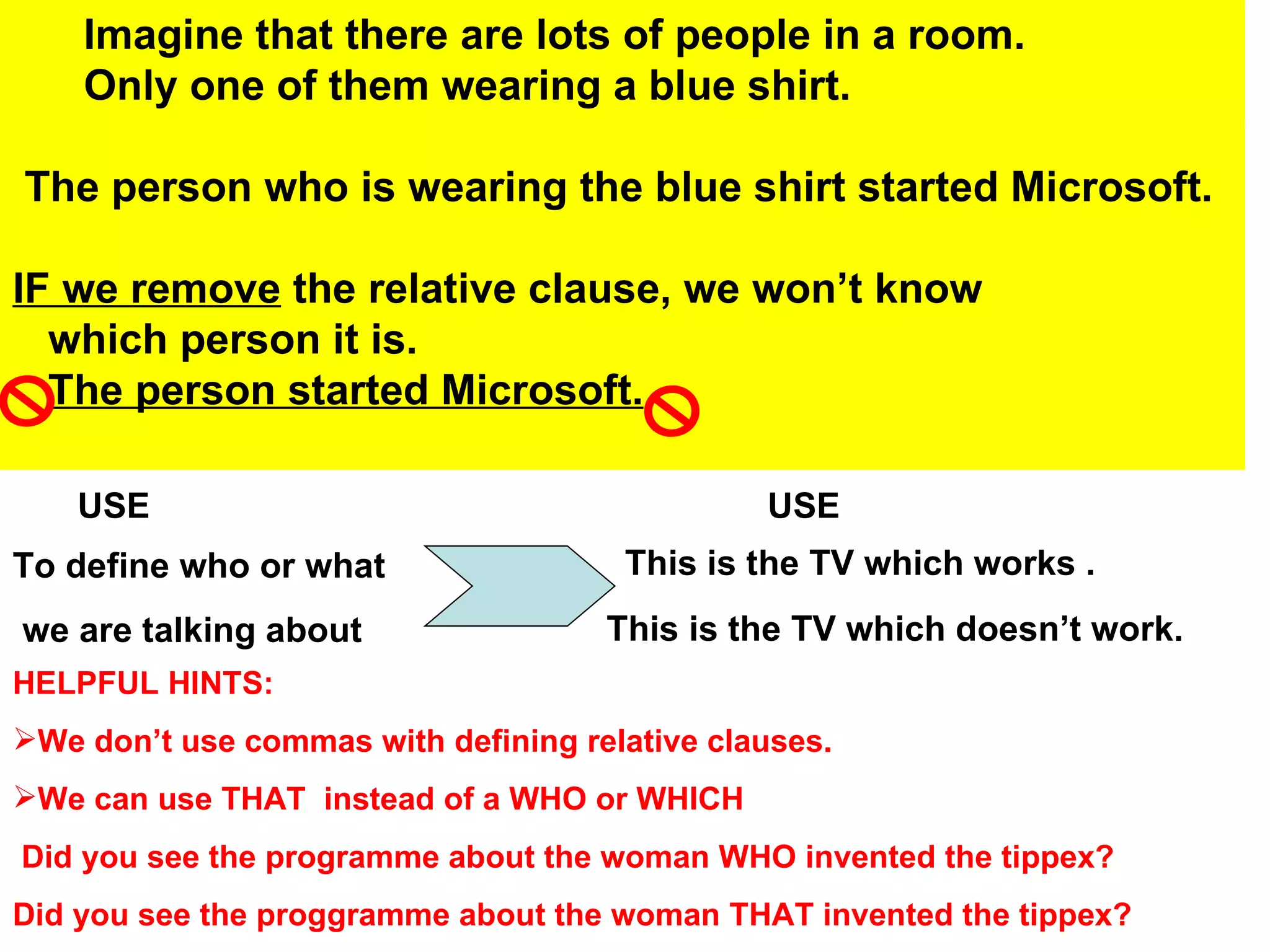
Imagine that there are lots of people in a room. Only one of them wearing a blue shirt. The person who is wearing the blue shirt started Microsoft. IF we remove  the relative clause, we won’t know  which person it is. The person started Microsoft. USE USE To define who or what we are talking about This is the TV which works . This is the TV which doesn’t work. HELPFUL HINTS: We don’t use commas with defining relative clauses. We can use THAT  instead of a WHO or WHICH Did you see the programme about the woman WHO invented the tippex? Did you see the proggramme about the woman THAT invented the tippex?

Relative pronouns

  • 1.
    Who , links the relative clause (who disappeared last week) to main clause (The police have found the boy.) That man over there is called Bill Gates, he started Microsoft. That man over there , who is called Bill Gates , started Microsoft. RELATIVE PRONOUNS We use relative pronouns in relative clauses. We use relative clauses to give more information about something, without having to start a new sentence. The police have found the boy. (which boy? is not clear.) The police have found the boy who disappeared last week.
  • 2.
    Use Example Who for people What’s the name of the man who created the internet? Which for things The experiment which worked was the last one. and animals Where fo r places This is the town where Albert Einstein was born. Whose to show possession That’s the man whose sister discovered a new planet. Susan is the woman whose husband is an actor. ( Susan’s husband is an actor.)( Her husband is an actor.) THAT
  • 3.
    NOTE: We canuse Who for animals when we give them personality . Our dog , who’s called Benji, is six months old.
  • 4.
    2) When thereis a relative pronoun, REMEMBER not the repeat the Subject / Object EX: What’s the name of the man who he created the World Wide Web. This is the experiment which I’m doing it at the moment.
  • 5.
    That , Who , Which can be the Subjet of the Relative clause, like this SUBJECT I talked to girl who won. The girl won That is the dog that attacked me. The dog attacked me. There is no other pronoun (e. g. it, they): Note:That is the dog it attacked me.
  • 6.
    That , Who OR Which can be the OBJECT of the relative clause, like this : OBJECT The card which Tom sent was nice. Tom sent the card. The man that I saw was very rude. I saw the man. There is no other pronoun (e.g. him, them): Note: The man I saw him was very rude. When That , Who OR Which is the OBJECT of the relative clause (e.g. The card which Tom sent ,) WE CAN LEAVE THEM OUT.(OMMIT)
  • 7.
    Non Defining Relative Clauses Non-Defining relative clauses give extra information. The sentence make sense without the relative clause . If we remove the relative clause, the sentence still makes sense. That man over there started Microsoft. To give extra information This program, which is totally free, protects your computer against viruses. EXAMPLE USE HELPFUL HINTS: We use commas with non-defining relative clauses. CARLA, who is sister is famous ,is a friend of mine.
  • 8.
    DEFINING RELATIVE CLAUSESDefining relative clauses give very important information. If we remove a defining relative clause, the sentence doesn’t make sense.
  • 9.
    Imagine that thereare lots of people in a room. Only one of them wearing a blue shirt. The person who is wearing the blue shirt started Microsoft. IF we remove the relative clause, we won’t know which person it is. The person started Microsoft. USE USE To define who or what we are talking about This is the TV which works . This is the TV which doesn’t work. HELPFUL HINTS: We don’t use commas with defining relative clauses. We can use THAT instead of a WHO or WHICH Did you see the programme about the woman WHO invented the tippex? Did you see the proggramme about the woman THAT invented the tippex?