RELATIVE PRONOUNS REL A TIVE CLAUSES
Relative pronouns are: Who  (whom, whose) which that where when why …… .. NOT what!
We use  who –  for people which –  for things The book is about a girl  who   runs away from home. Where is the cheese  which  was in the fridge?
In informal language we can use  that  instead of  who / which The book is about a girl  that  runs away from home. Where is the cheese  that  was in the fridge?
In some cases we can leave out  that The job  (that)  he got wasn`t very interesting. A woman ( whom/that)  my sister knows has just bought the house next door.
We can`t leave out  who ,  which ,   what in relative clauses with extra information that is important Dorothy ,  who  does my hair,  has just had a baby. I lent him “The Old Man and The Sea” , which  is really easy to read. NB!  Here we can`t use   that .
Whose We say  whose  for possession (‘of who’) We only use  whose  after people to refer to things that are theirs I know t he  boy   whose   goal is to fold origami. We  cannot  omit  whose !
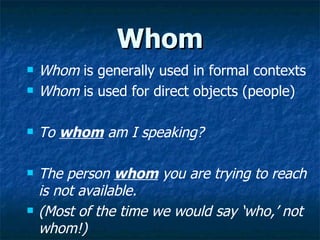
Whom Whom  is generally used in formal contexts Whom  is used for direct objects (people) To   whom  am I speaking? The person  whom  you are trying to reach is not available. (Most of the time we would say ‘who,’ not whom!)
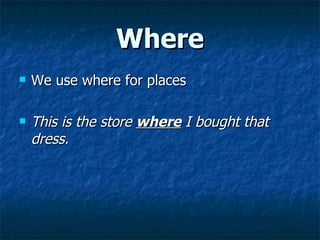
Where We use where for places This is the store  where  I bought that dress.
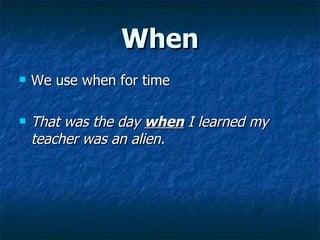
When We use when for time That was the day  when  I learned my teacher was an alien.
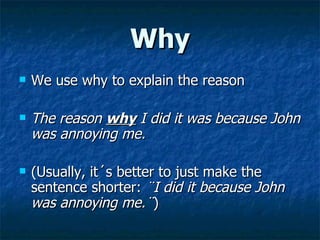
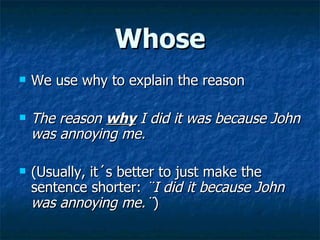
Why We use why to explain the reason The reason  why  I did it was because John was annoying me. (Usually, it´s better to just make the sentence shorter:  ¨I did it because John was annoying me.¨ )
Whose We use why to explain the reason The reason  why  I did it was because John was annoying me. (Usually, it´s better to just make the sentence shorter:  ¨I did it because John was annoying me.¨ )
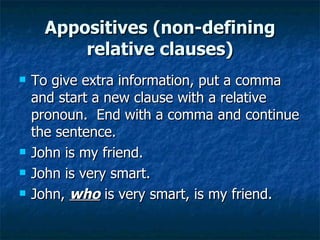
Appositives (non-defining relative clauses) To give extra information, put a comma and start a new clause with a relative pronoun.  End with a comma and continue the sentence. John is my friend. John is very smart. John,  who  is very smart, is my friend.
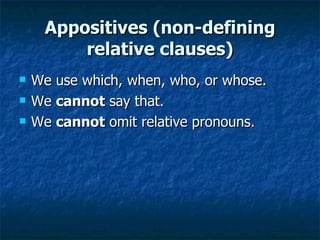
Appositives (non-defining relative clauses) We use which, when, who, or whose.  We  cannot  say that. We  cannot  omit relative pronouns.

Relative Pronouns

  • 1.
    RELATIVE PRONOUNS RELA TIVE CLAUSES
  • 2.
    Relative pronouns are:Who (whom, whose) which that where when why …… .. NOT what!
  • 3.
    We use who – for people which – for things The book is about a girl who runs away from home. Where is the cheese which was in the fridge?
  • 4.
    In informal languagewe can use that instead of who / which The book is about a girl that runs away from home. Where is the cheese that was in the fridge?
  • 5.
    In some caseswe can leave out that The job (that) he got wasn`t very interesting. A woman ( whom/that) my sister knows has just bought the house next door.
  • 6.
    We can`t leaveout who , which , what in relative clauses with extra information that is important Dorothy , who does my hair, has just had a baby. I lent him “The Old Man and The Sea” , which is really easy to read. NB! Here we can`t use that .
  • 7.
    Whose We say whose for possession (‘of who’) We only use whose after people to refer to things that are theirs I know t he boy whose goal is to fold origami. We cannot omit whose !
  • 8.
    Whom Whom is generally used in formal contexts Whom is used for direct objects (people) To whom am I speaking? The person whom you are trying to reach is not available. (Most of the time we would say ‘who,’ not whom!)
  • 9.
    Where We usewhere for places This is the store where I bought that dress.
  • 10.
    When We usewhen for time That was the day when I learned my teacher was an alien.
  • 11.
    Why We usewhy to explain the reason The reason why I did it was because John was annoying me. (Usually, it´s better to just make the sentence shorter: ¨I did it because John was annoying me.¨ )
  • 12.
    Whose We usewhy to explain the reason The reason why I did it was because John was annoying me. (Usually, it´s better to just make the sentence shorter: ¨I did it because John was annoying me.¨ )
  • 13.
    Appositives (non-defining relativeclauses) To give extra information, put a comma and start a new clause with a relative pronoun. End with a comma and continue the sentence. John is my friend. John is very smart. John, who is very smart, is my friend.
  • 14.
    Appositives (non-defining relativeclauses) We use which, when, who, or whose. We cannot say that. We cannot omit relative pronouns.