UNIT 4:SPECIAL
RELATIONSHIPS
Relative clause
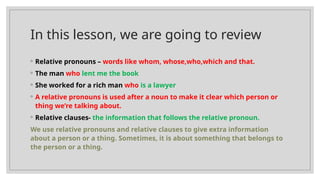
In this lesson, we are going to review
◦ Relative pronouns – words like whom, whose,who,which and that.
◦ The man who lent me the book
◦ She worked for a rich man who is a lawyer
◦ A relative pronouns is used after a noun to make it clear which person or
thing we’re talking about.
◦ Relative clauses- the information that follows the relative pronoun.
We use relative pronouns and relative clauses to give extra information
about a person or a thing. Sometimes, it is about something that belongs to
the person or a thing.
What is a
clause?
◦ A clause is a group of words that contains a verb (and
usually other components too). A clause may form part
of a sentence or it may be a complete sentence in itself.
For example:
◦ He was eating a bacon sandwich.
◦ [clause]
◦ Main clause
◦ Every sentence contains at least one main clause. A main
clause may form part of a compound sentence or a
complex sentence, but it also makes sense on its own,
as in this example:
What is a
clause?
◦ Subordinate clause
◦ A subordinate clause depends on a main clause for its
meaning. Together with a main clause, a subordinate
clause forms part of a complex sentence. Here is an
example of sentence containing subordinate clauses:
◦ After we had lunch,we went back to work.
◦ [subordinate clause] [main clause]
◦ In short, a clause is a part of a sentence or it can be a
complete sentence in itself.
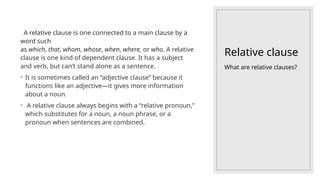
Relative clause
A relative clause is one connected to a main clause by a
word such
as which, that, whom, whose, when, where, or who. A relative
clause is one kind of dependent clause. It has a subject
and verb, but can’t stand alone as a sentence.
◦ It is sometimes called an “adjective clause” because it
functions like an adjective—it gives more information
about a noun.
◦ A relative clause always begins with a “relative pronoun,”
which substitutes for a noun, a noun phrase, or a
pronoun when sentences are combined.
What are relative clauses?
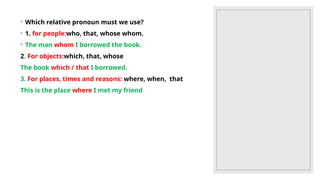
◦ Which relative pronoun must we use?
◦ 1. for people:who, that, whose whom.
◦ The man whom I borrowed the book.
2. For objects:which, that, whose
The book which / that I borrowed.
3. For places, times and reasons: where, when, that
This is the place where I met my friend
Relative clause
◦ Relative clauses
◦ A relative clause can be used to give additional
information about a noun.
◦ They are introduced by a relative pronoun like 'that',
'which', 'who', 'whose', 'where' and 'when'. We can use
relative clauses to join two English sentences, or to give
more information about something.
◦ I bought a new car. It is very fast.
◦ → I bought a new car that is very fast.
◦ She lives in Kuala Lumpur. She likes living in Kuala
Lumpur.
◦ → She lives in Kuala Lumpur, which she likes.
What are relative clauses?
Relative clause
◦ There are two types of relative clauses.
◦ Defining and Non-defining
◦ A defining relative clause tells which noun we are
talking about:
• I like the woman who lives next door.
(If I don't say 'who lives next door', then we don't know
which woman I mean).
◦ A non-defining relative clause gives us extra
information about something. We don't need this
information to understand the sentence.
• I live in Taiping, which has some fantastic parks.
(Everybody knows where Taiping is, so 'which has some
fantastic parks' is extra information).
Defining and Non-
defining
Relative clause
◦ Defining relative clauses:
◦ 1: The relative pronoun is the subject:
◦ First, let's consider when the relative pronoun is the
subject of a defining relative clause.
◦ We can use 'who', 'which' or 'that'. We use 'who' for
people and 'which' for things. We can use 'that' for
people or things.
◦ The relative clause can come after the subject or the
object of the sentence. We can't drop the relative
pronoun.
◦ For example (clause after the object of the sentence):
• I'm looking for a secretary who / that can use a computer
well.
• She has a son who / that is a doctor.
• We bought a house which / that is 200 years old.
• I sent a letter which / that arrived three weeks later.
Defining relative clauses
Relative clause
◦ More examples (clause after the subject of the sentence):
• The people who / that live on the island are very friendly.
• The man who / that phoned is my brother.
• The camera which / that costs RM100 is over there.
• The house which / that belongs to Hafiz is in Perak. Defining relative clauses
Relative clause
◦ Add the phrase in brackets to the sentence using
'that' or 'who' and a relative clause:
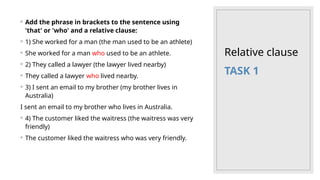
◦ 1) She worked for a man (the man used to be an athlete)
◦ She worked for a man who used to be an athlete.
◦ 2) They called a lawyer (the lawyer lived nearby)
◦ They called a lawyer who lived nearby.
◦ 3) I sent an email to my brother (my brother lives in
Australia)
I sent an email to my brother who lives in Australia.
◦ 4) The customer liked the waitress (the waitress was very
friendly)
◦ The customer liked the waitress who was very friendly.
TASK 1
Relative clause
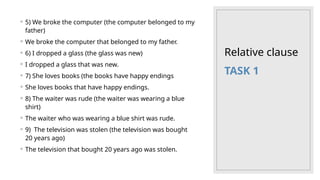
◦ 5) We broke the computer (the computer belonged to my
father)
◦ We broke the computer that belonged to my father.
◦ 6) I dropped a glass (the glass was new)
◦ I dropped a glass that was new.
◦ 7) She loves books (the books have happy endings
◦ She loves books that have happy endings.
◦ 8) The waiter was rude (the waiter was wearing a blue
shirt)
◦ The waiter who was wearing a blue shirt was rude.
◦ 9) The television was stolen (the television was bought
20 years ago)
◦ The television that bought 20 years ago was stolen.
TASK 1
Relative clause
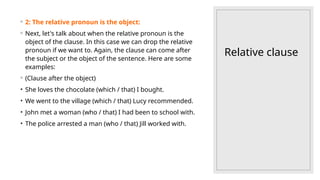
◦ 2: The relative pronoun is the object:
◦ Next, let's talk about when the relative pronoun is the
object of the clause. In this case we can drop the relative
pronoun if we want to. Again, the clause can come after
the subject or the object of the sentence. Here are some
examples:
◦ (Clause after the object)
• She loves the chocolate (which / that) I bought.
• We went to the village (which / that) Lucy recommended.
• John met a woman (who / that) I had been to school with.
• The police arrested a man (who / that) Jill worked with.
Relative clause
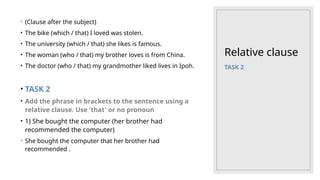
◦ (Clause after the subject)
• The bike (which / that) I loved was stolen.
• The university (which / that) she likes is famous.
• The woman (who / that) my brother loves is from China.
• The doctor (who / that) my grandmother liked lives in Ipoh.
• TASK 2
• Add the phrase in brackets to the sentence using a
relative clause. Use 'that' or no pronoun
• 1) She bought the computer (her brother had
recommended the computer)
◦ She bought the computer that her brother had
recommended .
TASK 2
Relative clause
◦ 2) He lost the money (I had given him the money)
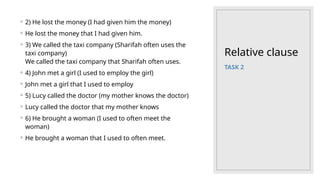
◦ He lost the money that I had given him.
◦ 3) We called the taxi company (Sharifah often uses the
taxi company)
We called the taxi company that Sharifah often uses.
◦ 4) John met a girl (I used to employ the girl)
◦ John met a girl that I used to employ
◦ 5) Lucy called the doctor (my mother knows the doctor)
◦ Lucy called the doctor that my mother knows
◦ 6) He brought a woman (I used to often meet the
woman)
◦ He brought a woman that I used to often meet.
TASK 2
Relative clause
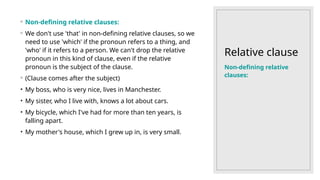
◦ Non-defining relative clauses:
◦ We don't use 'that' in non-defining relative clauses, so we
need to use 'which' if the pronoun refers to a thing, and
'who' if it refers to a person. We can't drop the relative
pronoun in this kind of clause, even if the relative
pronoun is the subject of the clause.
◦ (Clause comes after the subject)
• My boss, who is very nice, lives in Manchester.
• My sister, who I live with, knows a lot about cars.
• My bicycle, which I've had for more than ten years, is
falling apart.
• My mother's house, which I grew up in, is very small.
Non-defining relative
clauses:
Relative clause
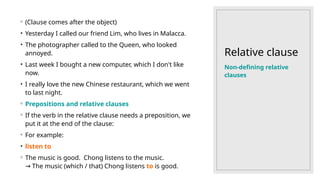
◦ (Clause comes after the object)
• Yesterday I called our friend Lim, who lives in Malacca.
• The photographer called to the Queen, who looked
annoyed.
• Last week I bought a new computer, which I don't like
now.
• I really love the new Chinese restaurant, which we went
to last night.
◦ Prepositions and relative clauses
◦ If the verb in the relative clause needs a preposition, we
put it at the end of the clause:
◦ For example:
• listen to
◦ The music is good. Chong listens to the music.
The music (which / that) Chong listens
→ to is good.
Non-defining relative
clauses
Relative clause
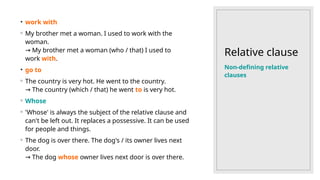
• work with
◦ My brother met a woman. I used to work with the
woman.
My brother met a woman (who / that) I used to
→
work with.
• go to
◦ The country is very hot. He went to the country.
The country (which / that) he went
→ to is very hot.
◦ Whose
◦ 'Whose' is always the subject of the relative clause and
can't be left out. It replaces a possessive. It can be used
for people and things.
◦ The dog is over there. The dog's / its owner lives next
door.
The dog
→ whose owner lives next door is over there.
Non-defining relative
clauses
Relative clause
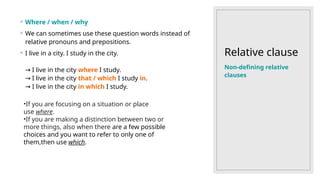
◦ Where / when / why
◦ We can sometimes use these question words instead of
relative pronouns and prepositions.
◦ I live in a city. I study in the city.
I live in the city
→ where I study.
I live in the city
→ that / which I study in.
I live in the city
→ in which I study.
Non-defining relative
clauses
•If you are focusing on a situation or place
use where.
•If you are making a distinction between two or
more things, also when there are a few possible
choices and you want to refer to only one of
them,then use which.
Writing
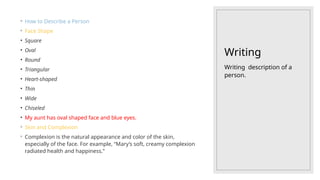
◦ How to Describe a Person
◦ Face Shape
• Square
• Oval
• Round
• Triangular
• Heart-shaped
• Thin
• Wide
• Chiseled
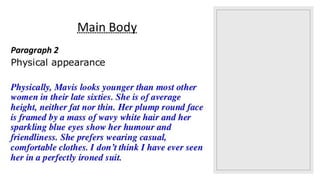
• My aunt has oval shaped face and blue eyes.
◦ Skin and Complexion
◦ Complexion is the natural appearance and color of the skin,
especially of the face. For example, “Mary’s soft, creamy complexion
radiated health and happiness.”
Writing description of a
person.
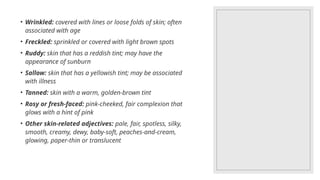
• Wrinkled: covered with lines or loose folds of skin; often
associated with age
• Freckled: sprinkled or covered with light brown spots
• Ruddy: skin that has a reddish tint; may have the
appearance of sunburn
• Sallow: skin that has a yellowish tint; may be associated
with illness
• Tanned: skin with a warm, golden-brown tint
• Rosy or fresh-faced: pink-cheeked, fair complexion that
glows with a hint of pink
• Other skin-related adjectives: pale, fair, spotless, silky,
smooth, creamy, dewy, baby-soft, peaches-and-cream,
glowing, paper-thin or translucent
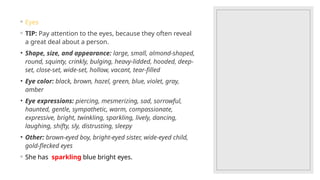
◦ Eyes
◦ TIP: Pay attention to the eyes, because they often reveal
a great deal about a person.
• Shape, size, and appearance: large, small, almond-shaped,
round, squinty, crinkly, bulging, heavy-lidded, hooded, deep-
set, close-set, wide-set, hollow, vacant, tear-filled
• Eye color: black, brown, hazel, green, blue, violet, gray,
amber
• Eye expressions: piercing, mesmerizing, sad, sorrowful,
haunted, gentle, sympathetic, warm, compassionate,
expressive, bright, twinkling, sparkling, lively, dancing,
laughing, shifty, sly, distrusting, sleepy
• Other: brown-eyed boy, bright-eyed sister, wide-eyed child,
gold-flecked eyes
◦ She has sparkling blue bright eyes.
◦ Mouth and Lips
• Lip shape and size: thin, full, pouting, rosebud (baby’s lips,
often), pursed (puckered up, as when concentrating)
• Mouth expressions: laugh, smile, beam, grin, frown, grimace,
scowl, sneer, curl, pout
• Adjectives describing the mouth or mouth
expressions: toothy, toothless, gap-toothed, kind, sweet,
dimpled, relaxed, firm, serious, cruel, snarling
◦ Hair
• Hair color: black, brunette, brown, chestnut-brown, blond,
honey-blond, golden-blond, ash-blond, fair, towhead, corn silk,
auburn, red, strawberry-blond, gray, silver, white, salt-and-
pepper
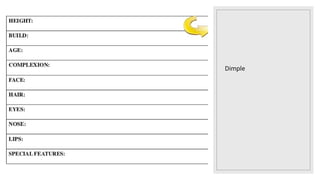
Mole,dimple
• Texture or appearance: wispy, fuzzy, wavy, curly, kinky, frizzy,
wild, untamed, unmanageable, straight, spiky, stiff, buzzed,
shaved, trimmed, parted, neatly-combed, tamed, cascading,
long, short, cropped, dull, shiny
• Hair styles: braids, ponytail, pigtails, bun, messy bun, twist,
bob, ringlets, flip, cornrows, extensions, bangs, buzz, layered,
feathered, chopped, gelled, spiked, slicked down
• Lots of hair: thick, full, lustrous, bushy, coarse, wiry, stiff
• Little hair: thin, scraggly, fine, baby-fine, downy, wispy, limp,
flat, balding, bald, bald spot, receding (gradual loss of hair at
the front of the head)
• Treated hair: permed, dyed, bleached, highlighted, weaved,
streaked, colored, ombre
◦ Body
◦ TIP: Choose strong verbs and adjectives, since they help
flesh out description.
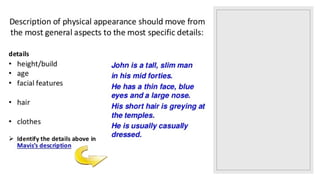
• Build: small, slim, slight, thin, lean, willowy, skinny, angular,
bony, fine-boned, chunky, chubby, large, portly, plump, round,
stout, pudgy, full-figured, ample, broad-shouldered, burly, solid,
muscular
• Posture: stand, sit, slouch, flop, lean, recline, rest, reach,
stretch, sprawl, curl up, roost, squirm, arch, slump, stoop, bend,
hunch, scoot, walk, run, race, jog, skip
◦ Clothing
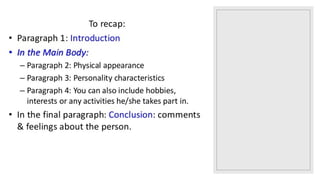
◦ • A descriptive composition about a person
◦ should consist of:
◦ – An introduction
◦ – A main body
◦ – A conclusion
◦
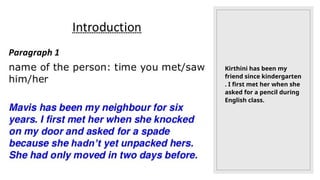
Kirthini has been my
friend since kindergarten
. I first met her when she
asked for a pencil during
English class.
Dimple
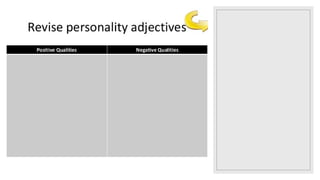
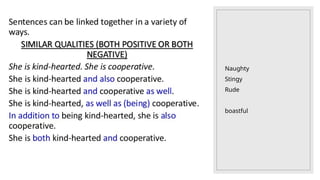
Naughty
Stingy
Rude
boastful
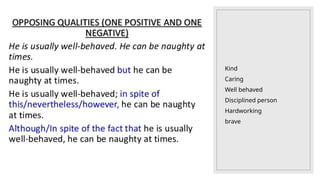
Kind
Caring
Well behaved
Disciplined person
Hardworking
brave
◦To be continued…..
Next, Writing description of
a person.

Unit 2 Relative clauses.pptx Grammar lesson Form 4

  • 1.
  • 2.
    In this lesson,we are going to review ◦ Relative pronouns – words like whom, whose,who,which and that. ◦ The man who lent me the book ◦ She worked for a rich man who is a lawyer ◦ A relative pronouns is used after a noun to make it clear which person or thing we’re talking about. ◦ Relative clauses- the information that follows the relative pronoun. We use relative pronouns and relative clauses to give extra information about a person or a thing. Sometimes, it is about something that belongs to the person or a thing.
  • 3.
    What is a clause? ◦A clause is a group of words that contains a verb (and usually other components too). A clause may form part of a sentence or it may be a complete sentence in itself. For example: ◦ He was eating a bacon sandwich. ◦ [clause] ◦ Main clause ◦ Every sentence contains at least one main clause. A main clause may form part of a compound sentence or a complex sentence, but it also makes sense on its own, as in this example:
  • 4.
    What is a clause? ◦Subordinate clause ◦ A subordinate clause depends on a main clause for its meaning. Together with a main clause, a subordinate clause forms part of a complex sentence. Here is an example of sentence containing subordinate clauses: ◦ After we had lunch,we went back to work. ◦ [subordinate clause] [main clause] ◦ In short, a clause is a part of a sentence or it can be a complete sentence in itself.
  • 5.
    Relative clause A relativeclause is one connected to a main clause by a word such as which, that, whom, whose, when, where, or who. A relative clause is one kind of dependent clause. It has a subject and verb, but can’t stand alone as a sentence. ◦ It is sometimes called an “adjective clause” because it functions like an adjective—it gives more information about a noun. ◦ A relative clause always begins with a “relative pronoun,” which substitutes for a noun, a noun phrase, or a pronoun when sentences are combined. What are relative clauses?
  • 6.
    ◦ Which relativepronoun must we use? ◦ 1. for people:who, that, whose whom. ◦ The man whom I borrowed the book. 2. For objects:which, that, whose The book which / that I borrowed. 3. For places, times and reasons: where, when, that This is the place where I met my friend
  • 7.
    Relative clause ◦ Relativeclauses ◦ A relative clause can be used to give additional information about a noun. ◦ They are introduced by a relative pronoun like 'that', 'which', 'who', 'whose', 'where' and 'when'. We can use relative clauses to join two English sentences, or to give more information about something. ◦ I bought a new car. It is very fast. ◦ → I bought a new car that is very fast. ◦ She lives in Kuala Lumpur. She likes living in Kuala Lumpur. ◦ → She lives in Kuala Lumpur, which she likes. What are relative clauses?
  • 8.
    Relative clause ◦ Thereare two types of relative clauses. ◦ Defining and Non-defining ◦ A defining relative clause tells which noun we are talking about: • I like the woman who lives next door. (If I don't say 'who lives next door', then we don't know which woman I mean). ◦ A non-defining relative clause gives us extra information about something. We don't need this information to understand the sentence. • I live in Taiping, which has some fantastic parks. (Everybody knows where Taiping is, so 'which has some fantastic parks' is extra information). Defining and Non- defining
  • 9.
    Relative clause ◦ Definingrelative clauses: ◦ 1: The relative pronoun is the subject: ◦ First, let's consider when the relative pronoun is the subject of a defining relative clause. ◦ We can use 'who', 'which' or 'that'. We use 'who' for people and 'which' for things. We can use 'that' for people or things. ◦ The relative clause can come after the subject or the object of the sentence. We can't drop the relative pronoun. ◦ For example (clause after the object of the sentence): • I'm looking for a secretary who / that can use a computer well. • She has a son who / that is a doctor. • We bought a house which / that is 200 years old. • I sent a letter which / that arrived three weeks later. Defining relative clauses
  • 10.
    Relative clause ◦ Moreexamples (clause after the subject of the sentence): • The people who / that live on the island are very friendly. • The man who / that phoned is my brother. • The camera which / that costs RM100 is over there. • The house which / that belongs to Hafiz is in Perak. Defining relative clauses
  • 11.
    Relative clause ◦ Addthe phrase in brackets to the sentence using 'that' or 'who' and a relative clause: ◦ 1) She worked for a man (the man used to be an athlete) ◦ She worked for a man who used to be an athlete. ◦ 2) They called a lawyer (the lawyer lived nearby) ◦ They called a lawyer who lived nearby. ◦ 3) I sent an email to my brother (my brother lives in Australia) I sent an email to my brother who lives in Australia. ◦ 4) The customer liked the waitress (the waitress was very friendly) ◦ The customer liked the waitress who was very friendly. TASK 1
  • 12.
    Relative clause ◦ 5)We broke the computer (the computer belonged to my father) ◦ We broke the computer that belonged to my father. ◦ 6) I dropped a glass (the glass was new) ◦ I dropped a glass that was new. ◦ 7) She loves books (the books have happy endings ◦ She loves books that have happy endings. ◦ 8) The waiter was rude (the waiter was wearing a blue shirt) ◦ The waiter who was wearing a blue shirt was rude. ◦ 9) The television was stolen (the television was bought 20 years ago) ◦ The television that bought 20 years ago was stolen. TASK 1
  • 13.
    Relative clause ◦ 2:The relative pronoun is the object: ◦ Next, let's talk about when the relative pronoun is the object of the clause. In this case we can drop the relative pronoun if we want to. Again, the clause can come after the subject or the object of the sentence. Here are some examples: ◦ (Clause after the object) • She loves the chocolate (which / that) I bought. • We went to the village (which / that) Lucy recommended. • John met a woman (who / that) I had been to school with. • The police arrested a man (who / that) Jill worked with.
  • 14.
    Relative clause ◦ (Clauseafter the subject) • The bike (which / that) I loved was stolen. • The university (which / that) she likes is famous. • The woman (who / that) my brother loves is from China. • The doctor (who / that) my grandmother liked lives in Ipoh. • TASK 2 • Add the phrase in brackets to the sentence using a relative clause. Use 'that' or no pronoun • 1) She bought the computer (her brother had recommended the computer) ◦ She bought the computer that her brother had recommended . TASK 2
  • 15.
    Relative clause ◦ 2)He lost the money (I had given him the money) ◦ He lost the money that I had given him. ◦ 3) We called the taxi company (Sharifah often uses the taxi company) We called the taxi company that Sharifah often uses. ◦ 4) John met a girl (I used to employ the girl) ◦ John met a girl that I used to employ ◦ 5) Lucy called the doctor (my mother knows the doctor) ◦ Lucy called the doctor that my mother knows ◦ 6) He brought a woman (I used to often meet the woman) ◦ He brought a woman that I used to often meet. TASK 2
  • 16.
    Relative clause ◦ Non-definingrelative clauses: ◦ We don't use 'that' in non-defining relative clauses, so we need to use 'which' if the pronoun refers to a thing, and 'who' if it refers to a person. We can't drop the relative pronoun in this kind of clause, even if the relative pronoun is the subject of the clause. ◦ (Clause comes after the subject) • My boss, who is very nice, lives in Manchester. • My sister, who I live with, knows a lot about cars. • My bicycle, which I've had for more than ten years, is falling apart. • My mother's house, which I grew up in, is very small. Non-defining relative clauses:
  • 17.
    Relative clause ◦ (Clausecomes after the object) • Yesterday I called our friend Lim, who lives in Malacca. • The photographer called to the Queen, who looked annoyed. • Last week I bought a new computer, which I don't like now. • I really love the new Chinese restaurant, which we went to last night. ◦ Prepositions and relative clauses ◦ If the verb in the relative clause needs a preposition, we put it at the end of the clause: ◦ For example: • listen to ◦ The music is good. Chong listens to the music. The music (which / that) Chong listens → to is good. Non-defining relative clauses
  • 18.
    Relative clause • workwith ◦ My brother met a woman. I used to work with the woman. My brother met a woman (who / that) I used to → work with. • go to ◦ The country is very hot. He went to the country. The country (which / that) he went → to is very hot. ◦ Whose ◦ 'Whose' is always the subject of the relative clause and can't be left out. It replaces a possessive. It can be used for people and things. ◦ The dog is over there. The dog's / its owner lives next door. The dog → whose owner lives next door is over there. Non-defining relative clauses
  • 19.
    Relative clause ◦ Where/ when / why ◦ We can sometimes use these question words instead of relative pronouns and prepositions. ◦ I live in a city. I study in the city. I live in the city → where I study. I live in the city → that / which I study in. I live in the city → in which I study. Non-defining relative clauses •If you are focusing on a situation or place use where. •If you are making a distinction between two or more things, also when there are a few possible choices and you want to refer to only one of them,then use which.
  • 20.
    Writing ◦ How toDescribe a Person ◦ Face Shape • Square • Oval • Round • Triangular • Heart-shaped • Thin • Wide • Chiseled • My aunt has oval shaped face and blue eyes. ◦ Skin and Complexion ◦ Complexion is the natural appearance and color of the skin, especially of the face. For example, “Mary’s soft, creamy complexion radiated health and happiness.” Writing description of a person.
  • 21.
    • Wrinkled: coveredwith lines or loose folds of skin; often associated with age • Freckled: sprinkled or covered with light brown spots • Ruddy: skin that has a reddish tint; may have the appearance of sunburn • Sallow: skin that has a yellowish tint; may be associated with illness • Tanned: skin with a warm, golden-brown tint • Rosy or fresh-faced: pink-cheeked, fair complexion that glows with a hint of pink • Other skin-related adjectives: pale, fair, spotless, silky, smooth, creamy, dewy, baby-soft, peaches-and-cream, glowing, paper-thin or translucent
  • 22.
    ◦ Eyes ◦ TIP:Pay attention to the eyes, because they often reveal a great deal about a person. • Shape, size, and appearance: large, small, almond-shaped, round, squinty, crinkly, bulging, heavy-lidded, hooded, deep- set, close-set, wide-set, hollow, vacant, tear-filled • Eye color: black, brown, hazel, green, blue, violet, gray, amber • Eye expressions: piercing, mesmerizing, sad, sorrowful, haunted, gentle, sympathetic, warm, compassionate, expressive, bright, twinkling, sparkling, lively, dancing, laughing, shifty, sly, distrusting, sleepy • Other: brown-eyed boy, bright-eyed sister, wide-eyed child, gold-flecked eyes ◦ She has sparkling blue bright eyes.
  • 23.
    ◦ Mouth andLips • Lip shape and size: thin, full, pouting, rosebud (baby’s lips, often), pursed (puckered up, as when concentrating) • Mouth expressions: laugh, smile, beam, grin, frown, grimace, scowl, sneer, curl, pout • Adjectives describing the mouth or mouth expressions: toothy, toothless, gap-toothed, kind, sweet, dimpled, relaxed, firm, serious, cruel, snarling ◦ Hair • Hair color: black, brunette, brown, chestnut-brown, blond, honey-blond, golden-blond, ash-blond, fair, towhead, corn silk, auburn, red, strawberry-blond, gray, silver, white, salt-and- pepper Mole,dimple
  • 24.
    • Texture orappearance: wispy, fuzzy, wavy, curly, kinky, frizzy, wild, untamed, unmanageable, straight, spiky, stiff, buzzed, shaved, trimmed, parted, neatly-combed, tamed, cascading, long, short, cropped, dull, shiny • Hair styles: braids, ponytail, pigtails, bun, messy bun, twist, bob, ringlets, flip, cornrows, extensions, bangs, buzz, layered, feathered, chopped, gelled, spiked, slicked down • Lots of hair: thick, full, lustrous, bushy, coarse, wiry, stiff • Little hair: thin, scraggly, fine, baby-fine, downy, wispy, limp, flat, balding, bald, bald spot, receding (gradual loss of hair at the front of the head) • Treated hair: permed, dyed, bleached, highlighted, weaved, streaked, colored, ombre
  • 25.
    ◦ Body ◦ TIP:Choose strong verbs and adjectives, since they help flesh out description. • Build: small, slim, slight, thin, lean, willowy, skinny, angular, bony, fine-boned, chunky, chubby, large, portly, plump, round, stout, pudgy, full-figured, ample, broad-shouldered, burly, solid, muscular • Posture: stand, sit, slouch, flop, lean, recline, rest, reach, stretch, sprawl, curl up, roost, squirm, arch, slump, stoop, bend, hunch, scoot, walk, run, race, jog, skip ◦ Clothing
  • 26.
    ◦ • Adescriptive composition about a person ◦ should consist of: ◦ – An introduction ◦ – A main body ◦ – A conclusion ◦
  • 27.
    Kirthini has beenmy friend since kindergarten . I first met her when she asked for a pencil during English class.
  • 30.
  • 34.
  • 35.
  • 38.
    ◦To be continued….. Next,Writing description of a person.