This document discusses different types of conjunctions. It defines conjunctions as words that connect sentences, clauses, or groups of words. The main types discussed are coordinating conjunctions, subordinating conjunctions, correlative conjunctions, and conjunctive adverbs. Coordinating conjunctions give equal importance to the words or sentences they connect, while subordinating conjunctions introduce subordinate clauses and join them to main clauses. Correlative conjunctions connect two balanced clauses or phrases, and conjunctive adverbs connect two sentences together with added meaning. Examples of each type are provided.
INTRODUCTION OF CONJUNCTION
OBJECTIVES
Identifyclauses and
sentences.
Use coordinating and
correlative conjunctions
correctly.
Use subordinating
conjunctions and
conjunctive adverbs
correctly.
Use correct punctuation in
sentences containing
coordinating, correlative,
or subordinating
conjunctions or
conjunctive adverbs.
3.
WHAT IS IT?
The word “ conjunction” coined from the Latin word
conjungere (join together). conjunctions are words
that link other words, phrases, clauses and
sentences, like peanut butter and jelly.
Key Concept:
Linker or join words
Scotch tape of the grammatical words
Avoiding the text seems like bullet point and to
make the text flow.
4.
CONJUNCTIONS
Conjunctions are wordswhich connect sentences, clauses
or groups of words. Some learners know them as
connectors or joining words.
Sentence
Number of words forming complete statement
I want it!
We enjoy playing cricket
Clause
A part of sentence having its own subject and
predicate.
Like ; Michal has a friend who is rich.
she’s crying because you were unkind.
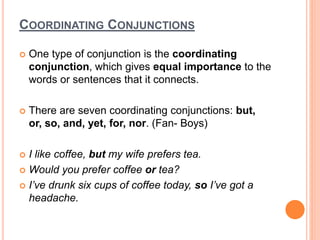
COORDINATING CONJUNCTIONS
Onetype of conjunction is the coordinating
conjunction, which gives equal importance to the
words or sentences that it connects.
There are seven coordinating conjunctions: but,
or, so, and, yet, for, nor. (Fan- Boys)
I like coffee, but my wife prefers tea.
Would you prefer coffee or tea?
I’ve drunk six cups of coffee today, so I’ve got a
headache.
7.
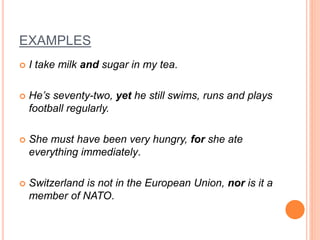
EXAMPLES
I takemilk and sugar in my tea.
He’s seventy-two, yet he still swims, runs and plays
football regularly.
She must have been very hungry, for she ate
everything immediately.
Switzerland is not in the European Union, nor is it a
member of NATO.
8.
FUNCTIONS OF COORDINATINGCONJUNCTIONS
so – for showing the consequence of something
He was very hungry, so he ate all the cake.
but – for contrast
I eat cake, but I never eat biscuits; I don’t like them.
for – for explaining why [more formal and less
common than because]
He’s overweight, for he eats too many cakes and
biscuits.
and – the same, similar or equal; without contrast
His favourite snacks are cakes and biscuits.
9.
EAMPLES
nor –for two non-contrasting grammatically
negative items (not + not)
He doesn’t eat cake, nor does he eat biscuits.
or – before an alternative
Would you like cake or biscuits with your coffee?
yet – contrast, despite something [synonyms
= nevertheless, but still]
He’s overweight and feels terrible, yet he continues
to eat lots of cakes and biscuits.
[He's overweight, but still he continues to eat lots of
cakes and biscuits.]
10.
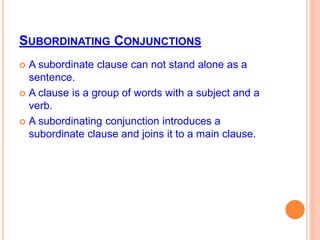
SUBORDINATING CONJUNCTIONS
Asubordinate clause can not stand alone as a
sentence.
A clause is a group of words with a subject and a
verb.
A subordinating conjunction introduces a
subordinate clause and joins it to a main clause.
11.
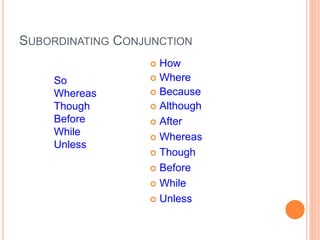
SUBORDINATING CONJUNCTION
How
Where
Because
Although
After
Whereas
Though
Before
While
Unless
So
Whereas
Though
Before
While
Unless
12.
SUBORDINATING CONJUNCTION
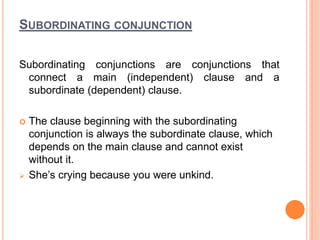
Subordinating conjunctionsare conjunctions that
connect a main (independent) clause and a
subordinate (dependent) clause.
The clause beginning with the subordinating
conjunction is always the subordinate clause, which
depends on the main clause and cannot exist
without it.
She’s crying because you were unkind.
13.
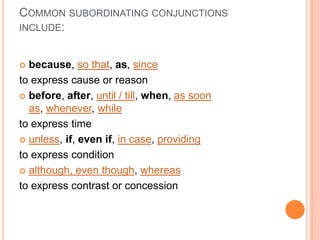
COMMON SUBORDINATING CONJUNCTIONS
INCLUDE:
because, so that, as, since
to express cause or reason
before, after, until / till, when, as soon
as, whenever, while
to express time
unless, if, even if, in case, providing
to express condition
although, even though, whereas
to express contrast or concession
14.
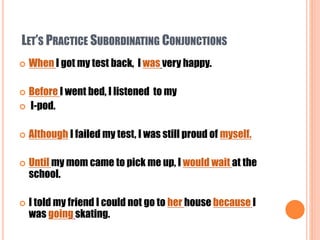
LET’S PRACTICE SUBORDINATINGCONJUNCTIONS
When I got my test back, I was very happy.
Before I went bed, I listened to my
I-pod.
Although I failed my test, I was still proud of myself.
Until my mom came to pick me up, I would wait at the
school.
I told my friend I could not go to her house because I
was going skating.
15.
EXAMPLS
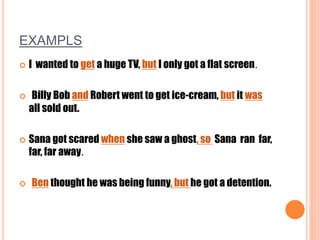
I wantedto get a huge TV, but I only got a flat screen.
Billy Bob and Robert went to get ice-cream, but it was
all sold out.
Sana got scared when she saw a ghost, so Sana ran far,
far, far away.
Ben thought he was being funny, but he got a detention.
16.
EXAMPLE OF SUBORDINATECONJUNCTION
Pete didn’t go to work yesterday because he was
ill. [reason]
As he was feeling unwell, Hafez didn’t go to work
yesterday. [cause, reason; more formal than
because]
I’ll send you a map so that you can find the place
more easily. [reason]
I’ll call you as soon as I get home. [time]
I’ll wait until you arrive. [time]
Did he say anything before he left? [time]
The baby gets very grumpy whenever he’s
tired. [time]
17.
EXAMPLES
If hedoesn’t change his attitude, he’ll lose his
job. [condition]
Even if you win a million dollars, it doesn’t mean you’ll
be happy. [condition]
I’ll lend you my car, providing you promise to be
careful. [condition]
Elliot is tall and blond, whereas his brother is short and
has dark hair. [comparison]
Mark’s very tall, although he’s not as tall as his father
yet. [comparison]
Although they’re poor, they’re happy. [concession]
Even though he’s rich, I’m not sure that he’s
happy. [concession
18.
CORRELATIVE CONJUNCTION
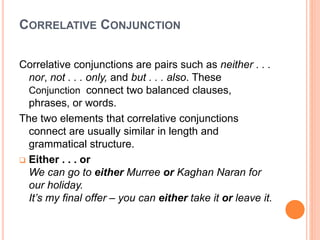
Correlative conjunctionsare pairs such as neither . . .
nor, not . . . only, and but . . . also. These
Conjunction connect two balanced clauses,
phrases, or words.
The two elements that correlative conjunctions
connect are usually similar in length and
grammatical structure.
Either . . . or
We can go to either Murree or Kaghan Naran for
our holiday.
It’s my final offer – you can either take it or leave it.
19.
CORRELATIVE CONJUNCTION
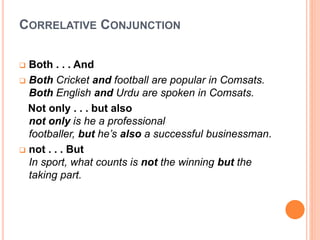
Both. . . And
Both Cricket and football are popular in Comsats.
Both English and Urdu are spoken in Comsats.
Not only . . . but also
not only is he a professional
footballer, but he’s also a successful businessman.
not . . . But
In sport, what counts is not the winning but the
taking part.
20.
EXAMPLES
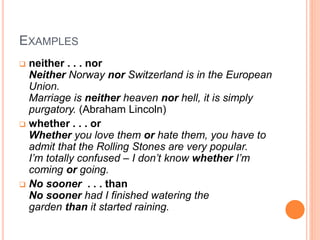
neither .. . nor
Neither Norway nor Switzerland is in the European
Union.
Marriage is neither heaven nor hell, it is simply
purgatory. (Abraham Lincoln)
whether . . . or
Whether you love them or hate them, you have to
admit that the Rolling Stones are very popular.
I’m totally confused – I don’t know whether I’m
coming or going.
No sooner . . . than
No sooner had I finished watering the
garden than it started raining.
21.
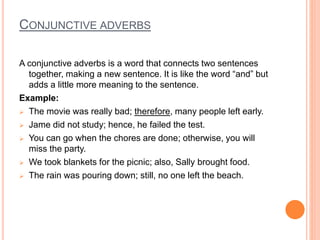
CONJUNCTIVE ADVERBS
A conjunctiveadverbs is a word that connects two sentences
together, making a new sentence. It is like the word “and” but
adds a little more meaning to the sentence.
Example:
The movie was really bad; therefore, many people left early.
Jame did not study; hence, he failed the test.
You can go when the chores are done; otherwise, you will
miss the party.
We took blankets for the picnic; also, Sally brought food.
The rain was pouring down; still, no one left the beach.
22.
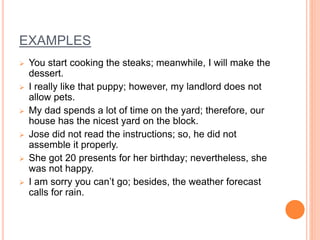
EXAMPLES
You startcooking the steaks; meanwhile, I will make the
dessert.
I really like that puppy; however, my landlord does not
allow pets.
My dad spends a lot of time on the yard; therefore, our
house has the nicest yard on the block.
Jose did not read the instructions; so, he did not
assemble it properly.
She got 20 presents for her birthday; nevertheless, she
was not happy.
I am sorry you can’t go; besides, the weather forecast
calls for rain.