



After completing this material the students
are able to:
Explain the definition of noun and types of
noun
Identify the types of noun in a song text






What is a Noun?
A noun is a word used to name a person,
animal, place, thing, and abstract idea.
Nouns are usually the first words which small
children learn. Example:
Late last year our neighbors bought a goat.
Portia White was an opera singer.


There are many different types of nouns.The
proper noun, the common noun, the
concrete noun, the abstract noun, the
countable noun, the non-countable noun
(also called the mass noun), and the
collective noun. You should note that a noun
will belong to more than one type: it will be
proper or common, abstract or concrete,
and countable or non-countable or
collective.
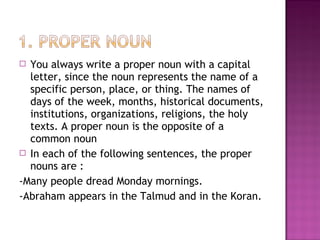
You always write a proper noun with a capital
letter, since the noun represents the name of a
specific person, place, or thing. The names of
days of the week, months, historical documents,
institutions, organizations, religions, the holy
texts. A proper noun is the opposite of a
common noun
 In each of the following sentences, the proper
nouns are :
-Many people dread Monday mornings.
-Abraham appears in the Talmud and in the Koran.

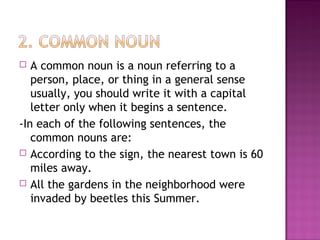
A common noun is a noun referring to a
person, place, or thing in a general sense
usually, you should write it with a capital
letter only when it begins a sentence.
-In each of the following sentences, the
common nouns are:
 According to the sign, the nearest town is 60
miles away.
 All the gardens in the neighborhood were
invaded by beetles this Summer.

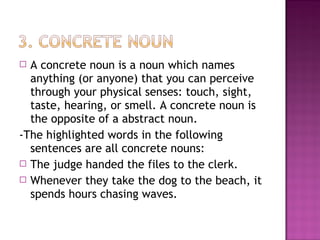
A concrete noun is a noun which names
anything (or anyone) that you can perceive
through your physical senses: touch, sight,
taste, hearing, or smell. A concrete noun is
the opposite of a abstract noun.
-The highlighted words in the following
sentences are all concrete nouns:
 The judge handed the files to the clerk.
 Whenever they take the dog to the beach, it
spends hours chasing waves.








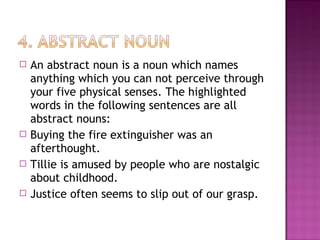
An abstract noun is a noun which names
anything which you can not perceive through
your five physical senses. The highlighted
words in the following sentences are all
abstract nouns:
Buying the fire extinguisher was an
afterthought.
Tillie is amused by people who are nostalgic
about childhood.
Justice often seems to slip out of our grasp.
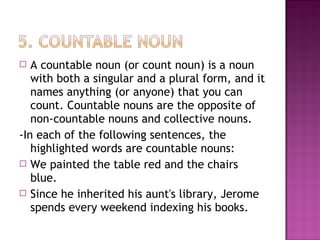
A countable noun (or count noun) is a noun
with both a singular and a plural form, and it
names anything (or anyone) that you can
count. Countable nouns are the opposite of
non-countable nouns and collective nouns.
-In each of the following sentences, the
highlighted words are countable nouns:
 We painted the table red and the chairs
blue.
 Since he inherited his aunt's library, Jerome
spends every weekend indexing his books.

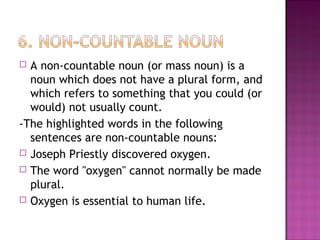
A non-countable noun (or mass noun) is a
noun which does not have a plural form, and
which refers to something that you could (or
would) not usually count.
-The highlighted words in the following
sentences are non-countable nouns:
 Joseph Priestly discovered oxygen.
 The word "oxygen" cannot normally be made
plural.
 Oxygen is essential to human life.



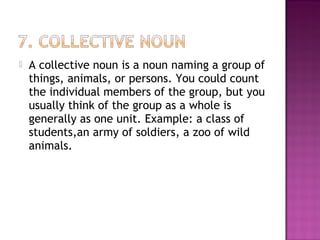
A collective noun is a noun naming a group of
things, animals, or persons. You could count
the individual members of the group, but you
usually think of the group as a whole is
generally as one unit. Example: a class of
students,an army of soldiers, a zoo of wild
animals.









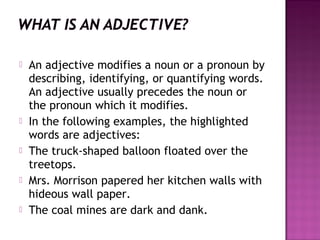
An adjective modifies a noun or a pronoun by
describing, identifying, or quantifying words.
An adjective usually precedes the noun or
the pronoun which it modifies.
In the following examples, the highlighted
words are adjectives:
The truck-shaped balloon floated over the
treetops.
Mrs. Morrison papered her kitchen walls with
hideous wall paper.
The coal mines are dark and dank.




A possessive adjective ("my," "your," "his,"
"her," "its," "our," "their") is similar or
identical to a possessive pronoun; however,
it is used as an adjective and modifies a noun
or a noun phrase, as in the following
sentences:
I can't complete my assignment because I
don't have the textbook.








The demonstrative adjectives "this," "these,"
"that," "those," and "what" are identical to
the demonstrative pronouns, but are used as
adjectives to modify nouns or noun phrases,
as in the following sentences:
When the librarian tripped over that cord,
she dropped a pile of books.
In this sentence, the demonstrative adjective
"that" modifies the noun "cord" and the noun
phrase "that cord" is the object of the
preposition "over."
This apartment needs to be fumigated.







An indefinite adjective is similar to an
indefinite pronoun, except that it modifies a
noun, pronoun, or noun phrase, as in the
following sentences:
Many people believe that corporations are
under-taxed.
The indefinite adjective "many" modifies the
noun "people" and the noun phrase "many
people" is the subject of the sentence.
I will send you any mail that arrives after you
have moved to Sudbury.

Noun and adjective

  • 1.
      After completing thismaterial the students are able to: Explain the definition of noun and types of noun Identify the types of noun in a song text
  • 2.
        What is aNoun? A noun is a word used to name a person, animal, place, thing, and abstract idea. Nouns are usually the first words which small children learn. Example: Late last year our neighbors bought a goat. Portia White was an opera singer.
  • 3.
     There are manydifferent types of nouns.The proper noun, the common noun, the concrete noun, the abstract noun, the countable noun, the non-countable noun (also called the mass noun), and the collective noun. You should note that a noun will belong to more than one type: it will be proper or common, abstract or concrete, and countable or non-countable or collective.
  • 4.
    You always writea proper noun with a capital letter, since the noun represents the name of a specific person, place, or thing. The names of days of the week, months, historical documents, institutions, organizations, religions, the holy texts. A proper noun is the opposite of a common noun  In each of the following sentences, the proper nouns are : -Many people dread Monday mornings. -Abraham appears in the Talmud and in the Koran. 
  • 5.
    A common nounis a noun referring to a person, place, or thing in a general sense usually, you should write it with a capital letter only when it begins a sentence. -In each of the following sentences, the common nouns are:  According to the sign, the nearest town is 60 miles away.  All the gardens in the neighborhood were invaded by beetles this Summer. 
  • 6.
    A concrete nounis a noun which names anything (or anyone) that you can perceive through your physical senses: touch, sight, taste, hearing, or smell. A concrete noun is the opposite of a abstract noun. -The highlighted words in the following sentences are all concrete nouns:  The judge handed the files to the clerk.  Whenever they take the dog to the beach, it spends hours chasing waves. 
  • 7.
        An abstract nounis a noun which names anything which you can not perceive through your five physical senses. The highlighted words in the following sentences are all abstract nouns: Buying the fire extinguisher was an afterthought. Tillie is amused by people who are nostalgic about childhood. Justice often seems to slip out of our grasp.
  • 8.
    A countable noun(or count noun) is a noun with both a singular and a plural form, and it names anything (or anyone) that you can count. Countable nouns are the opposite of non-countable nouns and collective nouns. -In each of the following sentences, the highlighted words are countable nouns:  We painted the table red and the chairs blue.  Since he inherited his aunt's library, Jerome spends every weekend indexing his books. 
  • 9.
    A non-countable noun(or mass noun) is a noun which does not have a plural form, and which refers to something that you could (or would) not usually count. -The highlighted words in the following sentences are non-countable nouns:  Joseph Priestly discovered oxygen.  The word "oxygen" cannot normally be made plural.  Oxygen is essential to human life. 
  • 10.
     A collective nounis a noun naming a group of things, animals, or persons. You could count the individual members of the group, but you usually think of the group as a whole is generally as one unit. Example: a class of students,an army of soldiers, a zoo of wild animals.
  • 11.
         An adjective modifiesa noun or a pronoun by describing, identifying, or quantifying words. An adjective usually precedes the noun or the pronoun which it modifies. In the following examples, the highlighted words are adjectives: The truck-shaped balloon floated over the treetops. Mrs. Morrison papered her kitchen walls with hideous wall paper. The coal mines are dark and dank.
  • 12.
      A possessive adjective("my," "your," "his," "her," "its," "our," "their") is similar or identical to a possessive pronoun; however, it is used as an adjective and modifies a noun or a noun phrase, as in the following sentences: I can't complete my assignment because I don't have the textbook.
  • 13.
        The demonstrative adjectives"this," "these," "that," "those," and "what" are identical to the demonstrative pronouns, but are used as adjectives to modify nouns or noun phrases, as in the following sentences: When the librarian tripped over that cord, she dropped a pile of books. In this sentence, the demonstrative adjective "that" modifies the noun "cord" and the noun phrase "that cord" is the object of the preposition "over." This apartment needs to be fumigated.
  • 14.
        An indefinite adjectiveis similar to an indefinite pronoun, except that it modifies a noun, pronoun, or noun phrase, as in the following sentences: Many people believe that corporations are under-taxed. The indefinite adjective "many" modifies the noun "people" and the noun phrase "many people" is the subject of the sentence. I will send you any mail that arrives after you have moved to Sudbury.