
RELATIVE CLAUSES
Description Relative clauses give additional information about a noun (person or thing). They function as adjectives do. There are two types of relative clauses : Defining Relative clauses Ex: The horse which I selected won the race Non-defining Relative Clauses Ex: Thank you for your letter, which I was happy to receive
DEFINING RELATIVE CLAUSES They are essential to understand the noun, and they substitute the noun in the relative clause: The lady who is sitting opposite you is John’s mother The car that is parked in front of the supermarket is my father’s Defining clauses often follow  THE + a noun  , but they can also be used after: Plural nouns without THE a /an + noun Pronouns: all , none, somebody, anybody, everybody and those. The man  who came was my boss. The book is about  a girl  who lives in Canada I met  somebody  who told me the news I got annoyed  by  something  that he said A boy who doesn’t do his homework is not a good student.
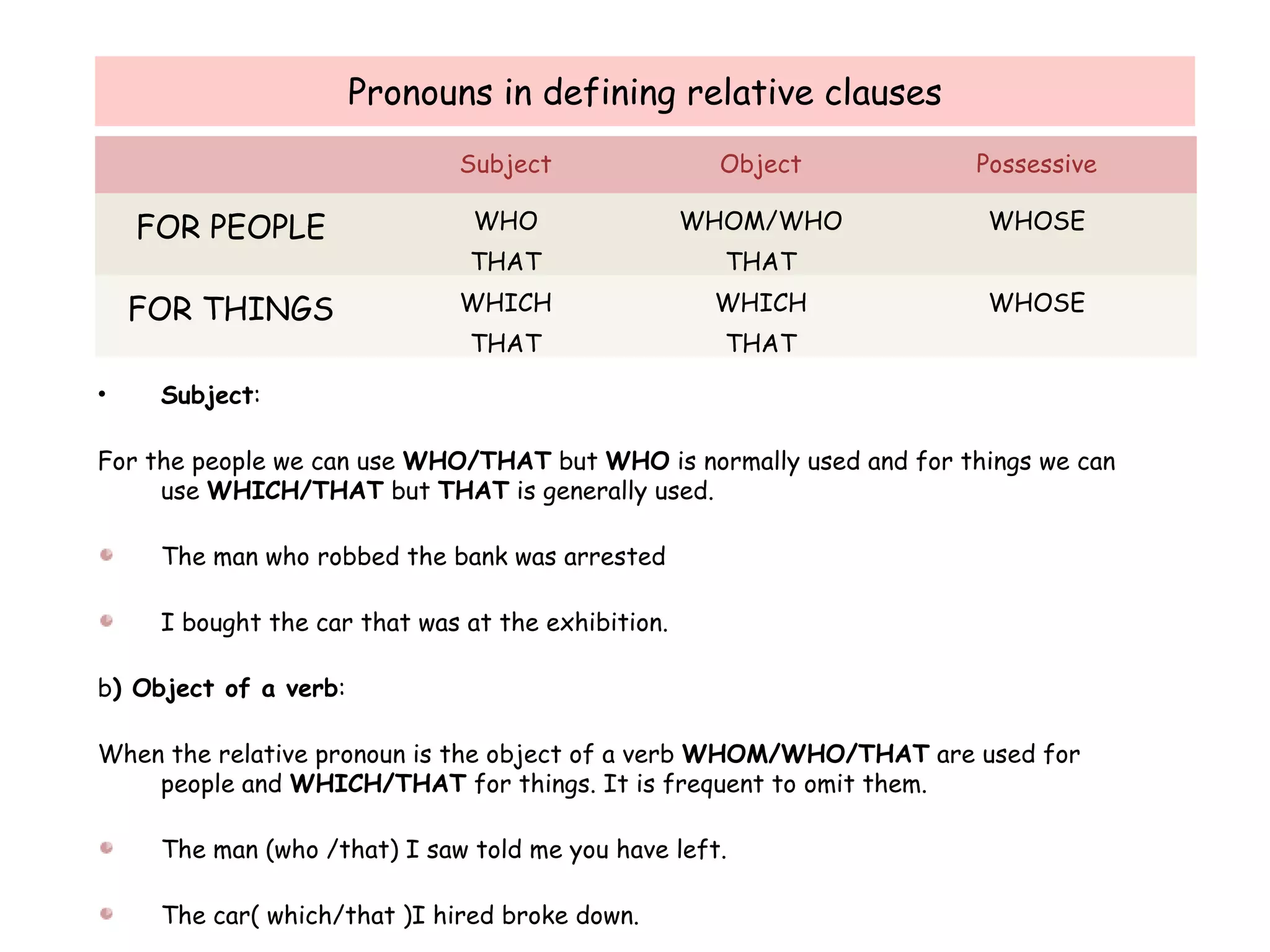
Pronouns in defining relative clauses Subject : For the people we can use  WHO/THAT  but  WHO  is normally used and for things we can use  WHICH/THAT  but  THAT  is generally used. The man who robbed the bank was arrested I bought the car that was at the exhibition. b ) Object of a verb : When the relative pronoun is the object of a verb  WHOM/WHO/THAT  are used for people and  WHICH/THAT  for things. It is frequent to omit them.  The man (who /that) I saw told me you have left. The car( which/that )I hired broke down. Subject Object Possessive FOR PEOPLE WHO THAT WHOM/WHO THAT WHOSE FOR THINGS WHICH THAT WHICH THAT WHOSE
More defining relative clauses c)  With a preposition : It is used  WHO/WHOM/THAT  for people and  WHICH/THAT  for things. In informal English the preposition is placed in front of te relative pronoun  WHO  (for people) and  WHICH  (for things). The lady to whom I spoke is a widow. The ladder on which I was standing slipped. In informal English the preposition is at the end of the relative clause and you can omit the relative pronoun. The lady WHO/THAT I spoke to is a widow. The ladder WHICH/THAT I was standing on slipped. d) P ossessive : WHOSE  is the only possible pronoun. It is always followed by a noun. The film is about a man whose wife has died. The bookshop whose owner lives next door is the oldest of the town. (*Sometimes we can use WITH + a phrase. For example: the house whose windows are blue is shut/ the house with blue windows is shut). e)  Sometimes it is possible to use a relative adverbs: WHEN, WHERE, WHY The year when she was born ( in which) The hotel where we stayed was beautiful (at/in which) The reason why he refused the present was very stupid ( for which)
NON-DEFINING RELATIVE CLAUSES They are also placed after nouns which are definite already. They don’t define the noun but add something to give more additional information. They are not essential in the sentence and can be omitted without causing confusion.  They are separated by commas . PRONOUNS IN NON-DEFINING RELATIVE CLAUSES (*THAT is not possible in this type of Relative Clauses) a) Subject: Peter, who has been driving all day, is very tired. This train, which is always very punctual, was late yesterday. b) Object: She wanted John, whom she liked, to be her partner. My grandmother gave me this pullover, which she had knitted herself. (* Relative pronouns can never be omitted ) SUBJECT OBJECT POSSESSIVE FOR PEOPLE WHO WHOM/WHO WHOSE FOR THINGS WHICH WHICH WHOSE
More non-defining relative clauses c ) With prepositions : Mr. Jones, with whom I played tennis on Saturday, is a good player/Mr Jones, whom I played tennis with on Saturday, is a good player. David’s house, for which he paid a lot, has a big garden/David’s house, which he paid a lot for, has a big garden. d) Possessive : Ann, whose car is in the garage, is working in the office today. This bicycle, whose wheel is flat, is my father’s.
QUESTIONS????
THAT’S ALL FOLKS

Relative clauses

  • 1.
  • 2.
    Description Relative clausesgive additional information about a noun (person or thing). They function as adjectives do. There are two types of relative clauses : Defining Relative clauses Ex: The horse which I selected won the race Non-defining Relative Clauses Ex: Thank you for your letter, which I was happy to receive
  • 3.
    DEFINING RELATIVE CLAUSESThey are essential to understand the noun, and they substitute the noun in the relative clause: The lady who is sitting opposite you is John’s mother The car that is parked in front of the supermarket is my father’s Defining clauses often follow THE + a noun , but they can also be used after: Plural nouns without THE a /an + noun Pronouns: all , none, somebody, anybody, everybody and those. The man who came was my boss. The book is about a girl who lives in Canada I met somebody who told me the news I got annoyed by something that he said A boy who doesn’t do his homework is not a good student.
  • 4.
    Pronouns in definingrelative clauses Subject : For the people we can use WHO/THAT but WHO is normally used and for things we can use WHICH/THAT but THAT is generally used. The man who robbed the bank was arrested I bought the car that was at the exhibition. b ) Object of a verb : When the relative pronoun is the object of a verb WHOM/WHO/THAT are used for people and WHICH/THAT for things. It is frequent to omit them. The man (who /that) I saw told me you have left. The car( which/that )I hired broke down. Subject Object Possessive FOR PEOPLE WHO THAT WHOM/WHO THAT WHOSE FOR THINGS WHICH THAT WHICH THAT WHOSE
  • 5.
    More defining relativeclauses c) With a preposition : It is used WHO/WHOM/THAT for people and WHICH/THAT for things. In informal English the preposition is placed in front of te relative pronoun WHO (for people) and WHICH (for things). The lady to whom I spoke is a widow. The ladder on which I was standing slipped. In informal English the preposition is at the end of the relative clause and you can omit the relative pronoun. The lady WHO/THAT I spoke to is a widow. The ladder WHICH/THAT I was standing on slipped. d) P ossessive : WHOSE is the only possible pronoun. It is always followed by a noun. The film is about a man whose wife has died. The bookshop whose owner lives next door is the oldest of the town. (*Sometimes we can use WITH + a phrase. For example: the house whose windows are blue is shut/ the house with blue windows is shut). e) Sometimes it is possible to use a relative adverbs: WHEN, WHERE, WHY The year when she was born ( in which) The hotel where we stayed was beautiful (at/in which) The reason why he refused the present was very stupid ( for which)
  • 6.
    NON-DEFINING RELATIVE CLAUSESThey are also placed after nouns which are definite already. They don’t define the noun but add something to give more additional information. They are not essential in the sentence and can be omitted without causing confusion. They are separated by commas . PRONOUNS IN NON-DEFINING RELATIVE CLAUSES (*THAT is not possible in this type of Relative Clauses) a) Subject: Peter, who has been driving all day, is very tired. This train, which is always very punctual, was late yesterday. b) Object: She wanted John, whom she liked, to be her partner. My grandmother gave me this pullover, which she had knitted herself. (* Relative pronouns can never be omitted ) SUBJECT OBJECT POSSESSIVE FOR PEOPLE WHO WHOM/WHO WHOSE FOR THINGS WHICH WHICH WHOSE
  • 7.
    More non-defining relativeclauses c ) With prepositions : Mr. Jones, with whom I played tennis on Saturday, is a good player/Mr Jones, whom I played tennis with on Saturday, is a good player. David’s house, for which he paid a lot, has a big garden/David’s house, which he paid a lot for, has a big garden. d) Possessive : Ann, whose car is in the garage, is working in the office today. This bicycle, whose wheel is flat, is my father’s.
  • 8.
  • 9.