The Relative Clause
DEFINING AND NON DEFINING
Relative clauses
➢give us information about the person, thing, place mentioned.
Jack, who's retired now, spends a lot of time with his grandchildren.
A serial murderer is a person who kills several people.
I found an apron which /that was covered in blood.
Whitchapel was the district where Jack the Ripper operated.
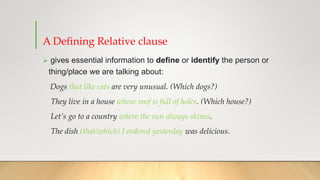
A Defining Relative clause
➢ gives essential information to define or identify the person or
thing/place we are talking about:
Dogs that like cats are very unusual. (Which dogs?)
They live in a house whose roof is full of holes. (Which house?)
Let’s go to a country where the sun always shines.
The dish (that/which) I ordered yesterday was delicious.
Defining Relative clause: pronouns
• To give essential info about
• people: who / that This is the man who told me the news.
• things: which/ that The letter that was delivered was from my boss.
places: where This is the house where we lived in when I was young.
possession: whose The cat whose left eye is injured is called Tom.
sentence: which He wouldn’t tell, which we had already expected.
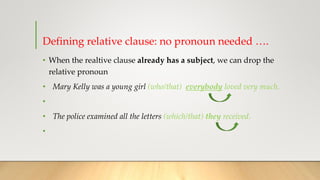
Defining relative clause: no pronoun needed ….
• When the realtive clause already has a subject, we can drop the
relative pronoun
• Mary Kelly was a young girl (who/that) everybody loved very much.
•
• The police examined all the letters (which/that) they received.
•
A non-defining relative clause
• gives us extra information about someone or something. It isn't essential for
understanding who or what we are talking about.
• My grandfather, who's 87, goes swimming every day.
The house, which was built in 1883, has just been opened to the public.
The award was given to Sara, whose short story impressed the judges.
• We also use commas to separate the clause from the rest of the sentence.
A non-defining relative clause
➢ here we cannot use the relative pronoun that:
Polly Nichols, who that was a nurse, was murdered in 1888.
On her birthday Sandra got a pony, which that she had dreamt of.
➢ the relative pronoun cannot be dropped either
Oxford Street, which is a famous shopping street in London, is always busy.
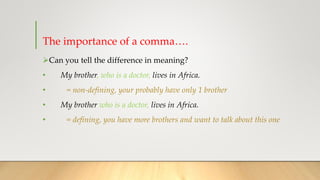
The importance of a comma….
➢Can you tell the difference in meaning?
• My brother, who is a doctor, lives in Africa.
• = non-defining, your probably have only 1 brother
• My brother who is a doctor, lives in Africa.
• = defining, you have more brothers and want to talk about this one
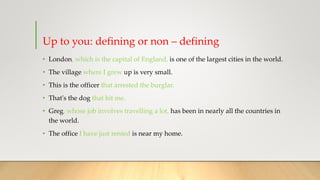
Up to you: defining or non – defining
• London, which is the capital of England, is one of the largest cities in the world.
• The village where I grew up is very small.
• This is the officer that arrested the burglar.
• That's the dog that bit me.
• Greg, whose job involves travelling a lot, has been in nearly all the countries in
the world.
• The office I have just rented is near my home.
Up to you: defining or non – defining
• London, which is the capital of England, is one of the largest cities in the world. ND
• The village where I grew up is very small. D
• This is the officer that arrested the burglar. D
• That's the dog that bit me. D
• Greg, whose job involves travelling a lot, has been in nearly all the countries in the world.
ND
• The office I have just rented is near my home. D
RELATIVE PRONUONS
• WHO
• WHOM
• WHICH
• WHOSE
• WHERE
• WHEN
• THAT
WHO
• It is used to talk about people
• It can be the subject or the object of the relative clause
• In defining relative clauses it can be always replaced by THAT.
• In defining relative clauses it can be omitted:
if it is the object of the relative clause
if it is followed by the subject of the relative clause
if it does not have a preposition before.
Eg.: Mary,who arrived late at the party,is my cousin
WHOM
• It is used to talk about people. More formal than WHO
• It is always the object of the relative clause, that is, it always has a subject
afterwards.
• In defining relative clauses it can be replaced by THAT.
• In defining relative clauses it can be omitted if it does not have a preposition
before.
Eg.: Mary is the girl whom I told you about yesterday.
WHICH
• It is used to talk about anything but people.
• It can be the subject or the object of the relative clause
• In defining relative clauses it can be always replaced by THAT.
• In defining relative clauses it can be omitted:
if it is the object of the relative clause
if it is followed by the subject of the relative clause
if it does not have a preposition before.
• Eg.: That car, which she bought last month, is a Ferrari.
WHOSE
• It is used to talk about possession.
• It cannot be substituted by any pronouns.
• It cannot be omitted in any case.
• It is always followed by whatever is possessed.
• Eg.: That is the boy whose mother is a doctor
WHERE
• It is used to talk about places when they are not the subject nor the object of the
relative clause, that is when they are followed by a subject and they are not an
object in the relative clause.
Eg.: That is the museum where I went last month
WHEN
• It is used to talk about times when they are not the subject nor the object of the
relative clause, that is when they are followed by a subject and they are not an
object in the relative clause.
Eg.: May is the month when flowers bloom.
THAT
• It only appears in Defing Relative Clauses.
• It may substitute WHO, WHOM and WHICH.
• It can be omitted if it is the object of the relative clause, that is, if it is followed by
the subject.
Eg: Paul is the man that I like so much.
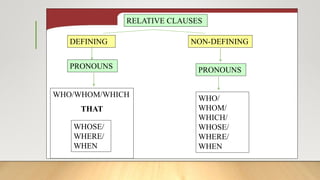
RELATIVE CLAUSES
DEFINING NON-DEFINING
PRONOUNS PRONOUNS
WHO/WHOM/WHICH
THAT
WHOSE/
WHERE/
WHEN
WHO/
WHOM/
WHICH/
WHOSE/
WHERE/
WHEN
Steps to join two sentences in a relative clause
1.- Find the common element
The man is very tall. I saw him yesterday.
2.- Cross out the second element.
That man is very tall. I saw him yesterday.
3.- Start copying the first sentence until the first common
element.
4.- Write the relative pronoun:
who
which
whose
That man
5.- Copy the second sentence, except the element we had
crossed out.
I saw yesterday
The man who
6.- If there is anything left from the first sentence, copy it
afterwards.
is very tall.
The man who I saw yesterday
7.- Check if you can write THAT instead of WHO, WHOM,
WHICH
The man who I saw yesterday is very tall.
that
8.- Check if you can omit the pronouns.
The man who I saw yesterday is very tall.
that
9.- The sentence is ready!!!
The man I saw yesterday is very tall.
Re write these sentences using relative clauses.
Use who, whose and which.
• Example:
He drank the juice. He made the juice. He drank the juice which he made.
1. A lion is an animal. It is very strong.
A lion
2. A novelist is a person. He writes novels.
A novelist
3. A bottle opener is a device. It opens bottles.
A bottle opener
4. The girl speaks Chinese. Her mother writes poems.
The girl
5. A detective is someone. He discovers the truth about crimes.
A detective
ANSWERS
• A lion is an animal which is very strong .
• A novelist is a person who writes novels.
• A bottle opener is a device which opens bottles.
• The girl whose mother writes poems speaks Chinese.
• A detective is someone who discovers the truth about crimes.

The Relative Clause - grade 8.pdf

  • 1.
  • 2.
    Relative clauses ➢give usinformation about the person, thing, place mentioned. Jack, who's retired now, spends a lot of time with his grandchildren. A serial murderer is a person who kills several people. I found an apron which /that was covered in blood. Whitchapel was the district where Jack the Ripper operated.
  • 3.
    A Defining Relativeclause ➢ gives essential information to define or identify the person or thing/place we are talking about: Dogs that like cats are very unusual. (Which dogs?) They live in a house whose roof is full of holes. (Which house?) Let’s go to a country where the sun always shines. The dish (that/which) I ordered yesterday was delicious.
  • 4.
    Defining Relative clause:pronouns • To give essential info about • people: who / that This is the man who told me the news. • things: which/ that The letter that was delivered was from my boss. places: where This is the house where we lived in when I was young. possession: whose The cat whose left eye is injured is called Tom. sentence: which He wouldn’t tell, which we had already expected.
  • 5.
    Defining relative clause:no pronoun needed …. • When the realtive clause already has a subject, we can drop the relative pronoun • Mary Kelly was a young girl (who/that) everybody loved very much. • • The police examined all the letters (which/that) they received. •
  • 6.
    A non-defining relativeclause • gives us extra information about someone or something. It isn't essential for understanding who or what we are talking about. • My grandfather, who's 87, goes swimming every day. The house, which was built in 1883, has just been opened to the public. The award was given to Sara, whose short story impressed the judges. • We also use commas to separate the clause from the rest of the sentence.
  • 7.
    A non-defining relativeclause ➢ here we cannot use the relative pronoun that: Polly Nichols, who that was a nurse, was murdered in 1888. On her birthday Sandra got a pony, which that she had dreamt of. ➢ the relative pronoun cannot be dropped either Oxford Street, which is a famous shopping street in London, is always busy.
  • 8.
    The importance ofa comma…. ➢Can you tell the difference in meaning? • My brother, who is a doctor, lives in Africa. • = non-defining, your probably have only 1 brother • My brother who is a doctor, lives in Africa. • = defining, you have more brothers and want to talk about this one
  • 9.
    Up to you:defining or non – defining • London, which is the capital of England, is one of the largest cities in the world. • The village where I grew up is very small. • This is the officer that arrested the burglar. • That's the dog that bit me. • Greg, whose job involves travelling a lot, has been in nearly all the countries in the world. • The office I have just rented is near my home.
  • 10.
    Up to you:defining or non – defining • London, which is the capital of England, is one of the largest cities in the world. ND • The village where I grew up is very small. D • This is the officer that arrested the burglar. D • That's the dog that bit me. D • Greg, whose job involves travelling a lot, has been in nearly all the countries in the world. ND • The office I have just rented is near my home. D
  • 11.
    RELATIVE PRONUONS • WHO •WHOM • WHICH • WHOSE • WHERE • WHEN • THAT
  • 12.
    WHO • It isused to talk about people • It can be the subject or the object of the relative clause • In defining relative clauses it can be always replaced by THAT. • In defining relative clauses it can be omitted: if it is the object of the relative clause if it is followed by the subject of the relative clause if it does not have a preposition before. Eg.: Mary,who arrived late at the party,is my cousin
  • 13.
    WHOM • It isused to talk about people. More formal than WHO • It is always the object of the relative clause, that is, it always has a subject afterwards. • In defining relative clauses it can be replaced by THAT. • In defining relative clauses it can be omitted if it does not have a preposition before. Eg.: Mary is the girl whom I told you about yesterday.
  • 14.
    WHICH • It isused to talk about anything but people. • It can be the subject or the object of the relative clause • In defining relative clauses it can be always replaced by THAT. • In defining relative clauses it can be omitted: if it is the object of the relative clause if it is followed by the subject of the relative clause if it does not have a preposition before. • Eg.: That car, which she bought last month, is a Ferrari.
  • 15.
    WHOSE • It isused to talk about possession. • It cannot be substituted by any pronouns. • It cannot be omitted in any case. • It is always followed by whatever is possessed. • Eg.: That is the boy whose mother is a doctor
  • 16.
    WHERE • It isused to talk about places when they are not the subject nor the object of the relative clause, that is when they are followed by a subject and they are not an object in the relative clause. Eg.: That is the museum where I went last month
  • 17.
    WHEN • It isused to talk about times when they are not the subject nor the object of the relative clause, that is when they are followed by a subject and they are not an object in the relative clause. Eg.: May is the month when flowers bloom.
  • 18.
    THAT • It onlyappears in Defing Relative Clauses. • It may substitute WHO, WHOM and WHICH. • It can be omitted if it is the object of the relative clause, that is, if it is followed by the subject. Eg: Paul is the man that I like so much.
  • 19.
    RELATIVE CLAUSES DEFINING NON-DEFINING PRONOUNSPRONOUNS WHO/WHOM/WHICH THAT WHOSE/ WHERE/ WHEN WHO/ WHOM/ WHICH/ WHOSE/ WHERE/ WHEN
  • 20.
    Steps to jointwo sentences in a relative clause 1.- Find the common element The man is very tall. I saw him yesterday.
  • 21.
    2.- Cross outthe second element. That man is very tall. I saw him yesterday. 3.- Start copying the first sentence until the first common element. 4.- Write the relative pronoun: who which whose That man
  • 22.
    5.- Copy thesecond sentence, except the element we had crossed out. I saw yesterday The man who 6.- If there is anything left from the first sentence, copy it afterwards. is very tall. The man who I saw yesterday
  • 23.
    7.- Check ifyou can write THAT instead of WHO, WHOM, WHICH The man who I saw yesterday is very tall. that 8.- Check if you can omit the pronouns. The man who I saw yesterday is very tall. that 9.- The sentence is ready!!! The man I saw yesterday is very tall.
  • 24.
    Re write thesesentences using relative clauses. Use who, whose and which. • Example: He drank the juice. He made the juice. He drank the juice which he made. 1. A lion is an animal. It is very strong. A lion 2. A novelist is a person. He writes novels. A novelist 3. A bottle opener is a device. It opens bottles. A bottle opener 4. The girl speaks Chinese. Her mother writes poems. The girl 5. A detective is someone. He discovers the truth about crimes. A detective
  • 25.
    ANSWERS • A lionis an animal which is very strong . • A novelist is a person who writes novels. • A bottle opener is a device which opens bottles. • The girl whose mother writes poems speaks Chinese. • A detective is someone who discovers the truth about crimes.