RELATIVE PRONOUNS
 WHO
 WHOM (object)
 WHICH
 WHOSE
 THAT
 They introduce relative clauses.
 A relative clause tells us which person or thing
the speaker means/ refers to.
Who / that: refer to people
 Those people live next door. They have 16
children.
 The people who /that live next door have 16
children.
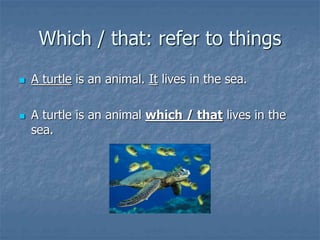
Which / that: refer to things
 A turtle is an animal. It lives in the sea.
 A turtle is an animal which / that lives in the
sea.
SUBJECT OF RELATIVE CLAUSE
 I know a man. He is a lawyer.
 I know a man who / that is a lawyer.
 A dog ran away. A dog is mine.
 The dog which /that ran away is mine.
 CAN NEVER BE OMITTED
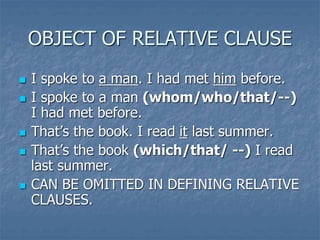
OBJECT OF RELATIVE CLAUSE
 I spoke to a man. I had met him before.
 I spoke to a man (whom/who/that/--)
I had met before.
 That’s the book. I read it last summer.
 That’s the book (which/that/ --) I read
last summer.
 CAN BE OMITTED IN DEFINING RELATIVE
CLAUSES.
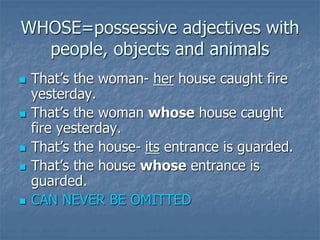
WHOSE=possessive adjectives with
people, objects and animals
 That’s the woman- her house caught fire
yesterday.
 That’s the woman whose house caught
fire yesterday.
 That’s the house- its entrance is guarded.
 That’s the house whose entrance is
guarded.
 CAN NEVER BE OMITTED
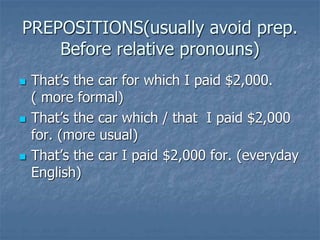
PREPOSITIONS(usually avoid prep.
Before relative pronouns)
 That’s the car for which I paid $2,000.
( more formal)
 That’s the car which / that I paid $2,000
for. (more usual)
 That’s the car I paid $2,000 for. (everyday
English)
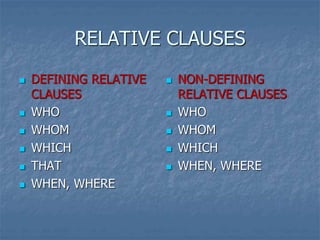
RELATIVE CLAUSES
 DEFINING RELATIVE
CLAUSES
 WHO
 WHOM
 WHICH
 THAT
 WHEN, WHERE
 NON-DEFINING
RELATIVE CLAUSES
 WHO
 WHOM
 WHICH
 WHEN, WHERE
DEFINING RELATIVE CLAUSES
 Necessary information
 Essential to the meaning of the main
sentence
 Relative pronouns can be omitted when
they are the object of the relative clause
 The relative clause is not put in commas
. People are fined. (Which people?)
People who /that park illegally are fined.
(Which people? Those who park illegally)
. The film was boring (Which film?)
The film (which/ that) I watched
yesterday was boring.
(Which film? The one I watched yesterday)
NON-DEFINING RELATIVE
CLAUSES
 They give extra information
 Not essential to the meaning of the
sentence
 RELATIVE PRONOUNS CANNOT BE
OMITTED
 THAT CANNOT BE USED
 THE RELATIVE CLAUSE IS PUT IN
COMMAS
. The Jeffersons live next door.
The Jeffersons, who own a Jaguar, live next door.
My cat is called Monty.
My cat, which I found on the street, is called
Monty.
RELATIVE ADVERBS
 WHERE
 WHEN
 WHY: THE REASON WHY
 I didn’t get a pay rise – that was the reason
why I left.
 I didn’t get a pay rise – that was the reason
(that) I left.
DEFINING RELATIVE CLAUSES
 WHERE: refers to
place, after nouns
like: place, house,
street, town and
country.
 The street where we
used to play is very
busy now.
 The street (which
/that) we used to
play in is very busy
now
 WHEN: refers to time,
after nouns like: time,
period, moment,
day…
 I’ll never forget the
day when I first met
him.
 I’ll never forget the
day (that) I first met
him.
NON-DEFINING
 WHERE: always after
a named place.
 WHEN: always after a
named time.
 I stopped in Dallas,
where my sister lives.
 Come back at 3:30,
when I won’t be busy.

relatives-pronouns-ppt.ppt

  • 1.
    RELATIVE PRONOUNS  WHO WHOM (object)  WHICH  WHOSE  THAT  They introduce relative clauses.  A relative clause tells us which person or thing the speaker means/ refers to.
  • 2.
    Who / that:refer to people  Those people live next door. They have 16 children.  The people who /that live next door have 16 children.
  • 3.
    Which / that:refer to things  A turtle is an animal. It lives in the sea.  A turtle is an animal which / that lives in the sea.
  • 4.
    SUBJECT OF RELATIVECLAUSE  I know a man. He is a lawyer.  I know a man who / that is a lawyer.  A dog ran away. A dog is mine.  The dog which /that ran away is mine.  CAN NEVER BE OMITTED
  • 5.
    OBJECT OF RELATIVECLAUSE  I spoke to a man. I had met him before.  I spoke to a man (whom/who/that/--) I had met before.  That’s the book. I read it last summer.  That’s the book (which/that/ --) I read last summer.  CAN BE OMITTED IN DEFINING RELATIVE CLAUSES.
  • 6.
    WHOSE=possessive adjectives with people,objects and animals  That’s the woman- her house caught fire yesterday.  That’s the woman whose house caught fire yesterday.  That’s the house- its entrance is guarded.  That’s the house whose entrance is guarded.  CAN NEVER BE OMITTED
  • 7.
    PREPOSITIONS(usually avoid prep. Beforerelative pronouns)  That’s the car for which I paid $2,000. ( more formal)  That’s the car which / that I paid $2,000 for. (more usual)  That’s the car I paid $2,000 for. (everyday English)
  • 8.
    RELATIVE CLAUSES  DEFININGRELATIVE CLAUSES  WHO  WHOM  WHICH  THAT  WHEN, WHERE  NON-DEFINING RELATIVE CLAUSES  WHO  WHOM  WHICH  WHEN, WHERE
  • 9.
    DEFINING RELATIVE CLAUSES Necessary information  Essential to the meaning of the main sentence  Relative pronouns can be omitted when they are the object of the relative clause  The relative clause is not put in commas
  • 10.
    . People arefined. (Which people?) People who /that park illegally are fined. (Which people? Those who park illegally) . The film was boring (Which film?) The film (which/ that) I watched yesterday was boring. (Which film? The one I watched yesterday)
  • 11.
    NON-DEFINING RELATIVE CLAUSES  Theygive extra information  Not essential to the meaning of the sentence  RELATIVE PRONOUNS CANNOT BE OMITTED  THAT CANNOT BE USED  THE RELATIVE CLAUSE IS PUT IN COMMAS
  • 12.
    . The Jeffersonslive next door. The Jeffersons, who own a Jaguar, live next door. My cat is called Monty. My cat, which I found on the street, is called Monty.
  • 13.
    RELATIVE ADVERBS  WHERE WHEN  WHY: THE REASON WHY  I didn’t get a pay rise – that was the reason why I left.  I didn’t get a pay rise – that was the reason (that) I left.
  • 14.
    DEFINING RELATIVE CLAUSES WHERE: refers to place, after nouns like: place, house, street, town and country.  The street where we used to play is very busy now.  The street (which /that) we used to play in is very busy now
  • 15.
     WHEN: refersto time, after nouns like: time, period, moment, day…  I’ll never forget the day when I first met him.  I’ll never forget the day (that) I first met him.
  • 16.
    NON-DEFINING  WHERE: alwaysafter a named place.  WHEN: always after a named time.  I stopped in Dallas, where my sister lives.  Come back at 3:30, when I won’t be busy.