RELATIVE CLAUSES
DEFINING RELATIVE CLAUSE   We use  defining relative clauses  to add essential information to a sentence. The clause goes immediately after the noun it describes. “ This is the man  who s old me the car.”
We use  relative pronouns :  who ,  that   – for people which ,  that   – for objects where  – for places whose  – to talk about possession when ,  that  – for a time why ,  that  – for a reason whom  – for object pronouns (people)
He is the man  who  /  that  owns  this car. This is the house  where  I was born. The girl  whose   party I went to phoned me.
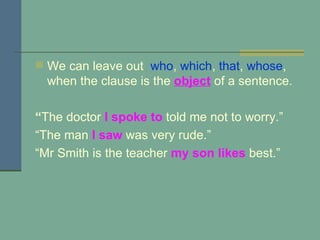
We can leave out  who ,  which ,  that ,  whose , when the clause is the  object  of a sentence. “ The doctor  I spoke to   told me not to worry.” “ The man  I saw  was very rude.” “ Mr Smith is the teacher  my son likes  best.”
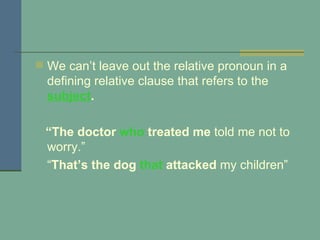
We can’t leave out the relative pronoun in a defining relative clause that refers to the  subject .   “ The doctor  who  treated   me  told me not to worry.”   “ That’s the dog  that  attacked  my children”
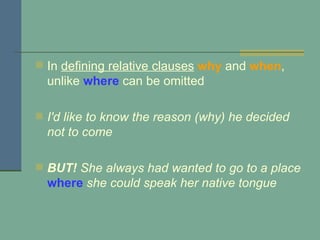
In  defining relative clauses   why   and  when , unlike  where  can be omitted I'd like to know the reason (why) he decided not to come BUT!  She always had wanted to go to a place  where  she could speak her native tongue
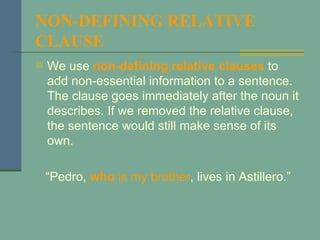
NON-DEFINING RELATIVE CLAUSE   We use  non-defining relative clauses  to add non-essential information to a sentence. The clause goes immediately after the noun it describes. If we removed the relative clause, the sentence would still make sense of its own. “ Pedro,  who  is my brother , lives in Astillero.”
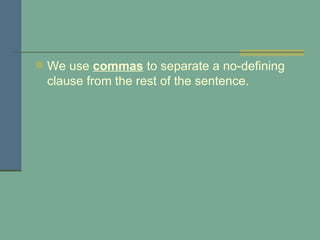
We use  commas   to separate a no-defining clause from the rest of the sentence.
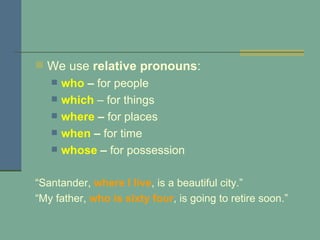
We use  relative pronouns : who  –  for people which  – for things where  –  for places when  –  for time whose  –  for possession “ Santander,  where I live , is a beautiful city.” “ My father,  who is sixty four , is going to retire soon.”
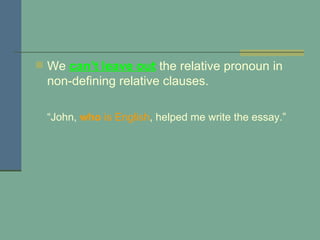
We  can’t leave out  the relative pronoun in non-defining relative clauses. “ John,  who  is English , helped me write the essay.”
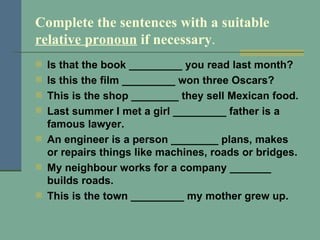
Complete the sentences with a suitable  relative pronoun  if necessary . Is that the book _________ you read last month? Is this the film _________ won three Oscars? This is the shop ________ they sell Mexican food. Last summer I met a girl _________ father is a famous lawyer. An engineer is a person ________ plans, makes or repairs things like machines, roads or bridges. My neighbour works for a company _______ builds roads. This is the town _________ my mother grew up.
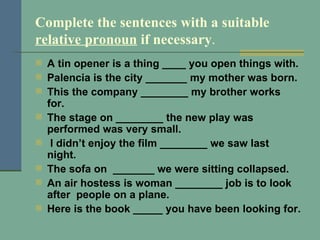
Complete the sentences with a suitable  relative pronoun  if necessary . A tin opener is a thing ____ you open things with. Palencia is the city _______ my mother was born. This the company ________ my brother works for. The stage on ________ the new play was performed was very small. I didn’t enjoy the film ________ we saw last night. The sofa on  _______ we were sitting collapsed. An air hostess is woman ________ job is to look after  people on a plane.  Here is the book _____ you have been looking for.

Relative clauses

  • 1.
  • 2.
    DEFINING RELATIVE CLAUSE We use defining relative clauses to add essential information to a sentence. The clause goes immediately after the noun it describes. “ This is the man who s old me the car.”
  • 3.
    We use relative pronouns : who , that – for people which , that – for objects where – for places whose – to talk about possession when , that – for a time why , that – for a reason whom – for object pronouns (people)
  • 4.
    He is theman who / that owns this car. This is the house where I was born. The girl whose party I went to phoned me.
  • 5.
    We can leaveout who , which , that , whose , when the clause is the object of a sentence. “ The doctor I spoke to told me not to worry.” “ The man I saw was very rude.” “ Mr Smith is the teacher my son likes best.”
  • 6.
    We can’t leaveout the relative pronoun in a defining relative clause that refers to the subject . “ The doctor who treated me told me not to worry.” “ That’s the dog that attacked my children”
  • 7.
    In definingrelative clauses why and when , unlike where can be omitted I'd like to know the reason (why) he decided not to come BUT! She always had wanted to go to a place where she could speak her native tongue
  • 8.
    NON-DEFINING RELATIVE CLAUSE We use non-defining relative clauses to add non-essential information to a sentence. The clause goes immediately after the noun it describes. If we removed the relative clause, the sentence would still make sense of its own. “ Pedro, who is my brother , lives in Astillero.”
  • 9.
    We use commas to separate a no-defining clause from the rest of the sentence.
  • 10.
    We use relative pronouns : who – for people which – for things where – for places when – for time whose – for possession “ Santander, where I live , is a beautiful city.” “ My father, who is sixty four , is going to retire soon.”
  • 11.
    We can’tleave out the relative pronoun in non-defining relative clauses. “ John, who is English , helped me write the essay.”
  • 12.
    Complete the sentenceswith a suitable relative pronoun if necessary . Is that the book _________ you read last month? Is this the film _________ won three Oscars? This is the shop ________ they sell Mexican food. Last summer I met a girl _________ father is a famous lawyer. An engineer is a person ________ plans, makes or repairs things like machines, roads or bridges. My neighbour works for a company _______ builds roads. This is the town _________ my mother grew up.
  • 13.
    Complete the sentenceswith a suitable relative pronoun if necessary . A tin opener is a thing ____ you open things with. Palencia is the city _______ my mother was born. This the company ________ my brother works for. The stage on ________ the new play was performed was very small. I didn’t enjoy the film ________ we saw last night. The sofa on _______ we were sitting collapsed. An air hostess is woman ________ job is to look after people on a plane. Here is the book _____ you have been looking for.