1
ELEMENTS OF MECHANICAL
ENGINEERING
BABARIA INSTITUTE OF TECHNOLOGY
FACULTY : RAGHVENDRA S DARJI
BY : HARSH RUPAPARA
2
Refrigeration & Air ConditioningRefrigeration & Air Conditioning
Introduction
Type of refrigeration
Refrigeration&AC
3
IntroductionIntroduction
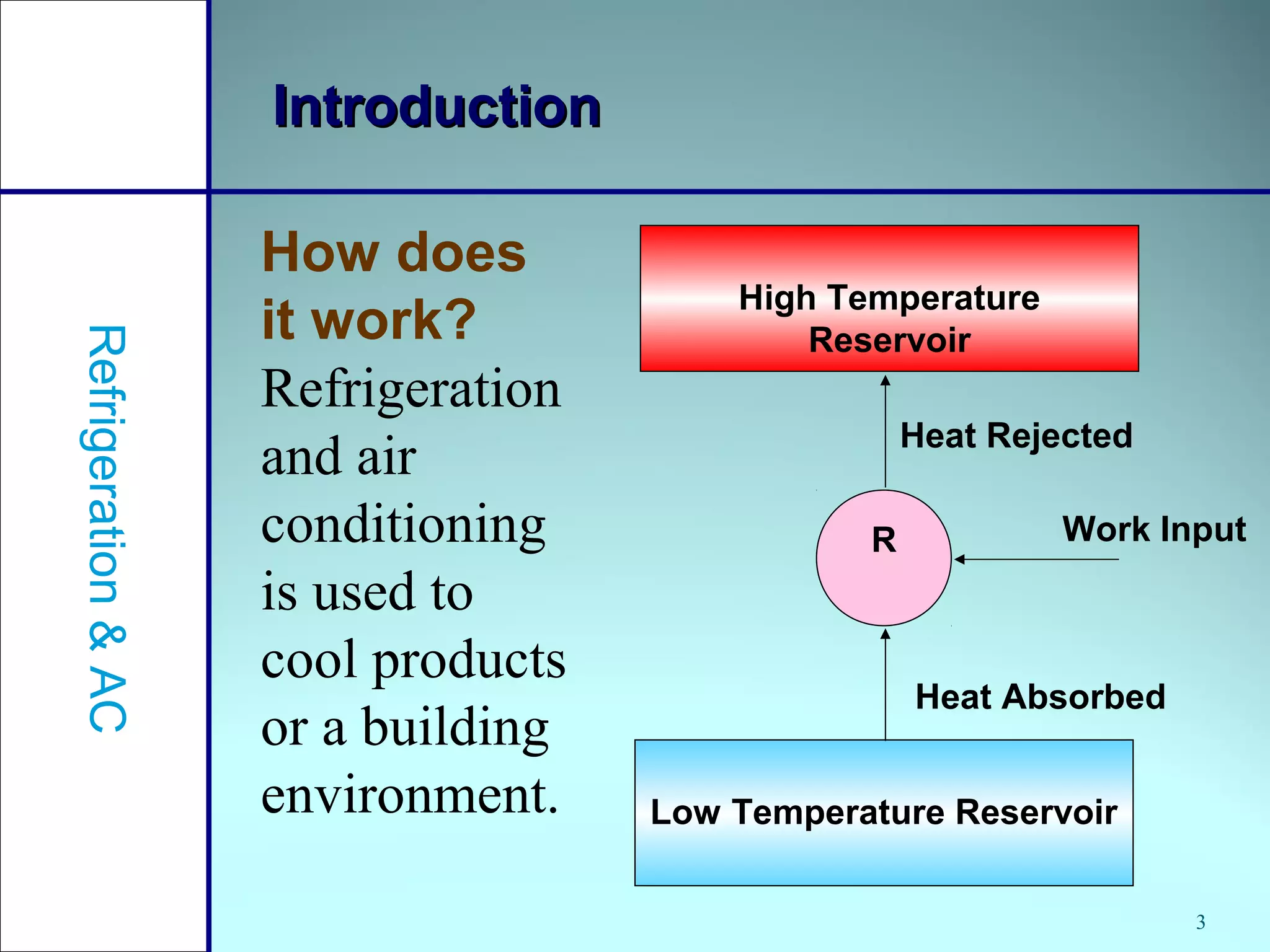
How does
it work?
Refrigeration
and air
conditioning
is used to
cool products
or a building
environment.
Refrigeration&AC
High Temperature
Reservoir
Low Temperature Reservoir
R Work Input
Heat Absorbed
Heat Rejected
4
IntroductionIntroduction
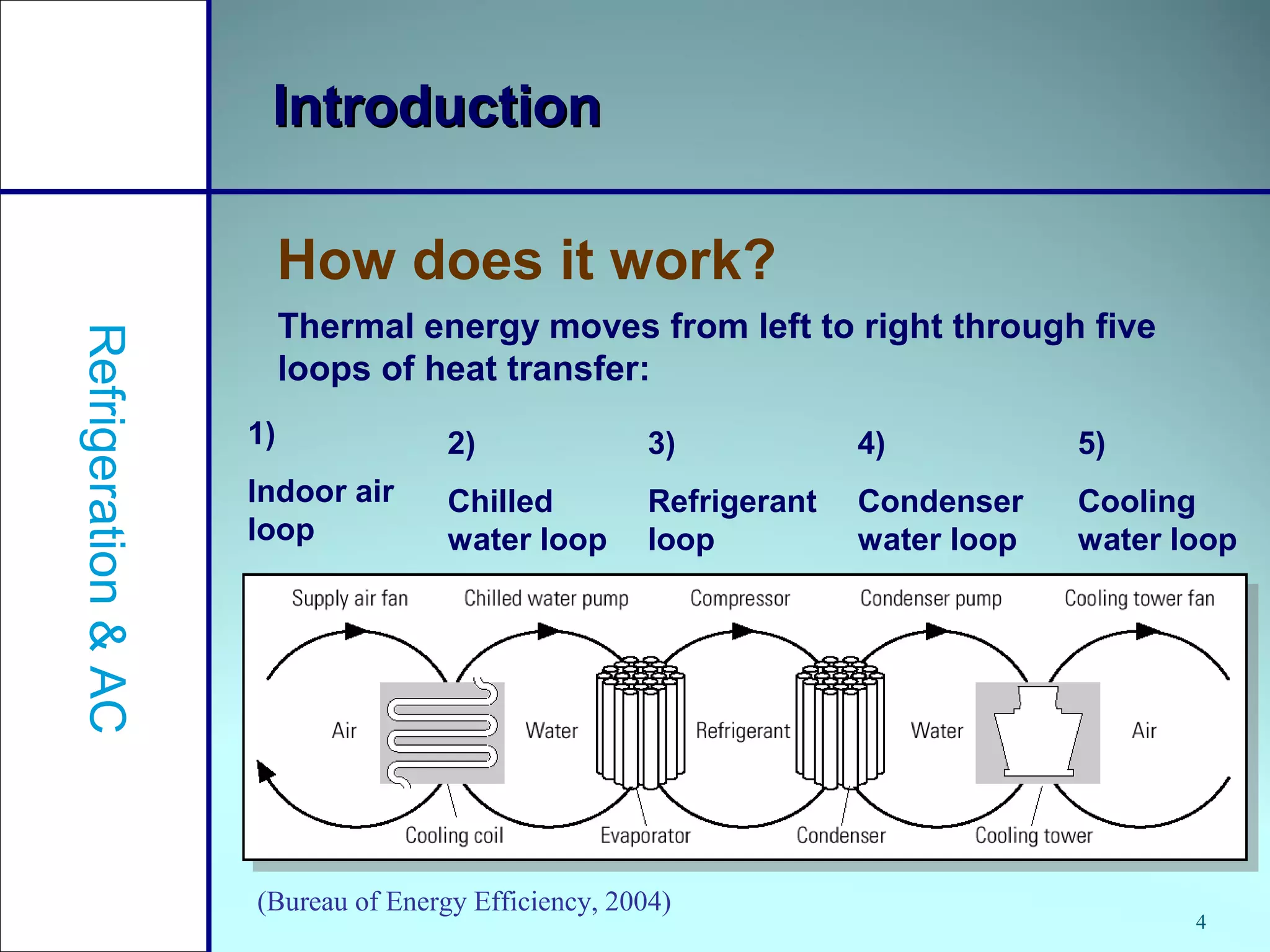
Thermal energy moves from left to right through five
loops of heat transfer:
How does it work?
Refrigeration&AC
(Bureau of Energy Efficiency, 2004)
1)
Indoor air
loop
2)
Chilled
water loop
3)
Refrigerant
loop
4)
Condenser
water loop
5)
Cooling
water loop
5
IntroductionIntroduction
• Small capacity modular units of direct
expansion type (50 Tons of Refrigeration)
• Centralized chilled water plants with
chilled water as a secondary coolant (50 –
250 TR)
• Brine plants with brines as lower
temperature, secondary coolant (>250 TR)
Refrigeration systems for industrial
processes
Refrigeration&AC
6
Training Agenda: Refrigeration &Training Agenda: Refrigeration &
Air ConditioningAir Conditioning
Introduction
Type of refrigeration
Types Of Air Conditioner
Refrigeration&AC
7
Types of RefrigerationTypes of Refrigeration
• Vapour Compression
Refrigeration (VCR): uses
mechanical energy
• Vapour Absorption Refrigeration
(VAR): uses thermal energy
Refrigeration systems
Refrigeration&AC
8
Type of RefrigerationType of Refrigeration
Vapour Compression Refrigeration
Refrigeration&AC
• Highly compressed fluids tend to get
colder when allowed to expand
• If pressure high enough
• Compressed air hotter than source
of cooling
• Expanded gas cooler than desired
cold temperature
9
Type of RefrigerationType of Refrigeration
Vapour Compression Refrigeration
Refrigeration&AC
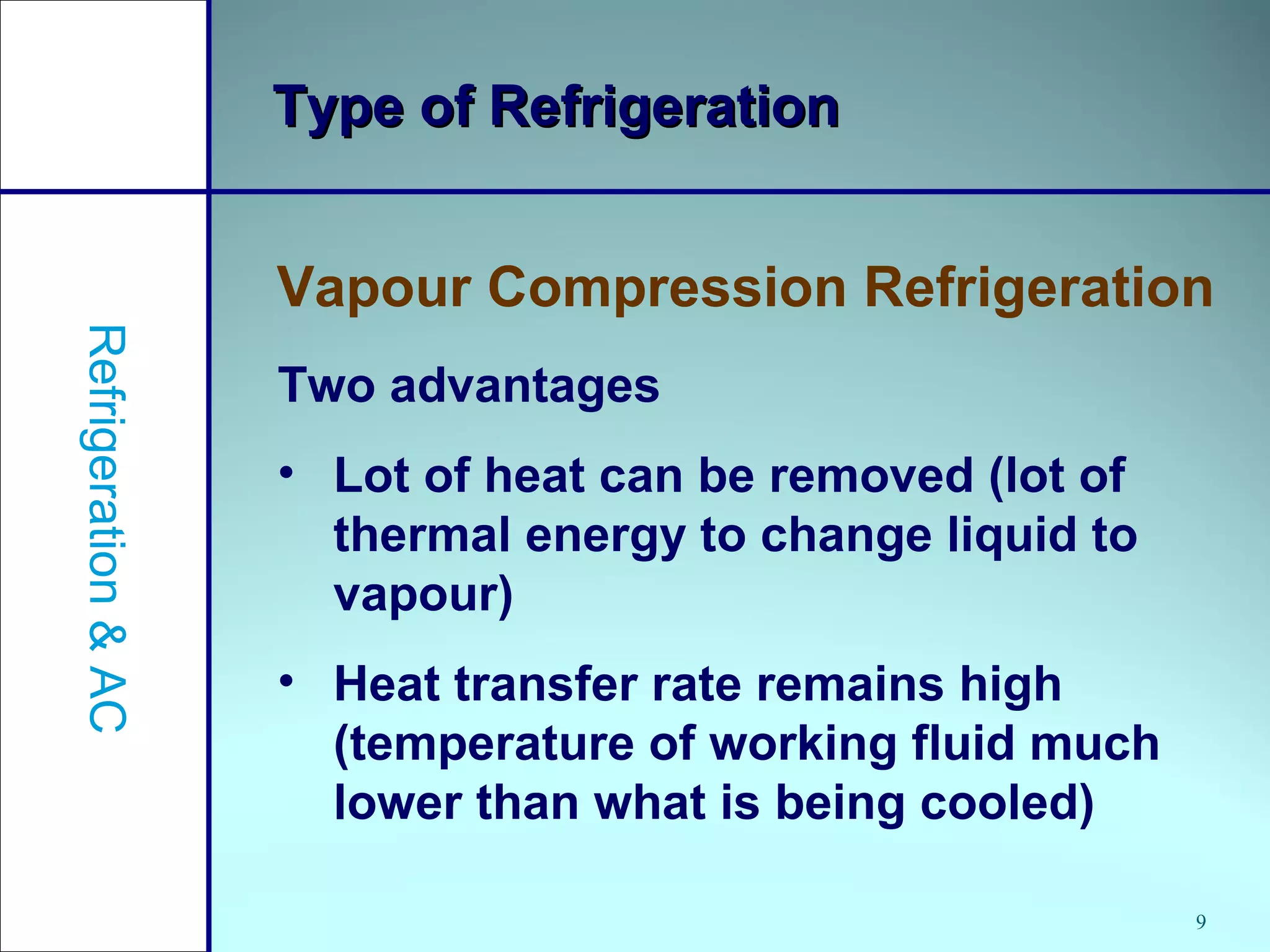
Two advantages
• Lot of heat can be removed (lot of
thermal energy to change liquid to
vapour)
• Heat transfer rate remains high
(temperature of working fluid much
lower than what is being cooled)
10
Type of RefrigerationType of Refrigeration
Vapour Compression Refrigeration
Refrigeration&AC
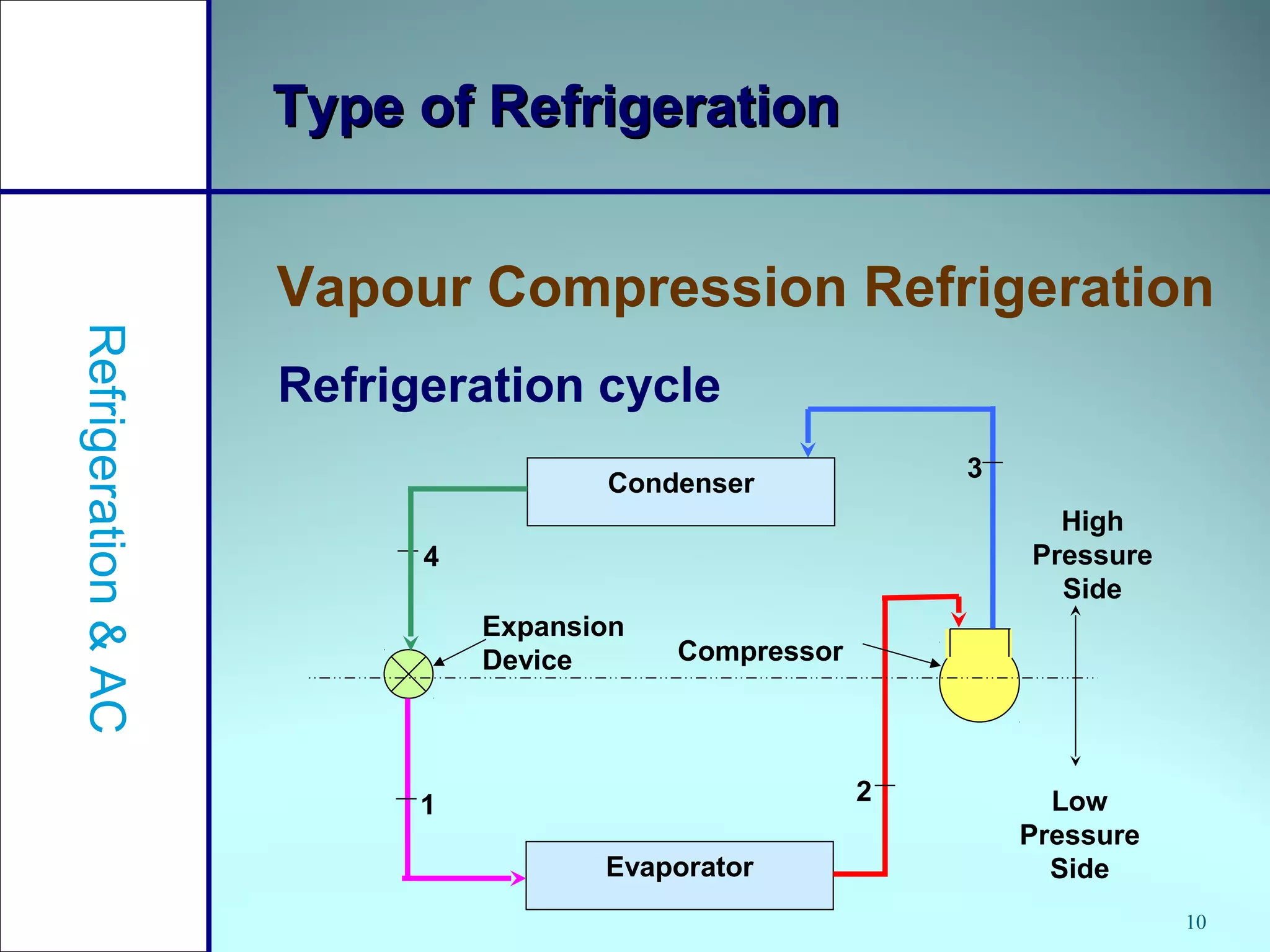
Refrigeration cycle
Condenser
Evaporator
High
Pressure
Side
Low
Pressure
Side
Compressor
Expansion
Device
1 2
3
4
11
Type of RefrigerationType of Refrigeration
Vapour Compression Refrigeration
/Refrigeration&AC
Refrigeration cycle
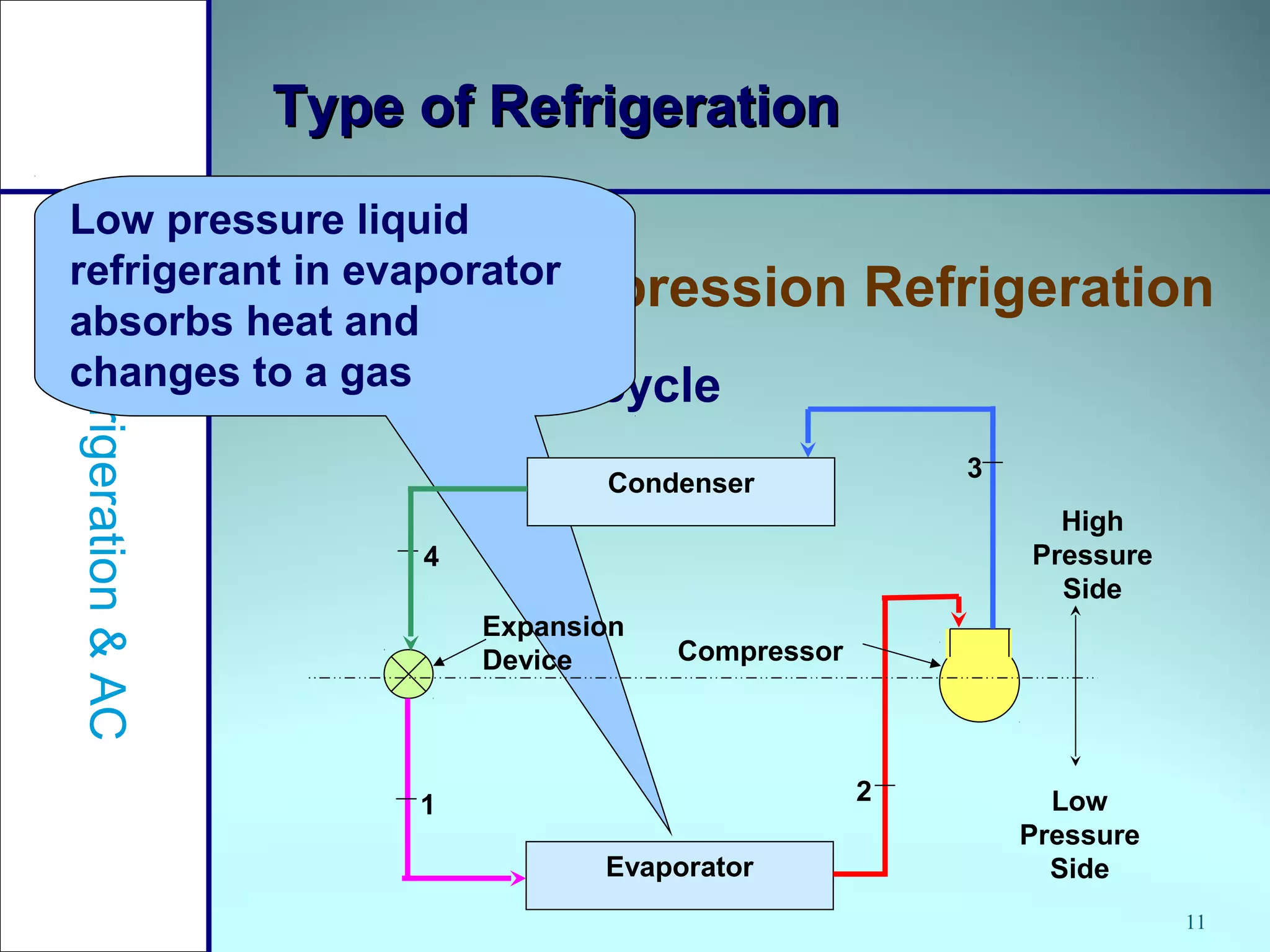
Low pressure liquid
refrigerant in evaporator
absorbs heat and
changes to a gas
Condenser
Evaporator
High
Pressure
Side
Low
Pressure
Side
Compressor
Expansion
Device
1 2
3
4
12
Type of RefrigerationType of Refrigeration
Vapour Compression Refrigeration
Refrigeration&AC
Refrigeration cycle
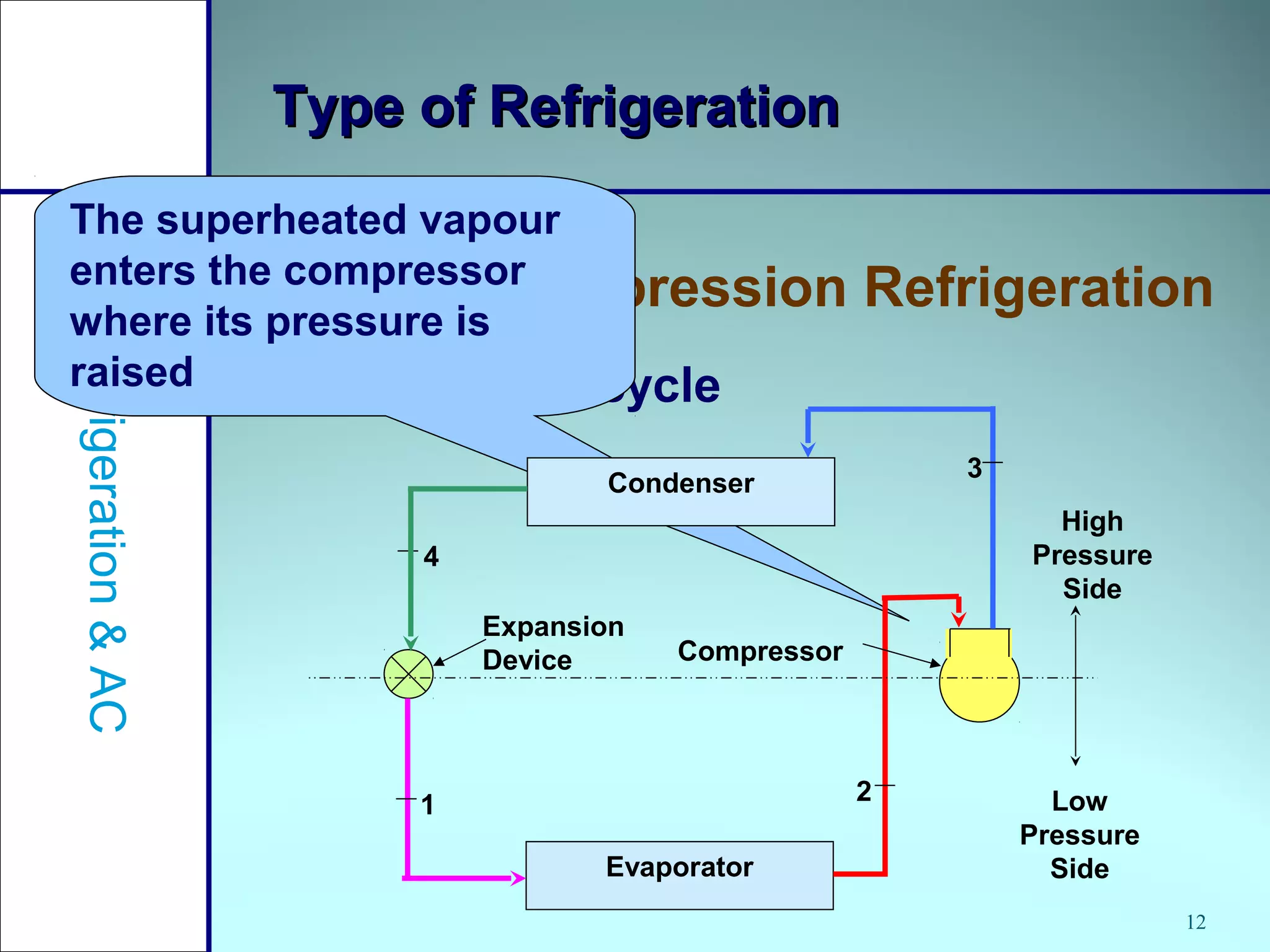
The superheated vapour
enters the compressor
where its pressure is
raised
Condenser
Evaporator
High
Pressure
Side
Low
Pressure
Side
Compressor
Expansion
Device
1 2
3
4
13
Type of RefrigerationType of Refrigeration
Vapour Compression Refrigeration
Refrigeration&AC
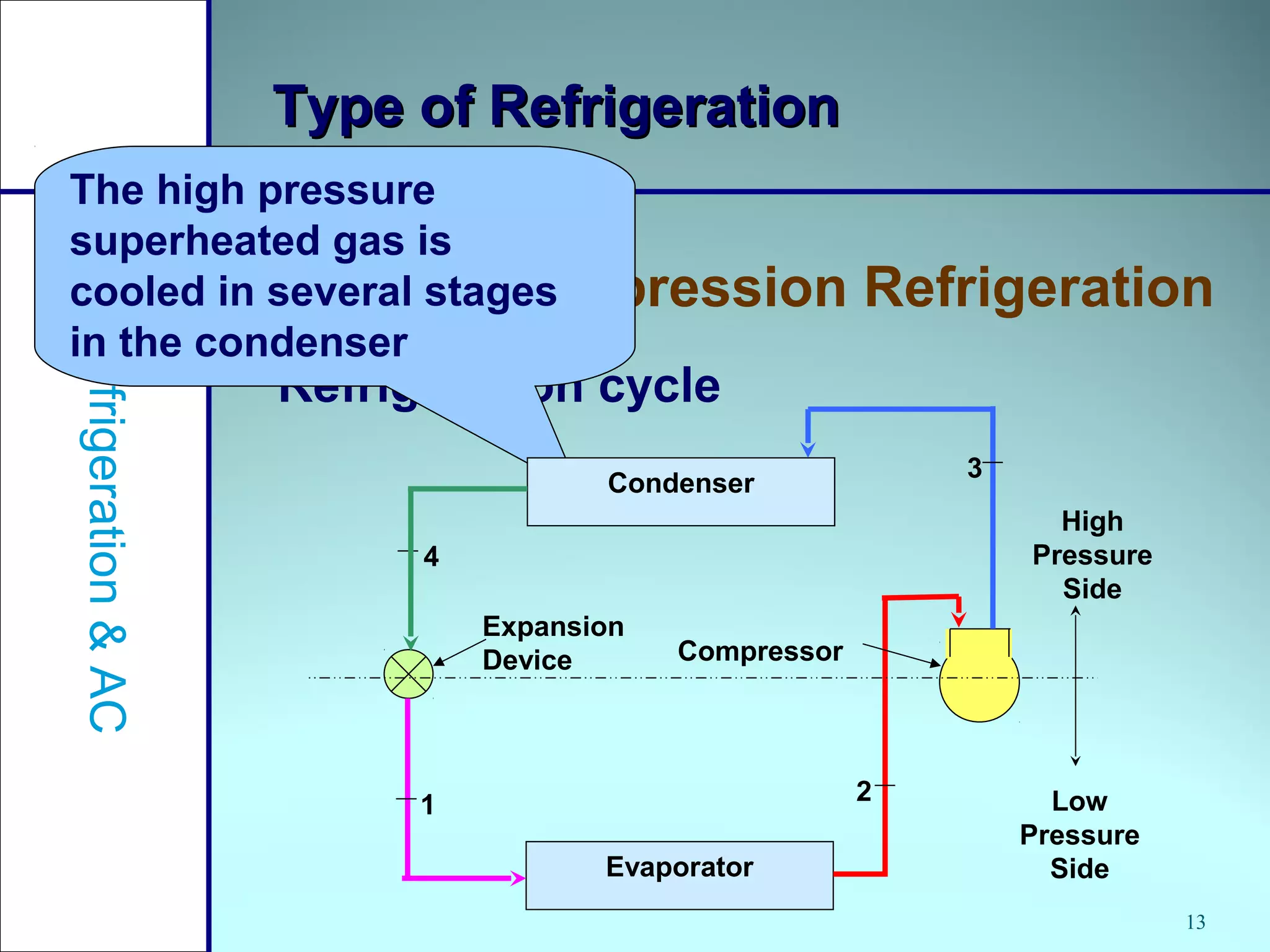
Refrigeration cycle
The high pressure
superheated gas is
cooled in several stages
in the condenser
Condenser
Evaporator
High
Pressure
Side
Low
Pressure
Side
Compressor
Expansion
Device
1 2
3
4
14
Type of RefrigerationType of Refrigeration
Vapour Compression Refrigeration
Refrigeration&AC
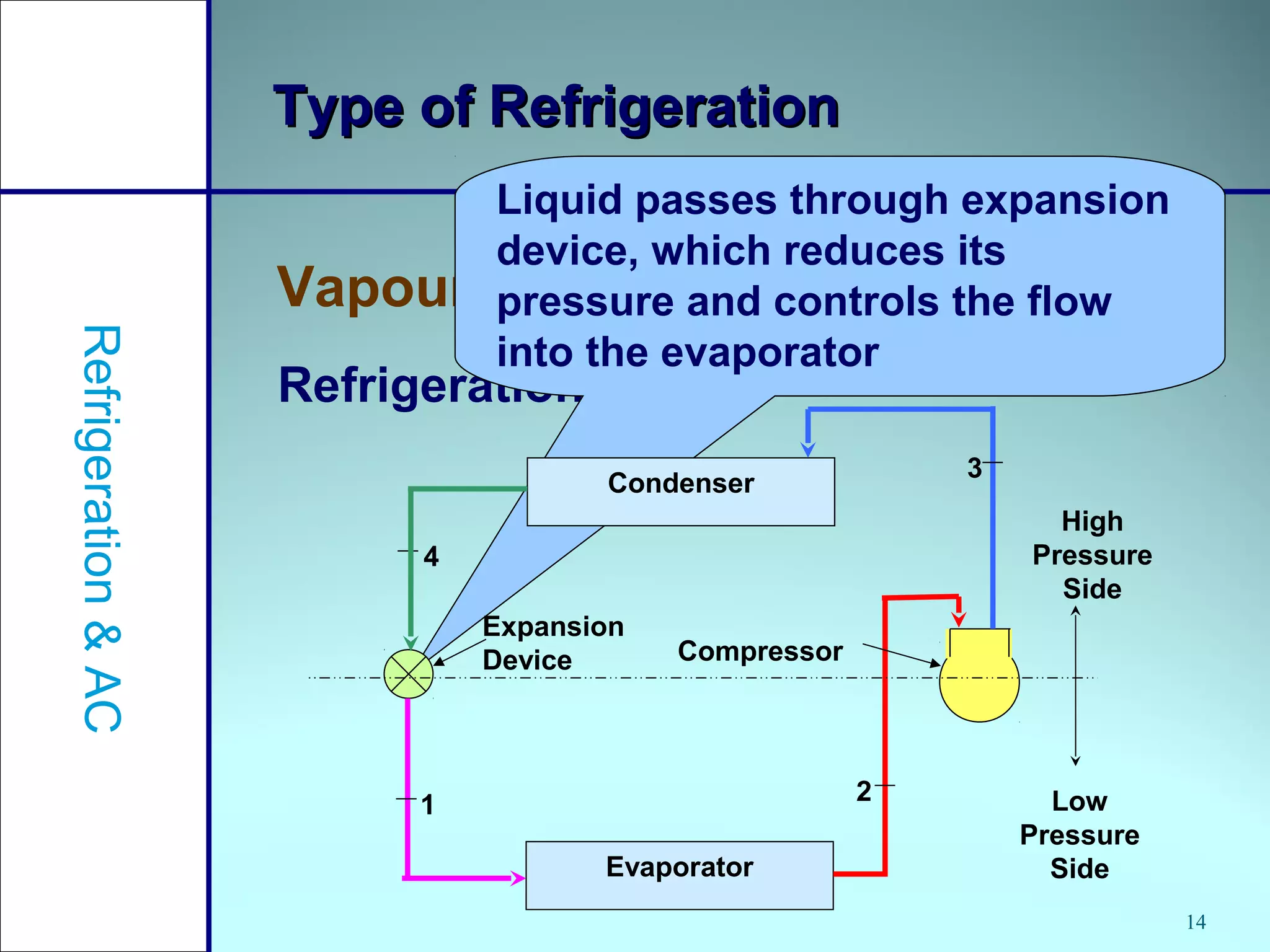
Refrigeration cycle
Liquid passes through expansion
device, which reduces its
pressure and controls the flow
into the evaporator
Condenser
Evaporator
High
Pressure
Side
Low
Pressure
Side
Compressor
Expansion
Device
1 2
3
4
15
Type of RefrigerationType of Refrigeration
Vapour Compression Refrigeration
Refrigeration&AC
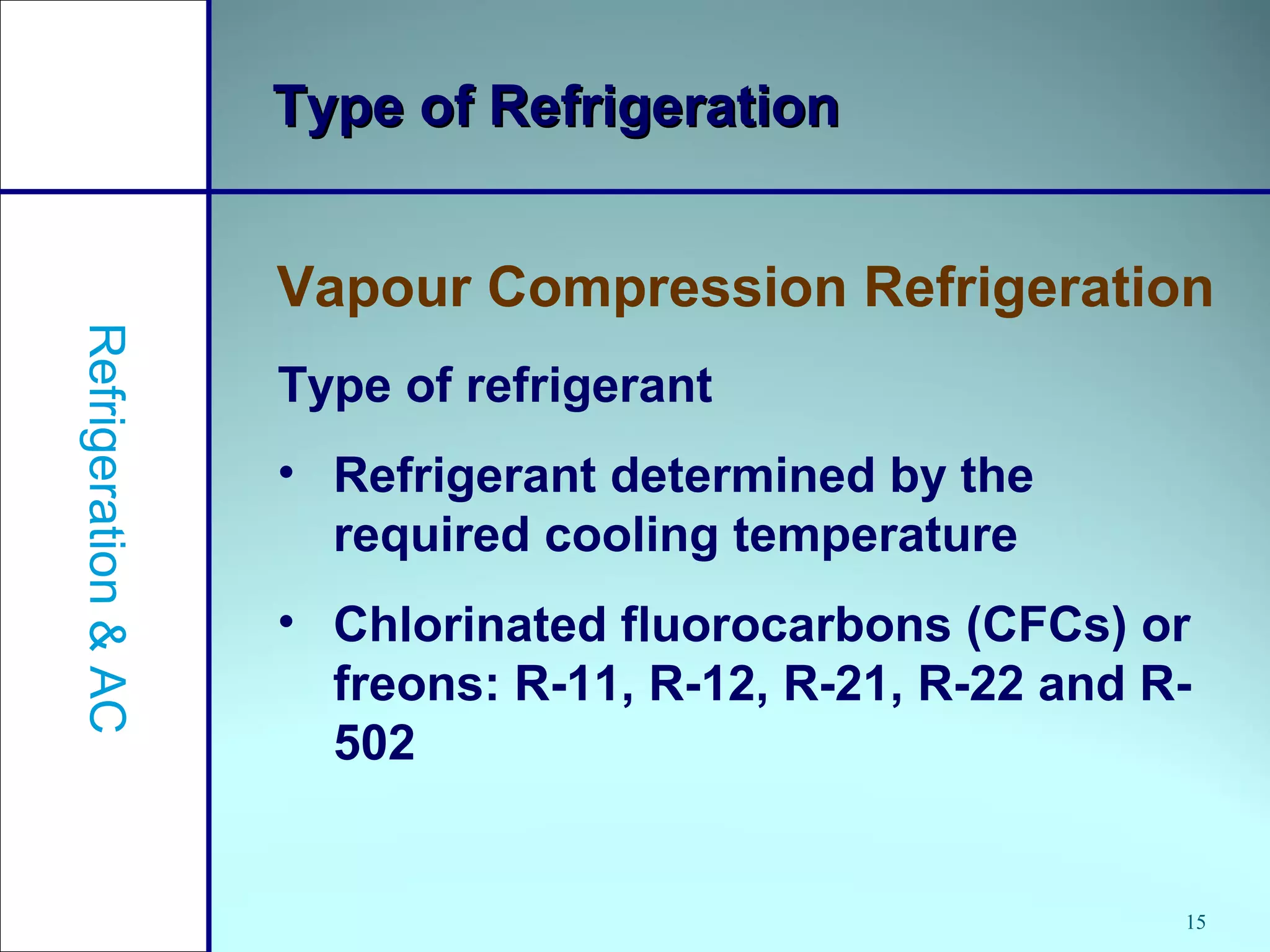
Type of refrigerant
• Refrigerant determined by the
required cooling temperature
• Chlorinated fluorocarbons (CFCs) or
freons: R-11, R-12, R-21, R-22 and R-
502
16
Type of RefrigerationType of Refrigeration
Vapour Compression Refrigeration
Refrigeration&AC
Choice of compressor, design of
condenser, evaporator determined by
• Refrigerant
• Required cooling
• Load
• Ease of maintenance
• Physical space requirements
• Availability of utilities (water, power)
17
Type of RefrigerationType of Refrigeration
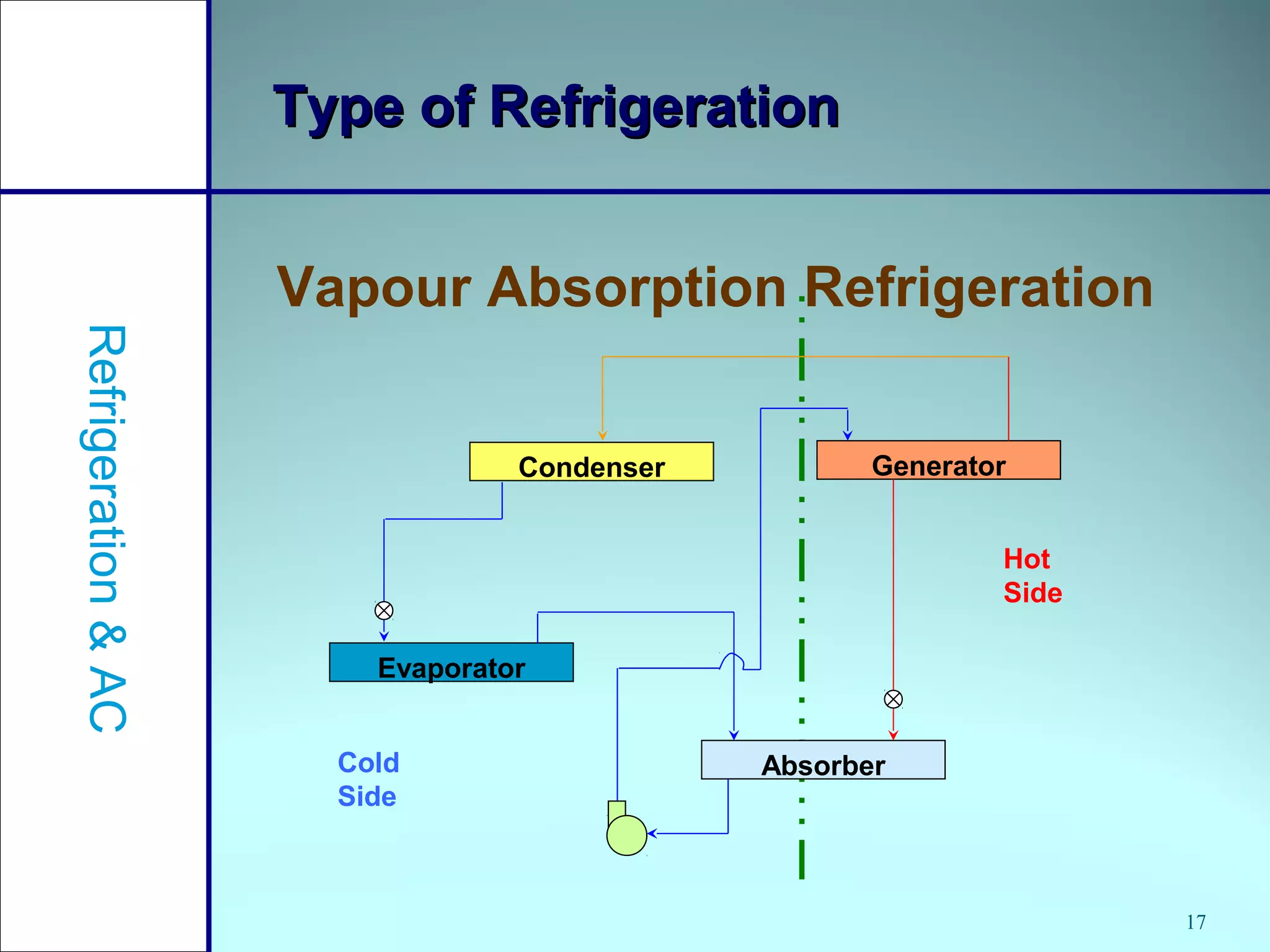
Vapour Absorption Refrigeration
Refrigeration&AC
Condenser Generator
Evaporator
AbsorberCold
Side
Hot
Side
18
Type of RefrigerationType of Refrigeration
Vapour Absorption Refrigeration
Refrigeration&AC
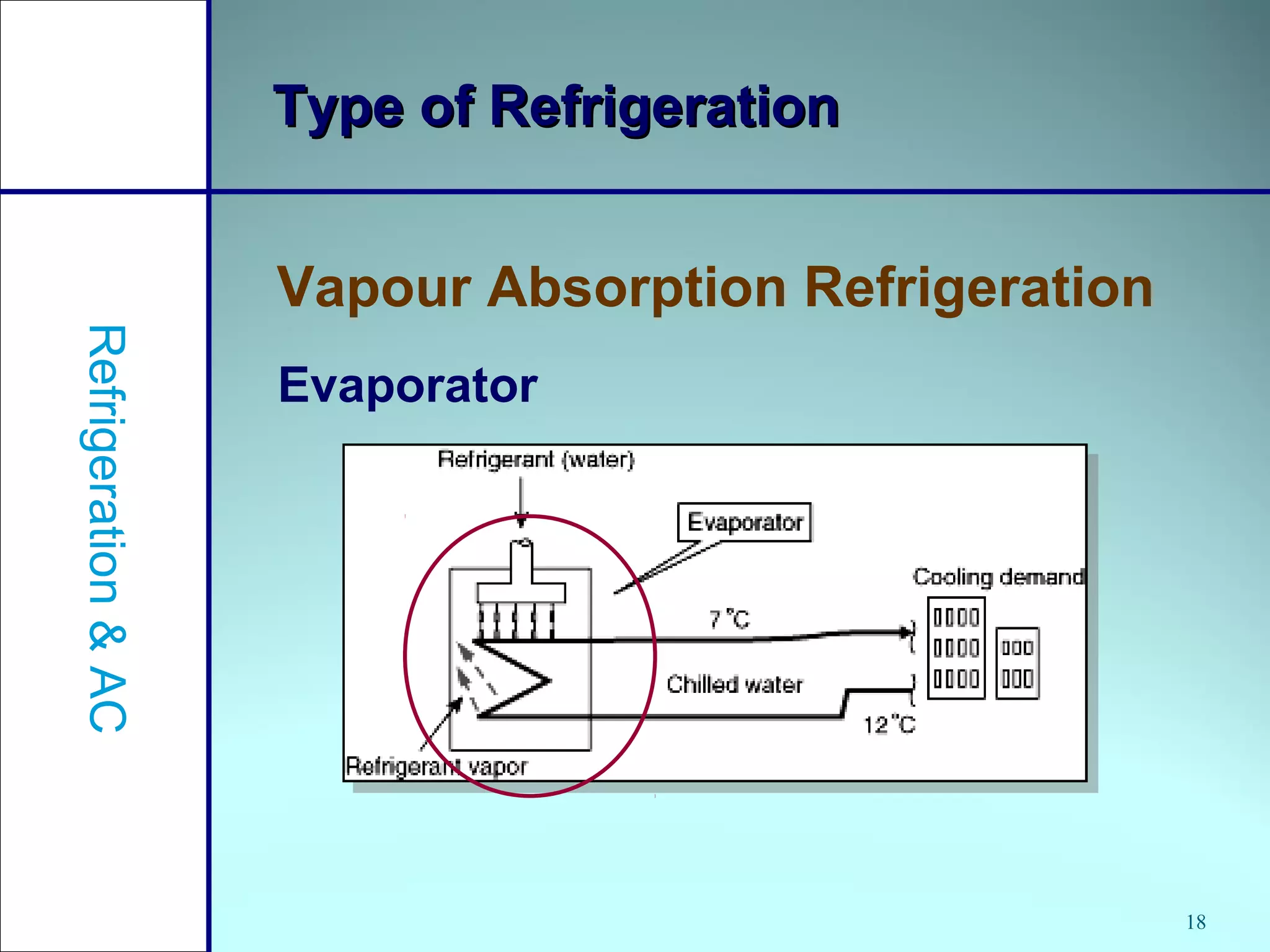
Evaporator
19
Type of RefrigerationType of Refrigeration
Vapour Absorption Refrigeration
Refrigeration&AC
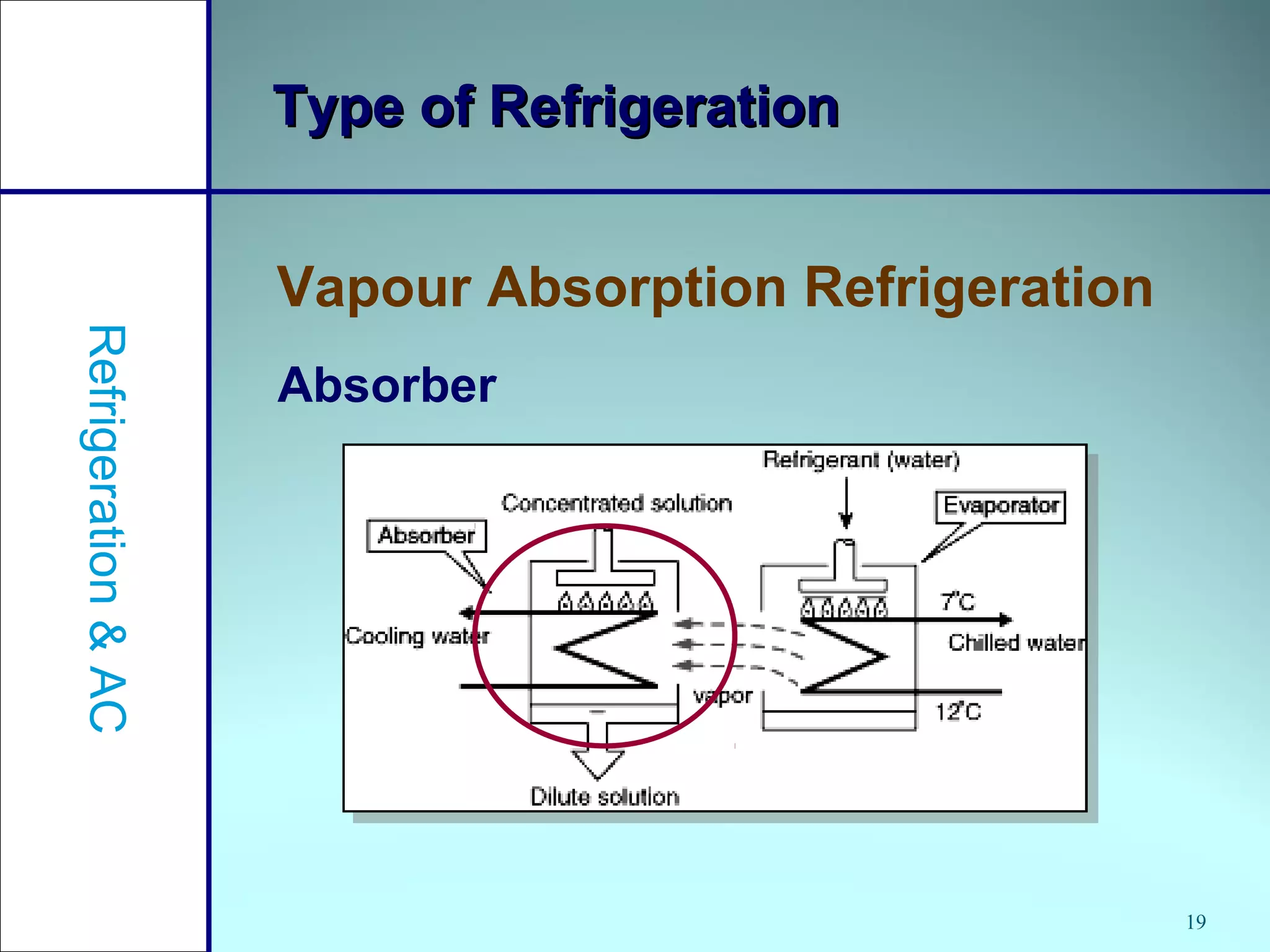
Absorber
20
Type of RefrigerationType of Refrigeration
Vapour Absorption Refrigeration
Refrigeration&AC
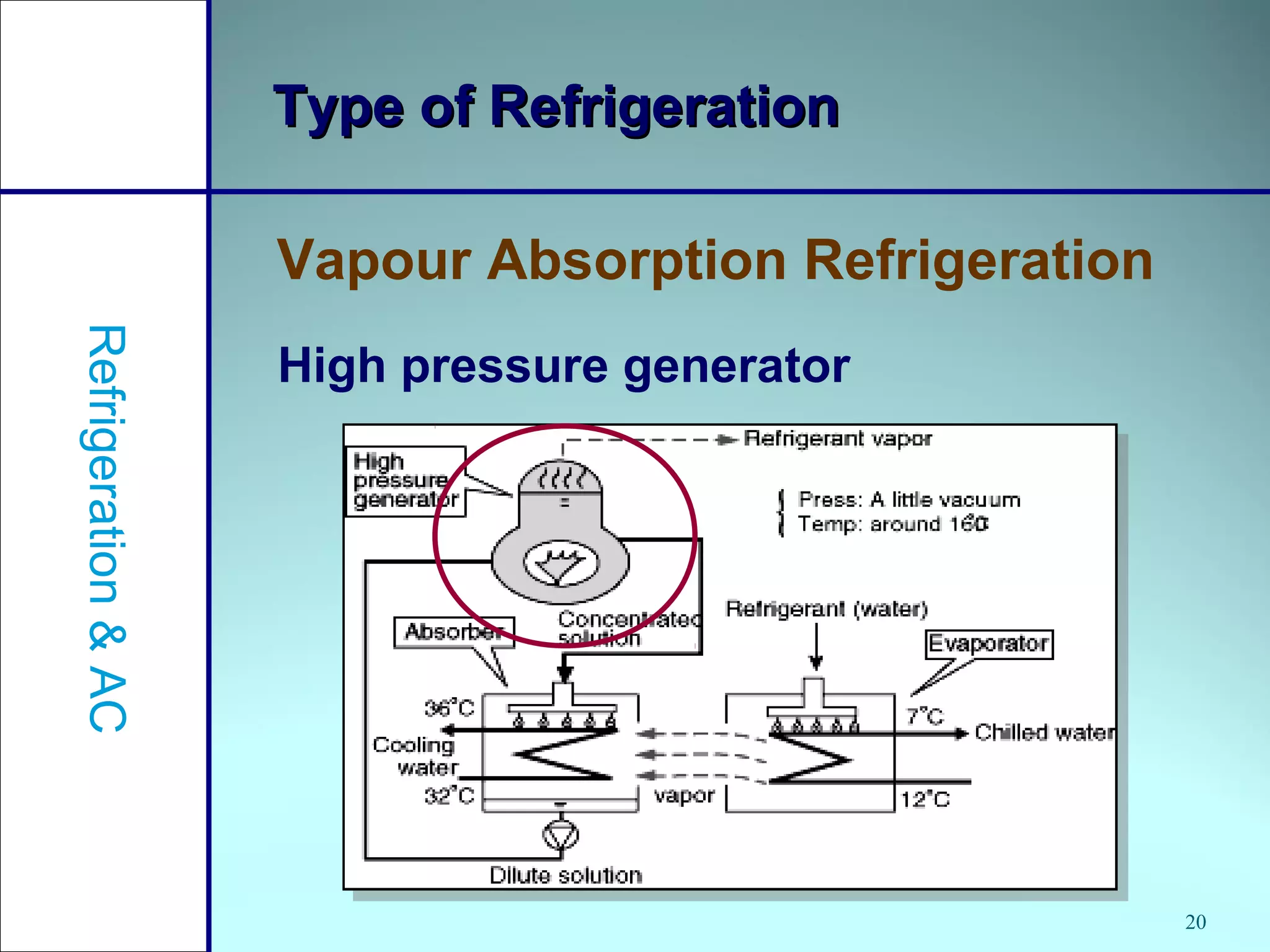
High pressure generator
21
Type of RefrigerationType of Refrigeration
Vapour Absorption Refrigeration
Refrigeration&AC
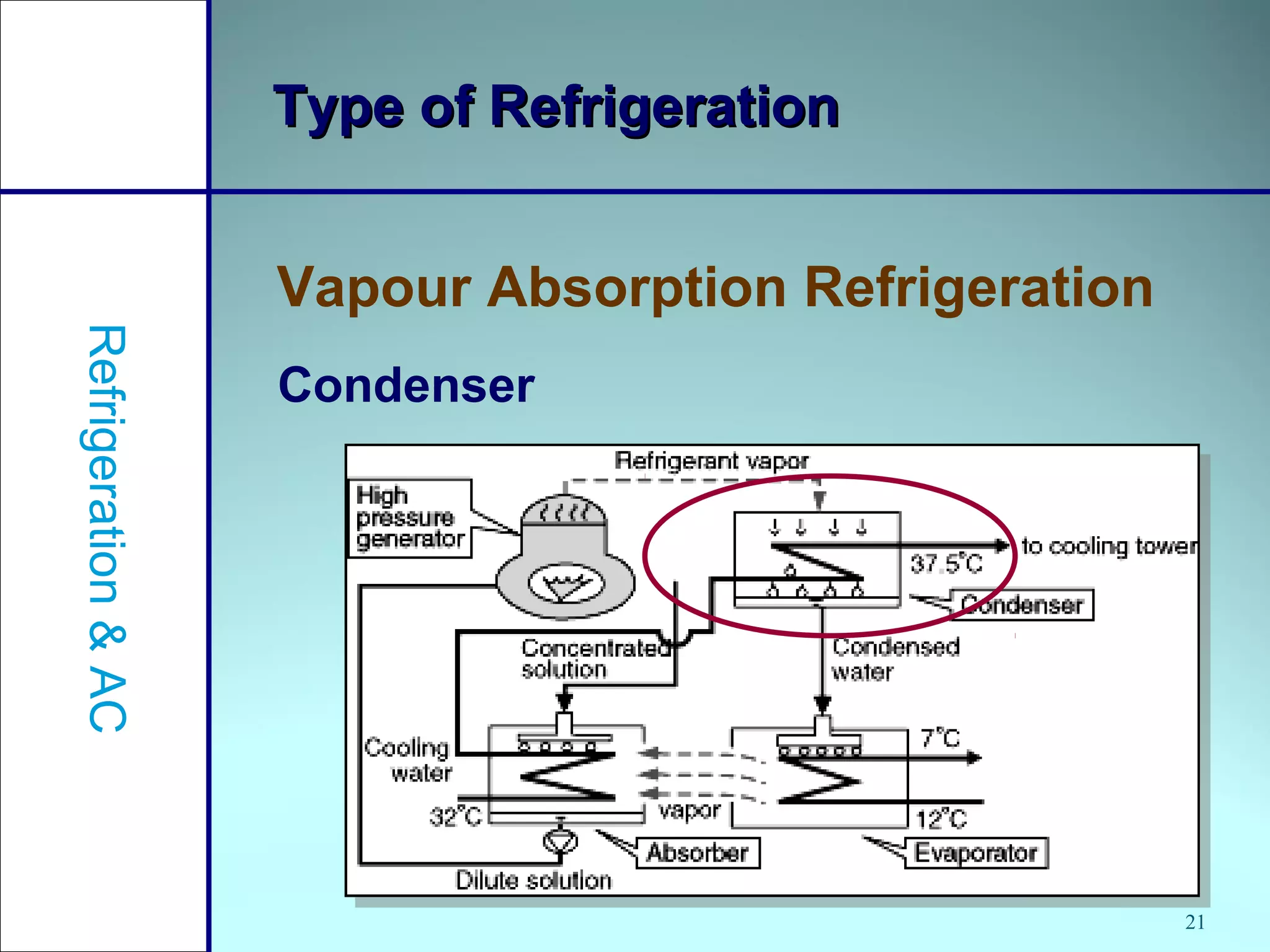
Condenser
22
Training Agenda: Refrigeration &Training Agenda: Refrigeration &
Air ConditioningAir Conditioning
Introduction
Type of refrigeration
Type Of Air Conditioner
Refrigeration&AC
23
• An air conditioning system is an assembly of different part of the
system used produce a specified condition of air within a require
space or building.
• The basic elements of air conditioning system:--
• Fans : For circulation of air
• Filters : For cleaning air
• Heating Elements : Heating of air(It may be electric heater , steam ,
hot water.
• Control System : It regulates automatically the amount of cooling
or heating.
• Grill : It adjust the direction of the conditioned air to the room.
• Tray : It collects condensed water.
• Refrigerating Plant : provide cooling . It consist of
compressor/generator and
absorber,eveporator,condensor,expansion
device(capallary tube).
Air Conditioning System
Refrigeration&AC
24
Types Of Air ConditionerTypes Of Air Conditioner
Refrigeration&AC
• Window Air Conditioner
• Split Air Conditioners
25
Types Of Air ConditionerTypes Of Air Conditioner
Window Air Conditioner
Refrigeration&AC
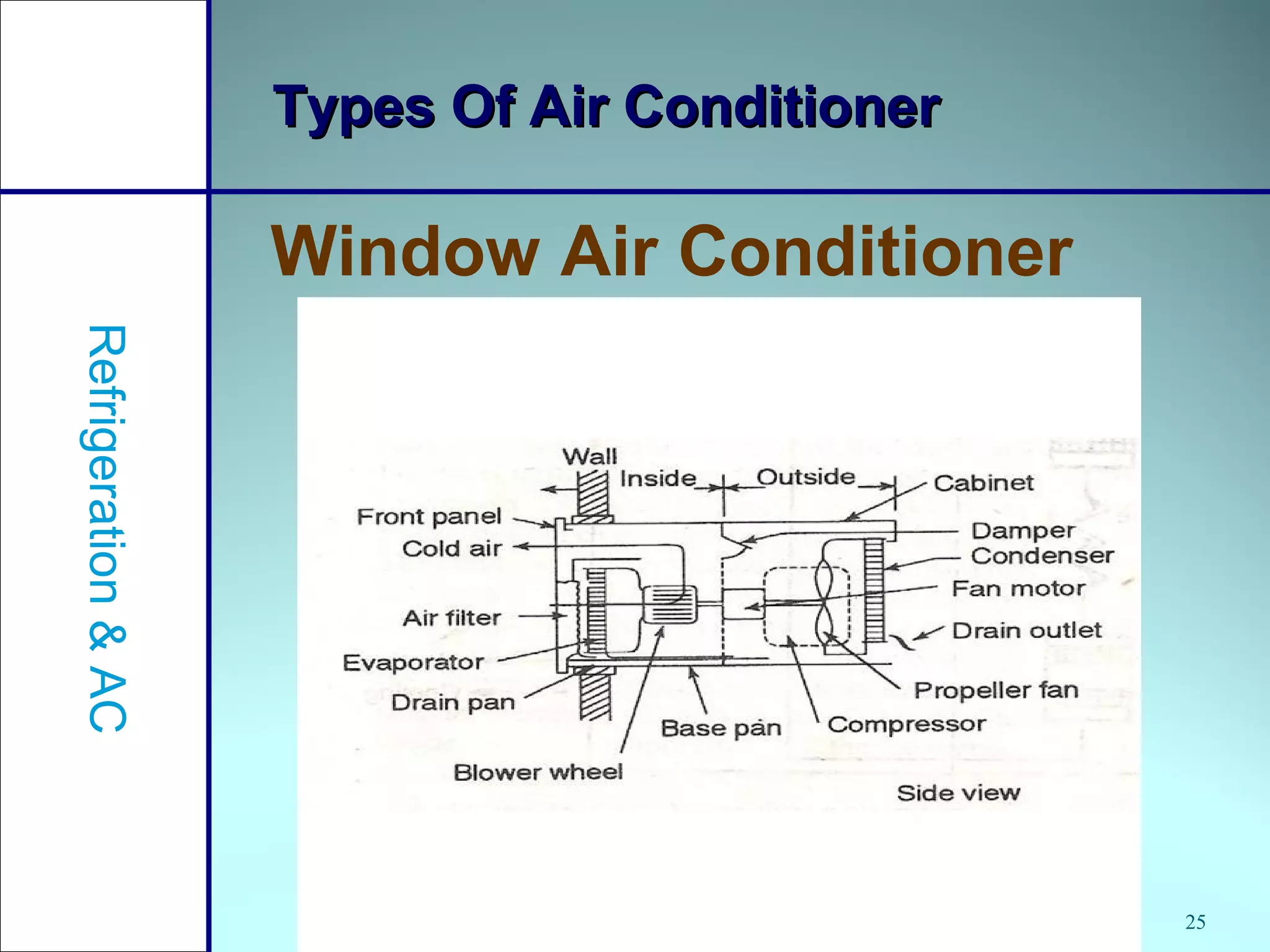
 Working:--The air circulation system of the window air conditioner comprises
of the following parts (please refer fig 4 & 5).
 1) Blower: This is the small blower that is fitted behind the evaporator or
cooling coil inside the assembly of the window air conditioner system. The
blower sucks the air from the room which first passes over the air filter and gets
filtered. The air then passes over the cooling coil and gets chilled. The blower
then blows this filtered and chilled air, which passes through the supply air
compartment inside the window air conditioner assembly. This air is then
delivered into the room from the supply air grill of the front panel.
 2) Propeller fan or the condenser fan: The condenser fan is the forced draft
type of propeller fan that sucks the atmospheric air and blows it over the
condenser. The hot refrigerant inside the condenser gives up the heat to the
atmospheric air and its temperature reduces.
 3) Fan motor: The motor inside the window air conditioner assembly is located
between the condenser and the evaporator coil. It has double shaft on one side
of which the blower is fitted and on the other side the condenser fan is fitted.
This makes the whole assembly of the blower, the condenser fan and the motor
highly compact.

26
Types Of Air ConditionerTypes Of Air Conditioner
Window Air Conditioner
Refrigeration&AC
Split Air Conditioner
The Split Air Conditioner divided in two
parts:--
(1)First part:-Include the
evaporator,filter,evaporator fan and grill. They
placed inside the room.
(2)Second part:-Include Condensor
,fan,compressor.This placed out side the
room.diameter tubes.therefore,small hole
rquired in wall of installation of split air
condition.The split air conditioning units are
available in capacity range of 1 to 3 tons.
27
28
WORKING OF SPLIT AC
CONDITIONER
The fans blow air over the coils to improve their ability to
dissipate heat (to the outside air) and cold (to the room being
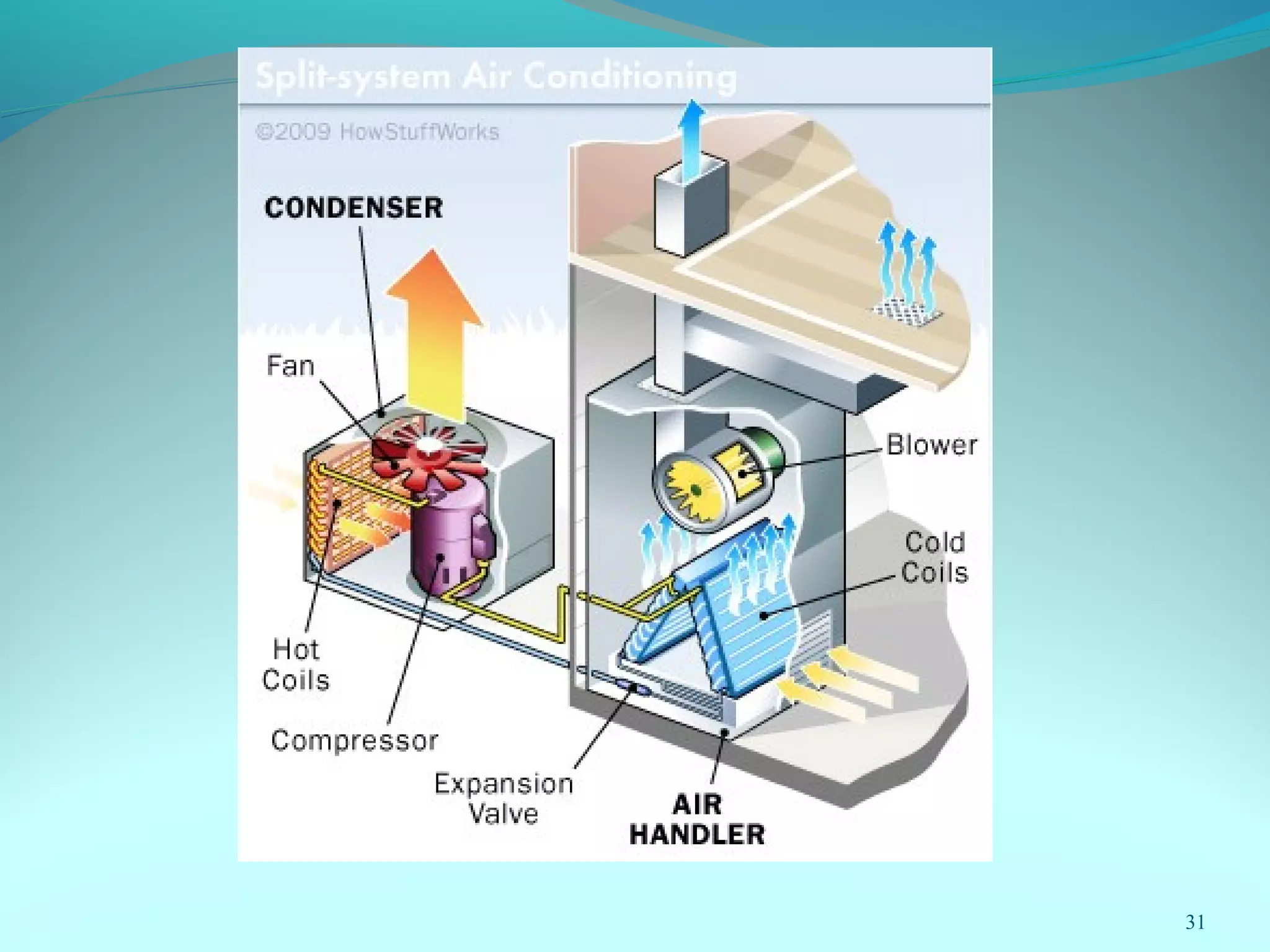
cooled).
When you get into larger air-conditioning applications, its time
to start looking at split-system units. A split-system air
conditioner splits the hot side from the cold side of the system,
as in the diagram below.
29
The cold side, consisting of the
expansion valve and the cold coil,
is generally placed into a furnace or
some other air handler. The air
handler blows air through the coil
and routes the air throughout the
building using a series of ducts.
The hot side, known as the
condensing unit, lives outside the
building.
30
The unit consists of a long, spiral
coil shaped like a cylinder. Inside
the coil is a fan, to blow air through
the coil, along with a weather-
resistant compressor and some
control logic. This approach has
evolved over the years because it's
low-cost, and also because it
normally results in reduced noise
inside the house (at the expense of
increased noise outside the house).
Other than the fact that the hot and
cold sides are split apart and the
capacity is higher (making the coils
and compressor larger), there's no
difference between a split-system
and a window air conditioner
31
32
References
http://home.howstuffworks.com/ac3.htm
33
Refrigeration & AirRefrigeration & Air
Conditioning SystemsConditioning Systems
THANK YOUTHANK YOU
FOR YOUR ATTENTIONFOR YOUR ATTENTION
Refrigeration&AC

Refrigrationairconditioning 140423035013-phpapp01 (1)

  • 1.
    1 ELEMENTS OF MECHANICAL ENGINEERING BABARIAINSTITUTE OF TECHNOLOGY FACULTY : RAGHVENDRA S DARJI BY : HARSH RUPAPARA
  • 2.
    2 Refrigeration & AirConditioningRefrigeration & Air Conditioning Introduction Type of refrigeration Refrigeration&AC
  • 3.
    3 IntroductionIntroduction How does it work? Refrigeration andair conditioning is used to cool products or a building environment. Refrigeration&AC High Temperature Reservoir Low Temperature Reservoir R Work Input Heat Absorbed Heat Rejected
  • 4.
    4 IntroductionIntroduction Thermal energy movesfrom left to right through five loops of heat transfer: How does it work? Refrigeration&AC (Bureau of Energy Efficiency, 2004) 1) Indoor air loop 2) Chilled water loop 3) Refrigerant loop 4) Condenser water loop 5) Cooling water loop
  • 5.
    5 IntroductionIntroduction • Small capacitymodular units of direct expansion type (50 Tons of Refrigeration) • Centralized chilled water plants with chilled water as a secondary coolant (50 – 250 TR) • Brine plants with brines as lower temperature, secondary coolant (>250 TR) Refrigeration systems for industrial processes Refrigeration&AC
  • 6.
    6 Training Agenda: Refrigeration&Training Agenda: Refrigeration & Air ConditioningAir Conditioning Introduction Type of refrigeration Types Of Air Conditioner Refrigeration&AC
  • 7.
    7 Types of RefrigerationTypesof Refrigeration • Vapour Compression Refrigeration (VCR): uses mechanical energy • Vapour Absorption Refrigeration (VAR): uses thermal energy Refrigeration systems Refrigeration&AC
  • 8.
    8 Type of RefrigerationTypeof Refrigeration Vapour Compression Refrigeration Refrigeration&AC • Highly compressed fluids tend to get colder when allowed to expand • If pressure high enough • Compressed air hotter than source of cooling • Expanded gas cooler than desired cold temperature
  • 9.
    9 Type of RefrigerationTypeof Refrigeration Vapour Compression Refrigeration Refrigeration&AC Two advantages • Lot of heat can be removed (lot of thermal energy to change liquid to vapour) • Heat transfer rate remains high (temperature of working fluid much lower than what is being cooled)
  • 10.
    10 Type of RefrigerationTypeof Refrigeration Vapour Compression Refrigeration Refrigeration&AC Refrigeration cycle Condenser Evaporator High Pressure Side Low Pressure Side Compressor Expansion Device 1 2 3 4
  • 11.
    11 Type of RefrigerationTypeof Refrigeration Vapour Compression Refrigeration /Refrigeration&AC Refrigeration cycle Low pressure liquid refrigerant in evaporator absorbs heat and changes to a gas Condenser Evaporator High Pressure Side Low Pressure Side Compressor Expansion Device 1 2 3 4
  • 12.
    12 Type of RefrigerationTypeof Refrigeration Vapour Compression Refrigeration Refrigeration&AC Refrigeration cycle The superheated vapour enters the compressor where its pressure is raised Condenser Evaporator High Pressure Side Low Pressure Side Compressor Expansion Device 1 2 3 4
  • 13.
    13 Type of RefrigerationTypeof Refrigeration Vapour Compression Refrigeration Refrigeration&AC Refrigeration cycle The high pressure superheated gas is cooled in several stages in the condenser Condenser Evaporator High Pressure Side Low Pressure Side Compressor Expansion Device 1 2 3 4
  • 14.
    14 Type of RefrigerationTypeof Refrigeration Vapour Compression Refrigeration Refrigeration&AC Refrigeration cycle Liquid passes through expansion device, which reduces its pressure and controls the flow into the evaporator Condenser Evaporator High Pressure Side Low Pressure Side Compressor Expansion Device 1 2 3 4
  • 15.
    15 Type of RefrigerationTypeof Refrigeration Vapour Compression Refrigeration Refrigeration&AC Type of refrigerant • Refrigerant determined by the required cooling temperature • Chlorinated fluorocarbons (CFCs) or freons: R-11, R-12, R-21, R-22 and R- 502
  • 16.
    16 Type of RefrigerationTypeof Refrigeration Vapour Compression Refrigeration Refrigeration&AC Choice of compressor, design of condenser, evaporator determined by • Refrigerant • Required cooling • Load • Ease of maintenance • Physical space requirements • Availability of utilities (water, power)
  • 17.
    17 Type of RefrigerationTypeof Refrigeration Vapour Absorption Refrigeration Refrigeration&AC Condenser Generator Evaporator AbsorberCold Side Hot Side
  • 18.
    18 Type of RefrigerationTypeof Refrigeration Vapour Absorption Refrigeration Refrigeration&AC Evaporator
  • 19.
    19 Type of RefrigerationTypeof Refrigeration Vapour Absorption Refrigeration Refrigeration&AC Absorber
  • 20.
    20 Type of RefrigerationTypeof Refrigeration Vapour Absorption Refrigeration Refrigeration&AC High pressure generator
  • 21.
    21 Type of RefrigerationTypeof Refrigeration Vapour Absorption Refrigeration Refrigeration&AC Condenser
  • 22.
    22 Training Agenda: Refrigeration&Training Agenda: Refrigeration & Air ConditioningAir Conditioning Introduction Type of refrigeration Type Of Air Conditioner Refrigeration&AC
  • 23.
    23 • An airconditioning system is an assembly of different part of the system used produce a specified condition of air within a require space or building. • The basic elements of air conditioning system:-- • Fans : For circulation of air • Filters : For cleaning air • Heating Elements : Heating of air(It may be electric heater , steam , hot water. • Control System : It regulates automatically the amount of cooling or heating. • Grill : It adjust the direction of the conditioned air to the room. • Tray : It collects condensed water. • Refrigerating Plant : provide cooling . It consist of compressor/generator and absorber,eveporator,condensor,expansion device(capallary tube). Air Conditioning System Refrigeration&AC
  • 24.
    24 Types Of AirConditionerTypes Of Air Conditioner Refrigeration&AC • Window Air Conditioner • Split Air Conditioners
  • 25.
    25 Types Of AirConditionerTypes Of Air Conditioner Window Air Conditioner Refrigeration&AC
  • 26.
     Working:--The aircirculation system of the window air conditioner comprises of the following parts (please refer fig 4 & 5).  1) Blower: This is the small blower that is fitted behind the evaporator or cooling coil inside the assembly of the window air conditioner system. The blower sucks the air from the room which first passes over the air filter and gets filtered. The air then passes over the cooling coil and gets chilled. The blower then blows this filtered and chilled air, which passes through the supply air compartment inside the window air conditioner assembly. This air is then delivered into the room from the supply air grill of the front panel.  2) Propeller fan or the condenser fan: The condenser fan is the forced draft type of propeller fan that sucks the atmospheric air and blows it over the condenser. The hot refrigerant inside the condenser gives up the heat to the atmospheric air and its temperature reduces.  3) Fan motor: The motor inside the window air conditioner assembly is located between the condenser and the evaporator coil. It has double shaft on one side of which the blower is fitted and on the other side the condenser fan is fitted. This makes the whole assembly of the blower, the condenser fan and the motor highly compact.  26 Types Of Air ConditionerTypes Of Air Conditioner Window Air Conditioner Refrigeration&AC
  • 27.
    Split Air Conditioner TheSplit Air Conditioner divided in two parts:-- (1)First part:-Include the evaporator,filter,evaporator fan and grill. They placed inside the room. (2)Second part:-Include Condensor ,fan,compressor.This placed out side the room.diameter tubes.therefore,small hole rquired in wall of installation of split air condition.The split air conditioning units are available in capacity range of 1 to 3 tons. 27
  • 28.
    28 WORKING OF SPLITAC CONDITIONER The fans blow air over the coils to improve their ability to dissipate heat (to the outside air) and cold (to the room being cooled). When you get into larger air-conditioning applications, its time to start looking at split-system units. A split-system air conditioner splits the hot side from the cold side of the system, as in the diagram below.
  • 29.
    29 The cold side,consisting of the expansion valve and the cold coil, is generally placed into a furnace or some other air handler. The air handler blows air through the coil and routes the air throughout the building using a series of ducts. The hot side, known as the condensing unit, lives outside the building.
  • 30.
    30 The unit consistsof a long, spiral coil shaped like a cylinder. Inside the coil is a fan, to blow air through the coil, along with a weather- resistant compressor and some control logic. This approach has evolved over the years because it's low-cost, and also because it normally results in reduced noise inside the house (at the expense of increased noise outside the house). Other than the fact that the hot and cold sides are split apart and the capacity is higher (making the coils and compressor larger), there's no difference between a split-system and a window air conditioner
  • 31.
  • 32.
  • 33.
    33 Refrigeration & AirRefrigeration& Air Conditioning SystemsConditioning Systems THANK YOUTHANK YOU FOR YOUR ATTENTIONFOR YOUR ATTENTION Refrigeration&AC

Editor's Notes

  • #4 Refrigeration and air conditioning is used to cool products or a building environment. The refrigeration or air conditioning system (R) transfers heat from a cooler low-energy reservoir to a warmer high-energy reservoir
  • #5 There are several heat transfer loops in a refrigeration system as shown in Figure 2. Thermal energy moves from left to right as it is extracted from the space and expelled into the outdoors through five loops of heat transfer: Indoor air loop. In the left loop, indoor air is driven by the supply air fan through a cooling coil, where it transfers its heat to chilled water. The cool air then cools the building space. Chilled water loop. Driven by the chilled water pump, water returns from the cooling coil to the chiller’s evaporator to be re-cooled. Refrigerant loop. Using a phase-change refrigerant, the chiller’s compressor pumps heat from the chilled water to the condenser water. Condenser water loop. Water absorbs heat from the chiller’s condenser, and the condenser water pump sends it to the cooling tower. Cooling tower loop. The cooling tower’s fan drives air across an open flow of the hot condenser water, transferring the heat to the outdoors.
  • #6 The following refrigeration systems exist for industrial processes (e.g. chilling plants) and domestic purposes (modular units, i.e. refrigerators): Small capacity modular units of the direct expansion type similar to domestic refrigerators. Centralized chilled water plants with chilled water as a secondary coolant for a temperature range over typically 5 oC. They can also be used for ice bank formation. Brine plants, which use brines as a lower temperature, secondary coolant for typically sub-zero temperature applications, which come as modular unit capacities as well as large centralized plant capacities. The plant capacities up to 50 TR (tons of refrigeration) are usually considered as small capacity, 50 – 250 TR as medium capacity and over 250 TR as large capacity units.
  • #7 This section include various types of refrigeration such as Vapour Compression Refrigeration and Vapour Absorption Refrigeration system
  • #8 The two principle types of refrigeration plants found in industrial use are: Vapour compression refrigeration (VCR) and vapour absorption refrigeration (VAR). VCR uses mechanical energy as the driving force for refrigeration, while VAR uses thermal energy as the driving force for refrigeration.
  • #9 Compression refrigeration cycles take advantage of the fact that highly compressed fluids at a certain temperature tend to get colder when they are allowed to expand. If the pressure change is high enough, then the compressed gas will be hotter than our source of cooling (outside air, for instance) and the expanded gas will be cooler than our desired cold temperature. In this case, fluid is used to cool a low temperature environment and reject the heat to a high temperature environment.
  • #10 Vapour compression refrigeration cycles have two advantages. First, a large amount of thermal energy is required to change a liquid to a vapor, and therefore a lot of heat can be removed from the air-conditioned space. Second, the isothermal nature of the vaporization allows extraction of heat without raising the temperature of the working fluid to the temperature of whatever is being cooled. This means that the heat transfer rate remains high, because the closer the working fluid temperature approaches that of the surroundings, the lower the rate of heat transfer.
  • #11 The refrigeration cycle is shown in the Figure and can be broken down into the following stages:---
  • #12 The refrigeration cycle is shown in the Figure and can be broken down into the following stages:--- 1 – 2. Low-pressure liquid refrigerant in the evaporator absorbs heat from its surroundings, usually air, water or some other process liquid. During this process it changes its state from a liquid to a gas, and at the evaporator exit is slightly superheated.
  • #13 The refrigeration cycle is shown in the Figure and can be broken down into the following stages:--- 2 – 3. The superheated vapour enters the compressor where its pressure is raised. The temperature will also increase, because a proportion of the energy put into the compression process is transferred to the refrigerant.
  • #14 The refrigeration cycle is shown in the Figure and can be broken down into the following stages:--- 3 – 4. The high pressure superheated gas passes from the compressor into the condenser. The initial part of the cooling process (3-3a) de-superheats the gas before it is then turned back into liquid (3a-3b). The cooling for this process is usually achieved by using air or water. A further reduction in temperature happens in the pipe work and liquid receiver (3b - 4), so that the refrigerant liquid is sub-cooled as it enters the expansion device
  • #15 The refrigeration cycle is shown in the Figure and can be broken down into the following stages:--- 1 – 2. Low-pressure liquid refrigerant in the evaporator absorbs heat from its surroundings, usually air, water or some other process liquid. During this process it changes its state from a liquid to a gas, and at the evaporator exit is slightly superheated. 2 – 3. The superheated vapour enters the compressor where its pressure is raised. The temperature will also increase, because a proportion of the energy put into the compression process is transferred to the refrigerant. 3 – 4. The high pressure superheated gas passes from the compressor into the condenser. The initial part of the cooling process (3-3a) de-superheats the gas before it is then turned back into liquid (3a-3b). The cooling for this process is usually achieved by using air or water. A further reduction in temperature happens in the pipe work and liquid receiver (3b - 4), so that the refrigerant liquid is sub-cooled as it enters the expansion device.CondenserEvaporatorHigh Pressure SideLow Pressure SideCompressorExpansion Device1234 4 - 1 The high-pressure sub-cooled liquid passes through the expansion device, which both reduces its pressure and controls the flow into the evaporator
  • #16 A variety of refrigerants are used in vapor compression systems. The choice of fluid is determined largely by the cooling temperature required. Commonly used refrigerants are in the family of chlorinated fluorocarbons, CFCs, also known as freons: R-11, R-12, R-21, R-22 and R-502.
  • #17 The choice of refrigerant and the required cooling temperature and load determine the choice of compressor, as well as the design of the condenser, evaporator, and other auxiliaries. Additional factors such as ease of maintenance, physical space requirements and availability of utilities for auxiliaries (water, power, etc.) also influence component selection.
  • #18 The vapour absorption refrigeration system consists of: Evaporator Absorber High pressure generator Condenser
  • #19 Evaporator The refrigerant (water) evaporates at around 4oC under a high vacuum condition of 754 mm Hg in the evaporator. Chilled water goes through heat exchanger tubes in the evaporator and transfers heat to the evaporated refrigerant. The evaporated refrigerant (vapor) turns into liquid again, while the latent heat from this vaporization process cools the chilled water (in the diagram from 12 oC to 7 oC). The chilled water is then used for cooling purposes.
  • #20 Absorber In order to keep evaporating, the refrigerant vapor must be discharged from the evaporator and refrigerant (water) must be supplied. The refrigerant vapor is absorbed into lithium bromide solution, which is convenient to absorb the refrigerant vapor in the absorber. The heat generated in the absorption process is continuously removed from the system by cooling water. The absorption also maintains the vacuum inside the evaporator.
  • #21 High Pressure Generator As lithium bromide solution is diluted, the ability to absorb the refrigerant vapor reduces. In order to keep the absorption process going, the diluted lithium bromide solution must be concentrated again. An absorption chiller is provided with a solution concentrating system, called a generator. Heating media such as steam, hot water, gas or oil perform the function of concentrating solutions.The concentrated solution is returned to the absorber to absorb refrigerant vapor again.
  • #22 Condenser To complete the refrigeration cycle, and thereby ensuring the refrigeration takes place continuously, the following two functions are required To concentrate and liquefy the evaporated refrigerant vapor, which is generated in the high-pressure generator. To supply the condensed water to the evaporator as refrigerant (water) For these two functions a condenser is installed.
  • #23 This section include performance evaluation of refrigeration plant and examples for the assessment of refrigeration plant.
  • #24 Depending on applications, there are several options / combinations of air conditioning, which are available for use: Air conditioning (for space or machines) Split air conditioners Window Air Conditioner
  • #25 Depending on applications, there are several options / combinations of air conditioning, which are available for use: Air conditioning (for space or machines) Split air conditioners Window Air Conditioner
  • #26 Depending on applications, there are several options / combinations of air conditioning, which are available for use: Air conditioning (for space or machines) Split air conditioners Window Air Conditioner
  • #27 Depending on applications, there are several options / combinations of air conditioning, which are available for use: Air conditioning (for space or machines) Split air conditioners Window Air Conditioner
  • #34 Thank you for your attention!