REFRIGERATION
SYSTEMS
PREPARE BY: DHRUPAL GANDHI
(116390319059)
GUIDANCE: VAISHALI MADAM
Refrigeration System
COURSE: DIPLOMA IN
MECHNICAL ENGINEERING
SUBJECT:THERMAL ENGINEERING
UNIT: REFRIGERATION AND AIR
CONDITIONING
Introduction
The mechanism used for lowering or
producing low temp. in a body or a space,
whose temp. is already below the temp. of
its surrounding, is called the refrigeration
system.
Here the heat is being generally pumped
from low level to the higher one & is
rejected at high temp.
Refrigeration
The term refrigeration may be defined as
the process of removing heat from a
substance under controlled conditions.
It also includes the process of reducing

heat & maintaining the temp. of a body
below the general temp. of its
surroundings.
Contd….
In other words the refrigeration means a
continued extraction of heat from a body
whose temp is already below the temp. of
its surroundings.
Refrigerator & Refrigerant
A refrigerator is a reversed heat engine or
a heat pump which takes out heat from a
cold body & delivers it to a hot body.
The refrigerant is a heat carrying medium
which during their cycle in a refrigeration
system absorbs heat from a low temp.
system & delivers it to a higher temp.
system.
Refrigeration Cycle
In refrigeration system the heat is being
generally pumped from low level to higher
one & rejected at that temp.
This rejection of heat from low level to
higher level of temp. can only be
performed with the help of external work
according to second law of
thermodynamics.
Contd….
The total amount of heat being rejected to
the outside body consist of two parts:-
- the heat extracted from the body to be
cooled .
- the heat equivalent to the mechanical
work required for extracting it.
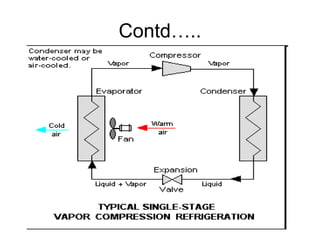
Contd…..
Contd….
A refrigerator is a reverse heat engine run
in the reverse direction by means of
external aid.
Every type of refrigeration system used for
producing cold must have the following
four basic units:-
Contd….
• Low temp. thermal sink to which the heat
is rejected for cooling the space.
• Means of extracting the heat energy from
the sink, raising its level of temp. before
delivering it to heat receiver.
• A receiver is a storage to which the heat is
transferred from the high temp., high
pressure refrigerant.
Contd…..
• Means of reducing the pressure & temp.
of the refrigerant before it return to the
sink.
The processes of the cycle are
evaporation, compression, condensation
& expansion.
By reversing the heat engine cycle
completely & by changing the working
agent, a refrigeration cycle is obtained.
Refrigeration Systems
• Vapour compression refrigeration system
• Vapour absorption refrigeration system
• Thermo electric refrigeration system
Vapour Compression Refrigeration
• This is the most important system from the
point of commercial & domestic utility &
most practical form of refrigeration.
• The working fluid refrigerant used in this
refrigeration system readily evaporates &
condenses or changes alternatively
between the vapour & liquid phases
without leaving the refrigerating plant
Contd….
• During evaporation it absorbs heat from
the cold body or in condensing or cooling
it rejects heat to the external hot body .
• The heat absorbed from cold body during
evaporation is used as its latent heat for
converting it from liquid to vapour.
• Thus a cooling effect is created in working
fluid.
Contd….
• This system of refrigeration thus act as latent
heat pump since its pump its latent heat from the
cold body or brine & rejects it or deliver it to the
external hot body or the cooling medium.
• According to the law of thermodynamics , this
can be done only on the expenditure of energy
which is supplied to the system in the form of
electrical energy driving the compressor.
Contd….
• The vapour compression cycle is used in
most of the modern refrigeration systems
in large industrial plants.
• The vapour in this cycle is circulated
through the various components of the
system, where it undergoes a number of
changes in its state or condition.
Contd….
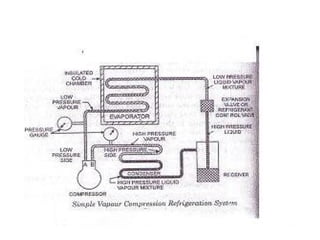
• Each cycle of operation consists of the
four fundamental changes of state or
processes:-
 Expansion
Vaporisation
Compression
Condensation
Components of Vapour
Compression Systems
Compressor
The low pressure & temp. refrigerant from
evaporator is drawn into the compressor through
the inlet or suction valve , where it is
compressed to a high pressure & temp.
The high pressure & temp vapour refrigerant is
discharged into the condenser through the
delivery or discharge valve.
Condenser
The condenser or the cooler consists of coils
of pipe in which the high pressure & temp.
vapour refrigerant is cooled & condensed.
The refrigerant while passing through the
condenser, rejects its latent heat to surrounding
condensing medium which is normally air or
water.
Thus hot refrigerant vapour received from
compressor is converted into liquid form in
condenser.
Receiver
The condensed liquid refrigerant from the
condenser is stored in a vessel, known as
receiver, from where it is supplied to the
expansion valve or refrigerant control
valve.
Expansion Valve
The function of this valve is to allow the
liquid refrigerant under high pressure &
temp. to pass at a controlled rate after
reducing its pressure & temp.
some of liquid refrigerant evaporates as it
passes through the expansion valve, but
the greater portion is vaporised in the
evaporator at the low pressure & temp.
Evaporator
An evaporator consists of coils of pipes in which
the liquid vapour refrigerant at low pressure &
temp. is evaporated & changed into vapour
refrigerant at low pressure & temp.
During evaporation process, the liquid vapour
refrigerant absorbs its latent heat of vaporization
from the medium which is to be cooled.
Advantages
• Smaller size for a given refrigerating
capacity
• Higher coeff. of performance
• Lower power requirements for a given
capacity
• Less complexity in both design &
operation
• It can be used over large of temp.
Domestic Refrigerator
• The application of refrigeration for
domestic purposes are mainly in the form
of domestic refrigerators & home freezers.
• The main purpose of this type of
refrigeration is to provide low temp. for
storage & distribution of foods & drinks.
Contd….
• It represents a significant portion of the
refrigeration industry due to the use of
these units in large number.
• For domestic preservation, the storage is
generally short term. The domestic
refrigerators used for the purposes are
usually small in sizes with rating in ranges
from 1/20 to ½ tonne.
Contd….
• The unit is usually self contained and
hermetically sealed.
• Due to short term storage the domestic
refrigerator load is intermittent.
Contd….
The requirement of domestic refrigerator is
that:-
• it should be simple in construction
• automatic in action
• nominal in initial cost
Contd….
• dependable and without any necessity of
expert inspection & repair.
• Non irritant & non toxic refrigerant should
be used.
• Generally methylene chloride, freon-12,
freon -11 are used as refrigerants.
Contd…
• The common type of domestic refrigerator
have a cabinet shaped with compressor
motor-fan assembly, the condensed and
receiver fitted in their basement.
• The expansion valve evaporator coils are
exposed in the storage cabinet with the
piping, carrying liquid refrigerant passing
through the body.
Contd….
• The heat of the bodies to be cooled is carried to
the evaporator coils by means of air trapped in
the cabinet.
• Refrigeration is not only provided with double
walled cabinet packed with materials having high
thermal insulation such as fibre glass or
expanded rubber but also all around the inside
of door flap soft rubber seal is used which
makes rubber air tight.
Electrical Circuit
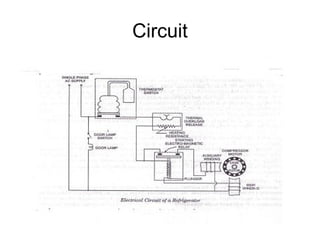
• Refrigerator is provided with a door push switch,
which closes on opening of refrigerator and puts
the lamp on.
• Capacitor start single phase induction motor is
used in open type refrigerators and split phase
induction motor is used in sealed unit
refrigerators.
• Electromagnetic relay is provided to connect
auxiliary winding on the start & disconnect it
when the motor picks up the speed.
Circuit
Contd…..
• Thermal overload release is provided to
protect the motor from damage against
flow of over current.
• Thermostat switch is provided to control
the temp. inside the refrigerator.
• Temp. inside the refrigerator can be
adjusted by means of temp. control screw.
Contd…
• To protect the motor against under voltage
use of automatic voltage regulator is
essential since in case of fall in applied
voltage, motor will draw heavy current to
develop the required torque and will
become hot, thermal overload relay will
therefore repeatedly disconnect and
connect the motor to supply, eventually
burning it out.
THANKS…..

Refrigeration system

  • 1.
    REFRIGERATION SYSTEMS PREPARE BY: DHRUPALGANDHI (116390319059) GUIDANCE: VAISHALI MADAM
  • 2.
    Refrigeration System COURSE: DIPLOMAIN MECHNICAL ENGINEERING SUBJECT:THERMAL ENGINEERING UNIT: REFRIGERATION AND AIR CONDITIONING
  • 3.
    Introduction The mechanism usedfor lowering or producing low temp. in a body or a space, whose temp. is already below the temp. of its surrounding, is called the refrigeration system. Here the heat is being generally pumped from low level to the higher one & is rejected at high temp.
  • 4.
    Refrigeration The term refrigerationmay be defined as the process of removing heat from a substance under controlled conditions. It also includes the process of reducing heat & maintaining the temp. of a body below the general temp. of its surroundings.
  • 5.
    Contd…. In other wordsthe refrigeration means a continued extraction of heat from a body whose temp is already below the temp. of its surroundings.
  • 6.
    Refrigerator & Refrigerant Arefrigerator is a reversed heat engine or a heat pump which takes out heat from a cold body & delivers it to a hot body. The refrigerant is a heat carrying medium which during their cycle in a refrigeration system absorbs heat from a low temp. system & delivers it to a higher temp. system.
  • 7.
    Refrigeration Cycle In refrigerationsystem the heat is being generally pumped from low level to higher one & rejected at that temp. This rejection of heat from low level to higher level of temp. can only be performed with the help of external work according to second law of thermodynamics.
  • 8.
    Contd…. The total amountof heat being rejected to the outside body consist of two parts:- - the heat extracted from the body to be cooled . - the heat equivalent to the mechanical work required for extracting it.
  • 9.
  • 10.
    Contd…. A refrigerator isa reverse heat engine run in the reverse direction by means of external aid. Every type of refrigeration system used for producing cold must have the following four basic units:-
  • 11.
    Contd…. • Low temp.thermal sink to which the heat is rejected for cooling the space. • Means of extracting the heat energy from the sink, raising its level of temp. before delivering it to heat receiver. • A receiver is a storage to which the heat is transferred from the high temp., high pressure refrigerant.
  • 12.
    Contd….. • Means ofreducing the pressure & temp. of the refrigerant before it return to the sink. The processes of the cycle are evaporation, compression, condensation & expansion. By reversing the heat engine cycle completely & by changing the working agent, a refrigeration cycle is obtained.
  • 13.
    Refrigeration Systems • Vapourcompression refrigeration system • Vapour absorption refrigeration system • Thermo electric refrigeration system
  • 14.
    Vapour Compression Refrigeration •This is the most important system from the point of commercial & domestic utility & most practical form of refrigeration. • The working fluid refrigerant used in this refrigeration system readily evaporates & condenses or changes alternatively between the vapour & liquid phases without leaving the refrigerating plant
  • 15.
    Contd…. • During evaporationit absorbs heat from the cold body or in condensing or cooling it rejects heat to the external hot body . • The heat absorbed from cold body during evaporation is used as its latent heat for converting it from liquid to vapour. • Thus a cooling effect is created in working fluid.
  • 17.
    Contd…. • This systemof refrigeration thus act as latent heat pump since its pump its latent heat from the cold body or brine & rejects it or deliver it to the external hot body or the cooling medium. • According to the law of thermodynamics , this can be done only on the expenditure of energy which is supplied to the system in the form of electrical energy driving the compressor.
  • 18.
    Contd…. • The vapourcompression cycle is used in most of the modern refrigeration systems in large industrial plants. • The vapour in this cycle is circulated through the various components of the system, where it undergoes a number of changes in its state or condition.
  • 19.
    Contd…. • Each cycleof operation consists of the four fundamental changes of state or processes:-  Expansion Vaporisation Compression Condensation
  • 20.
  • 21.
    Compressor The low pressure& temp. refrigerant from evaporator is drawn into the compressor through the inlet or suction valve , where it is compressed to a high pressure & temp. The high pressure & temp vapour refrigerant is discharged into the condenser through the delivery or discharge valve.
  • 22.
    Condenser The condenser orthe cooler consists of coils of pipe in which the high pressure & temp. vapour refrigerant is cooled & condensed. The refrigerant while passing through the condenser, rejects its latent heat to surrounding condensing medium which is normally air or water. Thus hot refrigerant vapour received from compressor is converted into liquid form in condenser.
  • 23.
    Receiver The condensed liquidrefrigerant from the condenser is stored in a vessel, known as receiver, from where it is supplied to the expansion valve or refrigerant control valve.
  • 24.
    Expansion Valve The functionof this valve is to allow the liquid refrigerant under high pressure & temp. to pass at a controlled rate after reducing its pressure & temp. some of liquid refrigerant evaporates as it passes through the expansion valve, but the greater portion is vaporised in the evaporator at the low pressure & temp.
  • 25.
    Evaporator An evaporator consistsof coils of pipes in which the liquid vapour refrigerant at low pressure & temp. is evaporated & changed into vapour refrigerant at low pressure & temp. During evaporation process, the liquid vapour refrigerant absorbs its latent heat of vaporization from the medium which is to be cooled.
  • 26.
    Advantages • Smaller sizefor a given refrigerating capacity • Higher coeff. of performance • Lower power requirements for a given capacity • Less complexity in both design & operation • It can be used over large of temp.
  • 27.
    Domestic Refrigerator • Theapplication of refrigeration for domestic purposes are mainly in the form of domestic refrigerators & home freezers. • The main purpose of this type of refrigeration is to provide low temp. for storage & distribution of foods & drinks.
  • 28.
    Contd…. • It representsa significant portion of the refrigeration industry due to the use of these units in large number. • For domestic preservation, the storage is generally short term. The domestic refrigerators used for the purposes are usually small in sizes with rating in ranges from 1/20 to ½ tonne.
  • 29.
    Contd…. • The unitis usually self contained and hermetically sealed. • Due to short term storage the domestic refrigerator load is intermittent.
  • 30.
    Contd…. The requirement ofdomestic refrigerator is that:- • it should be simple in construction • automatic in action • nominal in initial cost
  • 31.
    Contd…. • dependable andwithout any necessity of expert inspection & repair. • Non irritant & non toxic refrigerant should be used. • Generally methylene chloride, freon-12, freon -11 are used as refrigerants.
  • 32.
    Contd… • The commontype of domestic refrigerator have a cabinet shaped with compressor motor-fan assembly, the condensed and receiver fitted in their basement. • The expansion valve evaporator coils are exposed in the storage cabinet with the piping, carrying liquid refrigerant passing through the body.
  • 33.
    Contd…. • The heatof the bodies to be cooled is carried to the evaporator coils by means of air trapped in the cabinet. • Refrigeration is not only provided with double walled cabinet packed with materials having high thermal insulation such as fibre glass or expanded rubber but also all around the inside of door flap soft rubber seal is used which makes rubber air tight.
  • 34.
    Electrical Circuit • Refrigeratoris provided with a door push switch, which closes on opening of refrigerator and puts the lamp on. • Capacitor start single phase induction motor is used in open type refrigerators and split phase induction motor is used in sealed unit refrigerators. • Electromagnetic relay is provided to connect auxiliary winding on the start & disconnect it when the motor picks up the speed.
  • 35.
  • 36.
    Contd….. • Thermal overloadrelease is provided to protect the motor from damage against flow of over current. • Thermostat switch is provided to control the temp. inside the refrigerator. • Temp. inside the refrigerator can be adjusted by means of temp. control screw.
  • 37.
    Contd… • To protectthe motor against under voltage use of automatic voltage regulator is essential since in case of fall in applied voltage, motor will draw heavy current to develop the required torque and will become hot, thermal overload relay will therefore repeatedly disconnect and connect the motor to supply, eventually burning it out.
  • 38.