SEMINAR
ON
“VAPOUR COMPRESSION REFRIGERATION”
GUIDED BY:- PREPARED BY:-
Mr. Devendra Bhandari Ujjwal Nautiyal
B.Tech(ME) II sem
1014366(38)
Refrigeration
 Vapour Compression Refrigeration
 Refrigeration is a process of removal of heat from a
substance at a temperature lower than the
surrounding with the aid of external work.
 In a refrigeration system, the rate at which the heat is
absorbed in a cycle from the interior space to be
cooled is called Refrigerating Effect.
Refrigeration
*
*In a refrigerator, a medium called Refrigerant
continuously extracts the heat from the
refrigerator which is to be kept cool at
temperatures less than the atmosphere &
finally rejects to it.
*Refrigerant acts as a heat exchange medium.
*e.g.- Ammonia, Freon, Methyl Chloride, Carbon
dioxide, Isobutane.
Unit of Refrigeration & Ice making
Capacity
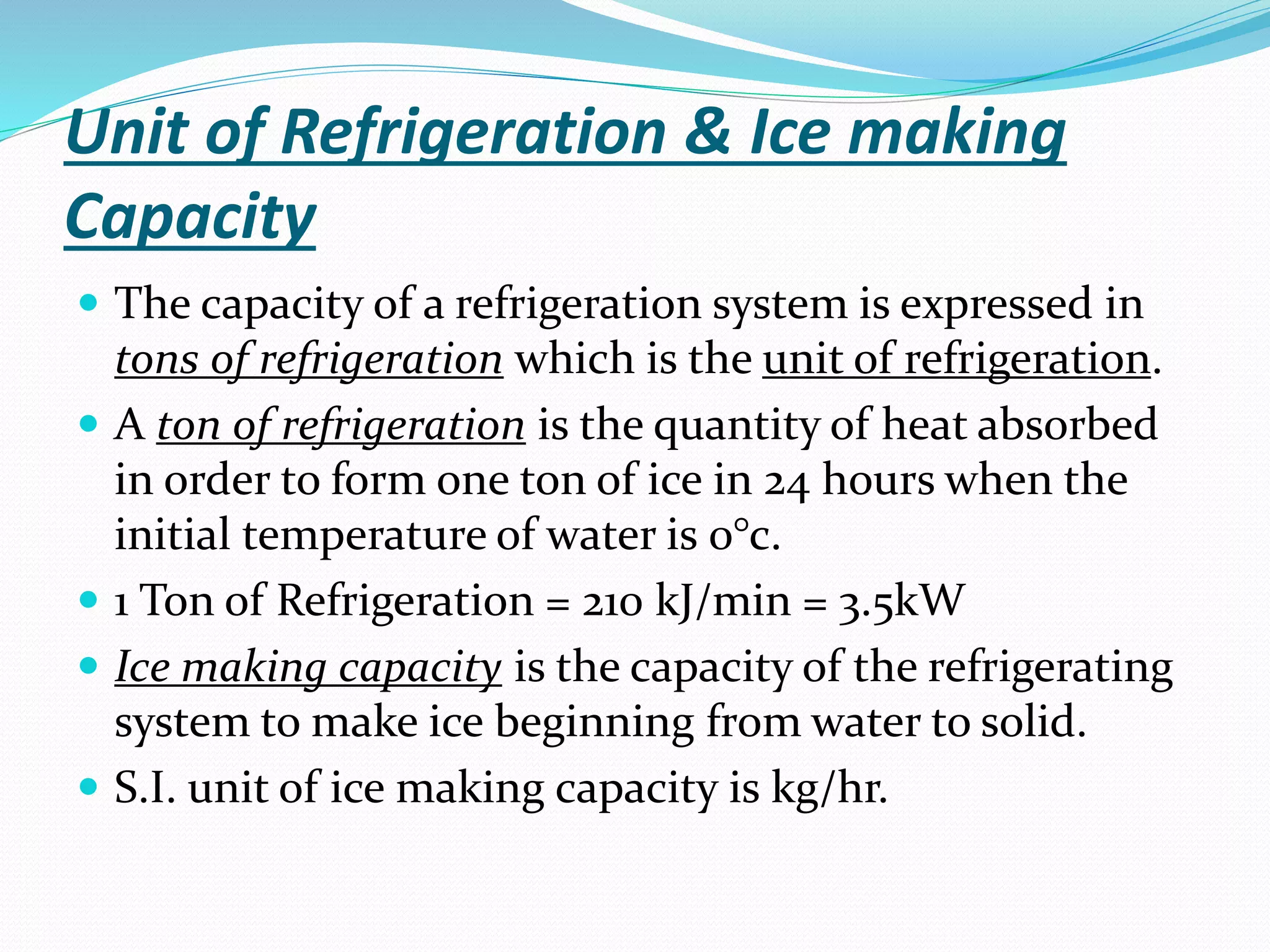
 The capacity of a refrigeration system is expressed in
tons of refrigeration which is the unit of refrigeration.
 A ton of refrigeration is the quantity of heat absorbed
in order to form one ton of ice in 24 hours when the
initial temperature of water is 0°c.
 1 Ton of Refrigeration = 210 kJ/min = 3.5kW
 Ice making capacity is the capacity of the refrigerating
system to make ice beginning from water to solid.
 S.I. unit of ice making capacity is kg/hr.
Coefficient of
Performance
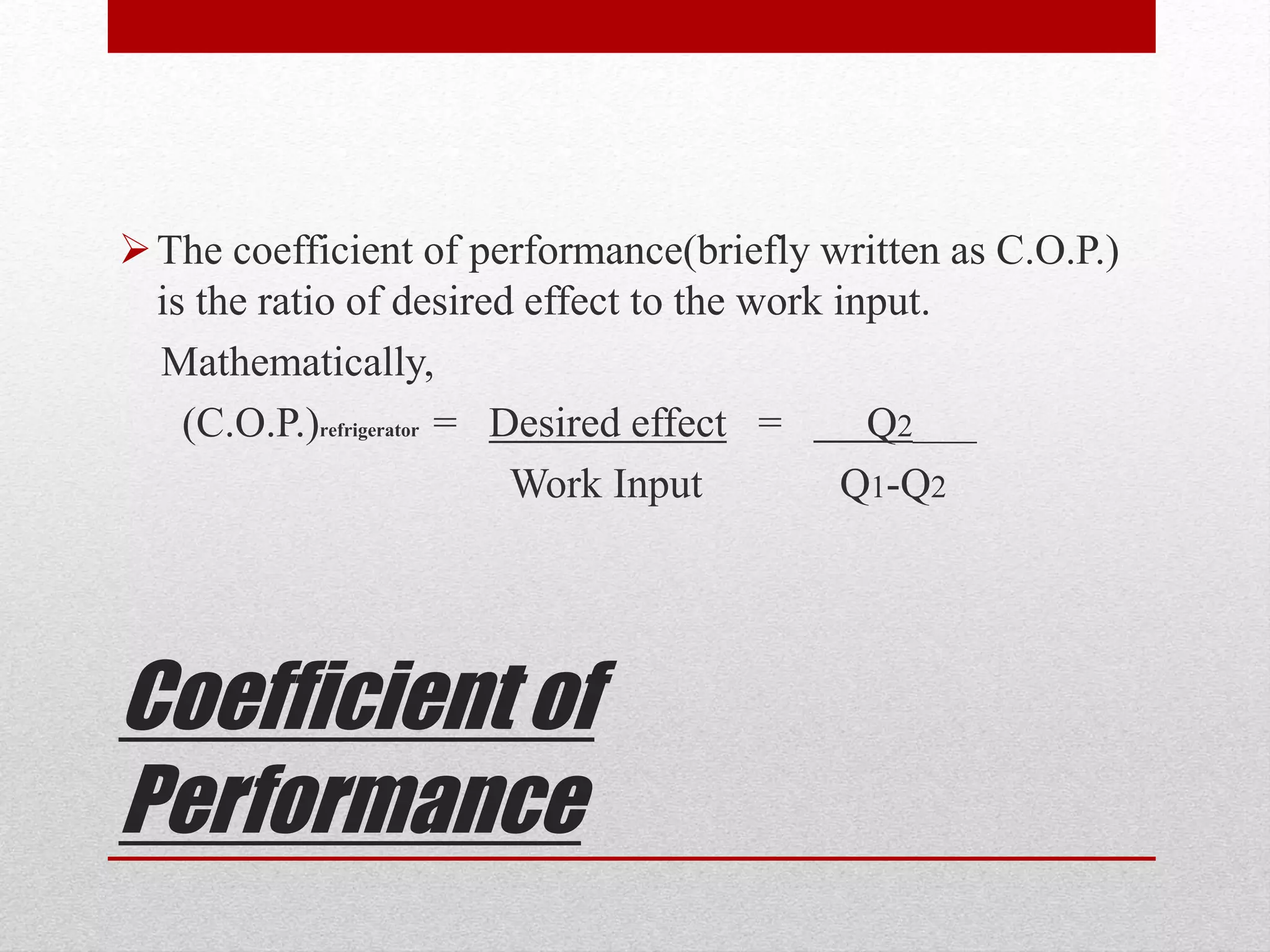
The coefficient of performance(briefly written as C.O.P.)
is the ratio of desired effect to the work input.
Mathematically,
(C.O.P.)refrigerator = Desired effect = Q2____
Work Input Q1-Q2
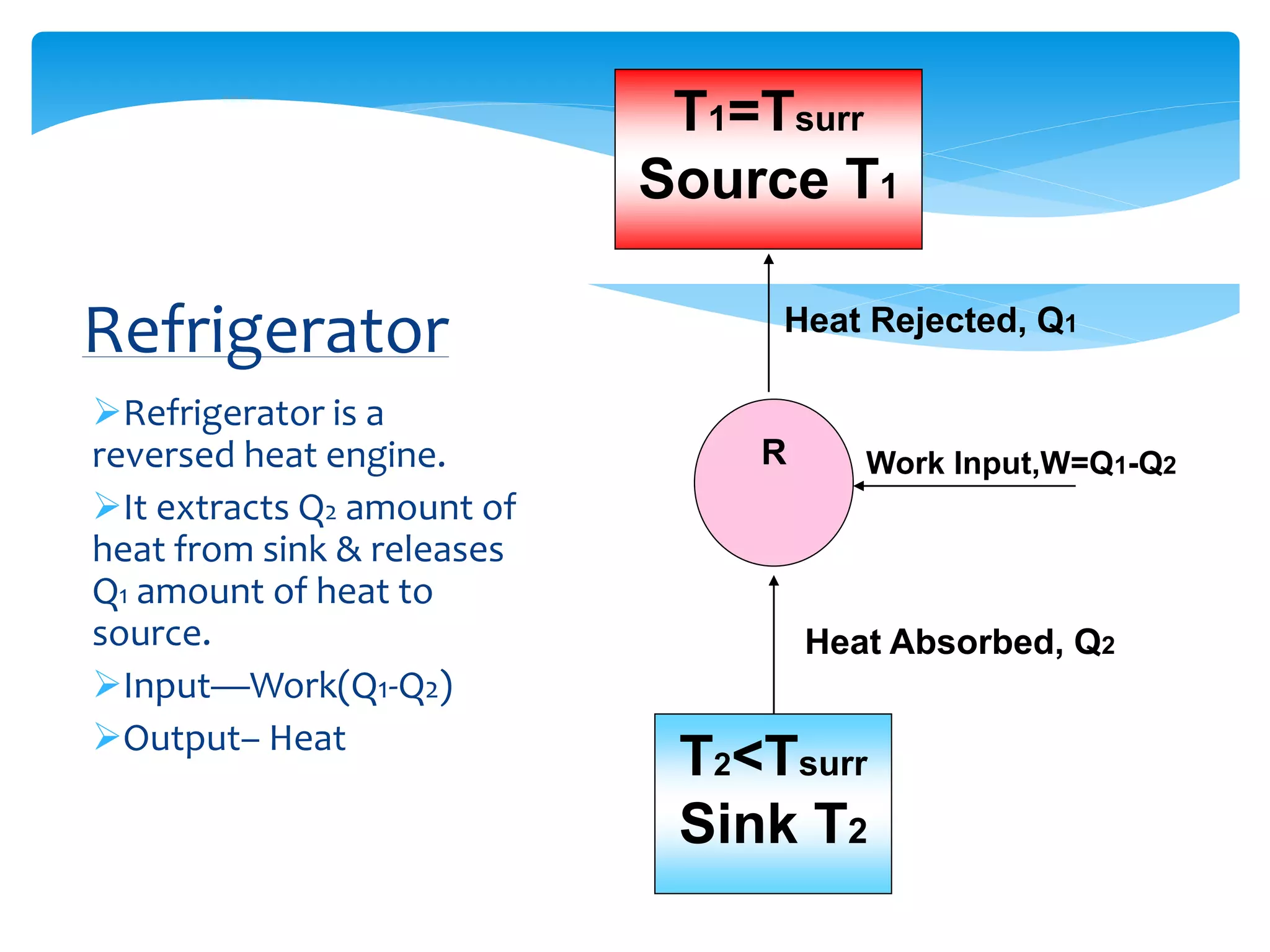
T1=Tsurr
Source T1
T2<Tsurr
Sink T2
R Work Input,W=Q1-Q2
Heat Absorbed, Q2
Heat Rejected, Q1
Refrigerator is a
reversed heat engine.
It extracts Q2 amount of
heat from sink & releases
Q1 amount of heat to
source.
Input—Work(Q1-Q2)
Output– Heat
Refrigerator
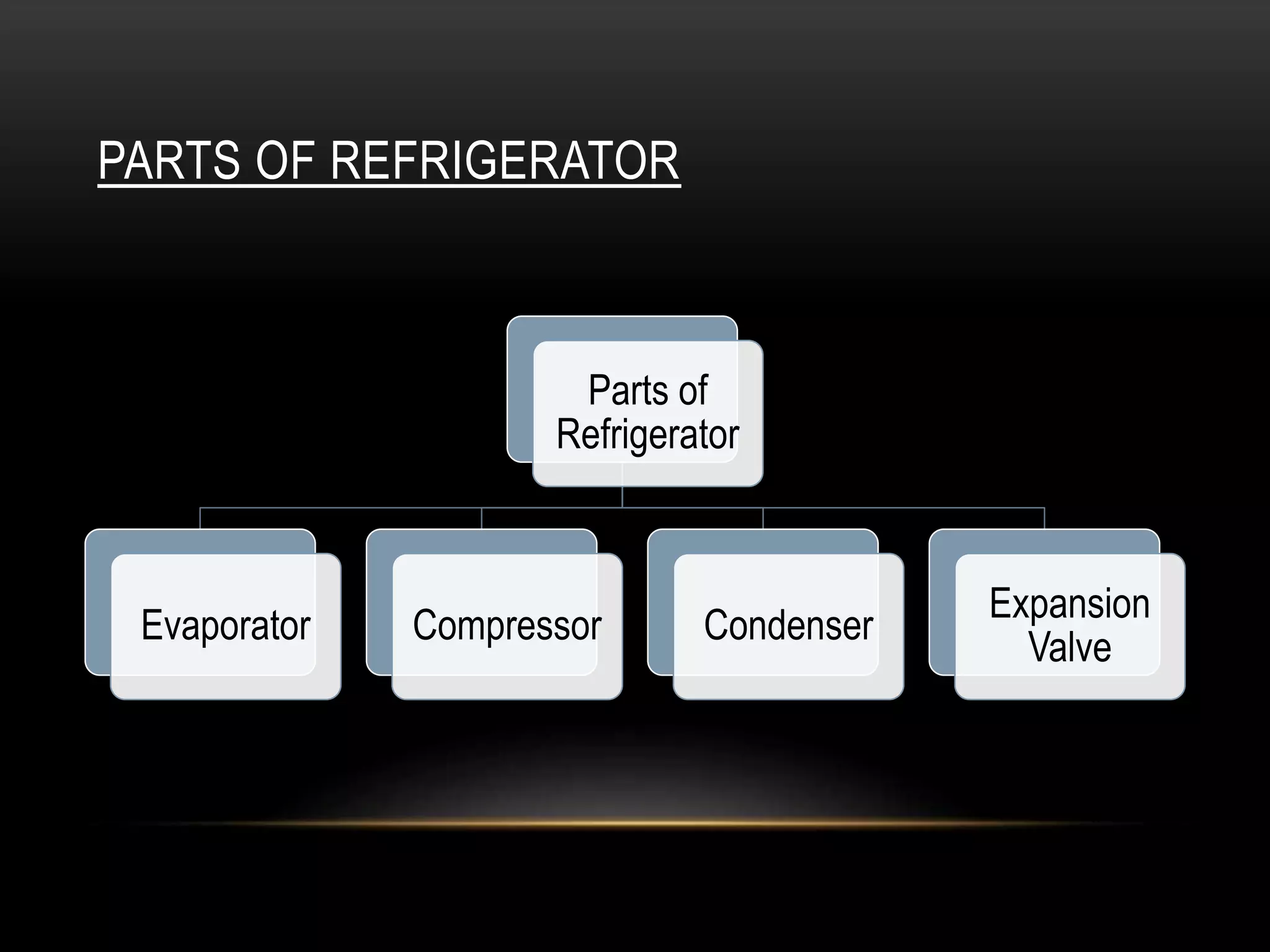
PARTS OF REFRIGERATOR
Parts of
Refrigerator
Evaporator Compressor Condenser
Expansion
Valve
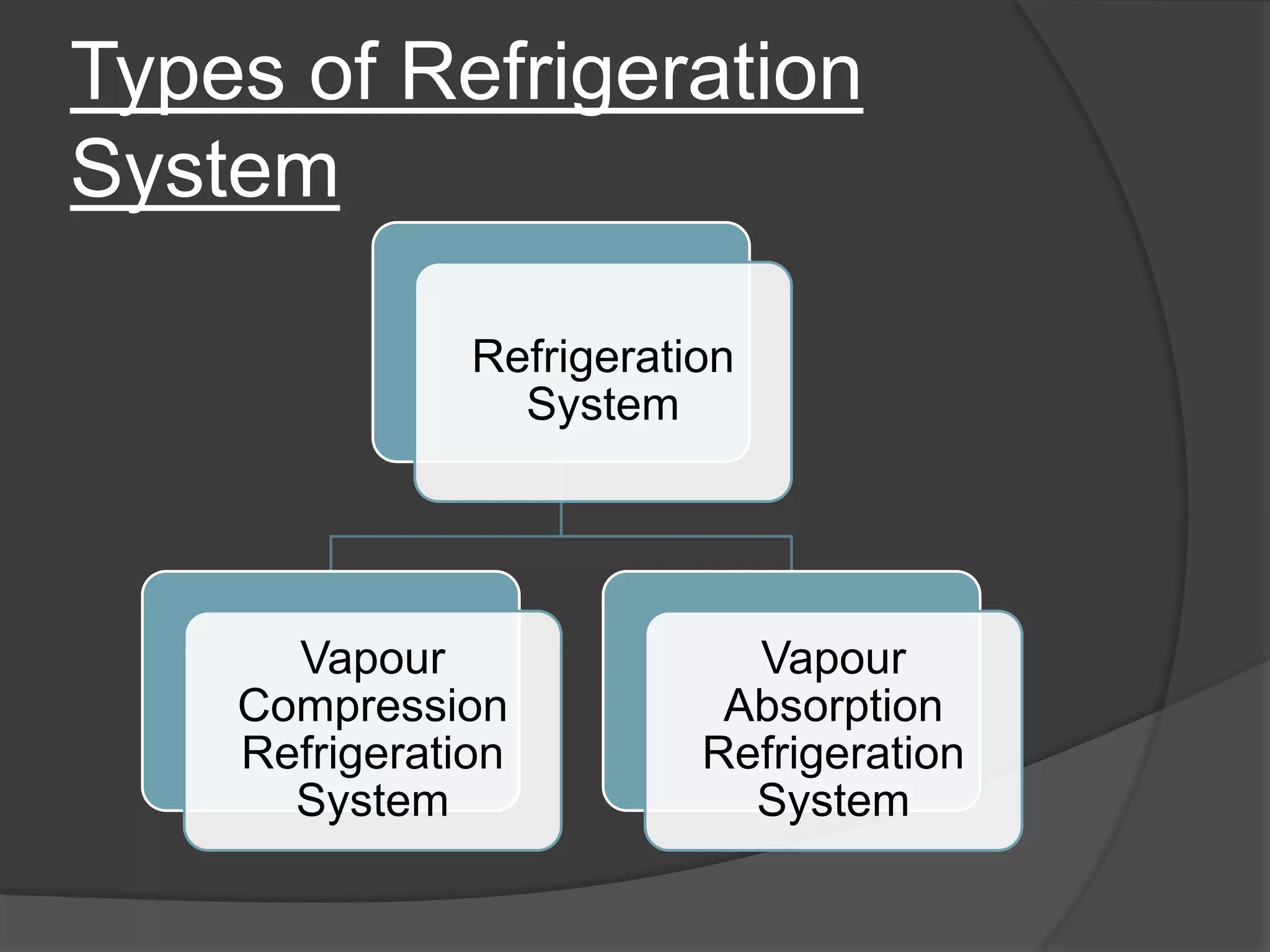
Types of Refrigeration
System
Refrigeration
System
Vapour
Compression
Refrigeration
System
Vapour
Absorption
Refrigeration
System
11
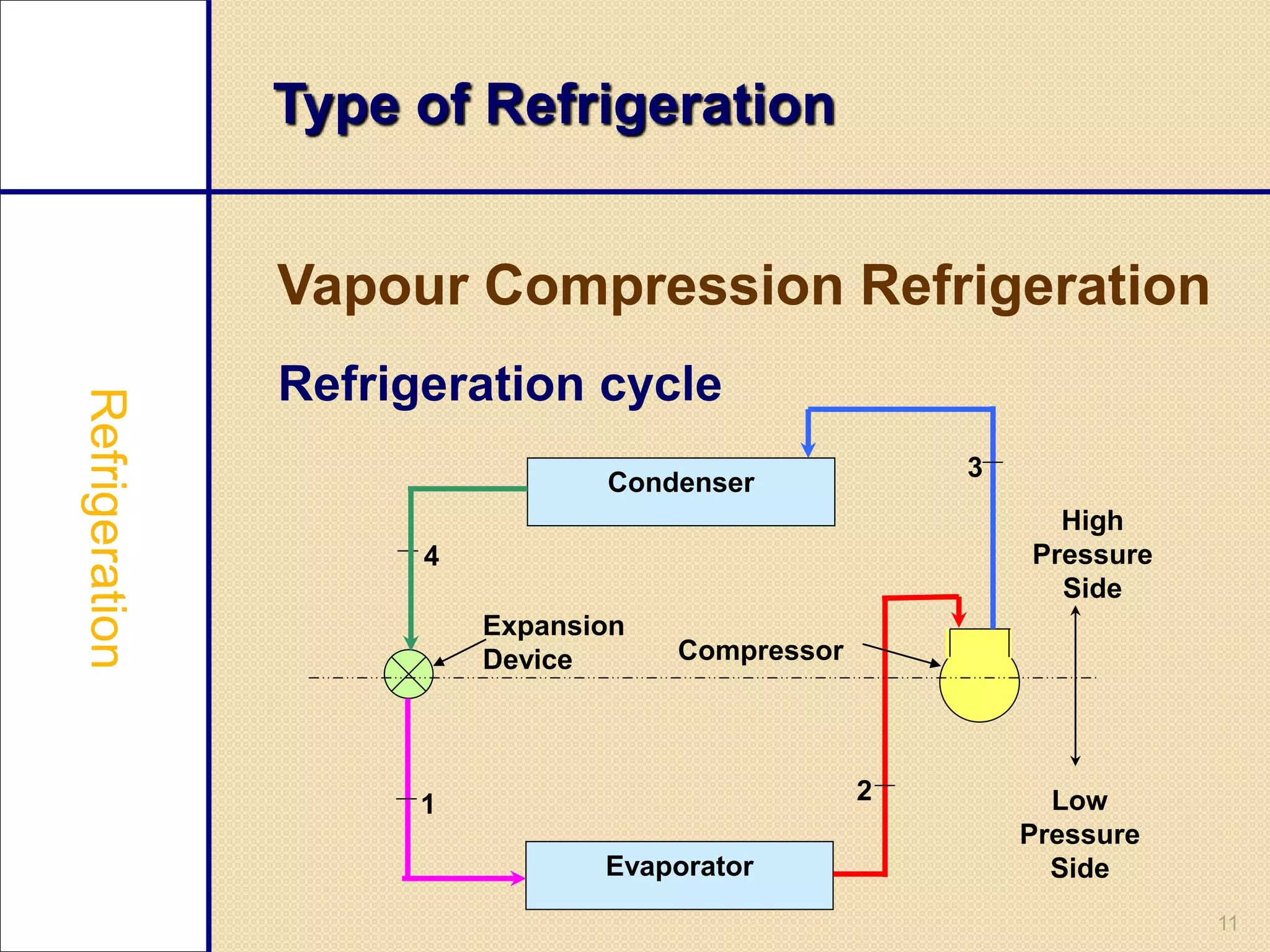
Type of Refrigeration
Vapour Compression Refrigeration
Refrigeration cycle
Condenser
Evaporator
High
Pressure
Side
Low
Pressure
Side
Compressor
Expansion
Device
1 2
3
4
12
Type of Refrigeration
Vapour Compression Refrigeration
Refrigeration cycle
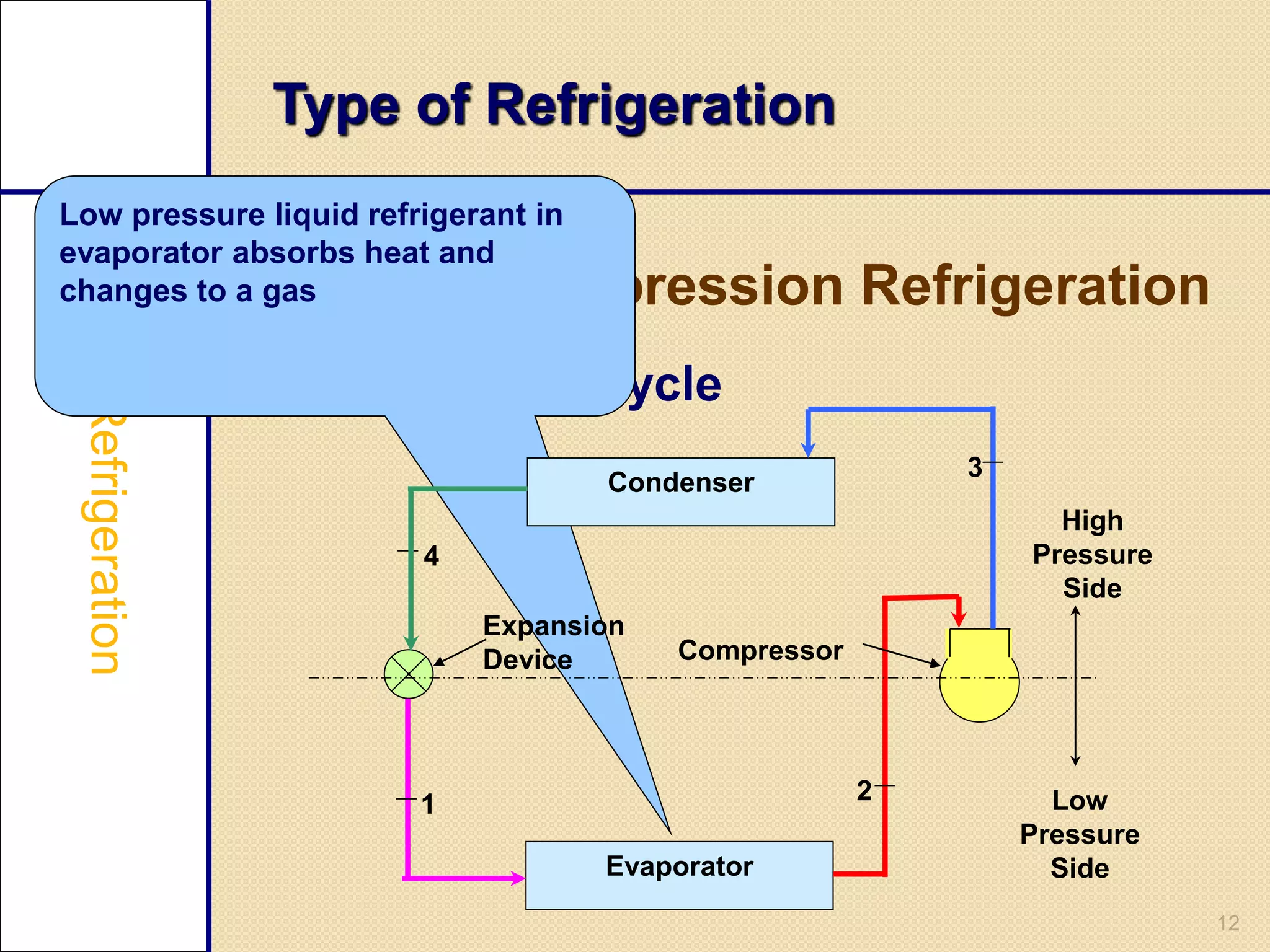
Low pressure liquid refrigerant in
evaporator absorbs heat and
changes to a gas
Condenser
Evaporator
High
Pressure
Side
Low
Pressure
Side
Compressor
Expansion
Device
1 2
3
4
13
Type of Refrigeration
Vapour Compression Refrigeration
Refrigeration cycle
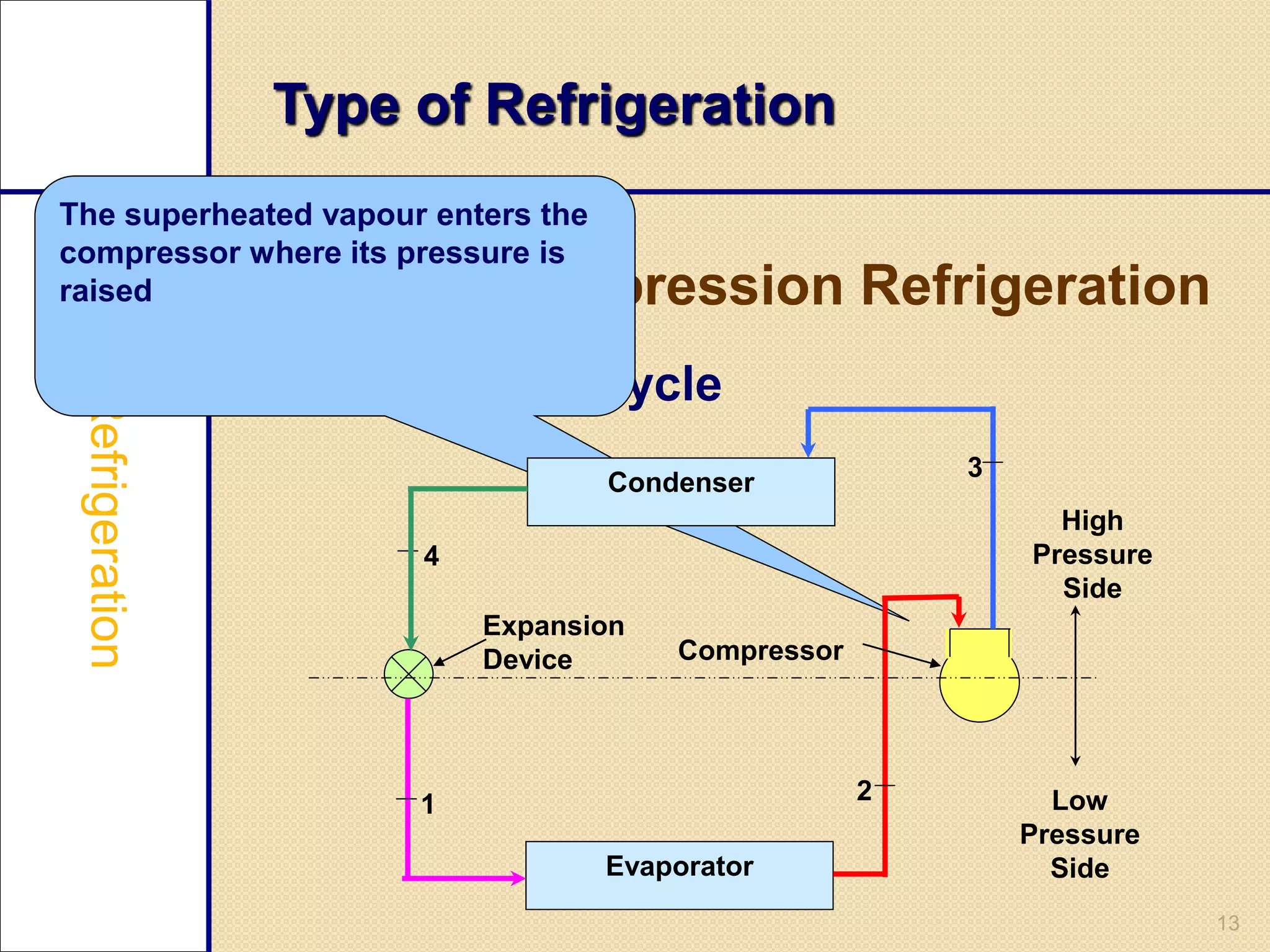
The superheated vapour enters the
compressor where its pressure is
raised
Condenser
Evaporator
High
Pressure
Side
Low
Pressure
Side
Compressor
Expansion
Device
1 2
3
4
14
Type of Refrigeration
Vapour Compression Refrigeration
Refrigeration cycle
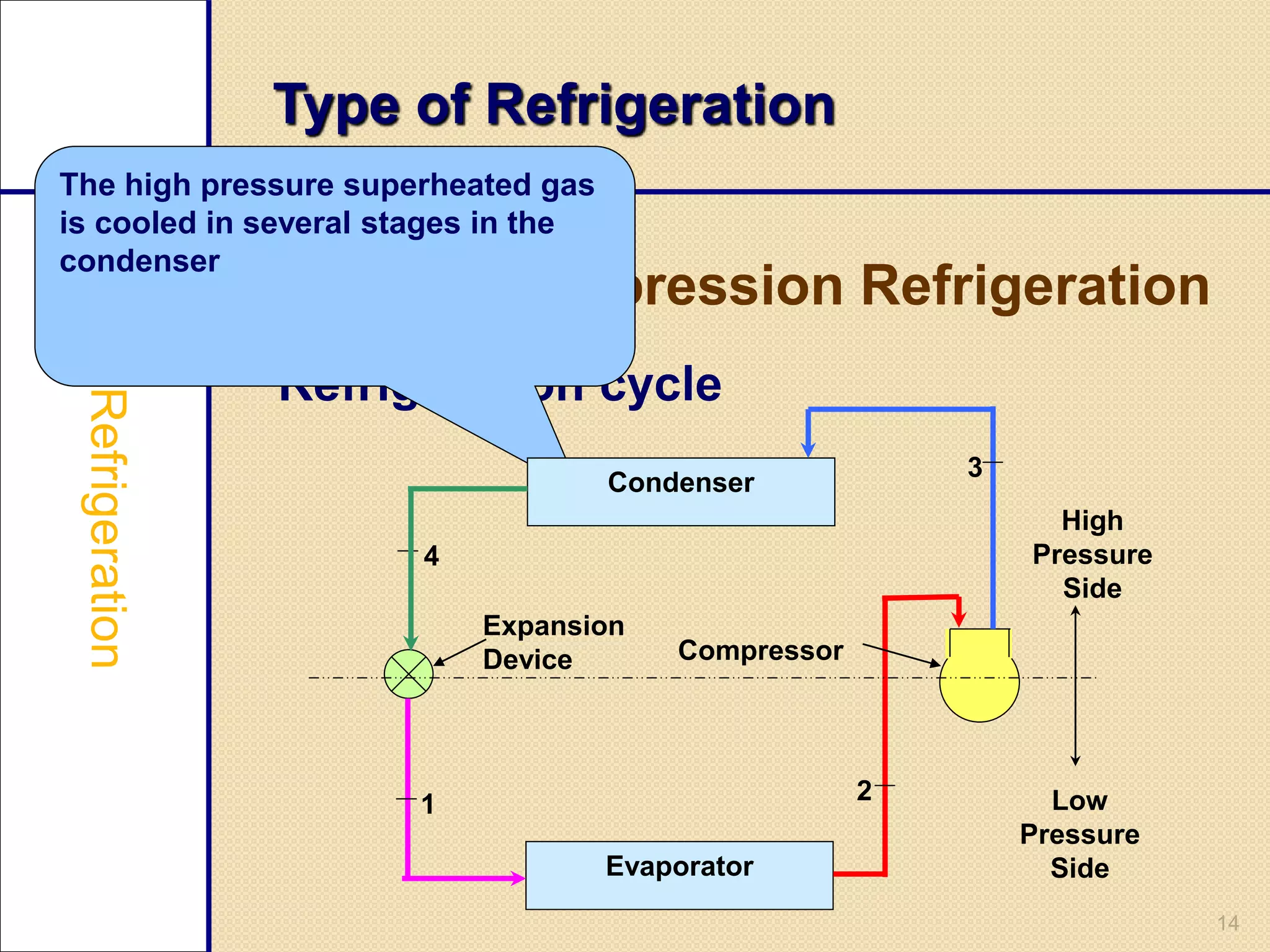
The high pressure superheated gas
is cooled in several stages in the
condenser
Condenser
Evaporator
High
Pressure
Side
Low
Pressure
Side
Compressor
Expansion
Device
1 2
3
4
15
Type of Refrigeration
Vapour Compression Refrigeration
Refrigeration cycle
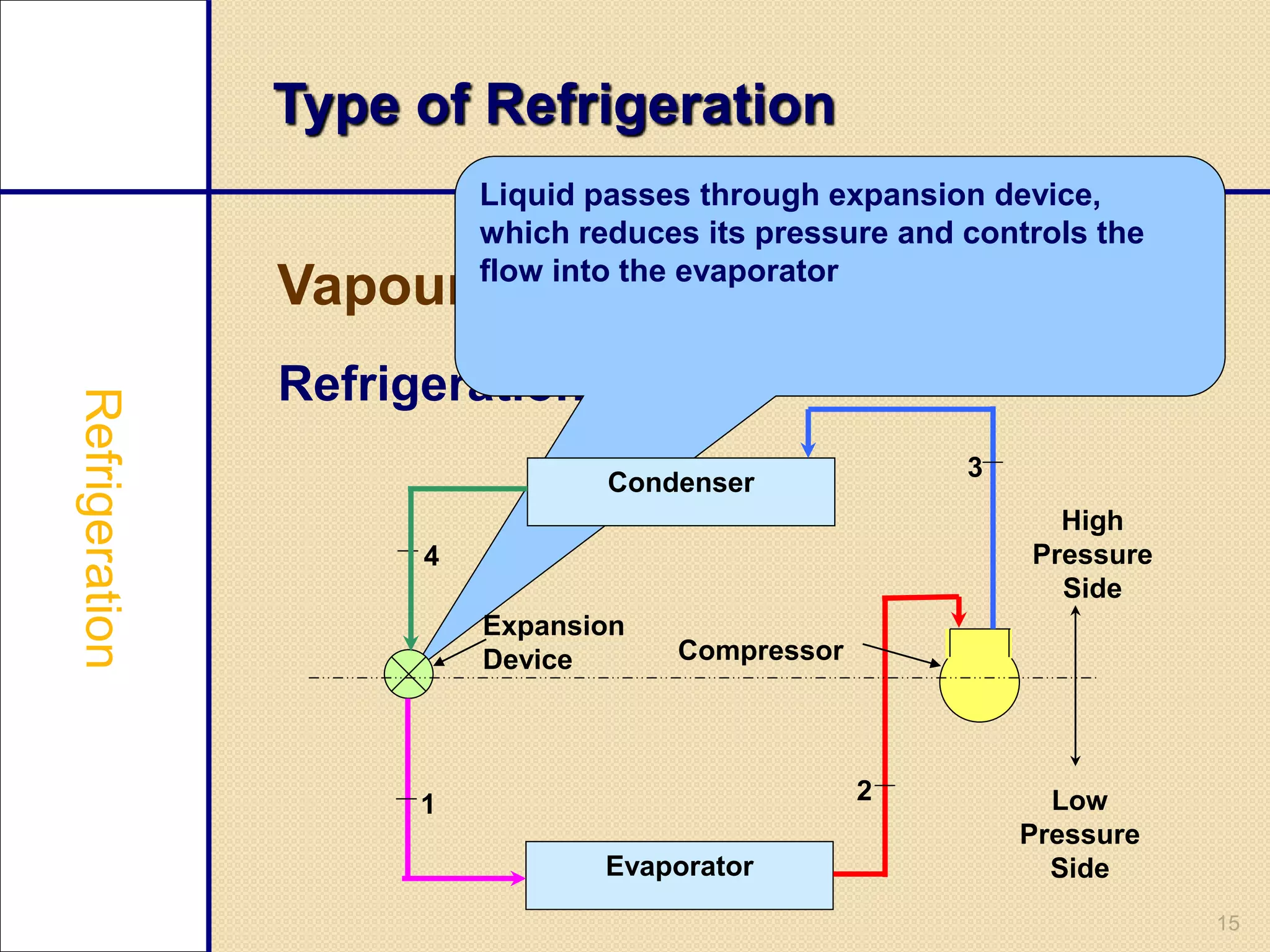
Liquid passes through expansion device,
which reduces its pressure and controls the
flow into the evaporator
Condenser
Evaporator
High
Pressure
Side
Low
Pressure
Side
Compressor
Expansion
Device
1 2
3
4
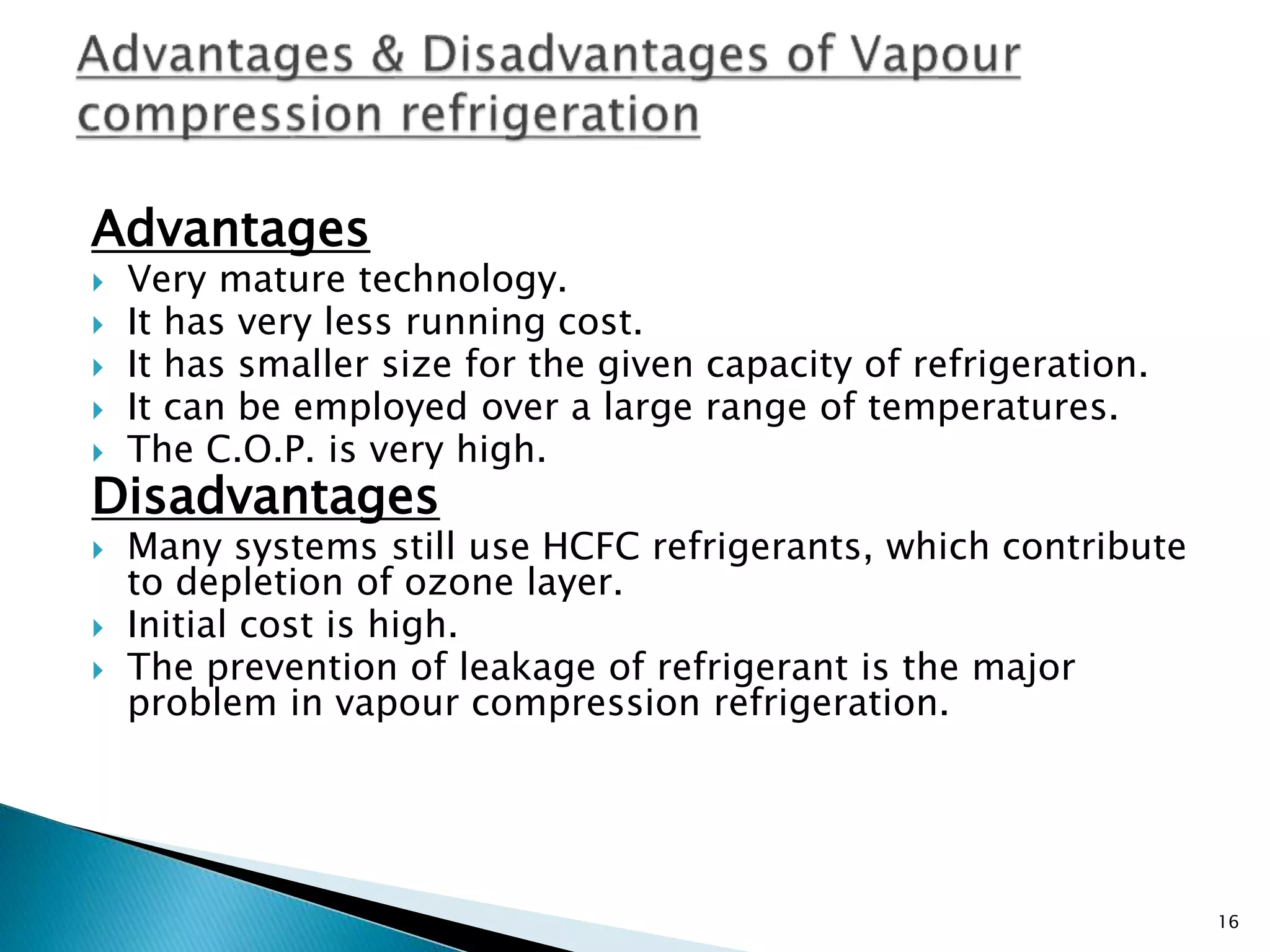
Advantages
 Very mature technology.
 It has very less running cost.
 It has smaller size for the given capacity of refrigeration.
 It can be employed over a large range of temperatures.
 The C.O.P. is very high.
Disadvantages
 Many systems still use HCFC refrigerants, which contribute
to depletion of ozone layer.
 Initial cost is high.
 The prevention of leakage of refrigerant is the major
problem in vapour compression refrigeration.
16
17
Seminar
on
“Vapour Compression
Refrigeration”
THANK YOU
FOR YOUR ATTENTION


Seminar presentation on Vapour Compression Refrigeration

  • 1.
    SEMINAR ON “VAPOUR COMPRESSION REFRIGERATION” GUIDEDBY:- PREPARED BY:- Mr. Devendra Bhandari Ujjwal Nautiyal B.Tech(ME) II sem 1014366(38)
  • 2.
  • 3.
     Refrigeration isa process of removal of heat from a substance at a temperature lower than the surrounding with the aid of external work.  In a refrigeration system, the rate at which the heat is absorbed in a cycle from the interior space to be cooled is called Refrigerating Effect. Refrigeration
  • 4.
    * *In a refrigerator,a medium called Refrigerant continuously extracts the heat from the refrigerator which is to be kept cool at temperatures less than the atmosphere & finally rejects to it. *Refrigerant acts as a heat exchange medium. *e.g.- Ammonia, Freon, Methyl Chloride, Carbon dioxide, Isobutane.
  • 5.
    Unit of Refrigeration& Ice making Capacity  The capacity of a refrigeration system is expressed in tons of refrigeration which is the unit of refrigeration.  A ton of refrigeration is the quantity of heat absorbed in order to form one ton of ice in 24 hours when the initial temperature of water is 0°c.  1 Ton of Refrigeration = 210 kJ/min = 3.5kW  Ice making capacity is the capacity of the refrigerating system to make ice beginning from water to solid.  S.I. unit of ice making capacity is kg/hr.
  • 6.
    Coefficient of Performance The coefficientof performance(briefly written as C.O.P.) is the ratio of desired effect to the work input. Mathematically, (C.O.P.)refrigerator = Desired effect = Q2____ Work Input Q1-Q2
  • 7.
    T1=Tsurr Source T1 T2<Tsurr Sink T2 RWork Input,W=Q1-Q2 Heat Absorbed, Q2 Heat Rejected, Q1 Refrigerator is a reversed heat engine. It extracts Q2 amount of heat from sink & releases Q1 amount of heat to source. Input—Work(Q1-Q2) Output– Heat Refrigerator
  • 8.
    PARTS OF REFRIGERATOR Partsof Refrigerator Evaporator Compressor Condenser Expansion Valve
  • 9.
  • 10.
    11 Type of Refrigeration VapourCompression Refrigeration Refrigeration cycle Condenser Evaporator High Pressure Side Low Pressure Side Compressor Expansion Device 1 2 3 4
  • 11.
    12 Type of Refrigeration VapourCompression Refrigeration Refrigeration cycle Low pressure liquid refrigerant in evaporator absorbs heat and changes to a gas Condenser Evaporator High Pressure Side Low Pressure Side Compressor Expansion Device 1 2 3 4
  • 12.
    13 Type of Refrigeration VapourCompression Refrigeration Refrigeration cycle The superheated vapour enters the compressor where its pressure is raised Condenser Evaporator High Pressure Side Low Pressure Side Compressor Expansion Device 1 2 3 4
  • 13.
    14 Type of Refrigeration VapourCompression Refrigeration Refrigeration cycle The high pressure superheated gas is cooled in several stages in the condenser Condenser Evaporator High Pressure Side Low Pressure Side Compressor Expansion Device 1 2 3 4
  • 14.
    15 Type of Refrigeration VapourCompression Refrigeration Refrigeration cycle Liquid passes through expansion device, which reduces its pressure and controls the flow into the evaporator Condenser Evaporator High Pressure Side Low Pressure Side Compressor Expansion Device 1 2 3 4
  • 15.
    Advantages  Very maturetechnology.  It has very less running cost.  It has smaller size for the given capacity of refrigeration.  It can be employed over a large range of temperatures.  The C.O.P. is very high. Disadvantages  Many systems still use HCFC refrigerants, which contribute to depletion of ozone layer.  Initial cost is high.  The prevention of leakage of refrigerant is the major problem in vapour compression refrigeration. 16
  • 16.