Refrigeration and Air ConditioningGroup MembersHafiz MudassirGulzar (07ME17)Waqas Ali Tunio (07ME34)KhalilRazaBhatti (07ME40)Ayaz Ali Tunio (07ME31)Muhammad Raees (07ME16)Department of Mechanical EngineeringQuaid-e-AwamUniversity of Engineering, Science & Technology, Nawabshah - Pakistan
RefrigerationRefrigeration is a process in which work is done to move heat from one location to another. Refrigeration has many applications these include but are not limited to; household refrigerators, industrial freezers, cryogenics, air conditioning, and heat pumps.Cold is the absence of heat, hence in order to decrease a temperature, one "removes heat", rather than "adding cold." In order to satisfy the Second Law of Thermodynamics, some form of work must be performed to accomplish this. The work is traditionally done by mechanical work but can also be done by magnetism, laser or other means.
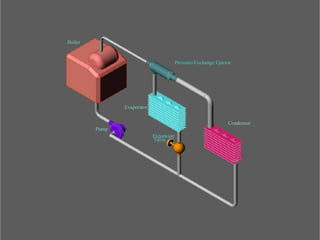
Refrigerant CycleThe refrigeration cycle is a closed loop of gas which undergoes four stages. The first stage is the compressor, which compresses the refrigerant to increase its temperature. The gas is then routed through heat dissipation coils which release heat outside the refrigerator. As it dissipates heat, the refrigerant cools and recondenses into a liquid. This liquid then passes through a high-pressure/low-pressure threshold, called an expansion valve, which causes it to expand and change phases into a gas. The cold gas circulates into the refrigerator again, absorbing heat from the inside, before being routed into the compressor again. The purpose of the refrigeration cycle is to take heat from the inside of the refrigerator and transfer it to the outside.
Methods of refrigerationMethods of refrigeration can be classified as non-cyclic, cyclic and thermoelectric.Non-cyclic refrigerationIn non-cyclic refrigeration, cooling is accomplished by melting ice or by subliming dry ice (frozen carbon dioxide). These methods are used for small-scale refrigeration such as in laboratories and workshops, or in portable coolers.Ice owes its effectiveness as a cooling agent to its constant melting point of 0 °C (32 °F). In order to melt, ice must absorb 333.55 kJ/kg (approx. 144 Btu/lb) of heat. Foodstuffs maintained at this temperature or slightly above have an increased storage life.Solid carbon dioxide has no liquid phase at normal atmospheric pressure, so sublimes directly from the solid to vapor phase at a temperature of -78.5 °C (-109.3 °F), and is therefore effective for maintaining products at low temperatures during the period of sublimation. Systems such as this where the refrigerant evaporates and is vented into the atmosphere are known as "total loss refrigeration".
Cyclic refrigerationThis consists of a refrigeration cycle, where heat is removed from a low-temperature space or source and rejected to a high-temperature sink with the help of external work, and its inverse, the thermodynamic power cycle. In the power cycle, heat is supplied from a high-temperature source to the engine, part of the heat being used to produce work and the rest being rejected to a low-temperature sink. This satisfies the second law of thermodynamics.A refrigeration cycle describes the changes that take place in the refrigerant as it alternately absorbs and rejects heat as it circulates through a refrigerator. It is also applied to HVACR work, when describing the "process" of refrigerant flow through an HVACR unit, whether it is a packaged or split system.
Cyclic refrigerationHeat naturally flows from hot to cold. Work is applied to cool a living space or storage volume by pumping heat from a lower temperature heat source into a higher temperature heat sink. Insulation is used to reduce the work and energy required to achieve and maintain a lower temperature in the cooled space. The operating principle of the refrigeration cycle was described mathematically by Sadi Carnot in 1824 as a heat engine.The most common types of refrigeration systems use the reverse-Rankine vapor-compression refrigeration cycle although absorption heat pumps are used in a minority of applications.Cyclic refrigeration can be classified as:Vapor cycle, and Gas cycleVapor cycle refrigeration can further be classified as:Vapor-compression refrigeration Vapor-absorption refrigeration
Unit of refrigerationDomestic and commercial refrigerators may be rated in kJ/s, or Btu/h of cooling. Commercial refrigerators in North America are mostly rated in tons of refrigeration, but elsewhere in kW. One ton of refrigeration capacity can freeze one short ton of water at 0 °C (32 °F) in 24 hours. Based on that: A much less common definition is: 1 tonne of refrigeration is the rate of heat removal required to freeze a metric ton (i.e., 1000 kg) of water at 0 °C in 24 hours. Based on the heat of fusion being 333.55 kJ/kg, 1 tonne of refrigeration = 13,898 kJ/h = 3.861 kW. As can be seen, 1 tonne of refrigeration is 10% larger than 1 ton of refrigeration.Most residential air conditioning units range in capacity from about 1 to 5 tons of refrigeration.
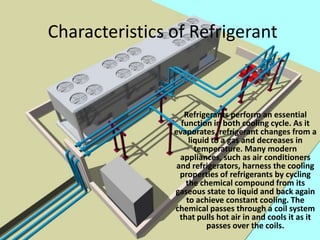
Characteristics of RefrigerantRefrigerants perform an essential function in both cooling cycle. As it evaporates, refrigerant changes from a liquid to a gas and decreases in temperature. Many modern appliances, such as air conditioners and refrigerators, harness the cooling properties of refrigerants by cycling the chemical compound from its gaseous state to liquid and back again to achieve constant cooling. The chemical passes through a coil system that pulls hot air in and cools it as it passes over the coils.
Characteristics of RefrigerantOdorMost refrigerants contain no odor in low concentrations. While having no odor at low levels, some concentrations of refrigerants smell distinctly chemical and refrigerant leakage is often identified by its chemical smell. In concentrations above 20 percent by volume of air, the odor resembles carbon tetrachloride, which smells sweet and is similar to the smell of cleaners used for dry cleaning.
Characteristics of RefrigerantColor and StabilityAll pure refrigerants are colorless in both gaseous and liquid forms. Color may be added for identification purposes or may appear when mixed with other chemical compounds. Many refrigerant compounds are considered stable because of their ability to not decompose while going through the physical change of a gas to a liquid.
Characteristics of RefrigerantBoiling PointThe boiling point of refrigerants depends on the atmospheric pressure. Many refrigerants have a boiling point between -45 and -33 degrees Celsius, with the exceptions of R12 and R11 that have very low boiling points of -29 and 9 degrees Celsius, respectively. At normal temperatures under average pressure, most refrigerants remain in liquid form and must reach their boiling point to become a vapor.
Characteristics of RefrigerantDangers and BenefitsRefrigerants with low boiling points may damage the eyes in their liquid states and protective eyewear must be worn at all times. If the liquid refrigerant comes into contact with the eyes, the tissues freeze. Most refrigerants don't contaminate foods and are nonpoisonous in both gas and liquid forms, with the exception of ammonia, which is highly toxic. When mixed with air, vapor forms of refrigerants cause no harm to the eyes, nose, throat or lungs if inhaled. Excessive concentrations of refrigerant vapor causes unconsciousness and possible death because of a lack of oxygen to the brain. It has solvent properties that reduce and remove particles of dirt and oil within the cooling system. Most liquid and vapor forms of refrigerants will not corrode metals in cooling systems. Some, such as ammonia and R290, are highly explosive or flammable.
JazakALLAH-o-KhairaDepartment of Mechanical EngineeringQuaid-e-Awam University of Engineering, Science & Technology, Nawabshah - Pakistan

Refrigeration and air conditioning (21 10-10)

  • 1.
    Refrigeration and AirConditioningGroup MembersHafiz MudassirGulzar (07ME17)Waqas Ali Tunio (07ME34)KhalilRazaBhatti (07ME40)Ayaz Ali Tunio (07ME31)Muhammad Raees (07ME16)Department of Mechanical EngineeringQuaid-e-AwamUniversity of Engineering, Science & Technology, Nawabshah - Pakistan
  • 2.
    RefrigerationRefrigeration is aprocess in which work is done to move heat from one location to another. Refrigeration has many applications these include but are not limited to; household refrigerators, industrial freezers, cryogenics, air conditioning, and heat pumps.Cold is the absence of heat, hence in order to decrease a temperature, one "removes heat", rather than "adding cold." In order to satisfy the Second Law of Thermodynamics, some form of work must be performed to accomplish this. The work is traditionally done by mechanical work but can also be done by magnetism, laser or other means.
  • 3.
    Refrigerant CycleThe refrigerationcycle is a closed loop of gas which undergoes four stages. The first stage is the compressor, which compresses the refrigerant to increase its temperature. The gas is then routed through heat dissipation coils which release heat outside the refrigerator. As it dissipates heat, the refrigerant cools and recondenses into a liquid. This liquid then passes through a high-pressure/low-pressure threshold, called an expansion valve, which causes it to expand and change phases into a gas. The cold gas circulates into the refrigerator again, absorbing heat from the inside, before being routed into the compressor again. The purpose of the refrigeration cycle is to take heat from the inside of the refrigerator and transfer it to the outside.
  • 5.
    Methods of refrigerationMethodsof refrigeration can be classified as non-cyclic, cyclic and thermoelectric.Non-cyclic refrigerationIn non-cyclic refrigeration, cooling is accomplished by melting ice or by subliming dry ice (frozen carbon dioxide). These methods are used for small-scale refrigeration such as in laboratories and workshops, or in portable coolers.Ice owes its effectiveness as a cooling agent to its constant melting point of 0 °C (32 °F). In order to melt, ice must absorb 333.55 kJ/kg (approx. 144 Btu/lb) of heat. Foodstuffs maintained at this temperature or slightly above have an increased storage life.Solid carbon dioxide has no liquid phase at normal atmospheric pressure, so sublimes directly from the solid to vapor phase at a temperature of -78.5 °C (-109.3 °F), and is therefore effective for maintaining products at low temperatures during the period of sublimation. Systems such as this where the refrigerant evaporates and is vented into the atmosphere are known as "total loss refrigeration".
  • 6.
    Cyclic refrigerationThis consistsof a refrigeration cycle, where heat is removed from a low-temperature space or source and rejected to a high-temperature sink with the help of external work, and its inverse, the thermodynamic power cycle. In the power cycle, heat is supplied from a high-temperature source to the engine, part of the heat being used to produce work and the rest being rejected to a low-temperature sink. This satisfies the second law of thermodynamics.A refrigeration cycle describes the changes that take place in the refrigerant as it alternately absorbs and rejects heat as it circulates through a refrigerator. It is also applied to HVACR work, when describing the "process" of refrigerant flow through an HVACR unit, whether it is a packaged or split system.
  • 7.
    Cyclic refrigerationHeat naturallyflows from hot to cold. Work is applied to cool a living space or storage volume by pumping heat from a lower temperature heat source into a higher temperature heat sink. Insulation is used to reduce the work and energy required to achieve and maintain a lower temperature in the cooled space. The operating principle of the refrigeration cycle was described mathematically by Sadi Carnot in 1824 as a heat engine.The most common types of refrigeration systems use the reverse-Rankine vapor-compression refrigeration cycle although absorption heat pumps are used in a minority of applications.Cyclic refrigeration can be classified as:Vapor cycle, and Gas cycleVapor cycle refrigeration can further be classified as:Vapor-compression refrigeration Vapor-absorption refrigeration
  • 8.
    Unit of refrigerationDomesticand commercial refrigerators may be rated in kJ/s, or Btu/h of cooling. Commercial refrigerators in North America are mostly rated in tons of refrigeration, but elsewhere in kW. One ton of refrigeration capacity can freeze one short ton of water at 0 °C (32 °F) in 24 hours. Based on that: A much less common definition is: 1 tonne of refrigeration is the rate of heat removal required to freeze a metric ton (i.e., 1000 kg) of water at 0 °C in 24 hours. Based on the heat of fusion being 333.55 kJ/kg, 1 tonne of refrigeration = 13,898 kJ/h = 3.861 kW. As can be seen, 1 tonne of refrigeration is 10% larger than 1 ton of refrigeration.Most residential air conditioning units range in capacity from about 1 to 5 tons of refrigeration.
  • 9.
    Characteristics of RefrigerantRefrigerantsperform an essential function in both cooling cycle. As it evaporates, refrigerant changes from a liquid to a gas and decreases in temperature. Many modern appliances, such as air conditioners and refrigerators, harness the cooling properties of refrigerants by cycling the chemical compound from its gaseous state to liquid and back again to achieve constant cooling. The chemical passes through a coil system that pulls hot air in and cools it as it passes over the coils.
  • 10.
    Characteristics of RefrigerantOdorMostrefrigerants contain no odor in low concentrations. While having no odor at low levels, some concentrations of refrigerants smell distinctly chemical and refrigerant leakage is often identified by its chemical smell. In concentrations above 20 percent by volume of air, the odor resembles carbon tetrachloride, which smells sweet and is similar to the smell of cleaners used for dry cleaning.
  • 11.
    Characteristics of RefrigerantColorand StabilityAll pure refrigerants are colorless in both gaseous and liquid forms. Color may be added for identification purposes or may appear when mixed with other chemical compounds. Many refrigerant compounds are considered stable because of their ability to not decompose while going through the physical change of a gas to a liquid.
  • 12.
    Characteristics of RefrigerantBoilingPointThe boiling point of refrigerants depends on the atmospheric pressure. Many refrigerants have a boiling point between -45 and -33 degrees Celsius, with the exceptions of R12 and R11 that have very low boiling points of -29 and 9 degrees Celsius, respectively. At normal temperatures under average pressure, most refrigerants remain in liquid form and must reach their boiling point to become a vapor.
  • 13.
    Characteristics of RefrigerantDangersand BenefitsRefrigerants with low boiling points may damage the eyes in their liquid states and protective eyewear must be worn at all times. If the liquid refrigerant comes into contact with the eyes, the tissues freeze. Most refrigerants don't contaminate foods and are nonpoisonous in both gas and liquid forms, with the exception of ammonia, which is highly toxic. When mixed with air, vapor forms of refrigerants cause no harm to the eyes, nose, throat or lungs if inhaled. Excessive concentrations of refrigerant vapor causes unconsciousness and possible death because of a lack of oxygen to the brain. It has solvent properties that reduce and remove particles of dirt and oil within the cooling system. Most liquid and vapor forms of refrigerants will not corrode metals in cooling systems. Some, such as ammonia and R290, are highly explosive or flammable.
  • 14.
    Characteristics of RefrigerantDangersand BenefitsRefrigerants with low boiling points may damage the eyes in their liquid states and protective eyewear must be worn at all times. If the liquid refrigerant comes into contact with the eyes, the tissues freeze. Most refrigerants don't contaminate foods and are nonpoisonous in both gas and liquid forms, with the exception of ammonia, which is highly toxic. When mixed with air, vapor forms of refrigerants cause no harm to the eyes, nose, throat or lungs if inhaled. Excessive concentrations of refrigerant vapor causes unconsciousness and possible death because of a lack of oxygen to the brain. It has solvent properties that reduce and remove particles of dirt and oil within the cooling system. Most liquid and vapor forms of refrigerants will not corrode metals in cooling systems. Some, such as ammonia and R290, are highly explosive or flammable.
  • 15.
    JazakALLAH-o-KhairaDepartment of MechanicalEngineeringQuaid-e-Awam University of Engineering, Science & Technology, Nawabshah - Pakistan