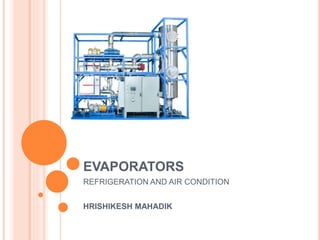
EVAPORATORS
REFRIGERATION AND AIR CONDITION
HRISHIKESH MAHADIK
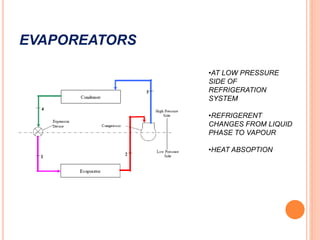
EVAPOREATORS
•AT LOW PRESSURE
SIDE OF
REFRIGERATION
SYSTEM
•REFRIGERENT
CHANGES FROM LIQUID
PHASE TO VAPOUR
•HEAT ABSOPTION
CAPACITY OF AN EVAPORATOR
THE AMOUNT OF HEAT ABSORBED BY IT OVER A GIVEN
PERIOD OF TIME.
HEAT TRANSFER CAPACITY OF AN EVAPORATOR:
Q = UA(T2 - T1) ….. W or J/s
WHERE;
U = OVERALL HEAT TRANSFER COIFICIENT
A = AREA OF EVAPORATOR SURFACE
T2 = TEMPERATURE OF MEDIUM TO BR COOLED
T1 = SATURATION TEMPERATURE OF
REFRIGERENT AT EVAPORATOR PRESSURE
FACTORS AFFECTING THE HEAT
TRANSFER CAPACITY OF AN EVAPORATOR
 MATERIAL
 TEMPERATURE DIFFERENCE
 VELOCITY OF REFRIGERENT
 THICKNESS OF THE EVAPORATOR COIL WALL
 CONTACT OF SURFACE AREA
TYPES OF EVAPORATORS
 According to type of construction
1. Bare tube coil evaporator
2. Finned tube evaporator
3. Plate evaporator
4. Shell and tube evaporator
5. Shell and coil evaporator
6. Tube in tube evaporator
 According to the manner in which liquid refrigerant is fed
1. Flooded evaporator
2. Dry expansion evaporator
 According to the mode of heat transfer
1. Natural convection evaporator
2. Forced convection evaporator
 According to operating condition
1. Frosting evaporator
2. Non-frosting evaporator
3. Defrosting evaporator
Bare tube coil evaporator Finned tube evaporator
•Prime surface evaporator
•Easy to clean and defrost
•s/f contact area is less
•Limited applications
•Over the bare tube metal fins
are fastened
•Shape, size, spacing can be
adapted for better rate of heat
transfer
•Extended surface evaporators
Plate evaporator Shell and tube evaporator
•The bare coils are either welded
on the plate or between the two
plates which are welded together
•Used in household refrigerators,
beverage cooler, ice cream
cabinets
•Contraction is same as shell and
tube type of condenser
•Available in flooded as well as
dry expansion type
•Baffle plates are provided for
good turbulence of liquid
•Capacity 2TR to 250TR
Shell and coil evaporator Tube in tube evaporator
•Generally dry expansion
evaporators for chilling water
•Used for small capacity
2TR to 10TR
•Restricted to operate above 5
degree calicoes to prevent
freezing problems
•Double tube evaporator
•Refrigerant can flow in outer pipe
and liquid to be cooled can flow in
inner pipe
•The flow of refrigerant can be
parallel or counter
Natural convection
evaporators
Forced convection
evaporators
•Low velocity and min. hydration is
require
•Velocity of air depends upon temp.
difference
•Circulation of air around coil
depends upon its size shape and
location
•The coil should occupy 2/3rd of
width of the path & 3/4th the length
of the box
•Air is forced over refrigerant coils
•Fins are provided to increase heat
transfer rate
•More efficient than natural
convection evaporators
•Require less cooling surface and
high evaporator pressure can be
used which save power input to the
compressor
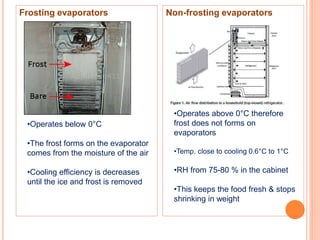
Frosting evaporators Non-frosting evaporators
•Operates below 0°C
•The frost forms on the evaporator
comes from the moisture of the air
•Cooling efficiency is decreases
until the ice and frost is removed
•Operates above 0°C therefore
frost does not forms on
evaporators
•Temp. close to cooling 0.6°C to 1°C
•RH from 75-80 % in the cabinet
•This keeps the food fresh & stops
shrinking in weight
DEFROSTING EVAPORATORS
•Frost creates on the coils on the
coils when the compressor is
running & melts after the
compressor shuts off
•Temp. of about -7°C to -6°C
•It also keeps high RH of about
90% to 95%
APPLICATIONS:
 EVAPORATORS ARE USED IN WIDE RANGE OF PROCESS
INDUSTRIES, PAPER AND PULP ONDUSTRIES, WINERY, BEVERGARES,
FOOD PRESERVATION, ICE PLANTS, CHEMICAL, POLYMERS AND
RESINS, INORGANIC SALTS, ACIDES AND VERITY OF OTHER
MATERIALS
Evaporators
Evaporators

Evaporators

  • 1.
    EVAPORATORS REFRIGERATION AND AIRCONDITION HRISHIKESH MAHADIK
  • 2.
    EVAPOREATORS •AT LOW PRESSURE SIDEOF REFRIGERATION SYSTEM •REFRIGERENT CHANGES FROM LIQUID PHASE TO VAPOUR •HEAT ABSOPTION
  • 3.
    CAPACITY OF ANEVAPORATOR THE AMOUNT OF HEAT ABSORBED BY IT OVER A GIVEN PERIOD OF TIME. HEAT TRANSFER CAPACITY OF AN EVAPORATOR: Q = UA(T2 - T1) ….. W or J/s WHERE; U = OVERALL HEAT TRANSFER COIFICIENT A = AREA OF EVAPORATOR SURFACE T2 = TEMPERATURE OF MEDIUM TO BR COOLED T1 = SATURATION TEMPERATURE OF REFRIGERENT AT EVAPORATOR PRESSURE
  • 4.
    FACTORS AFFECTING THEHEAT TRANSFER CAPACITY OF AN EVAPORATOR  MATERIAL  TEMPERATURE DIFFERENCE  VELOCITY OF REFRIGERENT  THICKNESS OF THE EVAPORATOR COIL WALL  CONTACT OF SURFACE AREA
  • 5.
    TYPES OF EVAPORATORS According to type of construction 1. Bare tube coil evaporator 2. Finned tube evaporator 3. Plate evaporator 4. Shell and tube evaporator 5. Shell and coil evaporator 6. Tube in tube evaporator  According to the manner in which liquid refrigerant is fed 1. Flooded evaporator 2. Dry expansion evaporator
  • 6.
     According tothe mode of heat transfer 1. Natural convection evaporator 2. Forced convection evaporator  According to operating condition 1. Frosting evaporator 2. Non-frosting evaporator 3. Defrosting evaporator
  • 7.
    Bare tube coilevaporator Finned tube evaporator •Prime surface evaporator •Easy to clean and defrost •s/f contact area is less •Limited applications •Over the bare tube metal fins are fastened •Shape, size, spacing can be adapted for better rate of heat transfer •Extended surface evaporators
  • 8.
    Plate evaporator Shelland tube evaporator •The bare coils are either welded on the plate or between the two plates which are welded together •Used in household refrigerators, beverage cooler, ice cream cabinets •Contraction is same as shell and tube type of condenser •Available in flooded as well as dry expansion type •Baffle plates are provided for good turbulence of liquid •Capacity 2TR to 250TR
  • 9.
    Shell and coilevaporator Tube in tube evaporator •Generally dry expansion evaporators for chilling water •Used for small capacity 2TR to 10TR •Restricted to operate above 5 degree calicoes to prevent freezing problems •Double tube evaporator •Refrigerant can flow in outer pipe and liquid to be cooled can flow in inner pipe •The flow of refrigerant can be parallel or counter
  • 10.
    Natural convection evaporators Forced convection evaporators •Lowvelocity and min. hydration is require •Velocity of air depends upon temp. difference •Circulation of air around coil depends upon its size shape and location •The coil should occupy 2/3rd of width of the path & 3/4th the length of the box •Air is forced over refrigerant coils •Fins are provided to increase heat transfer rate •More efficient than natural convection evaporators •Require less cooling surface and high evaporator pressure can be used which save power input to the compressor
  • 11.
    Frosting evaporators Non-frostingevaporators •Operates below 0°C •The frost forms on the evaporator comes from the moisture of the air •Cooling efficiency is decreases until the ice and frost is removed •Operates above 0°C therefore frost does not forms on evaporators •Temp. close to cooling 0.6°C to 1°C •RH from 75-80 % in the cabinet •This keeps the food fresh & stops shrinking in weight
  • 12.
    DEFROSTING EVAPORATORS •Frost createson the coils on the coils when the compressor is running & melts after the compressor shuts off •Temp. of about -7°C to -6°C •It also keeps high RH of about 90% to 95%
  • 13.
    APPLICATIONS:  EVAPORATORS AREUSED IN WIDE RANGE OF PROCESS INDUSTRIES, PAPER AND PULP ONDUSTRIES, WINERY, BEVERGARES, FOOD PRESERVATION, ICE PLANTS, CHEMICAL, POLYMERS AND RESINS, INORGANIC SALTS, ACIDES AND VERITY OF OTHER MATERIALS