REFRIGERATION SYSTEMS
GUIDED BY
1. PROF Y.R SHARMA IN MECHANICAL DEPT.
2. PROF P.K. PATEL IN MECHANICAL DEPT.
PREPARED BY
(1). TRIVEDI KULDIPKUMAR J 130930119116
(2). VANJARA JAYESHKUMAR R 130930119117
(3).PRATIKKUMAR D 130930119118
(4)VINAYKANT TRIPATHI 130930119119
(5)VINIT PATEL 130930119120
(6)YADAV ANKUR RAMJEE 130930119121
(7)YADAV HIMANSHU S 130930119122
ARRDEKTA INSTITUTE OF TECHNOLOGY
Introduction
• The mechanism used for lowering or
producing low temp. in a body or a space,
whose temp. is already below the temp. of
its surrounding, is called the refrigeration
system.
• Here the heat is being generally pumped
from low level to the higher one & is
rejected at high temp.
Refrigeration
• The term refrigeration may be defined as
the process of removing heat from a
substance under controlled conditions.
• It also includes the process of reducing
heat & maintaining the temp. of a body
below the general temp. of its
surroundings.
• In other words the refrigeration means a
continued extraction of heat from a body
whose temp is already below the temp. of
its surroundings.
Refrigerator & Refrigerant
• A refrigerator is a reversed heat engine or
a heat pump which takes out heat from a
cold body & delivers it to a hot body.
• The refrigerant is a heat carrying medium
which during their cycle in a refrigeration
system absorbs heat from a low temp.
system & delivers it to a higher temp.
system.
Refrigeration Cycle
• In refrigeration system the heat is being
generally pumped from low level to higher
one & rejected at that temp.
• This rejection of heat from low level to
higher level of temp. can only be
performed with the help of external work
according to second law of
thermodynamics.
• The total amount of heat being rejected to
the outside body consist of two parts:-
- the heat extracted from the body to be
cooled .
- the heat equivalent to the mechanical work
required for extracting it.
HEAT REJECTION
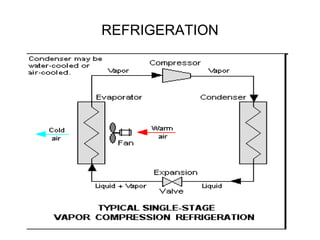
REFRIGERATION
REFRIGERATIOR
• A refrigerator is a reverse heat engine run
in the reverse direction by means of
external aid.
• Every type of refrigeration system used for
producing cold must have the following
four basic units:-
REFRIGERATIOR
• Low temp. thermal sink to which the heat
is rejected for cooling the space.
• Means of extracting the heat energy from
the sink, raising its level of temp. before
delivering it to heat receiver.
• A receiver is a storage to which the heat is
transferred from the high temp., high
pressure refrigerant.
• Means of reducing the pressure & temp. of
the refrigerant before it return to the sink.
• The processes of the cycle are
evaporation, compression, condensation &
expansion.
• By reversing the heat engine cycle
completely & by changing the working
agent, a refrigeration cycle is obtained.
Refrigeration Systems
• Vapour compression refrigeration system
• Vapour absorption refrigeration system
Vapour Compression Refrigeration
• This is the most important system from the
point of commercial & domestic utility &
most practical form of refrigeration.
• The working fluid refrigerant used in this
refrigeration system readily evaporates &
condenses or changes alternatively
between the vapour & liquid phases
without leaving the refrigerating plant
• During evaporation it absorbs heat from
the cold body or in condensing or cooling it
rejects heat to the external hot body .
• The heat absorbed from cold body during
evaporation is used as its latent heat for
converting it from liquid to vapour.
• Thus a cooling effect is created in working
fluid.
• This system of refrigeration thus act as latent
heat pump since its pump its latent heat from the
cold body or brine & rejects it or deliver it to the
external hot body or the cooling medium.
• According to the law of thermodynamics , this
can be done only on the expenditure of energy
which is supplied to the system in the form of
electrical energy driving the compressor.
• The vapour compression cycle is used in
most of the modern refrigeration systems
in large industrial plants.
• The vapour in this cycle is circulated
through the various components of the
system, where it undergoes a number of
changes in its state or condition.
REFRIGERATOR COMPONENTS
• Each cycle of operation consists of the
four fundamental changes of state or
processes:-
 Expansion
Vaporisation
Compression
Condensation
Compressor
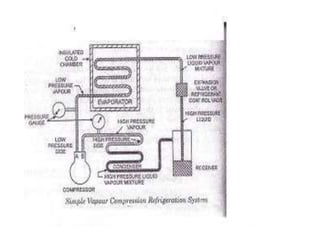
The low pressure & temp. refrigerant from
evaporator is drawn into the compressor through
the inlet or suction valve , where it is
compressed to a high pressure & temp.
The high pressure & temp vapour refrigerant is
discharged into the condenser through the
delivery or discharge valve.
Condenser
The condenser or the cooler consists of coils
of pipe in which the high pressure & temp.
vapour refrigerant is cooled & condensed.
The refrigerant while passing through the
condenser, rejects its latent heat to surrounding
condensing medium which is normally air or
water.
Thus hot refrigerant vapour received from
compressor is converted into liquid form in
condenser.
Receiver
The condensed liquid refrigerant from the
condenser is stored in a vessel, known as
receiver, from where it is supplied to the
expansion valve or refrigerant control
valve.
Expansion Valve
The function of this valve is to allow the
liquid refrigerant under high pressure &
temp. to pass at a controlled rate after
reducing its pressure & temp.
some of liquid refrigerant evaporates as it
passes through the expansion valve, but
the greater portion is vaporised in the
evaporator at the low pressure & temp.
Evaporator
An evaporator consists of coils of pipes in which
the liquid vapour refrigerant at low pressure &
temp. is evaporated & changed into vapour
refrigerant at low pressure & temp.
During evaporation process, the liquid vapour
refrigerant absorbs its latent heat of vaporization
from the medium which is to be cooled.
Advantages
• Smaller size for a given refrigerating
capacity
• Higher coeff. of performance
• Lower power requirements for a given
capacity
• Less complexity in both design &
operation
• It can be used over large of temp.
Contd….
• It represents a significant portion of the
refrigeration industry due to the use of
these units in large number.
• For domestic preservation, the storage is
generally short term. The domestic
refrigerators used for the purposes are
usually small in sizes with rating in ranges
from 1/20 to ½ tonne.
Contd….
• The unit is usually self contained and
hermetically sealed.
• Due to short term storage the domestic
refrigerator load is intermittent.
THANKS…..

Refrigeration system.ppt

  • 1.
    REFRIGERATION SYSTEMS GUIDED BY 1.PROF Y.R SHARMA IN MECHANICAL DEPT. 2. PROF P.K. PATEL IN MECHANICAL DEPT. PREPARED BY (1). TRIVEDI KULDIPKUMAR J 130930119116 (2). VANJARA JAYESHKUMAR R 130930119117 (3).PRATIKKUMAR D 130930119118 (4)VINAYKANT TRIPATHI 130930119119 (5)VINIT PATEL 130930119120 (6)YADAV ANKUR RAMJEE 130930119121 (7)YADAV HIMANSHU S 130930119122 ARRDEKTA INSTITUTE OF TECHNOLOGY
  • 2.
    Introduction • The mechanismused for lowering or producing low temp. in a body or a space, whose temp. is already below the temp. of its surrounding, is called the refrigeration system. • Here the heat is being generally pumped from low level to the higher one & is rejected at high temp.
  • 3.
    Refrigeration • The termrefrigeration may be defined as the process of removing heat from a substance under controlled conditions. • It also includes the process of reducing heat & maintaining the temp. of a body below the general temp. of its surroundings. • In other words the refrigeration means a continued extraction of heat from a body whose temp is already below the temp. of its surroundings.
  • 4.
    Refrigerator & Refrigerant •A refrigerator is a reversed heat engine or a heat pump which takes out heat from a cold body & delivers it to a hot body. • The refrigerant is a heat carrying medium which during their cycle in a refrigeration system absorbs heat from a low temp. system & delivers it to a higher temp. system.
  • 5.
    Refrigeration Cycle • Inrefrigeration system the heat is being generally pumped from low level to higher one & rejected at that temp. • This rejection of heat from low level to higher level of temp. can only be performed with the help of external work according to second law of thermodynamics.
  • 6.
    • The totalamount of heat being rejected to the outside body consist of two parts:- - the heat extracted from the body to be cooled . - the heat equivalent to the mechanical work required for extracting it. HEAT REJECTION
  • 7.
  • 8.
    REFRIGERATIOR • A refrigeratoris a reverse heat engine run in the reverse direction by means of external aid. • Every type of refrigeration system used for producing cold must have the following four basic units:-
  • 9.
    REFRIGERATIOR • Low temp.thermal sink to which the heat is rejected for cooling the space. • Means of extracting the heat energy from the sink, raising its level of temp. before delivering it to heat receiver. • A receiver is a storage to which the heat is transferred from the high temp., high pressure refrigerant.
  • 10.
    • Means ofreducing the pressure & temp. of the refrigerant before it return to the sink. • The processes of the cycle are evaporation, compression, condensation & expansion. • By reversing the heat engine cycle completely & by changing the working agent, a refrigeration cycle is obtained.
  • 11.
    Refrigeration Systems • Vapourcompression refrigeration system • Vapour absorption refrigeration system
  • 12.
    Vapour Compression Refrigeration •This is the most important system from the point of commercial & domestic utility & most practical form of refrigeration. • The working fluid refrigerant used in this refrigeration system readily evaporates & condenses or changes alternatively between the vapour & liquid phases without leaving the refrigerating plant
  • 13.
    • During evaporationit absorbs heat from the cold body or in condensing or cooling it rejects heat to the external hot body . • The heat absorbed from cold body during evaporation is used as its latent heat for converting it from liquid to vapour. • Thus a cooling effect is created in working fluid.
  • 15.
    • This systemof refrigeration thus act as latent heat pump since its pump its latent heat from the cold body or brine & rejects it or deliver it to the external hot body or the cooling medium. • According to the law of thermodynamics , this can be done only on the expenditure of energy which is supplied to the system in the form of electrical energy driving the compressor.
  • 16.
    • The vapourcompression cycle is used in most of the modern refrigeration systems in large industrial plants. • The vapour in this cycle is circulated through the various components of the system, where it undergoes a number of changes in its state or condition.
  • 17.
    REFRIGERATOR COMPONENTS • Eachcycle of operation consists of the four fundamental changes of state or processes:-  Expansion Vaporisation Compression Condensation
  • 18.
    Compressor The low pressure& temp. refrigerant from evaporator is drawn into the compressor through the inlet or suction valve , where it is compressed to a high pressure & temp. The high pressure & temp vapour refrigerant is discharged into the condenser through the delivery or discharge valve.
  • 19.
    Condenser The condenser orthe cooler consists of coils of pipe in which the high pressure & temp. vapour refrigerant is cooled & condensed. The refrigerant while passing through the condenser, rejects its latent heat to surrounding condensing medium which is normally air or water. Thus hot refrigerant vapour received from compressor is converted into liquid form in condenser.
  • 20.
    Receiver The condensed liquidrefrigerant from the condenser is stored in a vessel, known as receiver, from where it is supplied to the expansion valve or refrigerant control valve.
  • 21.
    Expansion Valve The functionof this valve is to allow the liquid refrigerant under high pressure & temp. to pass at a controlled rate after reducing its pressure & temp. some of liquid refrigerant evaporates as it passes through the expansion valve, but the greater portion is vaporised in the evaporator at the low pressure & temp.
  • 22.
    Evaporator An evaporator consistsof coils of pipes in which the liquid vapour refrigerant at low pressure & temp. is evaporated & changed into vapour refrigerant at low pressure & temp. During evaporation process, the liquid vapour refrigerant absorbs its latent heat of vaporization from the medium which is to be cooled.
  • 23.
    Advantages • Smaller sizefor a given refrigerating capacity • Higher coeff. of performance • Lower power requirements for a given capacity • Less complexity in both design & operation • It can be used over large of temp.
  • 24.
    Contd…. • It representsa significant portion of the refrigeration industry due to the use of these units in large number. • For domestic preservation, the storage is generally short term. The domestic refrigerators used for the purposes are usually small in sizes with rating in ranges from 1/20 to ½ tonne.
  • 25.
    Contd…. • The unitis usually self contained and hermetically sealed. • Due to short term storage the domestic refrigerator load is intermittent.
  • 26.