Principles of
Basic Refrigeration
What Is A Chiller?
Industrially speaking, a chiller is a single
component within a more complex mechanical
system that is used to remove heat from a
process or substance.
Components of a
Refrigeration System
In order to work properly, a refrigeration system
requires four major components connected by
tubing or “lines” to make sure the refrigerant
doesn’t escape.
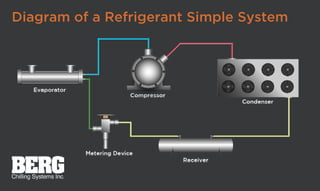
Diagram of a Refrigerant Simple System
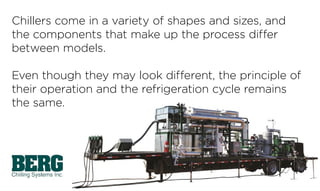
Chillers come in a variety of shapes and sizes, and
the components that make up the process differ
between models.
Even though they may look different, the principle of
their operation and the refrigeration cycle remains
the same.
How Does It Work?
Let’s look at what happens in a simple
refrigeration cycle.
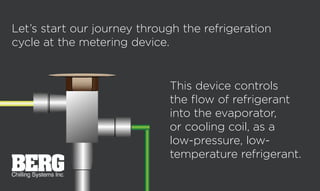
Let’s start our journey through the refrigeration
cycle at the metering device.
This device controls
the flow of refrigerant
into the evaporator,
or cooling coil, as a
low-pressure, low-
temperature refrigerant.
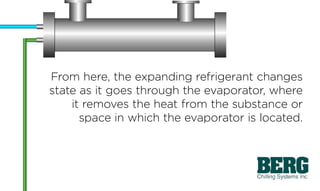
From here, the expanding refrigerant changes
state as it goes through the evaporator, where
it removes the heat from the substance or
space in which the evaporator is located.
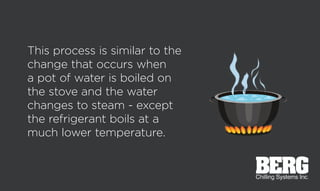
This process is similar to the
change that occurs when
a pot of water is boiled on
the stove and the water
changes to steam - except
the refrigerant boils at a
much lower temperature.
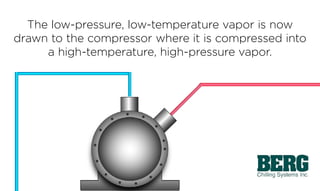
The low-pressure, low-temperature vapor is now
drawn to the compressor where it is compressed into
a high-temperature, high-pressure vapor.
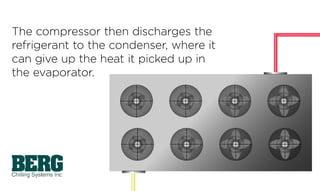
The compressor then discharges the
refrigerant to the condenser, where it
can give up the heat it picked up in
the evaporator.
At this point, the refrigerant vapor is at a higher
temperature than the air passing through the
condenser (air-cooled type); or the water passing
through the condenser (water-cooled type); therefore,
it transfers the heat from the warmer refrigerant
vapor to the cooler air or water.
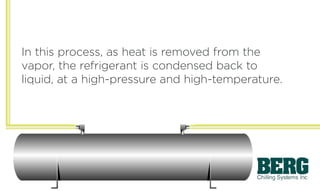
In this process, as heat is removed from the
vapor, the refrigerant is condensed back to
liquid, at a high-pressure and high-temperature.
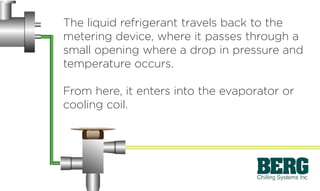
The liquid refrigerant travels back to the
metering device, where it passes through a
small opening where a drop in pressure and
temperature occurs.
From here, it enters into the evaporator or
cooling coil.
As the refrigerant makes its way into the
large opening of the evaporator tubing or
coil, it vaporizes, ready to start another cycle
through the system.
Learn more about
refrigeration
Berg Chilling Systems Inc.
51 Nantucket Blvd.
Toronto, On, M1P2N5
416-755-2221
bergsales@berg-group.com
berg-group.com

Principles of Refrigeration

  • 1.
  • 2.
    What Is AChiller? Industrially speaking, a chiller is a single component within a more complex mechanical system that is used to remove heat from a process or substance.
  • 3.
    Components of a RefrigerationSystem In order to work properly, a refrigeration system requires four major components connected by tubing or “lines” to make sure the refrigerant doesn’t escape.
  • 4.
    Diagram of aRefrigerant Simple System
  • 5.
    Chillers come ina variety of shapes and sizes, and the components that make up the process differ between models. Even though they may look different, the principle of their operation and the refrigeration cycle remains the same.
  • 6.
    How Does ItWork? Let’s look at what happens in a simple refrigeration cycle.
  • 7.
    Let’s start ourjourney through the refrigeration cycle at the metering device. This device controls the flow of refrigerant into the evaporator, or cooling coil, as a low-pressure, low- temperature refrigerant.
  • 8.
    From here, theexpanding refrigerant changes state as it goes through the evaporator, where it removes the heat from the substance or space in which the evaporator is located.
  • 9.
    This process issimilar to the change that occurs when a pot of water is boiled on the stove and the water changes to steam - except the refrigerant boils at a much lower temperature.
  • 10.
    The low-pressure, low-temperaturevapor is now drawn to the compressor where it is compressed into a high-temperature, high-pressure vapor.
  • 11.
    The compressor thendischarges the refrigerant to the condenser, where it can give up the heat it picked up in the evaporator.
  • 12.
    At this point,the refrigerant vapor is at a higher temperature than the air passing through the condenser (air-cooled type); or the water passing through the condenser (water-cooled type); therefore, it transfers the heat from the warmer refrigerant vapor to the cooler air or water.
  • 13.
    In this process,as heat is removed from the vapor, the refrigerant is condensed back to liquid, at a high-pressure and high-temperature.
  • 14.
    The liquid refrigeranttravels back to the metering device, where it passes through a small opening where a drop in pressure and temperature occurs. From here, it enters into the evaporator or cooling coil.
  • 15.
    As the refrigerantmakes its way into the large opening of the evaporator tubing or coil, it vaporizes, ready to start another cycle through the system.
  • 16.
    Learn more about refrigeration BergChilling Systems Inc. 51 Nantucket Blvd. Toronto, On, M1P2N5 416-755-2221 bergsales@berg-group.com berg-group.com