GROUP 4:
JULIE ANN M. SIONICIO
EDISON P. GORDO
MAE O. MAGALONA
What made me successful
as a student?
Which among my study habits
is/are more effective (that yields
positive outcomes)?
Why do students lose
motivation in the classroom?
Reflective Teaching
 Looking at what you do in the
classroom, thinking about why you
do it, and thinking about if it works –
a process of self-observation and
self-evaluation.
Reflective Teaching
 Involves examining one’s underlying
beliefs about teaching and learning
and one’s alignment with actual
classroom practice before, during
and after a course is taught.
Reflective Teaching:
Why is it important?
Reflective Teaching for Teachers:
Significance
1.Professional growth
2.Enhance innovation
3.Facilitate teaching
4.Boost teacher-student relationship
5.Make lessons more lively and interesting
6.Enhance problem solving
7.Boost classroom democracy
1. Professional Growth
Reflective teaching can help promote
your professional growth. By carrying out
an extensive inner thought process, you
can have a much better understanding of
your strengths and weaknesses.
2. Enhance Innovation
Reflective teaching is not a complicated
practice. After you have taught your
lesson, take a few minutes to assess your
teaching. You can use reflective teaching
methods to search innovations on how to
improve your teaching methods.
3. Facilitate Teaching
Teaching can be quite a challenge. It can
be challenging to plan lessons, teach
classes then manage and assess your
students’ progression. Reflective practice
will ensure that each student is
benefitting from the learning experience.
4. Boost Teacher-Student Relationship
Teachers really value their relationships
with their students. If you want to help
your students to understand your
teaching methods, it is important to
cultivate positive individual relationships
with your students.
5. Make Lessons More Lively and
Interesting
A dull class is every teacher’s nightmare.
You know the feeling and the number of
times you look at the clock. To avoid this
experience, you can implement some
reflective teaching strategies to
troubleshoot and liven up your
classroom.
6. Enhance Problem Solving
Experienced teachers would agree that
major part of teaching includes strong
coping skills. Learning to solve problems
and meet challenges effectively and
efficiently is of the utmost experience
7. Boost Classroom Democracy
Encouraging a democratic environment
within your classroom has its benefits.
You can interact more freely with your
students, raise issues, and deliver
knowledge much easier.
Reflective Learning for Students:
Significance
8. Improve student performance
9. Boost engagement in class
10. Develop critical thinking and coping skills
11. Enhance student motivation
12. Improve overall effectiveness
8. Improve Student Performance
Student performance can be improved
by using reflective learning practices.
Since individual students can reflect on
class sessions, they will identify, and
improve on their weaknesses to
ameliorate their overall performance in a
topic.
9. Boost Engagement in Class
Students detest dull classes, as much as
their teachers do. In the case of a less
than inspiring lesson, students can
provide productive feedback for teachers,
by using their reflective learning diary to
express their ideas or suggestions.
10. Develop Critical Thinking and
Coping Skills
For students, reflective learning can help
improve their skills in solving problems
and challenges. Using reflection will
improve their problem-solving abilities
and stimulate their cognitive thinking
and analytical skills.
11. Enhance Student Motivation
Motivation is the motor of our
classrooms. It is also very important to
students. For students who lack
motivation and investment, reflective
learning practices can encourage them to
face and overcome their learning issues
and problems.
12. Improve Overall Effectiveness
Teachers who encourage students to form
learning groups may find the overall
experience is much more effective if the
students include reflection as part of their
routine. Reflective practices can help improve
their assimilation and recall capacity, while
boosting motivation levels through active
group performance, as well as critical thinking
skills development.
Reflective Teaching Examples:
1. Reflection Journals
2. Learning Log
3. Learning Journal
Reflection Journals
Reflective journals for teachers are used to help
them analyze experiences working with students
and relate it to other experiences as well as with
theories and methods they were taught.
The purpose is for teachers to determine what
results in the best outcome and the most
productive learning environment for students.
Learning Log
 Similar to a reflective journal, a learning
log is a chronological record of teaching
experiences, observations, and thoughts.
It’s often used to track progress over time.
Learning Journal
 This is often used by students, but
educators can also maintain one. It’s a
place to document personal reactions,
thoughts, and insights related to
teaching experiences and professional
development.
“We do not learn from
experience… we learn from
reflecting on experience.”
- John Dewey
“The more reflective you are,
the more effective you are.”
- Hall and Simeral
Reflective Teaching Lesson Worksheet
1. Lesson Details
• Date
• Subject/Topic
• Grade/Level
2. Lesson Goals
• What were the intended learning outcomes for this lesson?
3. Teaching Strategies
• Describe the instructional methods and techniques you used
during the lesson.
4. Observations And Insights
• What did you notice during the lesson? Were there any unexpected
student reactions or engagement levels?
• Did the students seem to grasp the concepts effectively? If not, what
challenges did you observe?
5. Self-assessment
• What do you feel went well during the lesson? Why?
• What aspects of your teaching could be improved? How?
6. Student Feedback
• Were there any comments or questions from students that stood out?
How might this inform your future teaching?
Reflective Teaching Lesson Worksheet
7. Areas Of Improvement
• Based on your observations and self-assessment, identify specific
areas that you want to work on for future lessons.
8. Action Plan
• What steps you will take to address the areas for improvement?
• How will you adjust your teaching strategies or methods in
upcoming lessons?
9. Reflection
• Summarize your overall reflections on this lesson. What did you
learn from this experience?
Processing Questions for Reflective Teaching
1. What were my goals?
• What were the main learning objectives of the lesson?
• Did I communicate these objectives clearly to the students?
2. What worked well?
• What instructional strategies or activities engaged the students
effectively?
• Did any specific teaching methods lead to notable moments of
understanding or enthusiasm?
3. What challenges did I encounter?
• Were there any difficulties I faced while delivering the lesson?
• Did students struggle with certain concepts or tasks?
Processing Questions for Reflective Teaching
4. How did I adapt?
• Did I need to adjust my teaching strategies during the lesson? Why?
• How did I respond to unexpected situations or student inquiries?
5. Student engagement and participation
• Were all students actively participating? If not, why might that have been
the case?
• Did I employ techniques to involve quieter or less engaged students?
6. Assessment and feedback
• How did I gauge student understanding during the lesson?
• Did I provide opportunities for students to ask questions or offer
feedback?
Processing Questions for Reflective Teaching
7. Differentiation
• Did I address diverse learning styles and needs within the classroom?
• Were there strategies to challenge advanced students and support
struggling ones?
8. Learning outcomes
• Did students achieve the learning objectives by the end of the lesson?
• How do I know if they gained a deeper understanding of the topic?
9. Reflecting on pedagogy
• Did I use a variety of teaching methods to cater to different learning
preferences?
• How did my teaching style contribute to student engagement and
learning?
Processing Questions for Reflective Teaching
10. Relationship building
• How did I establish a positive classroom environment and build
rapport with students?
• Were there moments where my interactions with students positively
impacted their learning experience?
11. Future improvements
• What specific changes or adjustments would I make if I were to teach
this lesson again?
• How can I apply what I’ve learned from this reflection to enhance
future lessons?
References:
https://reflectiveteachingjournal.com/benefits-of-reflective-teaching/
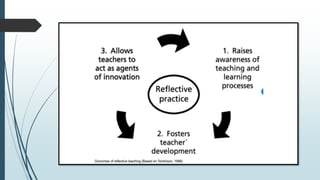
https://www.researchgate.net/figure/Outcomes-of-reflective-teaching-Based-on-
Tomlinson-1998_fig1_262461546
https://helpfulprofessor.com/reflective-teaching-examples/
https://youtu.be/iZuD2o7BKdw?si=7zdEQbJd6AAW7DIQ
THANK
YOU!!!

Reflective-Teaching-PowerPoint-Group-4.pptx

  • 1.
    GROUP 4: JULIE ANNM. SIONICIO EDISON P. GORDO MAE O. MAGALONA
  • 2.
    What made mesuccessful as a student?
  • 3.
    Which among mystudy habits is/are more effective (that yields positive outcomes)?
  • 4.
    Why do studentslose motivation in the classroom?
  • 5.
    Reflective Teaching  Lookingat what you do in the classroom, thinking about why you do it, and thinking about if it works – a process of self-observation and self-evaluation.
  • 6.
    Reflective Teaching  Involvesexamining one’s underlying beliefs about teaching and learning and one’s alignment with actual classroom practice before, during and after a course is taught.
  • 8.
  • 9.
    Reflective Teaching forTeachers: Significance 1.Professional growth 2.Enhance innovation 3.Facilitate teaching 4.Boost teacher-student relationship 5.Make lessons more lively and interesting 6.Enhance problem solving 7.Boost classroom democracy
  • 10.
    1. Professional Growth Reflectiveteaching can help promote your professional growth. By carrying out an extensive inner thought process, you can have a much better understanding of your strengths and weaknesses.
  • 11.
    2. Enhance Innovation Reflectiveteaching is not a complicated practice. After you have taught your lesson, take a few minutes to assess your teaching. You can use reflective teaching methods to search innovations on how to improve your teaching methods.
  • 12.
    3. Facilitate Teaching Teachingcan be quite a challenge. It can be challenging to plan lessons, teach classes then manage and assess your students’ progression. Reflective practice will ensure that each student is benefitting from the learning experience.
  • 13.
    4. Boost Teacher-StudentRelationship Teachers really value their relationships with their students. If you want to help your students to understand your teaching methods, it is important to cultivate positive individual relationships with your students.
  • 14.
    5. Make LessonsMore Lively and Interesting A dull class is every teacher’s nightmare. You know the feeling and the number of times you look at the clock. To avoid this experience, you can implement some reflective teaching strategies to troubleshoot and liven up your classroom.
  • 15.
    6. Enhance ProblemSolving Experienced teachers would agree that major part of teaching includes strong coping skills. Learning to solve problems and meet challenges effectively and efficiently is of the utmost experience
  • 16.
    7. Boost ClassroomDemocracy Encouraging a democratic environment within your classroom has its benefits. You can interact more freely with your students, raise issues, and deliver knowledge much easier.
  • 17.
    Reflective Learning forStudents: Significance 8. Improve student performance 9. Boost engagement in class 10. Develop critical thinking and coping skills 11. Enhance student motivation 12. Improve overall effectiveness
  • 18.
    8. Improve StudentPerformance Student performance can be improved by using reflective learning practices. Since individual students can reflect on class sessions, they will identify, and improve on their weaknesses to ameliorate their overall performance in a topic.
  • 19.
    9. Boost Engagementin Class Students detest dull classes, as much as their teachers do. In the case of a less than inspiring lesson, students can provide productive feedback for teachers, by using their reflective learning diary to express their ideas or suggestions.
  • 20.
    10. Develop CriticalThinking and Coping Skills For students, reflective learning can help improve their skills in solving problems and challenges. Using reflection will improve their problem-solving abilities and stimulate their cognitive thinking and analytical skills.
  • 21.
    11. Enhance StudentMotivation Motivation is the motor of our classrooms. It is also very important to students. For students who lack motivation and investment, reflective learning practices can encourage them to face and overcome their learning issues and problems.
  • 22.
    12. Improve OverallEffectiveness Teachers who encourage students to form learning groups may find the overall experience is much more effective if the students include reflection as part of their routine. Reflective practices can help improve their assimilation and recall capacity, while boosting motivation levels through active group performance, as well as critical thinking skills development.
  • 23.
    Reflective Teaching Examples: 1.Reflection Journals 2. Learning Log 3. Learning Journal
  • 24.
    Reflection Journals Reflective journalsfor teachers are used to help them analyze experiences working with students and relate it to other experiences as well as with theories and methods they were taught. The purpose is for teachers to determine what results in the best outcome and the most productive learning environment for students.
  • 25.
    Learning Log  Similarto a reflective journal, a learning log is a chronological record of teaching experiences, observations, and thoughts. It’s often used to track progress over time.
  • 26.
    Learning Journal  Thisis often used by students, but educators can also maintain one. It’s a place to document personal reactions, thoughts, and insights related to teaching experiences and professional development.
  • 27.
    “We do notlearn from experience… we learn from reflecting on experience.” - John Dewey
  • 28.
    “The more reflectiveyou are, the more effective you are.” - Hall and Simeral
  • 29.
    Reflective Teaching LessonWorksheet 1. Lesson Details • Date • Subject/Topic • Grade/Level 2. Lesson Goals • What were the intended learning outcomes for this lesson? 3. Teaching Strategies • Describe the instructional methods and techniques you used during the lesson.
  • 30.
    4. Observations AndInsights • What did you notice during the lesson? Were there any unexpected student reactions or engagement levels? • Did the students seem to grasp the concepts effectively? If not, what challenges did you observe? 5. Self-assessment • What do you feel went well during the lesson? Why? • What aspects of your teaching could be improved? How? 6. Student Feedback • Were there any comments or questions from students that stood out? How might this inform your future teaching? Reflective Teaching Lesson Worksheet
  • 31.
    Reflective Teaching LessonWorksheet 7. Areas Of Improvement • Based on your observations and self-assessment, identify specific areas that you want to work on for future lessons. 8. Action Plan • What steps you will take to address the areas for improvement? • How will you adjust your teaching strategies or methods in upcoming lessons? 9. Reflection • Summarize your overall reflections on this lesson. What did you learn from this experience?
  • 32.
    Processing Questions forReflective Teaching 1. What were my goals? • What were the main learning objectives of the lesson? • Did I communicate these objectives clearly to the students? 2. What worked well? • What instructional strategies or activities engaged the students effectively? • Did any specific teaching methods lead to notable moments of understanding or enthusiasm? 3. What challenges did I encounter? • Were there any difficulties I faced while delivering the lesson? • Did students struggle with certain concepts or tasks?
  • 33.
    Processing Questions forReflective Teaching 4. How did I adapt? • Did I need to adjust my teaching strategies during the lesson? Why? • How did I respond to unexpected situations or student inquiries? 5. Student engagement and participation • Were all students actively participating? If not, why might that have been the case? • Did I employ techniques to involve quieter or less engaged students? 6. Assessment and feedback • How did I gauge student understanding during the lesson? • Did I provide opportunities for students to ask questions or offer feedback?
  • 34.
    Processing Questions forReflective Teaching 7. Differentiation • Did I address diverse learning styles and needs within the classroom? • Were there strategies to challenge advanced students and support struggling ones? 8. Learning outcomes • Did students achieve the learning objectives by the end of the lesson? • How do I know if they gained a deeper understanding of the topic? 9. Reflecting on pedagogy • Did I use a variety of teaching methods to cater to different learning preferences? • How did my teaching style contribute to student engagement and learning?
  • 35.
    Processing Questions forReflective Teaching 10. Relationship building • How did I establish a positive classroom environment and build rapport with students? • Were there moments where my interactions with students positively impacted their learning experience? 11. Future improvements • What specific changes or adjustments would I make if I were to teach this lesson again? • How can I apply what I’ve learned from this reflection to enhance future lessons?
  • 36.
  • 37.