What is Reflection?
• Reflection is a metacognitive
strategy that helps teachers think
critically upon their experiences,
actions and
decisions during their teaching
practices.
Reflection
What is Reflective teaching?
Why do we need to reflect?
• Reflective practice helps teachers to have
a deeper understanding of their own
teaching styles, teaching beliefs and
teaching identities. As you reflect, you will
better understand your roles as teacher!
Reflective Practice Relevance
Certainly, there are various definitions of reflective
teaching, “however, most of the definitions can be
contained within two main stances to reflective
teaching,
one that emphasizes reflection only on
classroom action,
while the other also includes reflections on
matters outside the classroom”
Reflection on teaching can be carried out on three levels:
 refection-in-action
 reflection-on-action
 reflection-for-action
Reflection-in-action
• It occurs in the classroom whenever a
problem arises that requires immediate
action or on-the-spot experimentation
on the part of the teacher.
Reflection-on-action:
• It entails reflection outside of the classroom
though the retrospective analysis of events
that occurred during the lesson.
Reflection-for-action:
• it is “proactive in nature” in that it occurs
after the first two phases of reflection, with
the teacher deciding what action to take in
the classroom.
What about Self-reflection?
A crucial step in reflective teaching, namely, self-reflection.
successful and constructive reflective teaching must begin with a
thorough process of self-reflection: the discovery and
understanding of who instructors are, what their experiences as
teachers have been so far, where they would like to go
professionally, and what their priorities are and so on.
Self-reflection
What is a
Portfolio?
• A useful tool in this initial step of self-reflection is the creation
of a teaching portfolio, which records instructors’ teaching
experiences and accomplishments, including critical periods and
incidents. A teaching portfolio favors self-assessment and
development and promotes collaboration with colleagues.
Narrative Reflection
• Difficult and critical incidents inevitably occur in class, involving both students’
and/or teachers’ practices. For example, a student may be totally demotivated and may
not contribute to classwork, and/or the teacher may feel uncertain as to when a grammar
topic should be introduced in a lesson and how. Through teachers’ narrative reflection,
these incidents can be closely examined and resolved, and teachers can then “consolidate
their theoretical understanding of their practices” leading to the adoption of alternative
teaching methods and outlooks.
Farrell’s two different talk
modes:
 Exploratory
talk
Draft
talk
• exploratory talk: By adopting exploratory talk, teachers are hesitant
to provide a definite answer on a given topic, thus leaving more
room for discussion and students’ participation.
• draft talk: In contrast, teachers tend to affirm their authority as
experts on the topic at hand through final draft talk. By means of
careful reflection on these two modes of talk, teachers could choose
that which best suits a particular group of students.
Exploratory and draft talk
Self-observation
• This is a technique where you observe and
evaluate yourself under the guidance of an
observation checklist or some questions you
decide on before the observation.
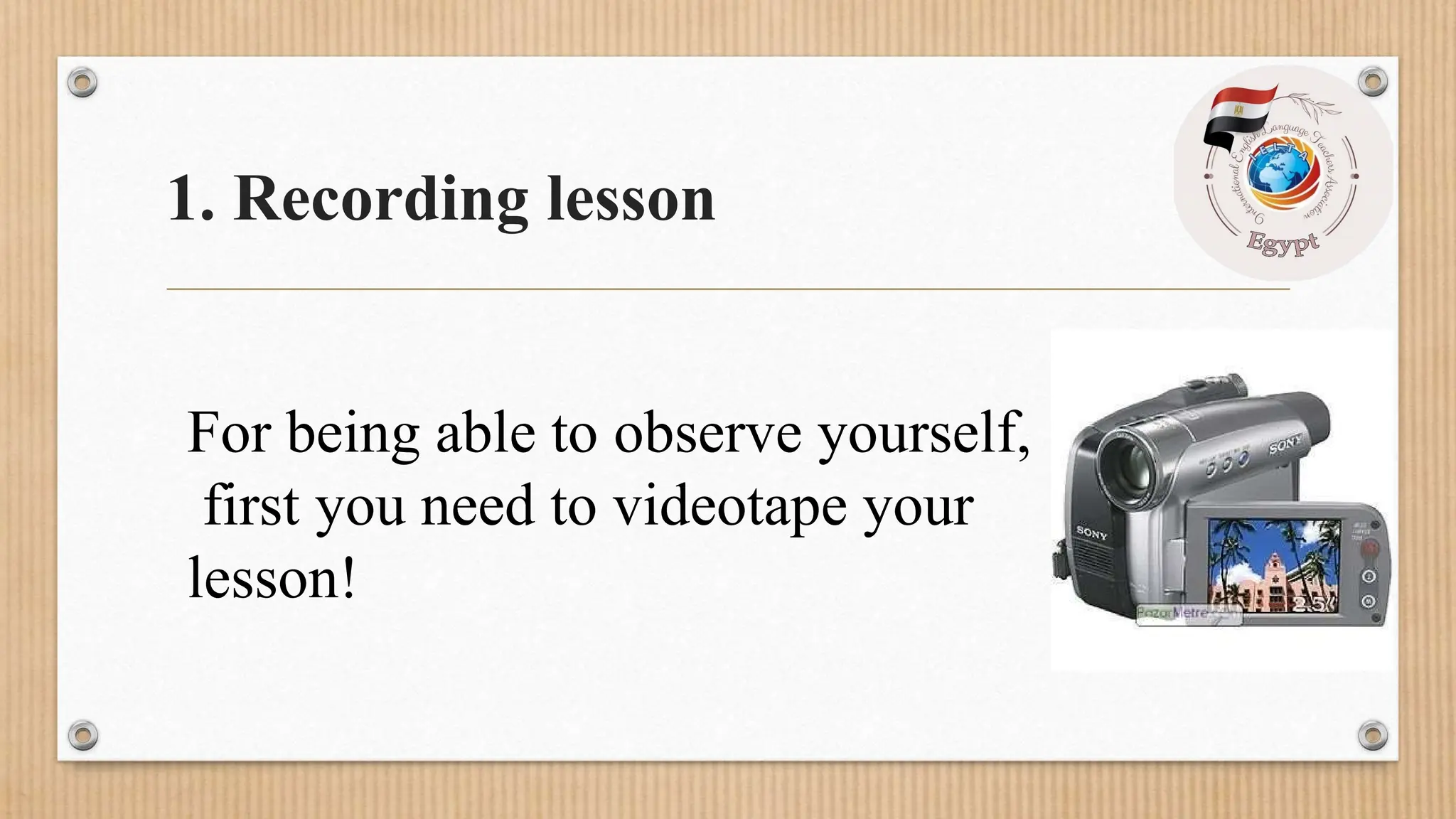
1. Recording lesson
For being able to observe yourself,
first you need to videotape your
lesson!
2. Teaching Journal
• In order to document their teaching results, it is highly advisable for
instructors to keep teaching journal. Teaching journals provide teachers
which a written record of various aspects of their practice such as
classroom events and enable them to step back for a moment to reflect on
their work. Still we have a technology-integrated way that can be used as a
teaching journal or blog
3. Action Research
• It involves observation in the classroom by other teachers and/or by means of
information collected on teaching. The notable advantage of action research is that it
can lead to practical results and improvements in teaching and class management.
 It is a reflective process of progressive problem solving.
It is the systematic, reflective study of a teacher's actions and the effects of
these actions in a school or classroom context.
 It includes data collection and data analysis
4. Peer classroom
observation
• It could help teachers to get an overall picture of what is going on in class
and change less successful teaching practices. Moreover, classroom
observation should not be viewed as an evaluation tool. Rather, it should be
considered an instrument for professional development, which helps
teachers to consider what works and what does not for a given class.
Secondary Reflective Practices
1. Teacher development groups
2. Critical friendships
3. Concept mapping
1. Teacher development groups
• It is a tool for the discussion of classroom practices. Such a group does not need to
be large, and can include both teachers and other members of the school, or even
teachers from different schools. Working together with other teachers promotes
empowerment and confidence while at the same time provides invaluable
opportunities and outcomes that teachers could not achieve by working alone.
2. Critical Friendships
• Establishing critical friendships with colleagues helps
teachers monitor each other’s work in the classroom,
obtain advice, and engage in peer coaching. Critical
friendships enhance teamwork while helping to reduce
the sense of isolation that teachers often feel.
3. Concept Mapping
• It originated in the field of cognitive psychology.
Drawing a concept map before and after a course could
effectively convey a picture of the learning process and
facilitate the assessment of students’ acquisition of new
knowledge.
Advantages of reflection:
1. Reflective teaching helps free the teachers from impulse and
routine behavior.
2. Reflective teaching allows the teacher to act in a deliberate,
intentional manner and avoid the “I don’t know what will I do
today” syndrome.
3. Reflective teaching distinguishes teachers as educated human
beings.
Disadvantages:
1. That unless given clear pointers, the reflection can be
formulaic with a tendency for “boast statements”.
2. Some staff may not be comfortable with assigning
marks to a reflective process.
• Generally speaking, teachers are the best judges when
it comes to establishing what they need to improve and
adjust, a bottom-up approach seems to best promote
reflections on language teaching.
Conclusion
References
Farrell, T.S.C. & Baecher, L (2017). Reflecting on Critical Incidents in Language
Education. London: Bloomsbury.
Reflective Practice Conversation
Thomas Farrell Reflective Practice
Reflective Practice in education imp.pptx

Reflective Practice in education imp.pptx

  • 2.
  • 3.
    • Reflection isa metacognitive strategy that helps teachers think critically upon their experiences, actions and decisions during their teaching practices. Reflection
  • 4.
  • 6.
    Why do weneed to reflect?
  • 7.
    • Reflective practicehelps teachers to have a deeper understanding of their own teaching styles, teaching beliefs and teaching identities. As you reflect, you will better understand your roles as teacher! Reflective Practice Relevance
  • 8.
    Certainly, there arevarious definitions of reflective teaching, “however, most of the definitions can be contained within two main stances to reflective teaching, one that emphasizes reflection only on classroom action, while the other also includes reflections on matters outside the classroom”
  • 9.
    Reflection on teachingcan be carried out on three levels:  refection-in-action  reflection-on-action  reflection-for-action
  • 10.
    Reflection-in-action • It occursin the classroom whenever a problem arises that requires immediate action or on-the-spot experimentation on the part of the teacher.
  • 11.
    Reflection-on-action: • It entailsreflection outside of the classroom though the retrospective analysis of events that occurred during the lesson.
  • 12.
    Reflection-for-action: • it is“proactive in nature” in that it occurs after the first two phases of reflection, with the teacher deciding what action to take in the classroom.
  • 13.
  • 14.
    A crucial stepin reflective teaching, namely, self-reflection. successful and constructive reflective teaching must begin with a thorough process of self-reflection: the discovery and understanding of who instructors are, what their experiences as teachers have been so far, where they would like to go professionally, and what their priorities are and so on. Self-reflection
  • 15.
    What is a Portfolio? •A useful tool in this initial step of self-reflection is the creation of a teaching portfolio, which records instructors’ teaching experiences and accomplishments, including critical periods and incidents. A teaching portfolio favors self-assessment and development and promotes collaboration with colleagues.
  • 16.
    Narrative Reflection • Difficultand critical incidents inevitably occur in class, involving both students’ and/or teachers’ practices. For example, a student may be totally demotivated and may not contribute to classwork, and/or the teacher may feel uncertain as to when a grammar topic should be introduced in a lesson and how. Through teachers’ narrative reflection, these incidents can be closely examined and resolved, and teachers can then “consolidate their theoretical understanding of their practices” leading to the adoption of alternative teaching methods and outlooks.
  • 17.
    Farrell’s two differenttalk modes:  Exploratory talk Draft talk
  • 18.
    • exploratory talk:By adopting exploratory talk, teachers are hesitant to provide a definite answer on a given topic, thus leaving more room for discussion and students’ participation. • draft talk: In contrast, teachers tend to affirm their authority as experts on the topic at hand through final draft talk. By means of careful reflection on these two modes of talk, teachers could choose that which best suits a particular group of students. Exploratory and draft talk
  • 19.
    Self-observation • This isa technique where you observe and evaluate yourself under the guidance of an observation checklist or some questions you decide on before the observation.
  • 21.
    1. Recording lesson Forbeing able to observe yourself, first you need to videotape your lesson!
  • 22.
    2. Teaching Journal •In order to document their teaching results, it is highly advisable for instructors to keep teaching journal. Teaching journals provide teachers which a written record of various aspects of their practice such as classroom events and enable them to step back for a moment to reflect on their work. Still we have a technology-integrated way that can be used as a teaching journal or blog
  • 23.
    3. Action Research •It involves observation in the classroom by other teachers and/or by means of information collected on teaching. The notable advantage of action research is that it can lead to practical results and improvements in teaching and class management.  It is a reflective process of progressive problem solving. It is the systematic, reflective study of a teacher's actions and the effects of these actions in a school or classroom context.  It includes data collection and data analysis
  • 24.
    4. Peer classroom observation •It could help teachers to get an overall picture of what is going on in class and change less successful teaching practices. Moreover, classroom observation should not be viewed as an evaluation tool. Rather, it should be considered an instrument for professional development, which helps teachers to consider what works and what does not for a given class.
  • 25.
    Secondary Reflective Practices 1.Teacher development groups 2. Critical friendships 3. Concept mapping
  • 26.
    1. Teacher developmentgroups • It is a tool for the discussion of classroom practices. Such a group does not need to be large, and can include both teachers and other members of the school, or even teachers from different schools. Working together with other teachers promotes empowerment and confidence while at the same time provides invaluable opportunities and outcomes that teachers could not achieve by working alone.
  • 27.
    2. Critical Friendships •Establishing critical friendships with colleagues helps teachers monitor each other’s work in the classroom, obtain advice, and engage in peer coaching. Critical friendships enhance teamwork while helping to reduce the sense of isolation that teachers often feel.
  • 28.
    3. Concept Mapping •It originated in the field of cognitive psychology. Drawing a concept map before and after a course could effectively convey a picture of the learning process and facilitate the assessment of students’ acquisition of new knowledge.
  • 29.
    Advantages of reflection: 1.Reflective teaching helps free the teachers from impulse and routine behavior. 2. Reflective teaching allows the teacher to act in a deliberate, intentional manner and avoid the “I don’t know what will I do today” syndrome. 3. Reflective teaching distinguishes teachers as educated human beings.
  • 30.
    Disadvantages: 1. That unlessgiven clear pointers, the reflection can be formulaic with a tendency for “boast statements”. 2. Some staff may not be comfortable with assigning marks to a reflective process.
  • 31.
    • Generally speaking,teachers are the best judges when it comes to establishing what they need to improve and adjust, a bottom-up approach seems to best promote reflections on language teaching. Conclusion
  • 33.
    References Farrell, T.S.C. &Baecher, L (2017). Reflecting on Critical Incidents in Language Education. London: Bloomsbury. Reflective Practice Conversation Thomas Farrell Reflective Practice