TEACHER’S
REFLECTION
OR
WHY?
Reflection is a metacognitive
strategy that helps teachers to
think critically upon their
experiences, actions and
decisions during their teaching
practices.
Reflective practice helps teachers
to have a deeper understanding
of their own teaching styles.
As we reflect, we will better
understand our role as teachers!
PROCESS OF SELF-OBSERVATION
AND
SELF-EVALUATION
Teacher should evaluate each lesson
Did things go as planned ?
What went well ?
What could be improved ?
Was preparation adequate ?
Were objectives fulfilled ?
Was the lesson relevant to the objective ?
Did the lesson develop logically ?
Were students motivated and interested ?
 According to Bailey (1997)
Creating:
What should I
do next?
Evaluating:
How well did I do?
Analyzing:
Do I see any patterns in
what I did?
Applying:
Where could I use this again?
Understanding:
What was important about it?
Remembering:
What did I do?
How to begin?
What to do next?
This is a place where you write
about your experiences or record
some specific teaching events,
and your feelings about them on
a periodical basis.
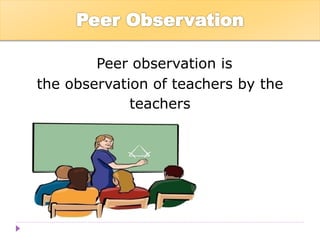
Peer observation is
the observation of teachers by the
teachers
Use of video-recorded lessons for
teachers' professional development
Viewing videos on their own is not
sufficient; they must be accompanied
by guidance and training
Receiving students feedback while
teaching can help you to know what are
you doing to facilitate the learning of the
students .
 Notice patterns occurring
in your teaching .
 Notice things that you
were previously unaware
of .
 Be surprised by some of
your students’ feedback .
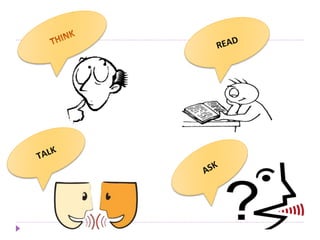
 Websites
 Journals
 Libraries
 Bookstores
 Colleagues
 Coordinators
 Friends
Questions posted on
websites
Trainings
Take time to reflect
upon the result, and
revise the lesson plan
accordingly!
Sample sentences
 Overall, this lesson went very well. I feel that the students understood everything that
was expected of them and they really did live up to my expectations.
 The next time I do this lesson I would also like to allow the students to do their own
research instead of relying so much on the materials provided in the class.
 This group of students is great! They remembered a lot from the last lesson. All of
them demonstrated eagerness to learn.
 Unfortunately, I spent so much time on the presentation stage of the lesson that we
had to rush through the other activities. Next time, I will start with the specific
information on the back of the application.
 I felt like I needed to include more communicative activities in the
lesson because the more timid students didn't get a chance of
speaking. By including such questions and activities they would get
more of the practice they need.
 From this experience I learned that I need to create a more open
teaching style. I must also remember to spend less time on
explanations and get right into the practice activities.
 The figures and graphs provided in the text book were very complex
to interpret from the students point of view. The next time I would
simple and easy illustrations.
THANK YOU

Reflective Teaching

  • 1.
  • 2.
  • 3.
    Reflection is ametacognitive strategy that helps teachers to think critically upon their experiences, actions and decisions during their teaching practices.
  • 4.
    Reflective practice helpsteachers to have a deeper understanding of their own teaching styles. As we reflect, we will better understand our role as teachers!
  • 5.
  • 6.
    Teacher should evaluateeach lesson Did things go as planned ? What went well ? What could be improved ? Was preparation adequate ? Were objectives fulfilled ? Was the lesson relevant to the objective ? Did the lesson develop logically ? Were students motivated and interested ?
  • 7.
     According toBailey (1997)
  • 8.
    Creating: What should I donext? Evaluating: How well did I do? Analyzing: Do I see any patterns in what I did? Applying: Where could I use this again? Understanding: What was important about it? Remembering: What did I do?
  • 9.
    How to begin? Whatto do next?
  • 11.
    This is aplace where you write about your experiences or record some specific teaching events, and your feelings about them on a periodical basis.
  • 12.
    Peer observation is theobservation of teachers by the teachers
  • 13.
    Use of video-recordedlessons for teachers' professional development Viewing videos on their own is not sufficient; they must be accompanied by guidance and training
  • 14.
    Receiving students feedbackwhile teaching can help you to know what are you doing to facilitate the learning of the students .
  • 16.
     Notice patternsoccurring in your teaching .  Notice things that you were previously unaware of .  Be surprised by some of your students’ feedback .
  • 17.
     Websites  Journals Libraries  Bookstores
  • 18.
  • 19.
  • 20.
    Take time toreflect upon the result, and revise the lesson plan accordingly!
  • 21.
    Sample sentences  Overall,this lesson went very well. I feel that the students understood everything that was expected of them and they really did live up to my expectations.  The next time I do this lesson I would also like to allow the students to do their own research instead of relying so much on the materials provided in the class.  This group of students is great! They remembered a lot from the last lesson. All of them demonstrated eagerness to learn.  Unfortunately, I spent so much time on the presentation stage of the lesson that we had to rush through the other activities. Next time, I will start with the specific information on the back of the application.
  • 22.
     I feltlike I needed to include more communicative activities in the lesson because the more timid students didn't get a chance of speaking. By including such questions and activities they would get more of the practice they need.  From this experience I learned that I need to create a more open teaching style. I must also remember to spend less time on explanations and get right into the practice activities.  The figures and graphs provided in the text book were very complex to interpret from the students point of view. The next time I would simple and easy illustrations.
  • 23.