• What is Affective Domain 
• Levels of Affective Domain 
o Receiving 
o Responding 
o Valuing 
o Commitment (Organization/Characterization) 
• Krathwohl’s Hierarchy of Affective Domain 
(Teachers & Student standpoint) 
• Evaluating Affective Domain
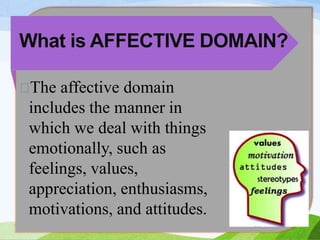
The affective domain 
includes the manner in 
which we deal with things 
emotionally, such as 
feelings, values, 
appreciation, enthusiasms, 
motivations, and attitudes.
Levels of Learning in the
Level Description 
RECEIVING Involves being aware of and willing 
to freely attend to a stimulus 
RESPONDING Involves active participation. 
VALUING 
Refers to voluntarily giving worth to 
an object, phenomenon or stimulus. 
COMMITMENT 
(Organization 
and 
Characterization) 
Involves building an internally 
consistent value system and freely 
living by it.
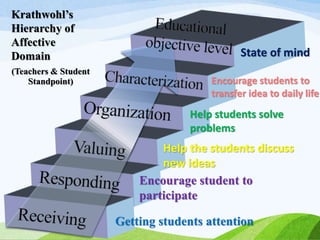
State of mind 
Encourage students to 
transfer idea to daily life 
Help students solve 
problems 
Help the students discuss 
new ideas 
Encourage student to 
participate 
Getting students attention 
Krathwohl’s 
Hierarchy of 
Affective 
Domain 
(Teachers & Student 
Standpoint)
Evaluating Affective Domain
Is a form of rating scale containing statements 
designed to gauge students’ feeling on an 
attitude or behavior. 
An Attitude Scale for Determining Interest in Mathematics
Used in evaluating attitudes, feelings, and 
opinions. 
2.1 . Checklist type of response provides the students 
a list of adjectives for describing or evaluating something 
and requires them to check those that apply. 
Checklist Questionnaire on Students Attitudes in a Science Class
2.2. Semantic Differential is another type of response 
on a questionnaire. It is usually a five-point scale 
showing polar or opposite objectives.
2.3. Likert Scale is a psychometric scale commonly involved 
in research that employs questionnaires.
are indirect and unstructured methods used 
when a teacher wants to probe deeper into the 
student’s feelings and attitude. 
3.1. Word Association: A projective technique in 
which the individual is presented with a list of words 
one at a time and asked to respond with the first word 
or idea that comes to mind. 
Terms: Answer: 
Coca cola 
Centrum 
Awards 
War 
Puzzle 
Very refreshing 
Complete vitamins 
Boost confidence 
Causes destruction 
Good brain exercise
3.2. Unfinished Sentence: A students or respondents 
are given incomplete sentences and ask to complete 
the thought with words that best express their feeling. 
3.3. Unfinished Story : Is a story with no ending is 
deliberately presented to the students, which they 
have to finished or complete.
“In trouble” 
Willie Johnson was in trouble! In school this morning he 
had thrown his paint water at Sue Nelligan and the teacher had 
become angry with him. “Why did you do that, Willie?’ she 
asked. Willie couldn’t tell her, because he really didn’t why 
himself. He knew that Sue had teased him a little, but wasn’t 
the real reason. He just didn’t know! The whole thing put him 
in a bad mood. From then on, the entire day went to heck. 
In the afternoon he had pushed Tommy Grigsley in the 
recess line. He also had stamped his foot and yelled at the 
teacher. The teacher had become angry with him again. But this 
time she put a note to his mother on his jacket with a pin. 
That note! Hew knew it was about his behaviour in class 
during the day. He knew that when he got home his mother would 
read the note and give him some kind of punishment. Then his 
father would find out about it and he’d really get it!
Continuation “In trouble” 
On his way home from school Willie was thinking about what 
his father would do to him. 
“Wow!” he thought. “I’ll get killed if I take this note home. I’d 
better take it off and throw it away.” 
He was just about to do that when he remembered what had 
happened to Billy Beatty when he was sent home with a note. Billy 
has thrown his note away and was sent to the principal’s office 
about it. Then Billy was in double trouble. 
Wow! He was in trouble. He couldn’t throw it away. What 
should he do? He had a problem, all right. He had to make a choice, 
but how should he choose? No matter what he did, the outcome 
didn’t look too good! What should he do?
Through these techniques, students are 
provided the opportunity to express their 
emotions and views about issue, themselves, 
and others. 
Sample forms: 
Log book of daily routines or activities 
Diaries/Journals 
Essays 
Other written composition or themes 
Autobiographies
Thank you! 
Prepared by: Rowena “wein” Intia

Affective domain

  • 2.
    • What isAffective Domain • Levels of Affective Domain o Receiving o Responding o Valuing o Commitment (Organization/Characterization) • Krathwohl’s Hierarchy of Affective Domain (Teachers & Student standpoint) • Evaluating Affective Domain
  • 3.
    The affective domain includes the manner in which we deal with things emotionally, such as feelings, values, appreciation, enthusiasms, motivations, and attitudes.
  • 4.
  • 5.
    Level Description RECEIVINGInvolves being aware of and willing to freely attend to a stimulus RESPONDING Involves active participation. VALUING Refers to voluntarily giving worth to an object, phenomenon or stimulus. COMMITMENT (Organization and Characterization) Involves building an internally consistent value system and freely living by it.
  • 6.
    State of mind Encourage students to transfer idea to daily life Help students solve problems Help the students discuss new ideas Encourage student to participate Getting students attention Krathwohl’s Hierarchy of Affective Domain (Teachers & Student Standpoint)
  • 7.
  • 8.
    Is a formof rating scale containing statements designed to gauge students’ feeling on an attitude or behavior. An Attitude Scale for Determining Interest in Mathematics
  • 9.
    Used in evaluatingattitudes, feelings, and opinions. 2.1 . Checklist type of response provides the students a list of adjectives for describing or evaluating something and requires them to check those that apply. Checklist Questionnaire on Students Attitudes in a Science Class
  • 10.
    2.2. Semantic Differentialis another type of response on a questionnaire. It is usually a five-point scale showing polar or opposite objectives.
  • 11.
    2.3. Likert Scaleis a psychometric scale commonly involved in research that employs questionnaires.
  • 12.
    are indirect andunstructured methods used when a teacher wants to probe deeper into the student’s feelings and attitude. 3.1. Word Association: A projective technique in which the individual is presented with a list of words one at a time and asked to respond with the first word or idea that comes to mind. Terms: Answer: Coca cola Centrum Awards War Puzzle Very refreshing Complete vitamins Boost confidence Causes destruction Good brain exercise
  • 13.
    3.2. Unfinished Sentence:A students or respondents are given incomplete sentences and ask to complete the thought with words that best express their feeling. 3.3. Unfinished Story : Is a story with no ending is deliberately presented to the students, which they have to finished or complete.
  • 14.
    “In trouble” WillieJohnson was in trouble! In school this morning he had thrown his paint water at Sue Nelligan and the teacher had become angry with him. “Why did you do that, Willie?’ she asked. Willie couldn’t tell her, because he really didn’t why himself. He knew that Sue had teased him a little, but wasn’t the real reason. He just didn’t know! The whole thing put him in a bad mood. From then on, the entire day went to heck. In the afternoon he had pushed Tommy Grigsley in the recess line. He also had stamped his foot and yelled at the teacher. The teacher had become angry with him again. But this time she put a note to his mother on his jacket with a pin. That note! Hew knew it was about his behaviour in class during the day. He knew that when he got home his mother would read the note and give him some kind of punishment. Then his father would find out about it and he’d really get it!
  • 15.
    Continuation “In trouble” On his way home from school Willie was thinking about what his father would do to him. “Wow!” he thought. “I’ll get killed if I take this note home. I’d better take it off and throw it away.” He was just about to do that when he remembered what had happened to Billy Beatty when he was sent home with a note. Billy has thrown his note away and was sent to the principal’s office about it. Then Billy was in double trouble. Wow! He was in trouble. He couldn’t throw it away. What should he do? He had a problem, all right. He had to make a choice, but how should he choose? No matter what he did, the outcome didn’t look too good! What should he do?
  • 16.
    Through these techniques,students are provided the opportunity to express their emotions and views about issue, themselves, and others. Sample forms: Log book of daily routines or activities Diaries/Journals Essays Other written composition or themes Autobiographies
  • 17.
    Thank you! Preparedby: Rowena “wein” Intia